


Albertina Identifies 199 Women Artists Already in Its Collection

Vienna’s Albertina has identified 199 women artists it did not previously know were represented in its collection. The finding emerged from a targeted review of museum databases and historical inventories, while “Her Story,” the exhibition built from that wider research, opened on October 30 with 250 works by 132 women.
Albertina Finds 199 Artists Its Records Had Not Revealed
The 199 figure comes from the museum’s first targeted search for women artists across its holdings. Curator Eva Michel told ORF Wien that the team found artists it had not known were represented in the collection after checking historical inventory books against internal records.
“New” therefore describes a discovery about the Albertina’s own holdings. It does not mean 199 previously unknown people were added to art history, and it does not mean 199 works were newly attributed. The unit is the artist: the museum learned that its collection contained work connected to 199 additional women.
That distinction also separates the research result from the exhibition checklist. “Her Story” presents 250 works by 132 women, 67 fewer artists than the number newly identified during research. The show cannot be read as a roll call of the discoveries; it is a selection drawn from a much larger, still-changing body of records.
This is collections research before it is an act of curating. Selection and interpretation come later. First, the museum has to know what it holds, whose name is attached to it, and whether basic biographical data allow that record to be found.

How the Inventory Search Changed the Picture
The search exposed two different access problems. ORF reported that life dates and places in the museum’s databases were sometimes wrong or incomplete. It also reported that much of the Albertina’s historical print collection remains undigitized, forcing researchers back to older inventory volumes that cannot be searched like a modern database.
Der Standard reported 43,000 works by women among approximately 500,000 cataloged graphic works, while Die Presse reported 41,000 works by 1,400 women; the sources do not reconcile the differing totals or scopes. Der Standard’s figures produce a rate of 8.6 percent for the cataloged group, but other reports give a lower underlying count, so the percentage should not be treated as settled. The denominator matters because the unentered half may change the result.
The same research brought eight drypoints by Berthe Morisot back into view. One is her 1889 self-portrait at work with her daughter Julie looking over her shoulder, which the Albertina lists in the exhibition. Another impression at The Metropolitan Museum of Art is titled The Drawing Lesson (Berthe Morisot and Her Daughter).
Morisot’s print shows why a corrected record is not a merely administrative gain. A searchable name reconnects the sheet to an artist’s small printmaking practice, to its subject, and to other impressions held elsewhere. Without that connection, an object can be physically safe in storage yet effectively absent from comparative research.
The wider research uncovered incorrect biographical data and false names, while the 199 figure specifically records artists found by checking undigitized inventory volumes against the database. Some records needed corrected or completed biographical metadata; some works had been carried under another name; and some artists became visible only when undigitized inventories were examined. Those routes all improve access, but only an object-by-object account could establish how many involve changed attribution.
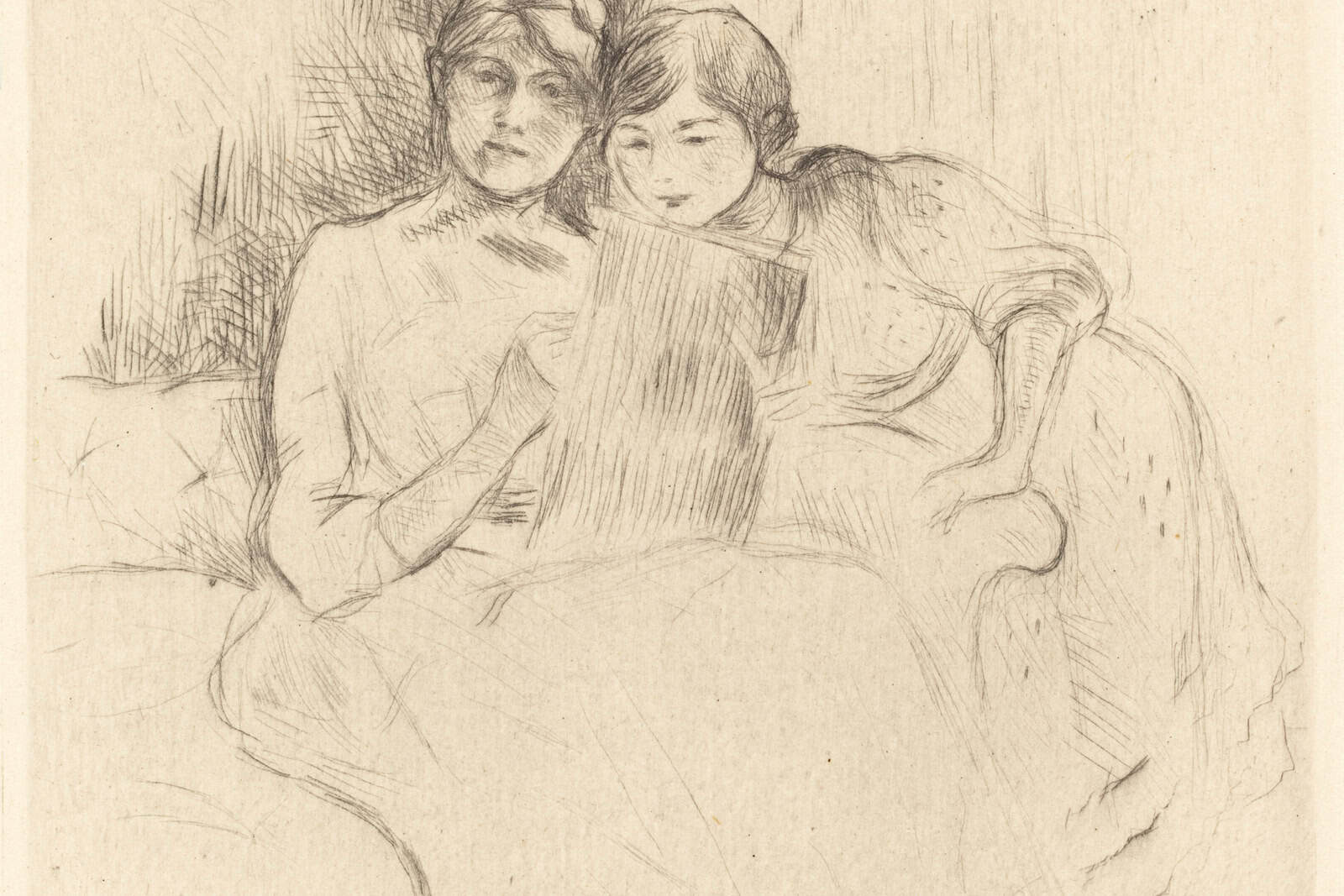
The Drawing Lesson, Berthe Morisot, 1888–1890. National Gallery of Art, via Wikimedia Commons, CC0 1.0.
What “Her Story” Puts on the Walls
The Albertina’s exhibition record describes the show as its first comprehensive, cross-period presentation of women artists in the collection. It runs through February 14, 2027, and ranges across five centuries, from early engravers and publishers to modernism and feminist work of the 1970s.
The checklist mixes celebrated figures—Maria Sibylla Merian, Angelica Kauffmann, Berthe Morisot, Käthe Kollwitz, Sonia Delaunay, Louise Bourgeois, Maria Lassnig, and VALIE EXPORT—with artists whose names are far less familiar. Its 250 objects amount to an average of fewer than two works per represented artist, reinforcing that the exhibition is an argument built from examples, not a catalogue of everything the project found.
Why Prints Matter to the Recovery
Print culture is central because the Albertina’s founding collectors, Duke Albert of Saxe-Teschen and Archduchess Maria Christina, already acquired sheets by women draftspeople and printmakers, as well as prints issued by women publishers. In collaborative print production, names attached to plates, designs, and publishing roles can preserve evidence of work that later histories marginalized.
Maria Sibylla Merian’s Stinging Nettle with the Metamorphosis of the Small Tortoiseshell and Two Species of Flies, dated 1679–1683, is one of the Albertina works on view. It joins close observation, insect life cycles, and image-making in a single vellum sheet. A related Rijksmuseum sheet, dated after 1679 and attributed to Merian’s workshop—possibly to her daughter Dorothea Maria Gsell—depicts insect metamorphosis on a cherry branch.
The comparison is useful because “women artists” is not a single visual category. Morisot’s drypoint tests the line between self-portrait, domestic scene, and artistic labor; Merian’s study binds natural history to drawing; Geertruydt Roghman’s etching of a woman doing handicrafts turns work inside the home into a subject; and Kauffmann’s drawing stages a dramatic history scene. The collection’s blind spots concern authorship and access, not one medium or genre.
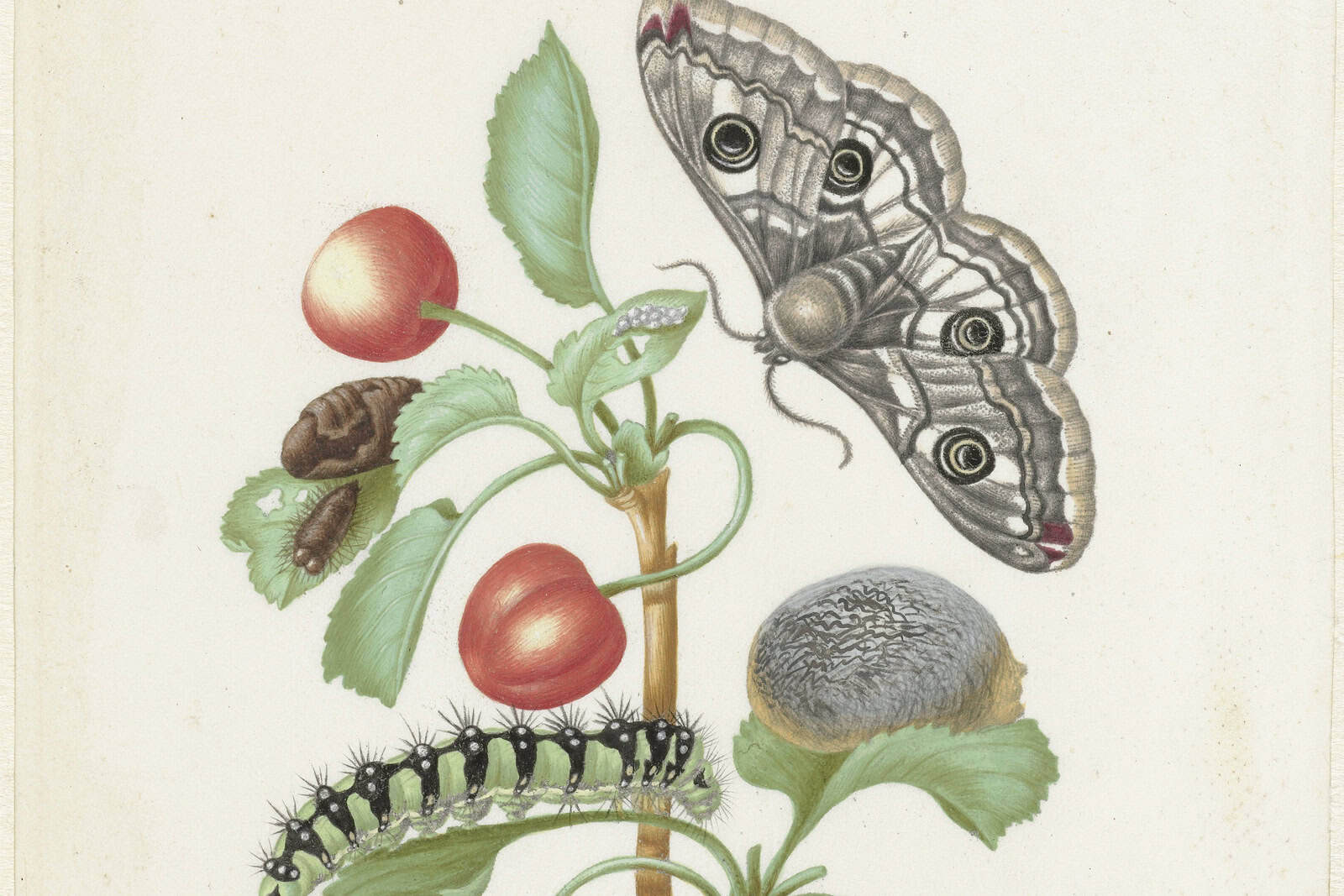
Metamorphosis of the Emperor Moth, Maria Sibylla Merian, 1679. Rijksmuseum, via Wikimedia Commons, CC0 1.0.
Four Numbers That Should Not Be Confused
The figures reported around “Her Story” answer different questions. Reading them as interchangeable would inflate the discovery or shrink the collection.
| Figure | What it measures |
|---|---|
| 1.2 million | Approximate objects across the Albertina |
| 43,000 | Database-entered works associated with women, according to Der Standard |
| 199 | Women artists newly recognized as represented in the holdings |
| 132 / 250 | Artists and works selected for the exhibition |
The table also shows why 199 cannot responsibly be converted into a percentage of 1.2 million: one number counts people and the other counts objects. Nor does the 43,000 figure settle the collection-wide share, because it describes an entered subset of the graphic holdings. The strongest conclusion is narrower and more consequential: the museum’s previous information systems did not reveal all the women artists already present.
199 Artists Found, With the Count Still Open
The Albertina has now established that a targeted review of its records and undigitized inventories identified 199 women artists it had not known were represented in the collection. Its exhibition establishes a different fact: 250 works by 132 women were selected to tell a five-century story, so the display is not the discovery list.
ORF’s account establishes that incorrect or incomplete biographical data and undigitized print holdings contributed to the problem, while Der Standard documents a large cataloging backlog and eight Morisot drypoints brought back into view. The full list of 199 names and the number of objects connected to them have not been published in the museum’s exhibition record. The museum describes the research as unfinished, so 199 is a documented interim result rather than a final census.

Isabella studied at the University of Cape Town in South Africa and graduated with a Bachelor of Arts majoring in English Literature & Language and Psychology. Throughout her undergraduate years, she took Art History as an additional subject and absolutely loved it. Building on from her art history knowledge that began in high school, art has always been a particular area of fascination for her. From learning about artworks previously unknown to her, or sharpening her existing understanding of specific works, the ability to continue learning within this interesting sphere excites her greatly.
Her focal points of interest in art history encompass profiling specific artists and art movements, as it is these areas where she is able to really dig deep into the rich narrative of the art world. Additionally, she particularly enjoys exploring the different artistic styles of the 20th century, as well as the important impact that female artists have had on the development of art history.
Learn more about Isabella Meyer and the Art in Context Team.
Choose Art in Context as a preferred source to see more of our reporting in Google Top Stories and other Google Search experiences.
Cite this Article
Isabella, Meyer, “Albertina Identifies 199 Women Artists Already in Its Collection.” Art in Context. October 30, 2026. URL: https://artincontext.org/albertina-identifies-199-women-artists-collection/
Meyer, I. (2026, 30 October). Albertina Identifies 199 Women Artists Already in Its Collection. Art in Context. https://artincontext.org/albertina-identifies-199-women-artists-collection/
Meyer, Isabella. “Albertina Identifies 199 Women Artists Already in Its Collection.” Art in Context, October 30, 2026. https://artincontext.org/albertina-identifies-199-women-artists-collection/.


