

Guatemala Regains Museo de Arte Colonial as 287 Works Await Return

Guatemala’s Ministry of Culture and Sports regained the Museo de Arte Colonial building in Antigua Guatemala on August 11, 2026, but the museum has not reopened and its 287-work collection has not yet followed the keys home. The recovery matters because it begins—not completes—a conservation process involving a historic building, objects split between two temporary venues, and an unresolved court case.
A Recovered Building, Not Yet a Reopened Museum
The ministry recovered the keys and resumed administration of the property on August 11. Prensa Libre reported that event on August 21, adding that officials expect the building diagnoses in the first weeks of September and intend to reopen during 2026, although no date has been set.
The ministry controls the venue again, but it is still assessing the roof, timber ceilings, walls, floors, electrical and lighting systems, and humidity. Cleaning, security and building work must precede the return of objects; a promise to reopen is not an announcement that the museum is ready for visitors.
The museum’s own permanent record explains what is at stake. Opened on November 10, 1936, in a building that housed the Real and Pontifical University of San Carlos from 1768 to 1777, the institution preserves paintings, sculpture and furniture dating from the 16th through 19th centuries. Its holdings include Tomás de Merlo’s Passion paintings, large canvases about Saint Francis by Cristóbal de Villalpando, and polychromed wooden sculpture associated with Antigua’s Baroque tradition.
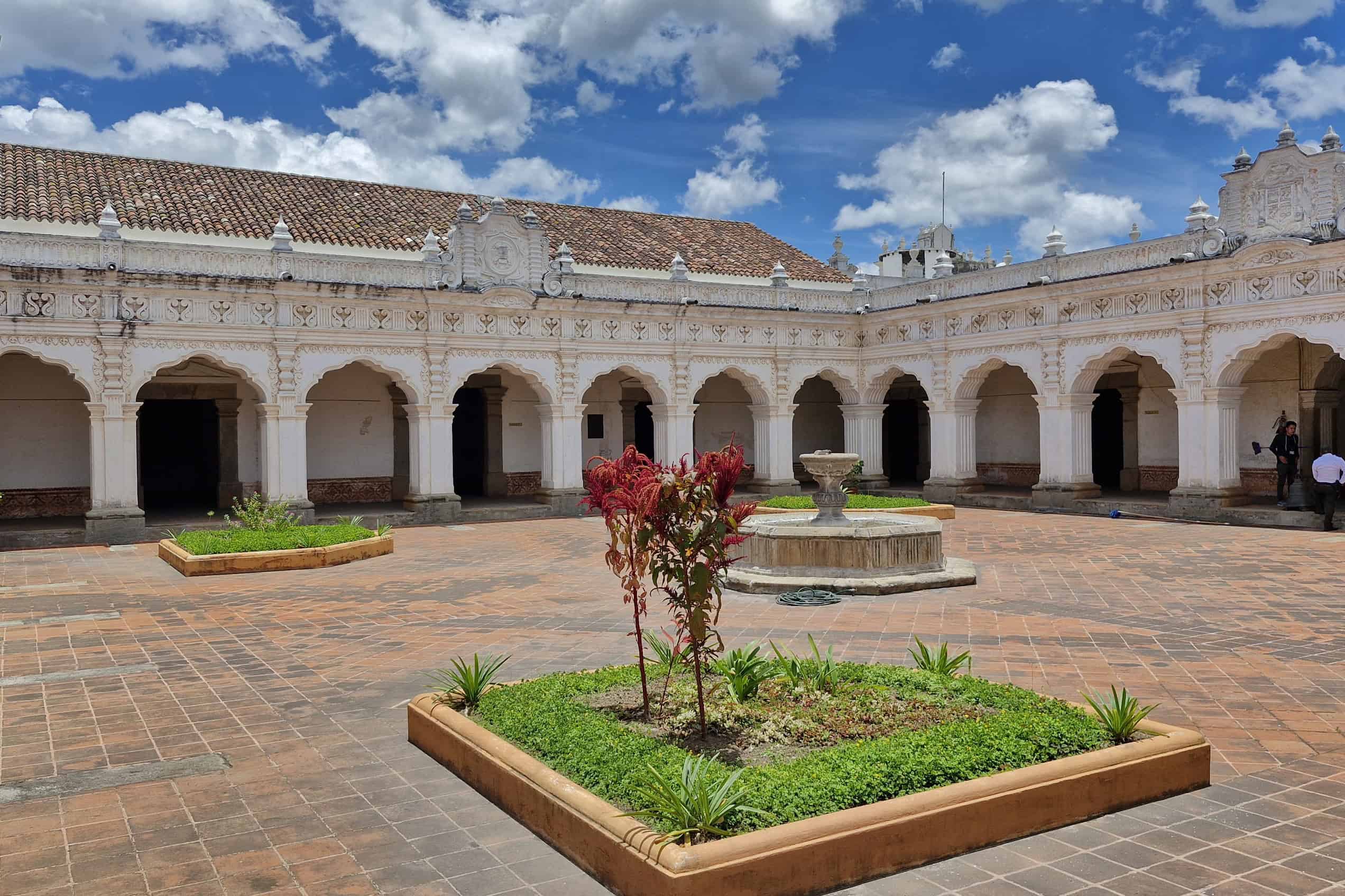
The Museo de Arte Colonial in Antigua Guatemala, photographed by Erik Cleves Kristensen. Source: Wikimedia Commons; licensed under Creative Commons Attribution 2.0 Generic. Cropped.
Where the 287 Works Went
The custody trail begins on December 29, 2025, when Guatemala’s Public Ministry entered the museum under a court order. By January 12, the culture ministry said 98% of the collection had been moved to an emergency space in the Palacio Nacional de la Cultura in Guatemala City. Six large paintings stayed behind because their size and fragile condition made removal unusually difficult.
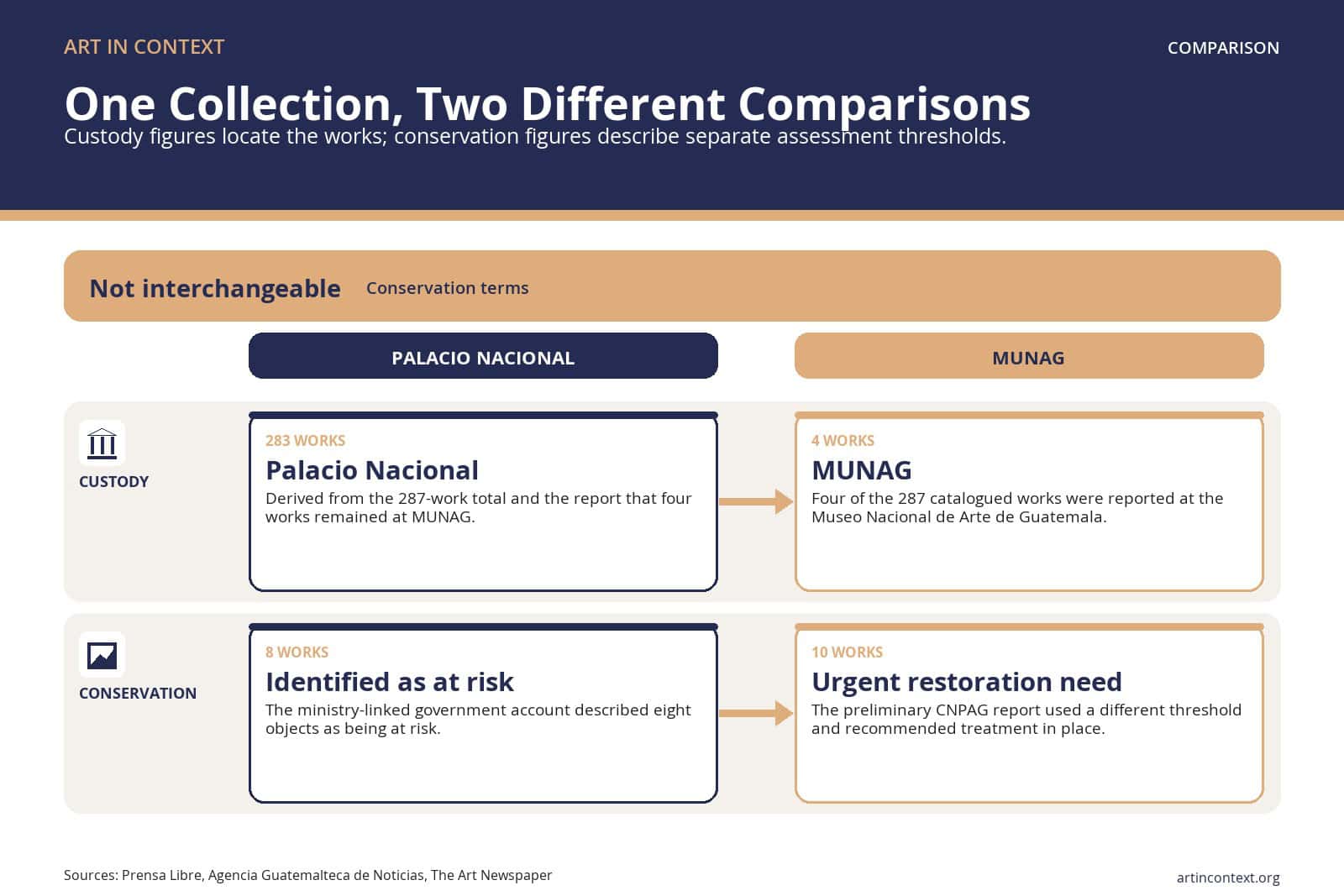
That first phase therefore moved 281 of the 287 catalogued works. Published accounts conflict over the final six paintings: Prensa Libre reported on February 26 that four went to MUNAG and two to the Palacio Nacional, but its August 8 account said all six went to MUNAG. A detailed contemporary account also records two wooden cherubs moving to the palace, but says the ministry treated them as part of the building’s masonry rather than as two of the six outstanding paintings.
The collection is split between the Palacio Nacional and MUNAG, but the published accounts do not establish a consistent exact count for each venue. The two cherubs accompanied the February transfer but sit outside that 287-work arithmetic as the ministry described it.
This distribution also explains why regaining the original building did not reunite the museum. The ministry’s August announcement describes the collection’s return as a future, planned operation. An August 8 Prensa Libre report said gradual unpacking had begun at the palace and that specialists had found damage in some objects, but neither the number of affected works nor the extent of the damage was disclosed.
Eight At-Risk Works and Ten Urgent Cases Are Not the Same Claim
The conservation figures in the public record do not align neatly. A January government account of the culture ministry’s position said eight objects had been identified as being at risk. The Art Newspaper, describing the preliminary report by the Consejo Nacional para la Protección de la Antigua Guatemala that underpinned the court action, reported ten works in urgent need of restoration and said the report recommended treating them in place.
Those figures may reflect different thresholds rather than a simple counting error. “At risk,” “at risk of collapse” and “in urgent need of restoration” are not interchangeable conservation categories. The published accounts do not identify the objects in each group or show whether the eight are contained within the ten, so neither number supports the broader conclusion that all 287 works were damaged.
The later evidence is also object-specific, not collection-wide. Conservators cited in the August 28 report described peeling paint, dirt and humidity among the works and called for individual assessments. That supports a need for a complete condition survey. It does not establish that transport caused every alteration, because the collection already had conservation problems and there is not yet a published object-by-object comparison of its condition before and after the moves.
Movement remains part of the risk history. The six largest paintings required stabilization, Japanese paper facing in some cases, and specially prepared spaces before they could leave. Their route demonstrates why the return cannot responsibly be treated as the reversal of a truck journey: each work needs a condition decision, an environmental destination and a handling plan.
What Has to Happen Before the Art Returns
The building diagnosis is the first gate. Officials are checking moisture, electrical systems, lighting, surfaces and structural coverings because a restored object cannot safely return to an unstable gallery. The expected early-September findings should define both the interventions and the order in which rooms can be used.
The ministry also plans a new museum script and display design, including revised circulation, lighting, labels, object distribution and possible temporary exhibitions. Those are substantive curatorial choices, not cosmetic additions: they determine which works return first, how large canvases are supported and how religious paintings and polychromed sculpture are interpreted together.
A second gate is the collection survey. The works held at MUNAG and the Palacio Nacional have experienced different buildings, storage arrangements and handling histories. A credible reopening plan therefore needs location-specific condition records before it can set a return sequence.
The legal process remains active even though administrative control of the building has changed. Prensa Libre reported on August 21 that the criminal proceeding had not concluded. The case may impose further conditions on the objects; the status of the building’s use agreement through 2032 and conservators’ authority to complete and publish the full survey remain unresolved.

The Museo Nacional de Arte de Guatemala, temporary custodian of four large paintings from the dispersed collection. Photograph by Gobierno de Guatemala; source: Wikimedia Commons; marked public domain.
The Keys Are Back; the Collection Is Not
Published accounts place the collection between the Palacio Nacional and MUNAG, with two additional cherubs handled as architectural elements, but conflict over the exact distribution.

Isabella studied at the University of Cape Town in South Africa and graduated with a Bachelor of Arts majoring in English Literature & Language and Psychology. Throughout her undergraduate years, she took Art History as an additional subject and absolutely loved it. Building on from her art history knowledge that began in high school, art has always been a particular area of fascination for her. From learning about artworks previously unknown to her, or sharpening her existing understanding of specific works, the ability to continue learning within this interesting sphere excites her greatly.
Her focal points of interest in art history encompass profiling specific artists and art movements, as it is these areas where she is able to really dig deep into the rich narrative of the art world. Additionally, she particularly enjoys exploring the different artistic styles of the 20th century, as well as the important impact that female artists have had on the development of art history.
Learn more about Isabella Meyer and the Art in Context Team.
Choose Art in Context as a preferred source to see more of our reporting in Google Top Stories and other Google Search experiences.
Cite this Article
Isabella, Meyer, “Guatemala Regains Museo de Arte Colonial as 287 Works Await Return.” Art in Context. August 29, 2026. URL: https://artincontext.org/museo-arte-colonial-guatemala-287-works-return/
Meyer, I. (2026, 29 August). Guatemala Regains Museo de Arte Colonial as 287 Works Await Return. Art in Context. https://artincontext.org/museo-arte-colonial-guatemala-287-works-return/
Meyer, Isabella. “Guatemala Regains Museo de Arte Colonial as 287 Works Await Return.” Art in Context, August 29, 2026. https://artincontext.org/museo-arte-colonial-guatemala-287-works-return/.


