

Snap the Whip by Winslow Homer: Meaning and Versions

Schoolboys race across a field, pulling one another through a turn until a child breaks free at the far end. Winslow Homer makes the game feel immediate, yet its mixture of teamwork and rupture leaves room for a more serious reading. The key to understanding the scene begins with an easily missed fact: Homer painted two different oils, and the smaller Metropolitan Museum version is the object examined here.
| Title: | Snap the Whip |
| Artist: | Winslow Homer |
| Date: | 1872 |
| Medium/Support: | Oil on canvas |
| Dimensions: | 12 × 20 in. (30.5 × 50.8 cm) |
| Collection: | The Metropolitan Museum of Art |
| Accession number: | 50.41 |
| Credit line: | Gift of Christian A. Zabriskie, 1950 |
| Version identity: | The smaller of two distinct 1872 oil paintings; Metropolitan Museum version |
Which Snap the Whip Is This?
The name Snap the Whip can refer to Homer’s composition generally or to either of two separate oil paintings. Here it refers specifically to the compact horizontal canvas owned by The Metropolitan Museum of Art, accession 50.41. Keeping that identity fixed prevents the dimensions, background, exhibition history, and number of figures from the larger painting from being assigned to the wrong object.

The Met Painting at a Glance
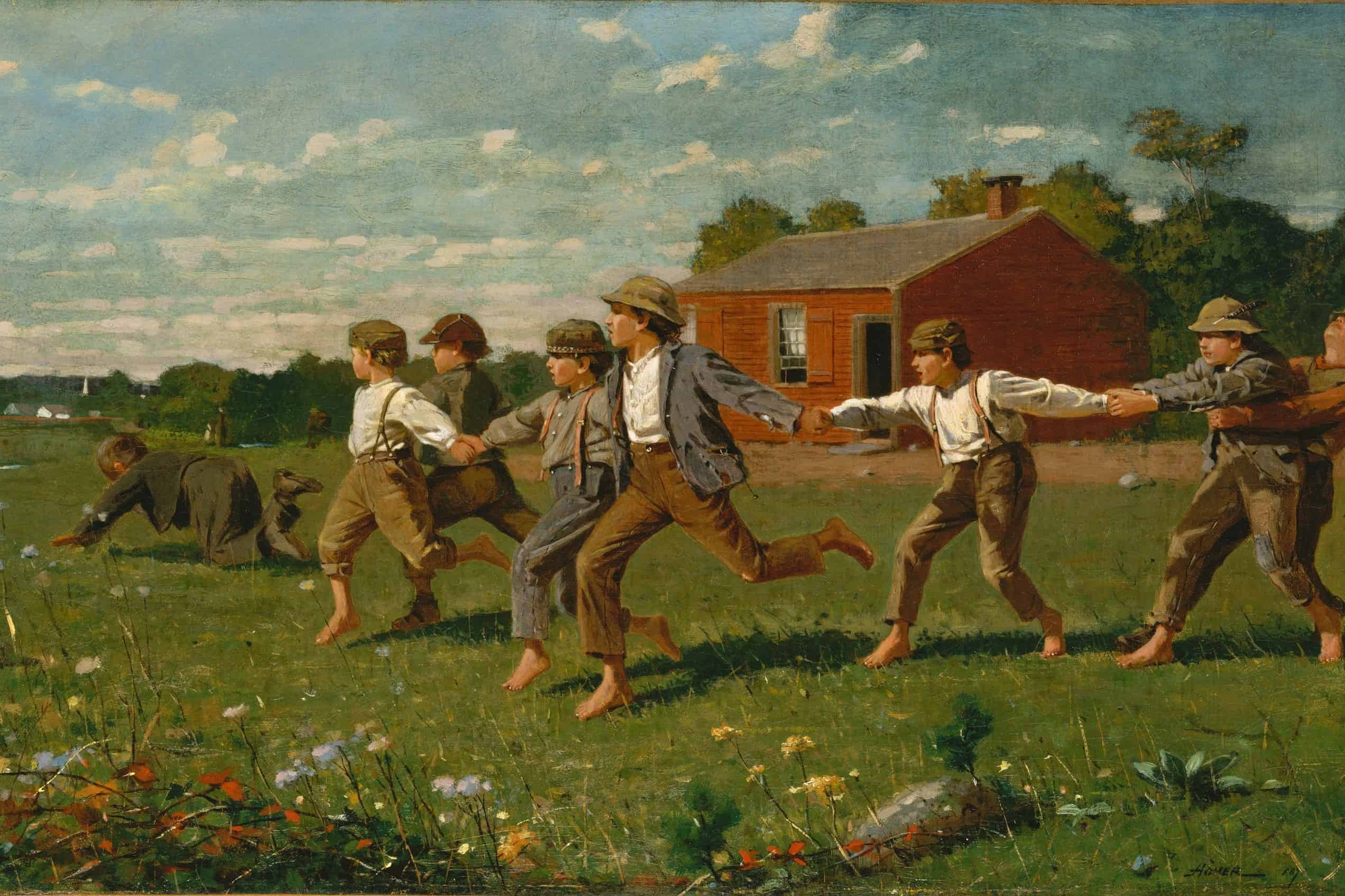
The Met painting places the action in a shallow rural field. A group of boys forms a low, irregular arc through the middle of the canvas, with the schoolhouse holding the right side and a separated child extending the movement toward the left. The broad sky and low distant landscape leave ample open space around the game.
Its modest physical scale matters. Homer does not need a large canvas to suggest force because the boys’ joined arms carry movement laterally across nearly the entire width. Oil paint supplies clear blocks of color, especially the red schoolhouse, while the compact format encourages viewers to follow small changes in posture, balance, and contact.
How the Butler Version Differs
The Butler Institute of American Art owns the other 1872 oil. It is larger than the Met canvas, includes an additional figure, and replaces the Met picture’s low, open distance with a mountainous background. These are not later alterations to the same painting. They identify a separate object.

A practical recognition test begins with the setting. A broad sky above a relatively low horizon signals the Met version. Mountains and another player signal the Butler version. The difference also changes the effect: the Met painting gives the moving chain more visual isolation, while the Butler landscape makes the game feel tied to a more topographically specific place. The Butler composition, not the smaller Met oil, later served as the basis for the magazine engraving and traveled to major international exhibitions.
How Homer Developed the Composition
Homer worked as a commercial printmaker, and during the 1870s he repeatedly depicted children at play and rural New York subjects. The Snap the Whip composition appears in several distinct objects: a study, two oil paintings, and a published wood engraving.
From Illustrator to Painter
Homer began his career as a commercial printmaker and worked as an artist-correspondent for Harper’s Weekly during the Civil War. In Snap the Whip, the joined figures function almost like one long graphic mark, even though each child has a different stance.

During the 1870s, Homer repeatedly depicted children playing and scenes from rural New York. Such images belong to the broad tradition of genre painting, which takes everyday life as its subject. The ordinary game is therefore not incidental. It gives Homer a familiar action through which to study bodies under strain, group coordination, and a changing rural world. A broader account of Winslow Homer’s career places these subjects within his development beyond commercial illustration.
The Proposed Hurley Schoolhouse Setting
Local historical research has associated the scene with the former Eagle’s Nest one-room schoolhouse on Hurley Mountain Road in Hurley, New York. The Hurley Heritage Society reports that the building survives as a private residence. This identification offers a plausible local setting, but it should not be treated as certain or confused with the Met’s canonical object information.
The two painted backgrounds also warn against reading the scenery as a literal record of one unchanging view. Homer used a lower, more open distance in the Met painting and mountains in the Butler version. Whatever place prompted the scene, he adjusted the landscape to suit each composition.
Study, Oils, and Engraving
An 1872 study now associated with Cooper Hewitt shows six boys on the front, or recto, of the sheet. Homer worked in black and white chalk with touches of light orange chalk on green paper. The drawing, accession 1912-12-82, isolates the linked bodies and lets their changing angles carry the action. It is a preparatory object, not the Met painting in another medium.
The study and both oil paintings date from 1872. In 1873, W. H. Lagarde translated the larger Butler composition into a wood engraving after Homer. Published images reverse the practical conditions of easel painting: line, tonal contrast, and reproducibility become central. Across these distinct objects, the moving chain appears in chalk and oil before the larger painted composition is adapted for mass circulation in the later engraving.
How to Look at Snap the Whip
The most useful way into the Met painting is to read its movement before assigning it a meaning. Start where the game pivots, follow the joined bodies, notice where contact fails, and then compare that unstable line with the fixed building and open landscape.
Follow the Chain from Right to Left
In the game commonly called snap the whip or crack the whip, players hold one another in a chain. An anchor at one end helps drive the turn, while speed and force increase toward the tail. Players at the outer end may lose their grip as the chain swings.
Homer makes that mechanism legible. Begin with the braced players near the schoolhouse on the right. Their planted feet and leaning bodies establish resistance. From there, follow the joined arms toward the center, where bent knees, long strides, and tilting torsos turn the group into a curving horizontal line. The poses vary enough that the chain seems to flex rather than slide rigidly across the field.
At the left, a separated child turns the implied force into a visible consequence. The gap is as important as the figures themselves. It interrupts the linked line, extends the action beyond the main group, and allows viewers to understand the game without seeing the moments immediately before or after it.
Still Architecture and Moving Bodies
The red schoolhouse acts as a fixed counterweight. Its upright walls and firm roof edges contrast with bent limbs, diagonal torsos, and uneven spacing. The building does not merely identify a schoolyard. Its stable geometry makes the children’s motion appear more restless.
Color strengthens that effect. The schoolhouse forms the strongest concentrated area of red, anchoring the side from which the chain seems to swing. The figures stretch away from it across quieter earth and plant colors. On a small canvas, this contrast between a dense architectural block and an unfolding human line helps the composition remain clear.
Grass, Wildflowers, and Open Sky
Grass and small wildflowers occupy the foreground, placing the viewer close to the field rather than on a detached overlook. They establish a near plane below the boys, while the low horizon and distant forms open space behind them. The eye can therefore move both across the human chain and outward into the landscape.
The sky occupies a large part of the Met version. That breadth prevents the compact scene from feeling crowded and makes the low-running figures appear exposed against open space. It is also a version-specific feature: importing the Butler painting’s mountainous backdrop would change both the setting and the balance of the Met composition.
What Does Snap the Whip Mean?
Observation and interpretation need separate footing. The painting supplies a set of visible facts, while its broader social meanings come from historically informed readings rather than a single fixed code.
What the Painting Actually Shows
The Met canvas shows barefoot schoolboys playing a physically demanding game in a rural field. Their bodies form a chain, but a child has separated at the left. A red schoolhouse stands at the right, with grass and flowers below the figures and a broad sky above a low landscape.
Those elements do not require every color, garment, or gesture to function as a symbol. The children’s linked hands communicate cooperation because holding on is part of the game. The gap communicates rupture because the chain has visibly broken. Interpretation begins with that concrete relationship.
Unity and Fracture After the Civil War
The Met interprets the boys as an optimistic image of the country’s postwar future and connects their teamwork with the challenge of national reunion. Under this reading, the game becomes more than recreation: individuals must coordinate their weight and movement to keep the group intact.
The broken tail complicates the optimism. The chain works only partially, and its own force can cast a participant out. The Met treats that disruption as a sign of difficulty within reunion. This is a museum-supported interpretation, not proof that Homer documented one exclusive symbolic intention.
Cooperation and fracture can coexist because they are already built into the game. The same linked structure that lets the players generate speed also creates the pressure that breaks their hold. Homer did not need to add a separate allegorical object to make that tension visible.
Rural Nostalgia and Urban Change
The Met also relates the rural schoolhouse setting to nostalgia during increasing urbanization. The field, school building, and outdoor game could evoke a form of childhood associated with a less urban America. From this perspective, the painting looks not only at play but at a rural social world that contemporary viewers might have felt was changing.
That reading does not turn the scene into uncomplicated pastoral comfort. The boys strain, stumble, and separate. The fixed schoolhouse may suggest continuity, but the bodies in front of it make instability equally present. Homer’s achievement lies partly in allowing an ordinary event to support both affection for communal life and awareness of how easily a group can come apart.
From Painting to Public Image
The composition did not remain confined to two canvases. Its conversion into a magazine engraving and the exhibition of the larger oil helped give the image a public life, although those events belong to specific versions rather than to the Met object automatically.
The 1873 Harper’s Weekly Engraving
W. H. Lagarde’s wood engraving after Homer appeared in Harper’s Weekly on September 20, 1873. It was printed on newsprint and followed the Butler composition rather than the smaller Met painting. The National Gallery of Art holds an impression under accession number 1986.31.268.

Magazine publication made the composition reproducible and carried it beyond audiences who could encounter an oil painting directly. It also helps explain the image’s broad familiarity. Yet the engraving should not be used as neutral evidence for every detail in the Met canvas, since its figure count and landscape derive from the other painted version.
Which Version Went to the International Exhibitions?
The Butler painting was shown at Philadelphia’s Centennial Exhibition in 1876 and at Paris’s Universal Exposition in 1878. The Met version did not supply this exhibition history. This distinction matters because accounts that combine the two paintings can make the smaller canvas appear to have traveled when the documented object was the larger one.
Why the Painting Matters and Where to See It
Snap the Whip turns the mechanics of a children’s game into a precise compositional system. Linked arms form a directional line, the anchor generates resistance, and the broken tail reveals force. The schoolhouse and landscape then expand that physical event into questions about education, rural memory, group loyalty, and separation without forcing one final answer.
The work’s path from chalk study to two oils and a magazine engraving also connects careful figure design with public circulation. Ordinary rural life becomes visually memorable through compression rather than spectacle. Readers who want to apply the same object-focused approach to another work can continue with The Gulf Stream by Winslow Homer.
The selected painting remains in The Metropolitan Museum of Art. As checked on September 13, 2026, the museum lists it as on view at The Met Fifth Avenue in Gallery 763. Gallery assignments and display status can change, so visitors should confirm the live object record before traveling.
Frequently Asked Questions
These short answers preserve the distinction between the Met painting, the Butler painting, and the related game.
Where Is Snap the Whip by Winslow Homer Located?
The smaller 1872 oil is in The Metropolitan Museum of Art, accession 50.41. The museum listed it in Gallery 763 at The Met Fifth Avenue on September 13, 2026, but visitors should verify its current display status.
Are There Two Versions of Snap the Whip?
Yes. Homer painted two distinct oils in 1872. The Met owns the smaller version discussed here, while the Butler Institute owns a larger painting with another figure and a mountainous background.
What Does the Broken Chain Symbolize?
It first shows a real event within the game: a player has lost contact at the tail. The Met also reads the break as a complication within a post-Civil War interpretation of teamwork and national reunion, but that remains an interpretation rather than a documented single meaning from Homer.
How Do Children Play Snap the Whip?
Players join hands or hold one another to form a chain around an anchor at one end. A rapid turn sends force toward the tail, where players may be pulled free. Homer places the anchor on the right and the released child on the left.

Alicia du Plessis is a multidisciplinary writer. She completed her Bachelor of Arts degree, majoring in Art History and Classical Civilization, as well as two Honors, namely, in Art History and Education and Development, at the University of KwaZulu-Natal, South Africa. For her main Honors project in Art History, she explored perceptions of the San Bushmen’s identity and the concept of the “Other”. She has also looked at the use of photography in art and how it has been used to portray people’s lives.
Alicia’s other areas of interest in Art History include the process of writing about Art History and how to analyze paintings. Some of her favorite art movements include Impressionism and German Expressionism. She is yet to complete her Masters in Art History (she would like to do this abroad in Europe) having given it some time to first develop more professional experience with the interest to one day lecture it too.
Alicia has been working for artincontext.com since 2021 as an author and art history expert. She has specialized in painting analysis and is covering most of our painting analysis.
Learn more about Alicia du Plessis and the Art in Context Team.
Cite this Article
Alicia, du Plessis, “Snap the Whip by Winslow Homer: Meaning and Versions.” Art in Context. October 16, 2026. URL: https://artincontext.org/snap-the-whip-by-winslow-homer/
du Plessis, A. (2026, 16 October). Snap the Whip by Winslow Homer: Meaning and Versions. Art in Context. https://artincontext.org/snap-the-whip-by-winslow-homer/
du Plessis, Alicia. “Snap the Whip by Winslow Homer: Meaning and Versions.” Art in Context, October 16, 2026. https://artincontext.org/snap-the-whip-by-winslow-homer/.


