

The Gross Clinic by Thomas Eakins – A Close Reading

A surgeon pauses above an open wound, his scalpel and bloodied fingers caught in a hard shaft of light. Around him, a patient disappears into a knot of bodies while a distressed witness turns away and students watch from the dark. Reading Thomas Eakins’s The Gross Clinic from light to shadow reveals how one difficult surgical scene became a bold claim about modern knowledge, public heroism, and the human cost of both.
| Artist: | Thomas Eakins |
| Title: | Portrait of Dr. Samuel D. Gross (The Gross Clinic) |
| Date: | 1875 |
| Medium/Support: | Oil on canvas |
| Dimensions: | 8 feet by 6 feet 6 inches (243.8 by 198.1 cm) |
| Collection: | Jointly owned by the Philadelphia Museum of Art and the Pennsylvania Academy of the Fine Arts |
| PMA Accession Number: | 2007-1-1 |
How to Look at The Gross Clinic
At nearly eight feet high, The Gross Clinic places its viewers before a life-size teaching theater rather than a small record of a medical procedure. Thomas Eakins filled the tall canvas with bodies, curved seating, medical equipment, and abrupt flashes of pale fabric and red blood. Yet the crowd is not chaotic. Light, gesture, and overlapping forms create a route through it.

The clearest approach is to begin with Dr. Samuel D. Gross, follow his raised hand toward the patient, and then move outward to the clinicians, witnesses, and students. That path also helps separate what the painting visibly shows from the meanings later viewers have assigned to it.
Light Directs the First Look
Gross stands near the center, isolated against the dark seating behind him. The illumination catches his gray hair and forehead before descending to his face, black coat, white shirt, and lifted hand. He has paused between operating and speaking, so the composition presents thought, action, and instruction as parts of the same profession.
Art historian Elizabeth Johns interprets the bright forehead and the prominence of the bloodied hand and scalpel as a deliberate union of intellect and manual skill. This is an attributed reading, not a measurable property of the canvas, but it fits the visual sequence Eakins constructed. The viewer sees Gross’s head, then the instrument in his hand, and finally the operation below.
Small red accents intensify that descent. Blood marks the surgeon’s fingers and the site of the procedure, while the surrounding browns and blacks absorb much of the theater. Pale skin and cloth reveal portions of the patient without making the body immediately understandable. Eakins therefore uses contrast to disclose the scene in stages instead of offering every figure with equal clarity.
Decoding the Patient and Surgical Team
The patient lies diagonally across the lower center, sharply foreshortened, meaning that the body projects toward the viewer and appears compressed within the flat picture. Sock-clad feet point forward, the head is covered during the administration of chloroform, and the left thigh becomes the focus of the operation. The patient’s buttocks, feet, and wounded leg can be located, but the overlapping doctors make the torso and overall position difficult to reconstruct.
This confusion has practical and expressive effects. It conveys the density of a team working in limited space, but it also denies the patient the commanding identity given to Gross. The museum records describe a young patient without establishing the gender claims that have often been attached to the figure. It is safer to recognize the deliberately obscured body than to turn an uncertain identity into fact.
The clinical group performs several coordinated tasks: administering chloroform, supporting the legs, probing the incision, and holding it open. The Philadelphia Museum of Art identifies James M. Barton, Charles S. Briggs, Daniel M. Appel, and W. Joseph Hearn among those gathered around the patient. Their bent heads and converging hands form a compact working unit beneath the upright lecturer.
The scene should not be treated as a complete visual manual for an operation in 1875. Eakins selected and arranged its details within a carefully designed painting. It represents medical practice, but composition, scale, and emphasis shape what the viewer is allowed to see.
Witnesses, Students, and Eakins in the Shadows
The seated woman at the left supplies the strongest emotional reaction. She raises a hand across her face and turns away from the exposed operation. She has traditionally been identified as the patient’s mother, but that relationship is not confirmed. Her pose is visible evidence; her identity remains qualified.
Near her, clinic clerk Franklin West writes as the procedure unfolds. His activity extends the scene beyond cutting and treatment to observation and documentation. Scholars have interpreted his pencil as a visual counterpart to Gross’s scalpel: one instrument alters the body, while the other records what occurs. That parallel is persuasive as interpretation, though Eakins left no label on the canvas declaring it.
At the far right, Eakins placed himself among the students, sketching or writing from the shadowed seating. His self-portrait establishes him as an observer inside the institution whose work he was transforming into art. Around him, rows of students and figures in a doorway recede into darkness. They define the amphitheater as a place of public instruction while keeping the visual pressure on Gross and the vulnerable patient below.
Why Eakins Painted a Surgical Theater
The setting is the surgical amphitheater at Jefferson Medical College in Philadelphia. Gross appears there in two connected roles: he is the surgeon responsible for the operation and the teacher explaining it to an audience. That combination gave Eakins a contemporary subject with physical action, concentrated attention, and civic importance.
A Painting Made for the Centennial
Eakins painted the canvas in 1875 specifically for Philadelphia’s 1876 Centennial Exhibition. He intended it to display his ability on a monumental scale and to honor the city’s scientific achievements. Instead of selecting an event from ancient history, religion, or war, he made modern professional work carry the weight of a grand public picture.

A separate oil sketch from 1875 shows Eakins testing the arrangement before completing the full-scale painting. The sketch and the monumental canvas are distinct objects, even though reproductions can make them easy to confuse online. The original discussed here is the tall, jointly owned canvas recorded by the Philadelphia Museum of Art and the Pennsylvania Academy of the Fine Arts.
Its scale was part of the argument. Gross does not appear as a private sitter contained within a conventional portrait. He dominates an active arena, surrounded by colleagues, witnesses, and students whose attention confirms his authority. The painting turns a clinical demonstration into an event meant for a broad public.
Gross, Osteomyelitis, and Limb-Saving Surgery
The operation represents treatment for osteomyelitis, an infection of bone. The surgeons remove dead tissue from the patient’s left thighbone, an approach intended to preserve the limb as knowledge of bone healing advanced. Chloroform anesthesia makes a sustained procedure possible while another member of the team manages the patient’s covered head.
These medical details clarify the gestures without making the painting a neutral document. Eakins compresses people and actions into a single intelligible moment, with Gross pausing to lecture while the team continues below. The procedure is both the subject of the lesson and the stage on which the surgeon’s expertise becomes visible.
The contrast between treatment and amputation is important to the painting’s confidence in applied knowledge. Yet the exposed body and blood prevent progress from looking painless. Eakins shows an effort to save a limb alongside the physical vulnerability that such an intervention requires.
Eakins’s Anatomy Training and Artistic Ambition
Eakins was prepared to make anatomy central to his art. He studied at the Pennsylvania Academy of the Fine Arts, attended anatomy classes, and observed dissections and operations at Jefferson Medical College. He also trained at the École des Beaux-Arts in Paris. Those experiences joined disciplined study of the body to the ambition of large-scale European painting.
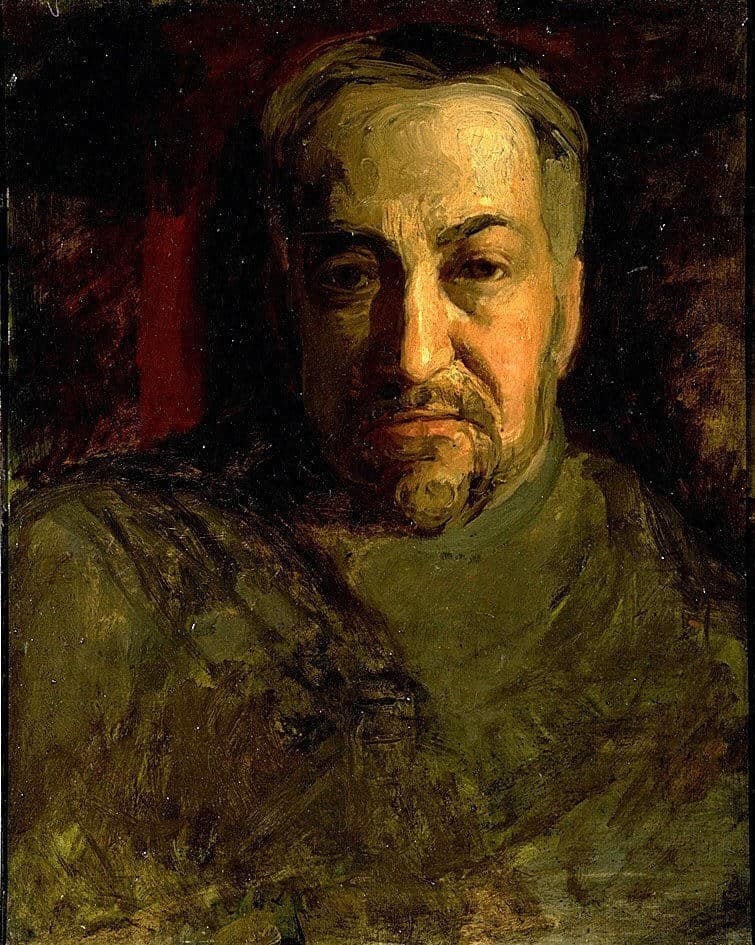
His focus on contemporary work also connects The Gross Clinic to the Realism art movement, which made ordinary environments and modern experience worthy of sustained attention. Eakins did not flatten the clinic into an everyday anecdote, however. He borrowed the gravity of history painting to enlarge a current scientific subject.
The result is often described as a modern history painting. That term explains the unusual combination: a recognizably contemporary profession appears on a scale associated with major public deeds. Gross becomes a leading actor, while the amphitheater replaces the palace, battlefield, or sacred setting.
Rejection, Praise, and Uneasy Interpretations
The painting’s difficult reception was not simply a later legend attached to a once-shocking image. Its original exhibition history documents a real conflict over whether blood, surgery, and an exposed patient belonged within ambitious fine art.

Rejected from Art, Shown with Medicine
The Centennial’s art jury excluded The Gross Clinic from the fine-arts galleries. The canvas still appeared at the exhibition, but among medical displays in the U.S. Army model post hospital. It was therefore rejected from the art presentation, not removed from the Centennial altogether.

Early reactions divided sharply. Some viewers praised Eakins’s composition and command of bodily form. Others objected to the blood, exposed body, and unsparing presentation of surgery. The disagreement concerned both subject and category: admirers saw an ambitious achievement, while detractors questioned whether such clinical reality was suitable for art.
Its placement with medicine created an unintended irony. Eakins had used a surgical demonstration to claim a place in monumental painting, but exhibition officials treated the image as more appropriate to professional or scientific display. The setting made the work’s subject legible while refusing the artistic status Eakins sought for it.
Verified Facts and Contested Meanings
Certain points are secure. Gross lectures with a scalpel in his bloodied hand. A medical team operates on a young patient’s left thigh. A woman recoils, Franklin West records the procedure, and Eakins watches from the seating. The painting does not securely establish that the woman is the patient’s mother or resolve the patient’s gender.
Interpretation begins with the relationships among those facts. Gross can be read as a modern scientific hero because light, height, and gesture distinguish him from the crowd. At the same time, the hidden face and exposed body of the patient have led scholars to examine gender, sexuality, spectatorship, and the medical gaze. The medical gaze is the way professional observation can turn a person into a body to be examined and treated.
The woman’s recoil further complicates a purely triumphant reading. She makes emotional distress visible within a space dominated by controlled professional attention. West’s writing and the students’ watching add still more forms of observation. The canvas can celebrate knowledge while asking viewers to notice who speaks, who looks, who records, and whose identity nearly disappears.
These readings need not cancel one another. Monumental portraiture elevates Gross, while the blood and obscured patient reveal the cost and limits of his authority. The work’s tension comes from Eakins allowing confidence and vulnerability to occupy the same scene.
The Original Painting and Its Philadelphia Homes
The Gross Clinic has remained closely tied to Philadelphia through its subject, ownership, and public reception. Its history also explains why two museum databases can describe one jointly owned original with different catalog numbers.
From a $200 Alumni Gift to Joint Ownership
Jefferson alumni purchased the painting for $200 and presented it to Jefferson Medical College in 1878. More than a century later, a proposed $68 million sale in 2006 prompted a campaign to keep the work in Philadelphia. The Philadelphia Museum of Art and the Pennsylvania Academy of the Fine Arts jointly acquired it in 2007.
The acquisition made the painting one object with two institutional homes, not two versions. The Philadelphia Museum of Art records it as accession 2007-1-1 and gives its dimensions as 243.8 by 198.1 centimeters. PAFA uses accession 2007.2 and publishes slightly different measurements of 243.84 by 199.39 centimeters. Those are separate co-owner catalog records for the same original canvas.
Eakins’s smaller 1875 composition study is a different work, as are later reproductions. Scale provides a quick recognition aid: the canonical painting is a monumental vertical canvas measuring eight feet high. A study can clarify how Eakins developed the arrangement, but it should not inherit the original’s accession, measurements, or exhibition history.
What Conservation Changed About Looking
A major conservation project in 2009 and 2010 investigated how Eakins made the painting and how its appearance had changed. Conservators and scholars examined preparatory works, X-radiographs, and historical images alongside the canvas. This combined technical and historical evidence helped them assess earlier alterations and the relationships among dark passages, colors, and visible details.
That work matters to a close reading because darkness is one of the composition’s main tools. A change in tonal balance can alter how quickly Gross emerges, how clearly the patient can be oriented, and how far the students recede. Conservation is therefore more than repair history here. It affects the sequence through which viewers understand the scene.
The technical study also reinforces the distinction between Eakins’s design and everything that happened to the surface afterward. What looks like a single frozen artifact has a physical history of preparation, alteration, examination, and treatment.
Where to See The Gross Clinic Today
As of September 2026, the original is on view at PAFA in A Nation of Artists. The exhibition is scheduled to run from April 12, 2026, through September 5, 2027. Because the work is jointly owned and display arrangements can change, visitors should confirm its status with PAFA before traveling.
Seeing the painting at full scale reveals effects that reproductions reduce. Gross’s standing figure approaches the viewer’s physical presence, while the patient occupies a compressed zone below. The difference in scale between commanding lecturer and obscured body becomes an immediate spatial experience rather than an abstract compositional point.
Why The Gross Clinic Still Matters
The painting offers more than a record of one celebrated surgeon. It makes medical knowledge into a public performance while preserving signs of pain, uncertainty, and unequal visibility. A comparison with Eakins’s later clinic painting shows how deliberately he built that effect.
The Later Clinic as a Controlled Comparison
Eakins painted The Agnew Clinic in 1889, fourteen years after The Gross Clinic. Comparing the same categories across the two works reveals changes in both surgery and composition. The earlier team wears street clothes and works with exposed instruments in a dark, vertical scene. The later clinic introduces white gowns, sterilized instruments, and the professional nurse Mary Clymer within a lighter, horizontal arrangement.

The difference is not simply dark versus light. In The Gross Clinic, illumination and vertical format concentrate authority in Gross, whose upright body rises above a dense knot of clinicians. The Agnew Clinic spreads the action laterally, giving the surgical team and surrounding space a broader visual field. The later arrangement makes activity feel more distributed even as its senior surgeon remains a public figure.
The presence of a professional nurse in the later painting and her absence from the earlier scene mark a change in staffing. White surgical clothing and sterilized instruments likewise point to developing antiseptic practice. These visible contrasts are more useful than treating every dark coat in the 1875 painting as proof of an individual surgeon’s beliefs about cleanliness.
Together, the paintings record change while also demonstrating Eakins’s control over presentation. He did not merely copy two rooms. He adjusted format, light, grouping, clothing, and visual emphasis to make each clinic legible as a particular kind of public event.
A Modern Hero Surrounded by Human Vulnerability
Among major Realism paintings and artists, The Gross Clinic stands out for making specialized labor feel as consequential as a traditional historical event. Gross’s authority depends on more than likeness. Light, scale, posture, spectators, and the suspended lecture all construct him as a person whose knowledge affects other bodies.
Yet Eakins did not isolate that authority from its consequences. Gross’s bloodied hand links intellect to physical intervention. The patient’s hidden face blocks easy identification, while the woman’s recoil interrupts the clinicians’ composure. Students watch, a clerk writes, and the artist observes from the edge. Knowledge is being applied, taught, documented, and converted into an image at the same time.
This layered structure explains why the painting remains more than a celebration of medical progress or a display of unsettling realism. It shows the confidence of modern expertise alongside incomplete knowledge about the person receiving care. It also turns viewers into another audience in the amphitheater, forcing them to decide whether they are studying Gross, witnessing the patient’s vulnerability, or doing both.
Frequently Asked Questions
The familiar title names the surgeon, but questions about the operation, the 1876 rejection, and the original canvas’s current location require separate answers.
Why Is It Called The Gross Clinic?
Gross is the surname of surgeon and teacher Samuel D. Gross. The familiar title refers to him and his teaching clinic, not to a judgment that the scene is disgusting.
What Surgery Is Shown in The Gross Clinic?
The painting represents surgeons removing dead tissue from the left thighbone of a young patient with osteomyelitis. The procedure was intended to treat the bone infection while preserving the limb.
Was the Painting Rejected in 1876?
It was rejected from the Centennial Exhibition’s fine-arts galleries, but it was still displayed at the event. Visitors encountered it among medical exhibits in the U.S. Army model post hospital.
Where Is the Original The Gross Clinic Now?
As of September 2026, the jointly owned original is displayed at PAFA in A Nation of Artists, scheduled through September 5, 2027. Check the museum’s current exhibition information before visiting because displays can change.

Alicia du Plessis is a multidisciplinary writer. She completed her Bachelor of Arts degree, majoring in Art History and Classical Civilization, as well as two Honors, namely, in Art History and Education and Development, at the University of KwaZulu-Natal, South Africa. For her main Honors project in Art History, she explored perceptions of the San Bushmen’s identity and the concept of the “Other”. She has also looked at the use of photography in art and how it has been used to portray people’s lives.
Alicia’s other areas of interest in Art History include the process of writing about Art History and how to analyze paintings. Some of her favorite art movements include Impressionism and German Expressionism. She is yet to complete her Masters in Art History (she would like to do this abroad in Europe) having given it some time to first develop more professional experience with the interest to one day lecture it too.
Alicia has been working for artincontext.com since 2021 as an author and art history expert. She has specialized in painting analysis and is covering most of our painting analysis.
Learn more about Alicia du Plessis and the Art in Context Team.
Cite this Article
Alicia, du Plessis, “The Gross Clinic by Thomas Eakins – A Close Reading.” Art in Context. September 26, 2026. URL: https://artincontext.org/the-gross-clinic-by-thomas-eakins/
du Plessis, A. (2026, 26 September). The Gross Clinic by Thomas Eakins – A Close Reading. Art in Context. https://artincontext.org/the-gross-clinic-by-thomas-eakins/
du Plessis, Alicia. “The Gross Clinic by Thomas Eakins – A Close Reading.” Art in Context, September 26, 2026. https://artincontext.org/the-gross-clinic-by-thomas-eakins/.