

Ursula von Rydingsvard Dies at 84, Leaving a Cedar Legacy

American sculptor Ursula von Rydingsvard died at her Manhattan home on October 27, 2026, at 84. Her death closes a five-decade practice that turned standardized cedar beams into psychologically charged monuments, while museum records clarify both the chronology of her breakthrough and the late works that were still changing her language this year.
Ursula von Rydingsvard Died at Her Manhattan Home
Artsy reported that studio manager Courtney Childress confirmed von Rydingsvard’s death and attributed the cause to Alzheimer’s disease. Hyperallergic separately spoke with Childress and reported that the artist died at home on the morning of October 27. Galerie Lelong, her representative for more than three decades, also confirmed the death.
The gallery’s memorial describes a 50-year sculptural practice and 13 solo exhibitions across its New York, Paris, and Zurich locations. Her last New York gallery exhibition ran from February 19 through March 28, 2026. The timing matters: von Rydingsvard was not simply an established figure being rediscovered at the end of her life. She was exhibiting new cedar sculpture and drawings in the same year she died.

Cedar Was Both a Standardized Material and a Memory
Born Urszula Karoliszyn in Deensen, Germany, in 1942, she was the daughter of Polish and Ukrainian parents. Her father was a forced laborer during World War II. After the war, the family moved through camps for displaced Polish people before immigrating to the United States in 1950 and settling in Plainville, Connecticut.
The number of camps is not consistently recorded. In a first-person Art21 interview, von Rydingsvard said the family passed through eight camps. The National Museum of Women in the Arts’ current artist profile says nine, although the museum’s own 2019 exhibition release also says eight. Von Rydingsvard herself gave both totals: eight in Art21’s 2007 interview and nine while receiving Poland’s Gloria Artis medal in 2021.
Von Rydingsvard connected her attraction to wood with the raw wooden floors, walls, and ceilings of the barracks, as well as with the wooden buildings and tools she later encountered in Polish villages. That connection was a source, not a code for reading every sculpture as autobiography. Her mature works remained abstract and deliberately open.
After earning her MFA at Columbia University in 1975, she made commercially milled four-by-four cedar beams her signature material. She and her studio marked, cut, stacked, glued, and repeatedly reconsidered the beams, then often rubbed graphite into the faceted surfaces. The work joined an industrial unit to a process that registered touch, strain, revision, and time.

Installation of Ursula von Rydingsvard’s work at the National Museum of Women in the Arts, 2019. Photograph by Dagmara Jasinska, via Wikimedia Commons (CC BY-SA 4.0).
Why Her Sculpture Was More Than Anti-Minimalism
Von Rydingsvard is often presented as a humanizing answer to Minimalism. That is true but incomplete. Her repeated beams, modular construction, large scale, and serial accumulation retain Minimalism’s vocabulary even as her saw cuts refuse its smooth finish and apparent impersonality. That tension places her productively within the broader history of Post-Minimalism, rather than outside Minimalism altogether.
The standardized beam acted as a neutral starting unit. Freehand cutting made each unit unequal; stacking turned those differences into ridges, cavities, folds, and unstable silhouettes. Graphite did not disguise the cedar so much as deepen the cuts and shadows. Forms that suggest bowls, tools, bodies, cliffs, or shelters then pull the modular structure toward memory without resolving into a single subject.
The Bruce Museum describes her method as both additive and subtractive: an outline was drawn on the studio floor, beams were mapped within it, and each new layer responded intuitively to the last. That sequence explains why the sculptures can feel engineered at a distance and bodily at close range.
A Career in Six Verified Dates
The institutional record shows a more precise arc than a list of famous collections can provide.
| Date | Record | Why it matters |
|---|---|---|
| 1975 | Columbia MFA and first solo show | Her professional starting point |
| 1976 | In 1976, cedar became her primary sculptural material. | The four-by-four beam becomes a system |
| 1988 | Exit Art solo exhibition | A major New York critical breakthrough |
| 1992 | First full-scale museum exhibition at Storm King | Indoor and outdoor scale meet |
| 2009–10 | Luba | First large solid-cedar work and first cedar-bronze combination |
| 2026 | Bruce survey, Galerie Lelong show, and Laumeier commission | Her late practice remained active and experimental |
Storm King’s formal exhibition archive dates the museum show from May 18 through October 31, 1992, and calls it her first full-scale museum exhibition. Her official CV separately lists Storm King from 1992 to 1994. Storm King’s formal exhibition ran from May 18 through October 31, 1992, while von Rydingsvard later described her single-person Storm King show as lasting two years and listed the venue under 1992–94 on her CV. The duration remains ambiguous.
A second date needs correction. Artsy’s October 27 obituary says the Bruce Museum retrospective ran through January 2026. The museum’s own record gives November 28, 2025, through May 10, 2026. The institutional dates are the ones to follow.
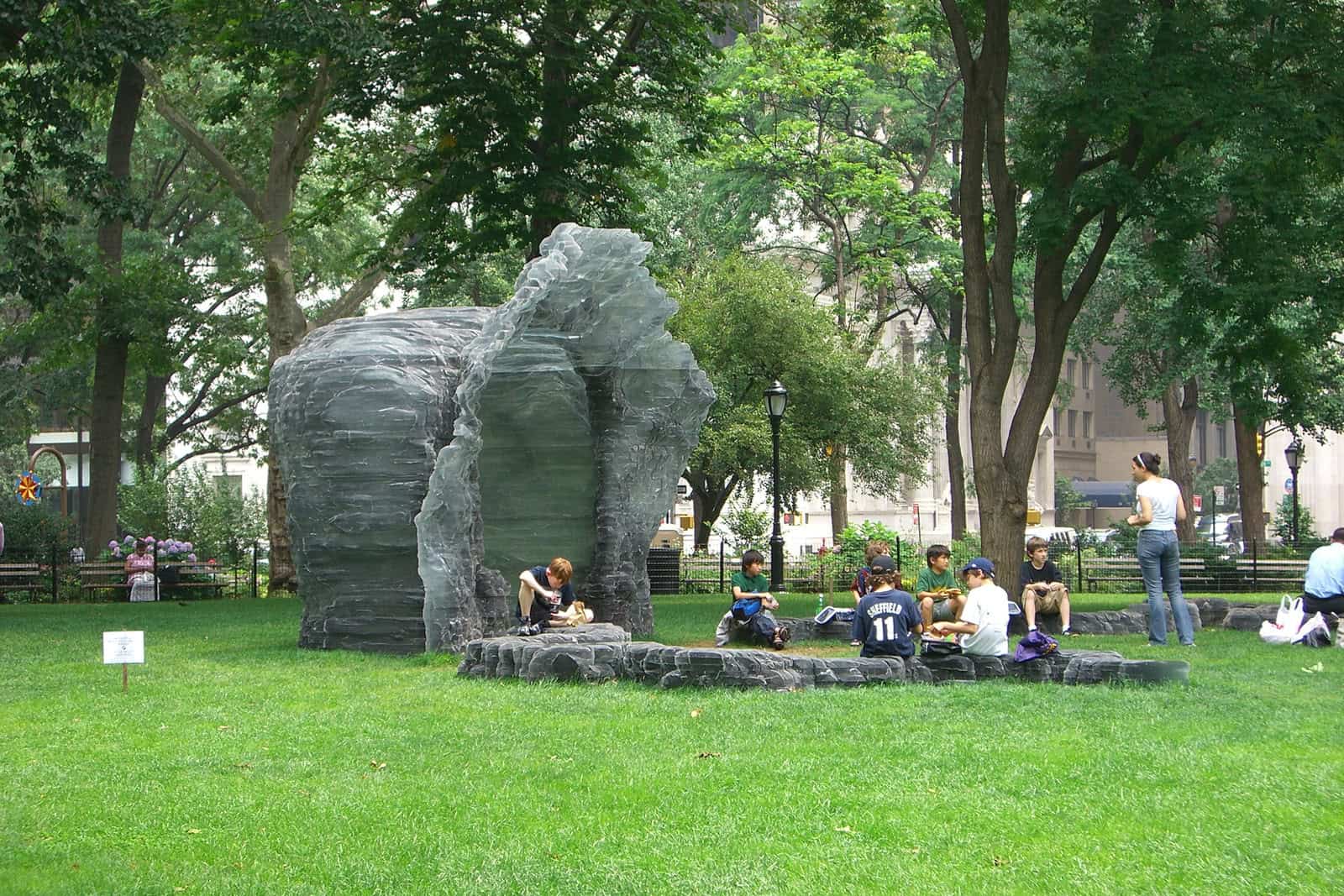
Ursula von Rydingsvard, Damski Czepek, installed in Madison Square Park, 2006. Photograph by Aaron Gustafson, via Wikimedia Commons (CC BY-SA 2.0).
The 2026 Work That Changes How the Cedar Legacy Reads
Two months before von Rydingsvard’s death, Laumeier Sculpture Park opened Begin Again: Untitled, a commission scheduled to remain on view through August 27, 2028. The park’s project record says the artist reimagined one of 45 carved cedar, tub-shaped chambers from her 1988–89 Untitled as a single bronze sculpture.
Laumeier had removed the original installation after material decomposition and limited conservation resources made continued display impossible. The 2026 work therefore does more than repeat an earlier form. It converts one element from a multipart, perishable cedar field into a durable, isolated bronze object, while its patina preserves the intricacy of the carved surface.
That late decision complicates the familiar description of von Rydingsvard as a cedar sculptor. Cedar supplied the cut, the resistance, and the memory; bronze could carry the resulting skin into public space and across a longer material life. The shift was translation, not abandonment.

Ursula von Rydingsvard in her Brooklyn studio, 1997. Photograph by Ursula von Rydingsvard via Wikimedia Commons, licensed under Creative Commons Attribution 3.0 Unported; cropped.
Eight Camps, a 1992 Full-Scale Museum Exhibition, and a 2026 Bronze Return
Childress’s confirmation establishes that von Rydingsvard died at home in Manhattan on October 27, 2026, and attributes the cause to Alzheimer’s disease. Von Rydingsvard reported eight camps to Art21 in 2007 but nine while receiving Poland’s Gloria Artis medal in 2021. Storm King’s archive fixes her first full-scale museum exhibition in 1992, while the artist’s CV separately records a longer 1992–94 association with the venue. The Bruce Museum survey ended May 10, not in January, and Laumeier’s bronze reworking of her 1988–89 installation remains on view through 2028. Galerie Lelong’s memorial does not address what will happen to her Brooklyn studio archive or any unfinished work.

Isabella studied at the University of Cape Town in South Africa and graduated with a Bachelor of Arts majoring in English Literature & Language and Psychology. Throughout her undergraduate years, she took Art History as an additional subject and absolutely loved it. Building on from her art history knowledge that began in high school, art has always been a particular area of fascination for her. From learning about artworks previously unknown to her, or sharpening her existing understanding of specific works, the ability to continue learning within this interesting sphere excites her greatly.
Her focal points of interest in art history encompass profiling specific artists and art movements, as it is these areas where she is able to really dig deep into the rich narrative of the art world. Additionally, she particularly enjoys exploring the different artistic styles of the 20th century, as well as the important impact that female artists have had on the development of art history.
Learn more about Isabella Meyer and the Art in Context Team.
Choose Art in Context as a preferred source to see more of our reporting in Google Top Stories and other Google Search experiences.
Cite this Article
Isabella, Meyer, “Ursula von Rydingsvard Dies at 84, Leaving a Cedar Legacy.” Art in Context. October 28, 2026. URL: https://artincontext.org/ursula-von-rydingsvard-dies-84/
Meyer, I. (2026, 28 October). Ursula von Rydingsvard Dies at 84, Leaving a Cedar Legacy. Art in Context. https://artincontext.org/ursula-von-rydingsvard-dies-84/
Meyer, Isabella. “Ursula von Rydingsvard Dies at 84, Leaving a Cedar Legacy.” Art in Context, October 28, 2026. https://artincontext.org/ursula-von-rydingsvard-dies-84/.


