

Tristan Tzara: Poet, Editor, and Dada Organizer

Tristan Tzara made words behave like live material: they collided onstage, scattered across posters, and traveled through magazines and letters. Best known as a driving force in Dada, he was not its lone inventor but a poet and editor who helped turn a restless Zurich circle into an international network. His later poems and political commitments reveal a career far larger than its most famous manifestos.
Who Was Tristan Tzara?
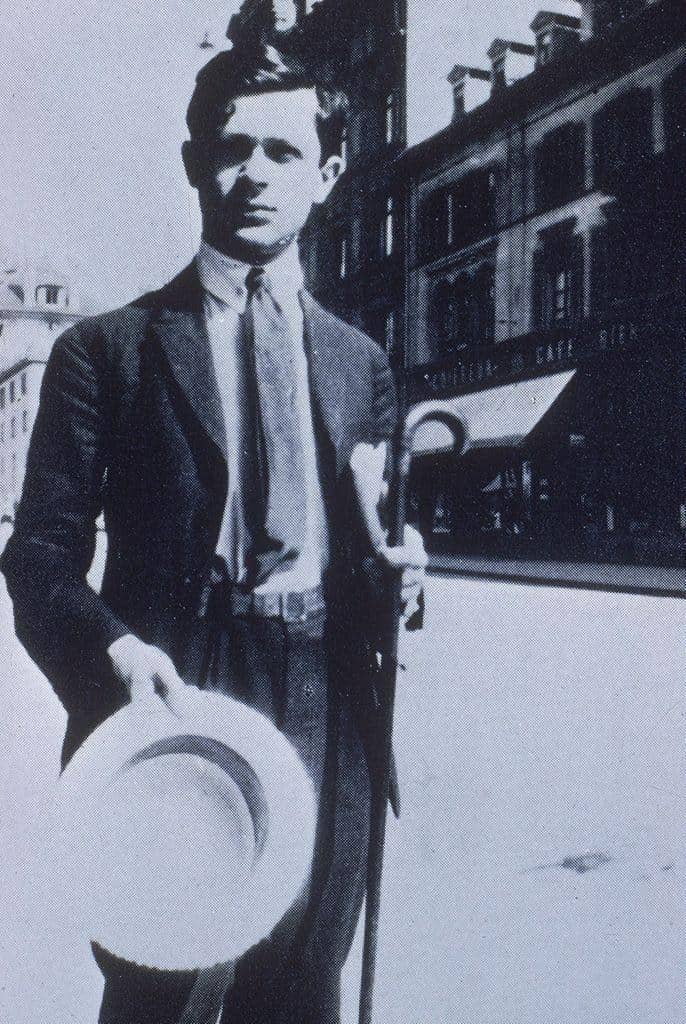
Tristan Tzara was born Samuel Rosenstock on April 16, 1896, in Moinești, Romania. He became a Romanian-born French poet, editor, performer, manifesto writer, and organizer, and died in Paris in December 1963. Although he appears frequently in histories of visual art, his principal materials were language, print, performance, and human connections.

His significance rests largely on what he made possible between people. Tzara participated in the formation of Dada in Zurich, edited publications that crossed national borders, and coordinated contributions from artists and writers who did not necessarily share a city or style. This role matters because Dada was an international network, not a uniform school founded by one person.
His career passed through several distinct phases. He began publishing with Romanian peers, joined an experimental wartime community in Zurich, carried its provocations into Paris, and later developed longer poetic forms while becoming politically active. The surviving record ranges from manifestos and correspondence to an unrealized international anthology and the Paris house designed for him and his wife, the painter Greta Knutson.
From Moinești to Zurich
Tzara’s story did not begin at Cabaret Voltaire. Before leaving Romania, he had already learned how literary work could be produced through partnership, editing, and circulation. He also studied mathematics and philosophy in Bucharest, an educational background that formed part of his early life without supplying a simple cause for the deliberate disruptions of his later writing.
Simbolul and the Move to Switzerland
In 1912, while still a teenager, Rosenstock co-founded the literary journal Simbolul with Ion Vinea and Marcel Janco. The project placed publication and collaboration at the beginning of his working life. Janco later became part of the Zurich Dada circle, so Tzara’s Romanian connections continued within his new international setting.

He adopted the name Tristan Tzara in 1915. During the First World War he settled in Zurich, where he was active in the circle around Cabaret Voltaire by 1916. The name became the public identity under which he wrote, performed, edited, and built his career.
Wartime Switzerland brought displaced artists and writers into contact. Tzara entered this community with experience as a young editor rather than as an entirely unformed newcomer. Publishing soon became as important to his Dada activity as appearing on a stage.
How Tzara Helped Build Dada in Zurich
Dada took shape collaboratively around Cabaret Voltaire in 1916. Tzara worked among figures including Hugo Ball, Emmy Hennings, Hans Arp, Marcel Janco, and Sophie Taeuber-Arp. Their activities crossed poetry, music, dance, visual experiment, publishing, and performance, making the cabaret a testing ground for forms that could interrupt ordinary expectations.

This collective origin corrects the familiar image of Tzara single-handedly inventing Dada. He was central, but centrality is not solitary authorship. His distinctive contribution was to combine public provocation with persistent editorial labor, helping the work move beyond the people who could fit inside a Zurich room.
Cabaret Voltaire as a Performance Laboratory
At Cabaret Voltaire, language could be experienced as sound, rhythm, gesture, or collision rather than merely as a carrier of meaning. Conventional divisions between a poetry reading, a concert, a dance, and an art event became unstable. The mixed program also made collaboration visible because no single medium or participant defined the whole enterprise.
The First World War formed the immediate historical background. Dada’s disorder was not random play detached from its moment. By disrupting familiar language and cultural conventions, the participants challenged inherited ideas about rational order while European institutions were producing industrialized conflict. Different Dadaists responded in different ways, however, and the movement never settled into one program.
Tzara proved especially effective at turning an event into something that could travel through reports, printed texts, and personal contacts. A performance disappeared when the evening ended; print could carry its pressure elsewhere.
DADA Magazine and the 1918 Manifesto
Tzara launched and edited the review DADA, which appeared from 1917 through 1921. Its inexpensive, rapidly produced, multilingual character made the magazine an instrument of exchange. Instead of waiting for museums or established literary institutions to validate the group, the review reproduced writing and images, announced positions, and connected participants across borders.
His Manifest Dada appeared in the journal’s third issue in December 1918. It reached readers as part of a designed periodical alongside other texts and images, giving the manifesto both a visual setting and a collective platform.
Early books such as La première aventure céleste de Mr. Antipyrine and Vingt-cinq poèmes show that Tzara’s Dada activity extended beyond slogans. His relationships with Cubist artists and the network’s use of collage also connected these publications to contemporary visual practice.
Within the broader history of early 20th-century modern art, Tzara’s magazines demonstrate how circulation could build a movement. Speed, mixed languages, varied contributors, and graphic interruptions made the publication perform Dada on paper.
Paris Dada, Dadaglobe, and the Break with Breton
After the First World War, Tzara transferred much of his activity to Paris. There he joined writers and artists who brought Dada into a different public arena through readings, staged events, publications, and provocations. The shift expanded his audience but also exposed disagreements over leadership, direction, and what should follow Dada.
Paris Performances and The Gas Heart
Paris Dada events used interruption and confrontation as artistic devices. Tzara’s play The Gas Heart assigns its dialogue to characters named Eye, Mouth, Nose, Ear, Neck, and Eyebrow. These speaking body parts replace the rounded personalities and clear motives expected in conventional theater.
The result is easy to recognize but difficult to settle into. Familiar parts of a face and body speak, yet they do not combine into one reliable person or a smoothly developing plot. Speech circles, jars, and resists ordinary conversation, leaving performers and spectators without the guidance that character psychology usually provides.
This theatrical experiment made spectatorship unstable, but the disturbances around Paris Dada should not replace the work itself. At the same time, Tzara was writing, editing, corresponding, and attempting an unusually ambitious international publishing project.
Dadaglobe as an International Network
Dadaglobe provides a measurable view of Tzara’s organizational reach. In 1920 and 1921, he invited approximately 50 artists in 10 countries to contribute to a planned anthology. His four requested categories were photographic self-portraits, photographs of artworks, original drawings, and layouts for book pages.
Those categories encouraged contributors to work across portraiture, documentation, drawing, collage, and page design while preparing material that could be reproduced in a book. Tzara supplied a common framework without requiring every participant to adopt the same style.
Financial and organizational difficulties prevented the anthology from appearing. Its surviving submissions and correspondence nevertheless document an international network assembled through the mail, with Tzara coordinating artists separated by national borders and local Dada circles.
Dadaglobe also clarifies the nature of his authorship. He did not need to make every item himself to shape the project. Selecting categories, framing requests, maintaining correspondence, and planning the arrangement of contributions made organization part of the creative work.
The 1923 Break
Tensions with André Breton’s circle became public in July 1923, when a performance of The Gas Heart was disrupted. The episode marked an artistic and organizational rupture, not simply a personal quarrel. Dada’s refusal of stable authority had become increasingly difficult to reconcile with attempts to establish a new collective direction in Paris.
Tzara gathered his Dada-era statements in Seven Dada Manifestos in 1924. The collection preserved arguments and performances that had first emerged in particular journals and public situations. His separation from Breton was not permanent, but it closed the most concentrated phase of Paris Dada.
What Tzara’s Work Looks and Sounds Like
Tzara’s work often asks the reader to do more than decode sentences. Scale, spacing, sequence, vocal rhythm, and the physical source of words affect how meaning arrives. A useful recognition method is to ask three questions: Where does the eye go first? What interrupts the expected order? How does the work reveal the way it was constructed?
Close Reading the 1921 Salon Dada Poster
Tzara’s Poster for the Exhibition Salon Dada: Exposition Internationale, Galerie Montaigne, Paris is a 1921 lithograph measuring 121 by 80.2 centimeters. A lithograph is a print produced from a prepared flat surface. This poster’s large size gives its typography a physical presence suited to a street or exhibition entrance rather than the intimate scale of a book page.
The design refuses a single calm route through the information. Words change size abruptly, lines tilt, and pieces of event information compete for attention. Some lettering announces itself at a distance while smaller elements require closer inspection. The eye jumps between verbal fragments instead of moving through a stable top-to-bottom hierarchy.
A poster must communicate, yet this one makes communication feel unsettled. Names, location details, and promotional language remain recognizable, but their scattered arrangement turns reading into an event. The typography enacts disruption while still performing the practical job of an announcement.
Readers can recognize this aspect of Tzara’s print practice by looking for competing scales, abrupt directional shifts, fragments of ordinary information, and tension between a page’s practical purpose and its refusal of orderly delivery.
Chance Poetry and Fractured Language
In a procedure published in 1920, Tzara instructed readers to choose a newspaper article, cut out its individual words, place them in a bag, shake it, and remove the slips one after another. The words were then copied in the order in which they emerged. Tzara still chose the source and set the rules, but chance determined the sequence.
The method has affinities with art made from pre-existing material. The source already exists, but selection and a new context alter how it is encountered. In Tzara’s procedure, ordinary newspaper language becomes the found material.
This recipe does not explain all his poetry. It was one provocative Dada method within a much broader writing career. Even this chance-based process involved decisions about the source article, the length of the text, its presentation, and the setting in which the resulting poem was read.
From Seven Dada Manifestos to The Approximate Man
The manifestos contradict themselves, change direction abruptly, and turn declaration into performance. Rather than laying out a stable doctrine, they repeatedly unsettle the authority that a manifesto normally claims. Collected in 1924, they retain the pressure of speech addressed to a crowd.
The Approximate Man, published in 1931, works on a larger scale. Its traveler searches for knowledge and a language capable of approaching an incomplete world, while clusters of sharply different images keep that search unsettled. Instead of delivering one quick Dada shock, the poem sustains uncertainty across an extended structure.
The development was not a simple move from nonsense to sense. Tzara carried fragmentation into a longer form, where changing images could accumulate, recur, and modify one another. The reader experiences uncertainty as an ongoing condition rather than as the punch line of a brief provocation.
Surrealism, Politics, and the Later Poems
Tzara’s biography did not stop with the collapse of Paris Dada. The following decades brought renewed artistic alliances, anti-fascist activity, wartime danger, and poetry that cannot be reduced to the techniques of his earlier manifestos.
A Return to the Surrealist Circle
Tzara reconciled with the Surrealist circle in 1929. The reunion placed him near a movement that had developed out of, but was not identical to, Dada. Surrealism pursued its own approaches to imagination, politics, and automatic writing, a method intended to let words proceed with as little deliberate planning as possible.
Rejoining the circle did not erase the 1923 rupture or reduce Tzara’s earlier work to a preliminary stage. His publication of The Approximate Man in 1931 shows a poetic development that crossed group boundaries while remaining recognizably his own.
Spain, Resistance, and Speaking Alone
During the 1930s, Tzara worked closely with Communist cultural organizations and supported the Republican cause in the Spanish Civil War. During the Nazi occupation of France, he left Paris, lived under a false identity, and participated in the literary Resistance. He formally joined the French Communist Party in 1947, after years of political cooperation with the French left.
Also in 1947, a Sorbonne address marked his renewed distance from Surrealism. Tzara used the occasion to defend Dada’s historical place and criticize what Surrealism had become, bringing his disagreement with Breton back into public view.
Tzara wrote Speaking Alone during a 1945 stay at the Saint-Alban psychiatric hospital, and the book appeared in 1950 with illustrations by Joan Miró. Its linked images of bodily strain, sand, a doll-like past, and the arrival of spring gather around a vulnerable human figure. The images remain surprising, but they sustain an emotional situation rather than functioning as isolated verbal explosions.
The poem therefore reveals both continuity and change. Tzara kept the abrupt image-making of his earlier work while using it to approach war, injury, solitude, and endurance. The reader follows a voice trying to remain human within damaged surroundings.
Collections, Collaborations, and Legacy
Tzara’s contribution survives in more than frequently quoted manifesto lines. A house, an extensive archive, dispersed publications, and the recovered components of Dadaglobe reveal how his private, editorial, and public activities intersected.
The Adolf Loos House as a Documented Collaboration
In 1926, architect Adolf Loos designed a house at 15 avenue Junot in Paris for Tzara and Greta Knutson. The building connects Tzara to modern architecture through a specific commission and client relationship.

The French heritage record identifies Loos as the architect and Tzara and Knutson as the clients. The facades and roof received historic-monument protection in 1975. As a surviving place, the house grounds Tzara’s Paris life in the physical city and documents a collaboration between a literary figure, a painter, and an architect.
Archives, Collections, and Dadaglobe Reconstructed
The Fonds Tristan Tzara preserves correspondence, manuscripts, photographs, and printed materials spanning his career. These holdings reveal the maintenance of contacts, the development of texts, and the practical labor behind exhibitions and magazines.
In 2016, the Museum of Modern Art reconstructed Dadaglobe in an exhibition that reunited more than 100 works connected to the unrealized anthology. Seen together, the photographs, drawings, photomontages, collages, and page designs made the original project’s range visible.
Tzara’s lasting contribution lies in the connections he formed among poetry, typography, performance, inexpensive print, correspondence, and collective organization. When looking at a Dada page or event, it is therefore useful to ask not only what the loudest phrase says, but also who assembled the contributors, how the material traveled, and what network made the apparent disorder possible.
Frequently Asked Questions
These concise answers clarify Tzara’s role in Dada, identify representative works, and explain two frequently misunderstood parts of his practice and career.
Was Tristan Tzara the Founder of Dada?
Tzara was a central participant in Dada’s formation and one of its most active promoters, but he did not found it alone. Dada emerged collaboratively in Zurich around figures including Hugo Ball, Emmy Hennings, Hans Arp, Marcel Janco, Sophie Taeuber-Arp, and Tzara.
What Are Tristan Tzara’s Most Important Works?
Representative works include Vingt-cinq poèmes, the 1918 Manifest Dada, the play The Gas Heart, the 1924 collection Seven Dada Manifestos, the long poem The Approximate Man from 1931, and Speaking Alone from 1950. DADA magazine and the unrealized Dadaglobe are equally important for understanding his editorial work.
How Did Tzara Make a Dada Poem?
One procedure he published involved cutting the words from a newspaper article, putting them in a bag, and drawing them one by one. He copied the words in the order in which they emerged, allowing chance to disrupt habitual composition. It was only one method within his much broader writing career.
Why Did Tzara and André Breton Split?
Their break reflected competing artistic and organizational directions within the Paris avant-garde. It became public during the disrupted July 1923 performance of The Gas Heart. They reconciled in 1929, but Tzara again distanced himself from Surrealism during the 1930s and criticized it publicly after the Second World War.

Isabella studied at the University of Cape Town in South Africa and graduated with a Bachelor of Arts majoring in English Literature & Language and Psychology. Throughout her undergraduate years, she took Art History as an additional subject and absolutely loved it. Building on from her art history knowledge that began in high school, art has always been a particular area of fascination for her. From learning about artworks previously unknown to her, or sharpening her existing understanding of specific works, the ability to continue learning within this interesting sphere excites her greatly.
Her focal points of interest in art history encompass profiling specific artists and art movements, as it is these areas where she is able to really dig deep into the rich narrative of the art world. Additionally, she particularly enjoys exploring the different artistic styles of the 20th century, as well as the important impact that female artists have had on the development of art history.
Learn more about Isabella Meyer and the Art in Context Team.
Cite this Article
Isabella, Meyer, “Tristan Tzara: Poet, Editor, and Dada Organizer.” Art in Context. November 4, 2026. URL: https://artincontext.org/tristan-tzara/
Meyer, I. (2026, 4 November). Tristan Tzara: Poet, Editor, and Dada Organizer. Art in Context. https://artincontext.org/tristan-tzara/
Meyer, Isabella. “Tristan Tzara: Poet, Editor, and Dada Organizer.” Art in Context, November 4, 2026. https://artincontext.org/tristan-tzara/.


