


£300 Marble Attributed to Pietro Bracci Heads to Auction

Woolley & Wallis has attributed a weathered marble figure bought for £300 to Pietro Bracci, cataloguing it as the only surviving maquette for a bronze Pope Clement XII destroyed in 1798. The claimed match could restore three-dimensional evidence for a lost Roman monument, but the public case currently rests on auction-house cataloguing rather than an announced independent scholarly consensus.
The £300 Find and the October 8 Sale
Artnet News reported on September 30 that a collector paid £300 for the marble at a salvage yard in Wiltshire, England, before taking it to Woolley & Wallis. That is the report’s publication date; neither it nor the sale catalogue gives a date for the original purchase.
The auction house’s Fine Furniture & Collections catalogue identifies the object as lot 470, dates it to approximately 1733, and assigns it to Bracci. It is scheduled for October 8 with an estimate of £5,000 to £10,000.
The marble measures 68 by 42 by 41.5 centimeters, or about 27 inches high. Clement XII is enthroned in a decorated cope, while winged cherubs and scrolls animate the architectural chair. The catalogue describes the surface as weathered and records the inscription “P. Bracci, Rom. F.” on the right side.
As a small freestanding sculpture, it preserves the pope’s whole seated pose rather than only his head and shoulders. That makes the proposed connection to a lost monumental statue more consequential than the leap from a £300 purchase to a five-figure estimate suggests: the object may retain spatial information that an engraving flattens.

Four Pieces of Evidence Behind the Pietro Bracci Claim
The auction house’s case becomes clearer when the marble is separated from three documented comparators. A Treccani biography of Bracci establishes the chronology of the two monumental Clement XII commissions, independently of the newly offered object.
| Evidence | What it establishes |
|---|---|
| The marble | The catalogue records a signed, weathered figure measuring 68 centimeters and dates it to about 1733. Its date and authorship remain the auction house’s attribution. |
| The lost bronze | A life-size model by Bracci was already in place in the Campidoglio by May 20, 1735. Francesco Giardoni completed a successful casting on August 15, 1739; the monument was destroyed in 1798. |
| The Pozzi prints | A Treccani biography of Giardoni records prints in Dresden and Rome showing the model. They anchor the lost composition but do not authenticate the marble. |
| The Ravenna statue | Bracci’s diary records that he began a separate marble Clement XII in 1733 and sent it to Ravenna in 1738. It survives as a documented comparator, not as proof of the new attribution. |
The bronze first stood in the Great Hall of Palazzo Nuovo and was later transferred to the Hall of the Horatii and Curiatii in the Palazzo dei Conservatori, according to the sale catalogue. The Capitoline Museums’ permanent record confirms that Palazzo Nuovo opened to the public under Clement XII in 1734, after his purchase of the 418-sculpture Albani collection the previous year. Artnet calls it the world’s first public art museum; the museum record establishes the dates and collection but does not adjudicate that global superlative.
The chronology is suggestive, not conclusive. If the catalogue’s circa-1733 date is correct, the marble predates Bracci’s documented work on the Campidoglio model in 1736 and could have informed it. But that date and the proposed function are components of the same attribution, so one cannot independently prove the other.
The visual relationship nevertheless explains why the claim matters. The enthroned figure, densely worked vestments, cherubs, and architectural seat translate papal authority into the animated surfaces associated with Baroque art. A three-dimensional model could reveal how Bracci organized those masses before Giardoni converted the design into bronze.
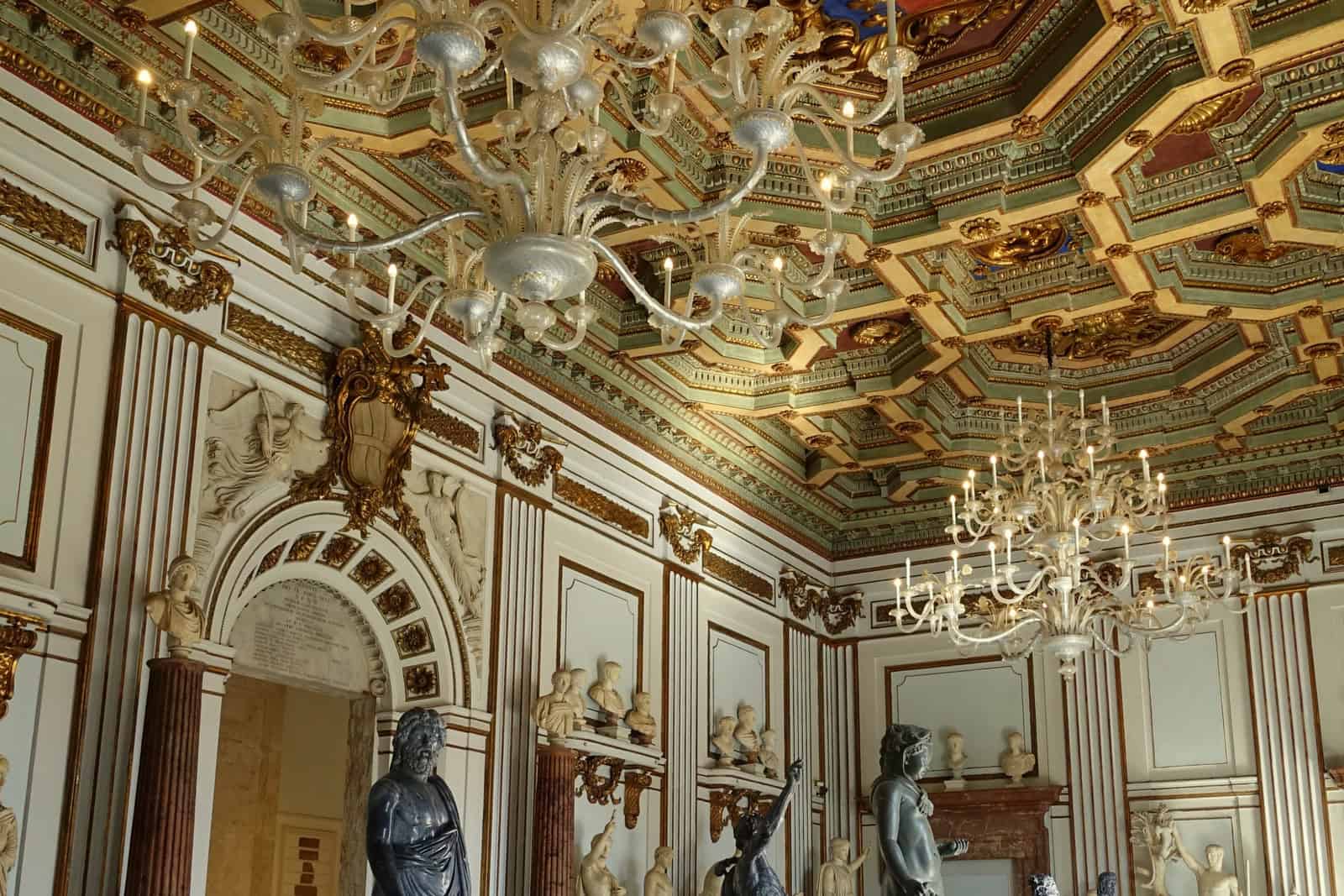
The Salone of Palazzo Nuovo, where the lost Clement XII bronze was first installed. Photograph by Daderot via Wikimedia Commons, CC0 1.0 Universal Public Domain Dedication.
Why the Attribution Is Not Yet a Consensus
Woolley & Wallis catalogues the marble as “by Pietro Bracci,” rather than merely “attributed to” him. That determination belongs to the auction house until a museum, an independent Bracci specialist, or a scholarly publication publicly endorses it. The Artnet report repeats the auction specialists’ conclusion; it is not a second authentication.
The carved signature is important physical evidence, but a signature is not self-authenticating. The published evidence does not establish when or by whom it was cut, whether the marble and tooling fit the proposed date, or whether the carving corresponds to Bracci’s documented practice rather than a later copy derived from the print or another version.
The published catalogue does not provide an ownership history predating the salvage-yard account, identify an outside scholar who examined the marble, or disclose petrographic, isotopic, or tool-mark analysis. Those omissions do not make the attribution false. The Daily Mail, quoting Woolley & Wallis specialist Mark Yuan Richards, reports that the marble came from a country house near Andover and had been outdoors for perhaps 50 years, but its earlier history remains unknown.
A related Clement XII bust demonstrates why that distinction matters. The Galleria Borghese now catalogues its marble portrait as the work of an unknown Roman sculptor, explaining that earlier scholars had assigned it to Bracci through comparison but that recent criticism questioned the attribution. The bust is not evidence against the auction marble; it shows that Bracci attributions can change when documentation and stylistic judgments are reconsidered.
The phrase “only surviving maquette” also remains an auction-house claim. Treccani’s established record supports the historical framework: the bronze was destroyed and was previously known through prints. The public lot entry does not document a broader scholarly survey establishing the newly found marble’s uniqueness.

The documented Clement XII statue at the National Museum of Ravenna. Photograph by José Luiz Bernardes Ribeiro via Wikimedia Commons, licensed under CC BY-SA 4.0.
What Is Established Before the Sale
The evidence supports five firm findings while leaving the central attribution open to further scrutiny.
- Woolley & Wallis has catalogued the signed, 68-centimeter marble as a circa-1733 work by Pietro Bracci and estimated it at £5,000 to £10,000.
- Treccani independently documents Bracci’s 1736 model, Giardoni’s successful 1739 casting, the surviving prints, and the bronze’s destruction in 1798.
- The Capitoline Museums’ own record confirms the Clement XII-era transformation of Palazzo Nuovo, giving the lost monument a specific institutional setting.
- No publicly identified outside specialist, technical examination, or pre-salvage provenance currently provides independent authentication of the marble.
- The attribution, the claim of uniqueness, and the object’s market reception remain unresolved before lot 470 is offered on October 8.

Isabella studied at the University of Cape Town in South Africa and graduated with a Bachelor of Arts majoring in English Literature & Language and Psychology. Throughout her undergraduate years, she took Art History as an additional subject and absolutely loved it. Building on from her art history knowledge that began in high school, art has always been a particular area of fascination for her. From learning about artworks previously unknown to her, or sharpening her existing understanding of specific works, the ability to continue learning within this interesting sphere excites her greatly.
Her focal points of interest in art history encompass profiling specific artists and art movements, as it is these areas where she is able to really dig deep into the rich narrative of the art world. Additionally, she particularly enjoys exploring the different artistic styles of the 20th century, as well as the important impact that female artists have had on the development of art history.
Learn more about Isabella Meyer and the Art in Context Team.
Choose Art in Context as a preferred source to see more of our reporting in Google Top Stories and other Google Search experiences.
Cite this Article
Isabella, Meyer, “£300 Marble Attributed to Pietro Bracci Heads to Auction.” Art in Context. October 1, 2026. URL: https://artincontext.org/pietro-bracci-marble-maquette-clement-xii-auction/
Meyer, I. (2026, 1 October). £300 Marble Attributed to Pietro Bracci Heads to Auction. Art in Context. https://artincontext.org/pietro-bracci-marble-maquette-clement-xii-auction/
Meyer, Isabella. “£300 Marble Attributed to Pietro Bracci Heads to Auction.” Art in Context, October 1, 2026. https://artincontext.org/pietro-bracci-marble-maquette-clement-xii-auction/.


