

Peter Max Dies at 88: What His Visual Record Shows

Peter Max, the Berlin-born American artist whose cosmic figures and high-voltage colors moved from 1960s posters onto stamps, airplanes, and household goods, died on September 14, 2026, at age 88. His legacy is best understood not as a choice between fine art and commerce, but as a career built by making that boundary unusually difficult to police.
Peter Max Died on September 14, Not September 16
The Associated Press reported Max’s death on September 16 after receiving a written statement from his son, Adam Max. The statement said the artist had died two days earlier, on Monday, September 14. No cause was disclosed. Reports noted that Max had lived with advanced dementia, but that diagnosis should not be substituted for an announced cause of death.
The date needs care because at least one early account got it wrong. The Washington Post initially relied on a gallery statement and reported September 16, then corrected the obituary to September 14. The Art Newspaper’s obituary was published on September 18; that was the report’s publication date, four days after the event.
Born Peter Max Finkelstein to a Jewish family in Berlin in 1937, Max left Nazi Germany as an infant, grew up partly in Shanghai, and reached New York in 1953 after periods in Israel and Paris. That longer life story is covered in Art in Context’s Peter Max biography. For the present reckoning, the crucial point is that he entered American culture through graphic design in the early 1960s, before he became widely known as a painter.
What Museums Actually Hold
Max is commonly placed where Pop art meets psychedelic art. Both labels fit, but they can conceal the medium that first made him consequential: the reproducible graphic image.
The Museum of Modern Art lists seven Max works online, all dated 1966 or 1967. Its individual records place examples including #12 Captain Midnight, The Visionaries at the East Hampton Gallery, and Penney’s Rainbow Lane in the Architecture and Design department, identifying them as offset lithographs or photolithographs. The sampled works are not on view. MoMA’s record is therefore neither evidence that museums ignored Max nor a miniature survey of his later painting; it is a concentrated institutional record of his early graphic design.
Max’s official studio chronology says he stepped back from public life in the early 1970s and shifted from line work colored on the printing press toward acrylic painting with large brushes. That distinction matters. The later, broad-brush Statues of Liberty and celebrity portraits were not simply more posters, even though reproductions and variations kept them circulating like graphic brands.
| Record | What it establishes |
|---|---|
| Museum holdings | MoMA’s online Max group centers on 1966–67 graphic design. |
| Painting | The studio dates his broad-brush acrylic turn to the early 1970s. |
| Public commissions | Stamps, border murals, event art, an airplane, and a ship carried his imagery. |
| Licensing | Clocks, clothing, bedding, and other goods made style recognition nearly automatic. |
This record explains why Max’s popular reach and art-establishment standing never aligned neatly. He was present in museums, but a major institutional foothold treated his breakthrough as design. Much of his later painting reached buyers through commercial galleries and licensed editions. That is a history of medium and distribution, not by itself a verdict on quality.

Peter Max’s Cosmic Runner design on the 1974 U.S. Postal Service “Preserve the Environment” stamp for Expo ’74. United States Postal Service, hosted by Wikimedia Commons, marked public domain; cropped.
From Posters to Products and Public Surfaces
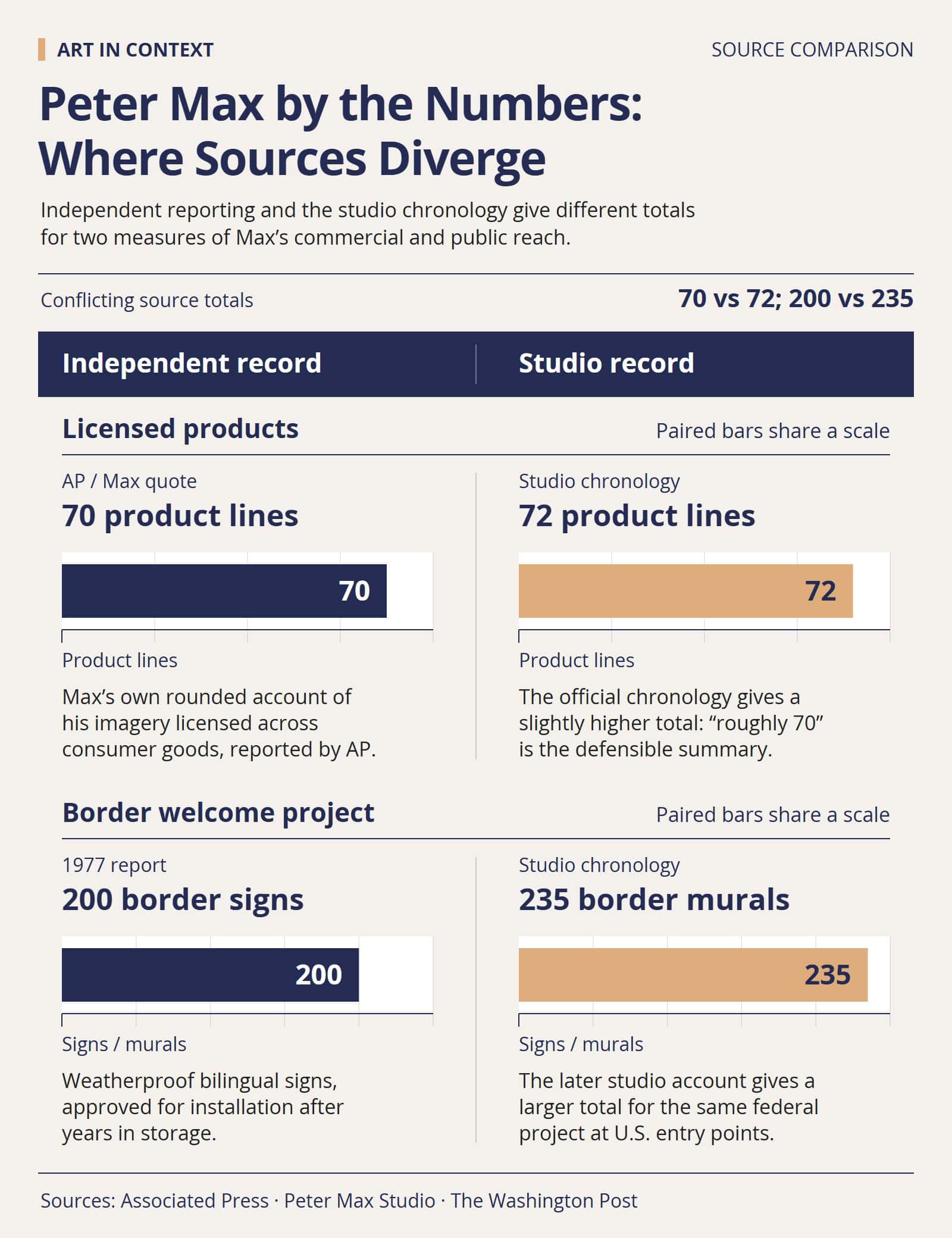
Scale arrived through multiplication. The official studio timeline says General Electric commissioned Max to make art clocks and that his imagery eventually covered 72 product lines. AP, quoting Max, gives the round figure of 70. The sources are close but not identical, so “roughly 70 product lines” is the defensible formulation.
A 1974 federal commission shows that mass circulation could also carry a civic message. The Henry Ford’s object record identifies Max as the designer of an advertising poster for the U.S. Postal Service’s “Preserve the Environment” Expo ’74 stamp, printed by the Bureau of Engraving and Printing.
The border murals require another qualification. Max’s studio chronology says the General Services Administration requested 235 “Welcome to America” murals. A contemporary Washington Post report from 1977 described 200 weatherproof bilingual signs, costing $300,000, that had been stored after objections from U.S. Customs and were then approved for installation. Because the contemporary account and later studio history disagree, an exact total should not be presented as settled. What is established is that a federal welcome project turned Max’s psychedelic vocabulary into infrastructure at U.S. entry points.
The same logic later expanded to Continental Airlines’ NYC 2000 Boeing 777 and Norwegian Cruise Line’s Breakaway. These were not easel paintings enlarged by accident. They were commissioned public surfaces designed for visibility at corporate scale.
Max’s commercialism did not merely distribute his art after it was made; distribution was one of the places where his art happened.

Continental Airlines’ Peter Max-liveried Boeing 777 at Paris Charles de Gaulle Airport. Photograph by Aero Icarus, hosted by Wikimedia Commons, licensed under CC BY-SA 2.0; cropped.
Peter Max Did Not Receive the Yellow Submarine Art Credit
The most persistent authorship confusion concerns the Beatles’ Yellow Submarine. The band’s official production record names George Dunning as director and Heinz Edelmann as art director, noting that more than 200 artists and animators worked under the film’s production. Edelmann is the documented art-direction credit.
AP reported that Max at times claimed an original design role, while his longtime dealer described his involvement more narrowly as early consulting. Neither version displaces Edelmann’s official credit. The production record also cannot, by itself, settle whether informal conversations occurred before production. The responsible conclusion is narrower: attributing the film’s art direction or finished visual design to Max is wrong; a preliminary advisory role remains a claim rather than a documented production credit.
The confusion nevertheless says something real about Max’s reach. His celestial figures, rainbow bands, flowers, and elastic profiles became so familiar that “Peter Max” often functioned as a generic label for late-1960s psychedelia. Resemblance is evidence of visual recognition, not evidence of authorship.
What Peter Max’s Record Now Shows
Peter Max died on September 14, 2026; his family’s announcement did not specify a cause, while longtime spokesman Michael Pagnotta said he died after a long battle with Alzheimer’s disease. MoMA’s online records establish that its seven listed Max works are 1966–67 graphic designs; they do not describe his broader museum history. The best-supported product-line figure is roughly 70, while surviving sources disagree on whether the federal border project comprised 200 or 235 murals. The official Yellow Submarine credit belongs to Heinz Edelmann, and any informal early role claimed for Max remains separate from that documented fact. Max’s defining achievement was to make a visual language travel across prints, paintings, commodities, and public commissions without losing its identity.

Isabella studied at the University of Cape Town in South Africa and graduated with a Bachelor of Arts majoring in English Literature & Language and Psychology. Throughout her undergraduate years, she took Art History as an additional subject and absolutely loved it. Building on from her art history knowledge that began in high school, art has always been a particular area of fascination for her. From learning about artworks previously unknown to her, or sharpening her existing understanding of specific works, the ability to continue learning within this interesting sphere excites her greatly.
Her focal points of interest in art history encompass profiling specific artists and art movements, as it is these areas where she is able to really dig deep into the rich narrative of the art world. Additionally, she particularly enjoys exploring the different artistic styles of the 20th century, as well as the important impact that female artists have had on the development of art history.
Learn more about Isabella Meyer and the Art in Context Team.
Choose Art in Context as a preferred source to see more of our reporting in Google Top Stories and other Google Search experiences.
Cite this Article
Isabella, Meyer, “Peter Max Dies at 88: What His Visual Record Shows.” Art in Context. September 19, 2026. URL: https://artincontext.org/peter-max-dies-88-visual-legacy/
Meyer, I. (2026, 19 September). Peter Max Dies at 88: What His Visual Record Shows. Art in Context. https://artincontext.org/peter-max-dies-88-visual-legacy/
Meyer, Isabella. “Peter Max Dies at 88: What His Visual Record Shows.” Art in Context, September 19, 2026. https://artincontext.org/peter-max-dies-88-visual-legacy/.


