
Persian Art – A History of Ancient Persian Paintings and Iranian Art

Persian art—more broadly Iranian art—spans ancient empires, Islamic courts, regional workshops, and living craft traditions. Its architecture, rock reliefs, metalwork, ceramics, manuscripts, calligraphy, painting, and carpets developed through exchange across Central Asia, Mesopotamia, the Mediterranean, South Asia, and China while sustaining distinctly Iranian languages of kingship, poetry, ornament, and place.
A History of Persian Art
“Persian art” can refer specifically to traditions associated with Persian language and culture or more broadly to art made in the Iranian world. “Iranian art” is often the clearer geographic term, especially for periods and communities that cannot be reduced to one ethnicity or language. The names overlap, but neither describes a single unchanging style.
Persia is the historical Greek-derived name associated with Parsa, a region in southwestern Iran. In 1935, Iran requested that foreign governments use the country’s own name in official correspondence; this did not begin Iranian history or make “Persian” obsolete. Today, Persian remains appropriate for the Persian language and many cultural traditions, while Iran identifies the modern state and a wider historical landscape.
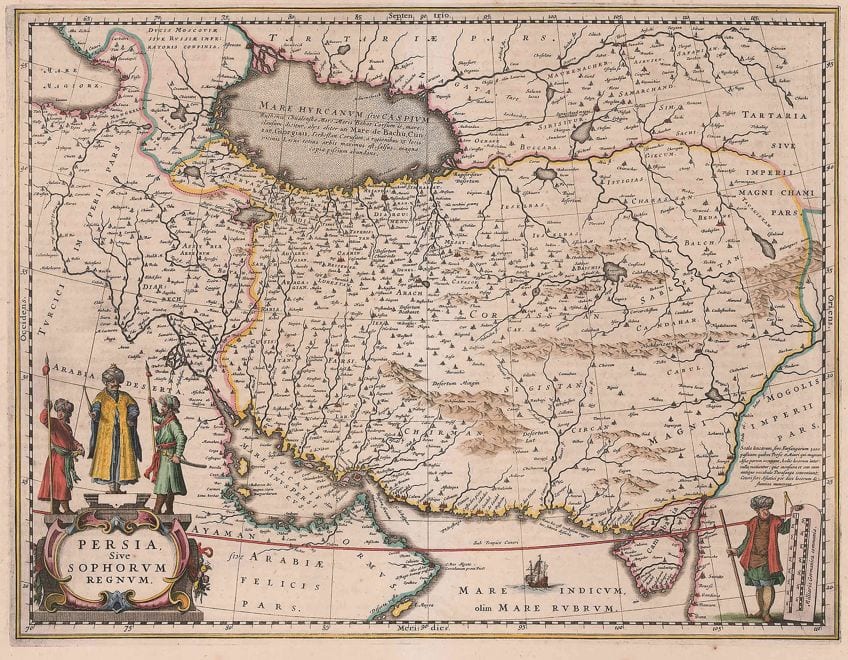
Ancient Iranian art long predates the Achaemenid Empire. Painted pottery, metalwork, seals, architecture, and sculpture survive from prehistoric and Bronze Age communities across the plateau. Later imperial periods connected an immense territory without erasing local traditions. Achaemenid, Seleucid, Parthian, and Sasanian workshops drew on many sources, but their art should not be described as passive borrowing.
| Period | Approximate Dates | Key Art-Historical Focus |
|---|---|---|
| Achaemenid | c. 550–330 BCE | Palaces, relief, glazed brick, luxury metalwork, imperial imagery |
| Parthian | 247 BCE–224 CE | Regional diversity, frontality, temples, sculpture, long-distance exchange |
| Sasanian | 224–651 CE | Rock reliefs, domed halls, stucco, silver, courtly hunting imagery |
| Islamic Iran | Seventh century onward | Architecture, ceramics, metalwork, calligraphy, books, textiles, painting |
The Arab-Muslim conquest ended Sasanian imperial rule in the seventh century, but it did not erase Iranian culture. Persian language and literary traditions re-emerged powerfully within Islamic societies. Iranian artists and patrons helped shape architecture, books, ceramics, metalwork, and textiles across a connected Islamic world.
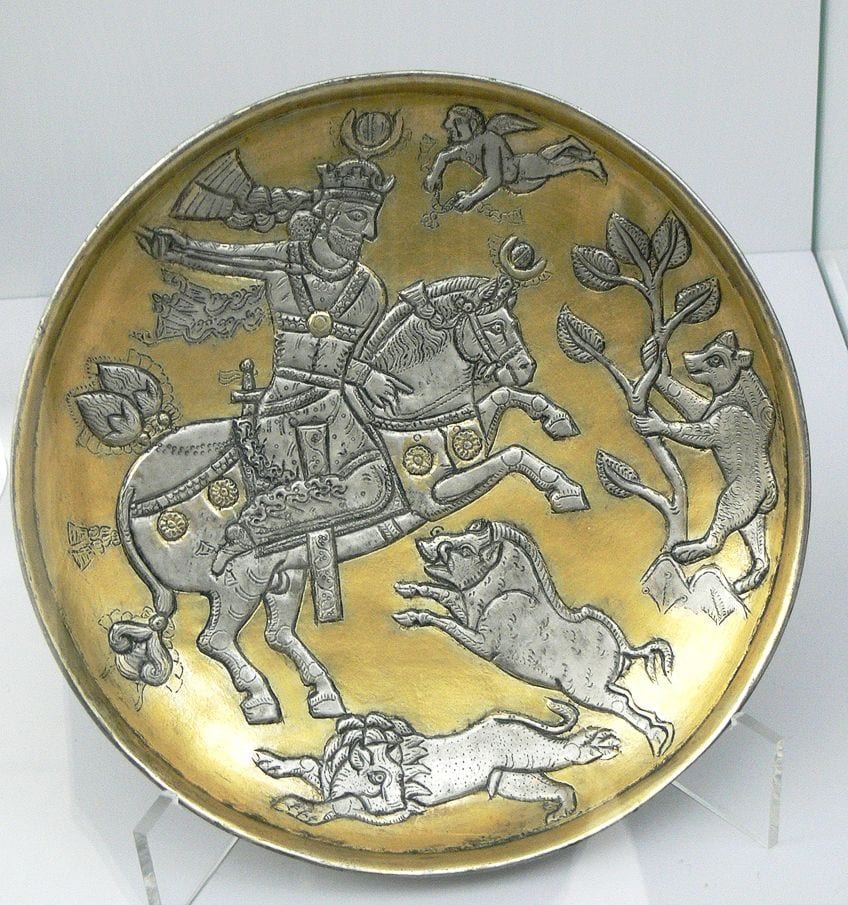
The gilded silver hunting vessel shown above belongs to a major Sasanian courtly tradition. Royal hunters defeat lions, boars, or other animals in carefully staged compositions. Such images projected courage, order, and legitimate kingship and circulated widely through diplomatic gifts, trade, and imitation.
Early Persian Art
The three imperial periods below offer a practical framework, not a complete history. Each governed territories with multiple peoples, languages, and workshops, and each interacted with neighboring powers.
Achaemenid Era (c. 550–330 BCE)
Cyrus II founded the Achaemenid Empire in the mid-sixth century BCE. Under Darius I and Xerxes I, royal centers at Susa and Persepolis brought together materials, labor, and visual traditions from across the empire. Egyptian, Mesopotamian, Anatolian, Greek, and Iranian elements were reorganized into a controlled court style.
At Susa, molded glazed siliceous bricks formed processions of archers and animals. The Louvre dates its Archers Frieze to the reign of Darius I and identifies it as part of the palace’s Apadana. Repeated figures, patterned garments, and brilliant surfaces made disciplined service to the king visible.
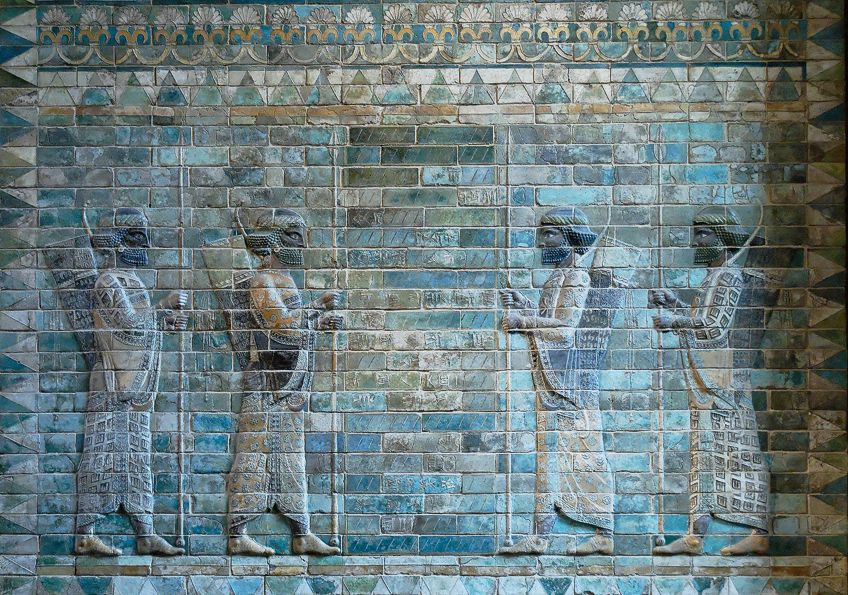
Persepolis was begun by Darius I around 518 BCE and expanded by successors. Reliefs on its stairways show delegations from across the empire bearing gifts. Although difference is carefully signaled in clothing, hairstyles, and offerings, the figures participate in an ordered ceremonial whole. The imagery does not document everyday provincial life; it constructs an ideal imperial audience.
Luxury objects carried similar ideas at intimate scale. Gold and silver vessels, jewelry, seals, weapon fittings, and animal-shaped rhyta show expert metalworking and a court culture connected across vast distances.
Parthian Era (247 BCE–224 CE)
After Alexander’s conquest, Seleucid rule was gradually displaced by the Arsacid Parthians. The Parthian Empire controlled shifting territories between Rome and Central Asia. Its art is highly regional: Hellenistic naturalism, Mesopotamian religious traditions, Achaemenid memory, and nomadic Iranian forms could coexist.
Direct, frontal presentation became prominent in sculpture and painting at sites such as Hatra, Dura-Europos, and Palmyra, although these places had distinct local identities and should not be treated as one uniform “Parthian style.” Frontality can intensify a figure’s encounter with the viewer and signal ritual or social presence.
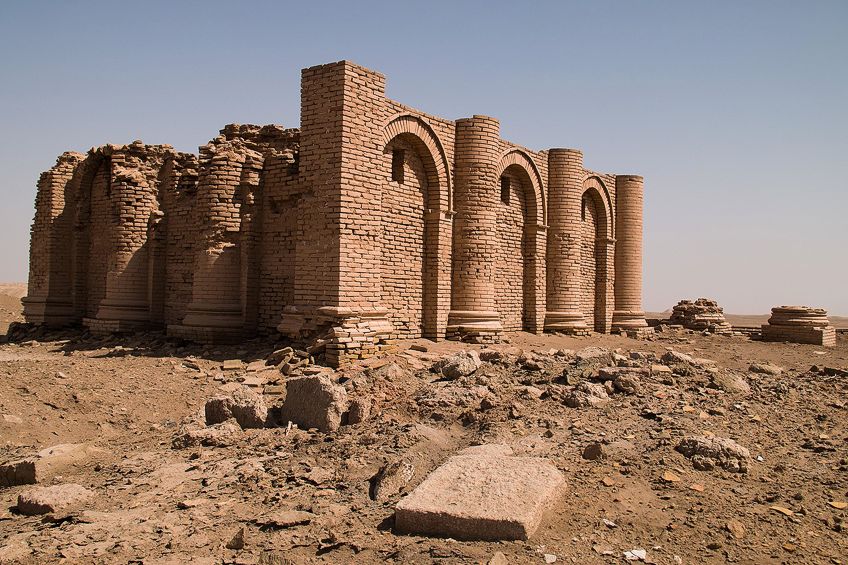
The supplied photograph is captioned as the Temple of Gareus at Uruk in present-day Iraq. Its record and dating require care: buildings in Mesopotamia can reflect Seleucid, Parthian, and local histories, so it should not stand for all Iranian architecture.
Parthian builders also used barrel-vaulted halls and the iwan, a vaulted space open on one side. These forms had long regional histories and later became especially important in Sasanian and Islamic architecture. It is inaccurate to explain them simply as Roman domes adapted to rise “from the earth.”
Sasanian Era (224–651 CE)
Ardashir I defeated the last Arsacid ruler and established the Sasanian dynasty in 224 CE. The empire became Rome and Byzantium’s major eastern rival. Royal centers included Ctesiphon, Firuzabad, and Bishapur, while Zoroastrian institutions played an important role in state ideology.
Rock reliefs commemorated investitures and victories at highly visible sites. Kings receive rings of authority, confront enemies, or appear with deities and courtiers. The reliefs combine political narrative, sacred sanction, and landscape.
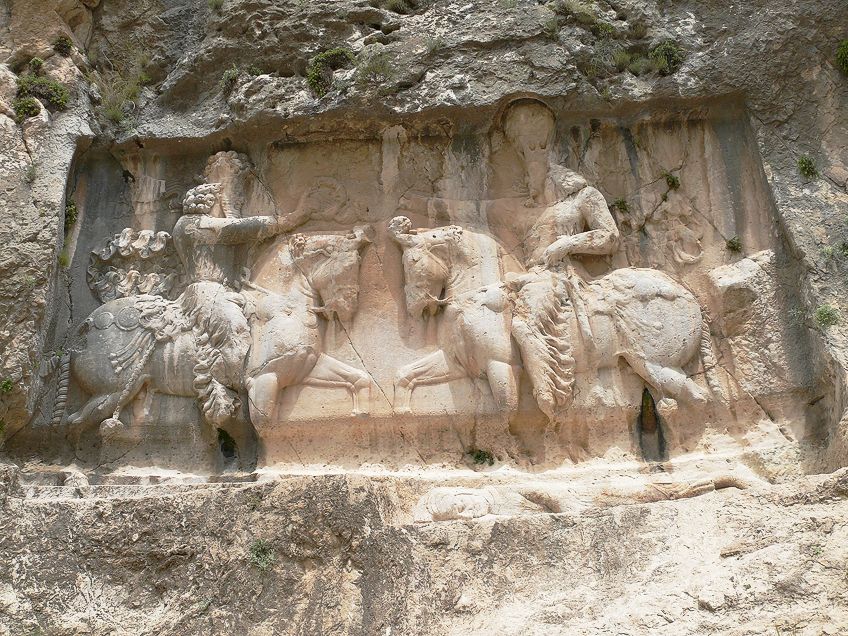
Sasanian architecture developed monumental domed chambers, barrel vaults, iwans, palaces, and fire temples. Builders used rubble, mortar, brick, and stucco rather than one uniform system. The minaret, however, is an Islamic architectural form and should not be listed as a Sasanian invention.
Silver and gilt vessels often show royal hunts, banquets, animals, or mythic imagery. Stucco decoration, seals, textiles, glass, ceramics, wall painting, and mosaics broaden the picture beyond court metalwork. The National Museum of Asian Art places Sasanian rule from 224 CE through the seventh-century conquests.
Persian Architecture
Iranian architecture responds to climate, materials, water, ceremony, defense, and urban life. Its history includes columned Achaemenid halls, Parthian and Sasanian vaulted spaces, Islamic mosques and madrasas, caravanserais, gardens, bridges, palaces, bathhouses, shrines, houses, and bazaars.
Persepolis was not simply the everyday capital of all Iran. It was a royal center and ceremonial showplace within an empire that had several administrative centers. UNESCO describes its immense terrace, monumental stairways, reception halls, reliefs, and unusually slender columns as a unique Achaemenid ensemble.
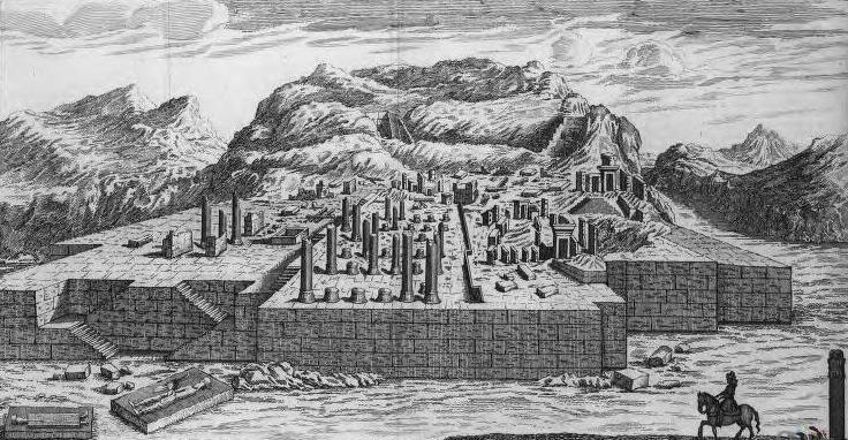
Achaemenid columns used stone bases and shafts, elaborate capitals, and wooden roof beams. Double bull, lion, or griffin protomes helped support the intersections of beams. The design combined structural purpose with a highly legible imperial vocabulary.
Under later Islamic dynasties, four-iwan courtyards, domes, muqarnas, brick patterning, carved stucco, calligraphic bands, and glazed tile transformed religious and civic space. Safavid Isfahan joined mosques, palace, bazaar, and public square in an ambitious urban composition. Continuity matters, but later builders did not merely reproduce ancient forms.
Persian Sculpture
Ancient Iranian sculpture survives in palace reliefs, rock carvings, architectural figures, stone and terracotta objects, and metalwork. The category must be used broadly: scale, material, function, and region differ greatly.
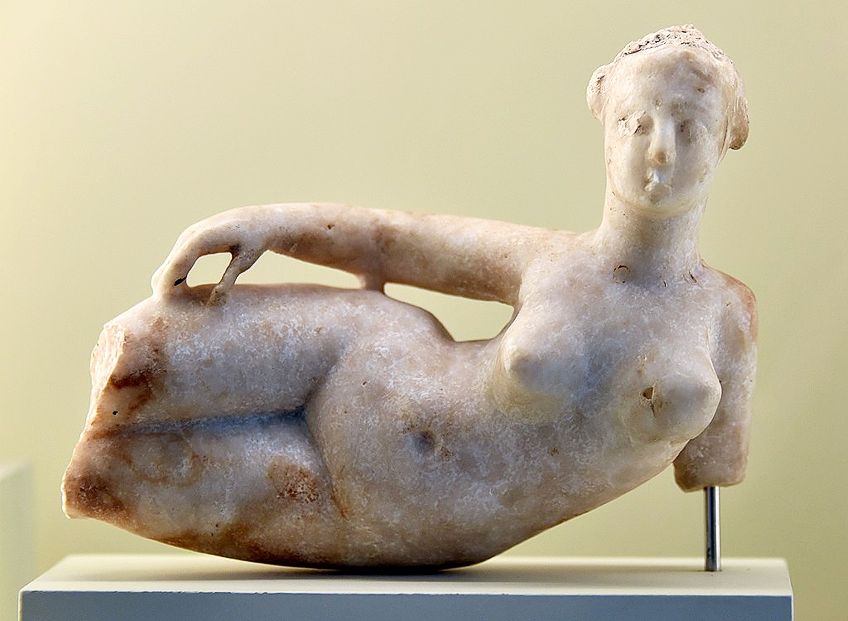
The reclining alabaster woman above was found in Iraq and is broadly dated to the Parthian period. It demonstrates the geographic range of Arsacid-era culture but should not be labeled uniquely “Persian” without acknowledging its Mesopotamian context.
Achaemenid reliefs favor clear profiles, repeated rhythms, and carefully differentiated costume. Sasanian rock reliefs often use larger, more emphatic bodies and hierarchical scale. Neither approach should be ranked as more realistic or more advanced. Each organizes bodies to serve architectural, ceremonial, or political meaning.
Metal figurines, animal vessels, jewelry, coins, seals, and silver plates complicate any account limited to monumental stone. Portable works connected royal imagery to dining, dress, devotion, exchange, and administration.
Persia Under Islam
The Islamic conquest brought political and religious transformation, but no universal ban ended figural art. Islamic legal and theological attitudes toward images varied by place, medium, function, and period. Figurative painting, ceramics, metalwork, textiles, and secular palace decoration continued, while mosques generally emphasized calligraphy, geometry, vegetal ornament, light, and material pattern.
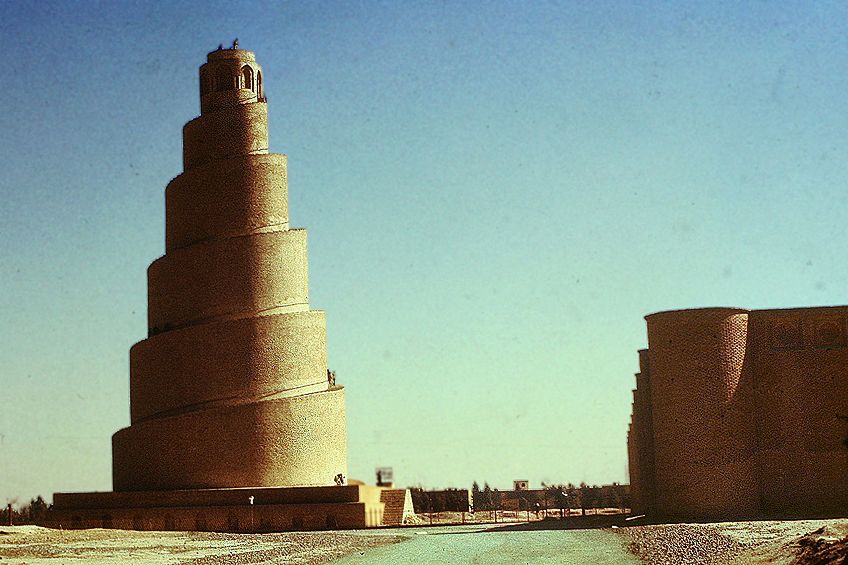
The Great Mosque of Samarra in present-day Iraq was commissioned by the Abbasid caliph al-Mutawakkil in the ninth century. It is part of the wider Islamic world rather than a specifically Persian building, yet its vast scale and spiral Malwiya minaret illustrate networks in which Iranian artists, officials, and patrons participated.
The Rise of Illumination and Calligraphy
Calligraphy was not a fallback caused by a ban on drawing. The written Qur’an gave Arabic script exceptional religious importance, while Persian literary culture expanded its aesthetic range. Scribes, painters, illuminators, binders, paper makers, and patrons collaborated in sophisticated book workshops.
Illumination uses gold, color, geometric divisions, and vegetal motifs to articulate headings, margins, frontispieces, and other manuscript structures. Calligraphic scripts such as nastaʿliq became strongly associated with Persian poetry. Albums known as muraqqaʿ assembled calligraphy, drawings, paintings, and older fragments for close study and appreciation.
The Development of Painting
Persianate painting flourished under Ilkhanid, Timurid, Turkmen, Safavid, Mughal, and other patrons. “Miniature” describes scale but can obscure that paintings were parts of books or albums. Artists used line, color, architecture, landscape, clothing, and spatial layering to coordinate narrative and ornament rather than pursue European single-point perspective.
Kamāl al-Dīn Bihzad was active at the Timurid court in Herat and later connected to the Safavid workshop at Tabriz. Attributions remain difficult because famous signatures could be copied or added. Works associated with him are valued for complex architecture, animated figures, and narrative clarity—not for European-style realism.
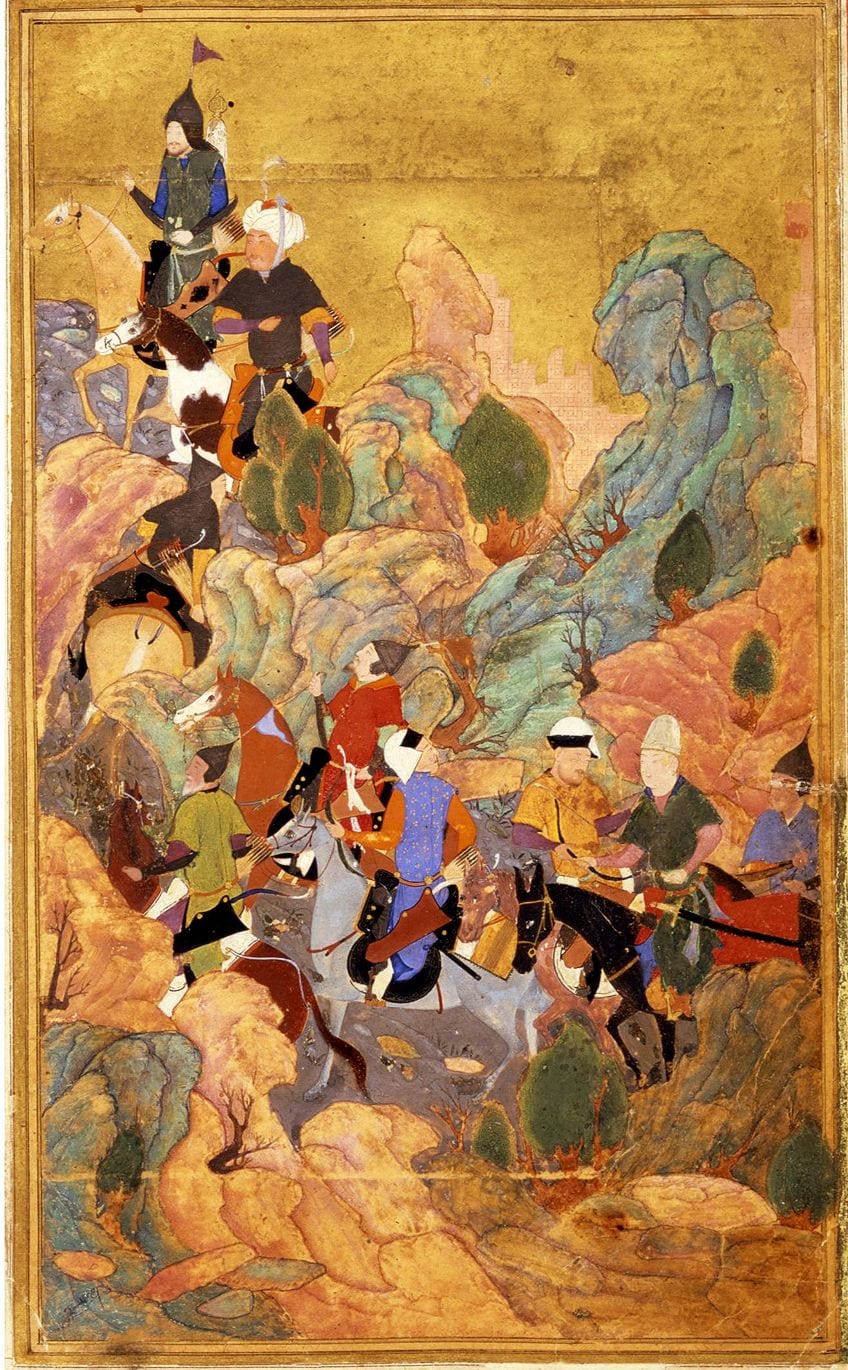
The inherited caption dates this Garrett Zafarnama illustration before the 1480s and assigns it to Bihzad. The Commons record itself has not been fully reviewed and cites a secondary image source, so both attribution and reproduction provenance need a human check.
Safavid painting later gave greater prominence to single figures and album pages. European prints, Indian painting, and changing court tastes affected Iranian workshops, but exchange did not amount to simple decline.
Famous Persian Artists and Their Artworks
Named artists become more visible in manuscript and album culture, but much Iranian art was collaborative or anonymous. Architecture, carpets, ceramics, metalwork, and books depended on teams whose names were not always recorded.
The Oxus Treasure (Fifth–Fourth Centuries BCE)
The Oxus Treasure is a group of Achaemenid gold and silver objects reportedly found near the Oxus River in the late 19th century. The find circumstances are poorly documented, so its original archaeological context remains uncertain. The group includes vessels, plaques, figurines, jewelry, and model chariots now in the British Museum.
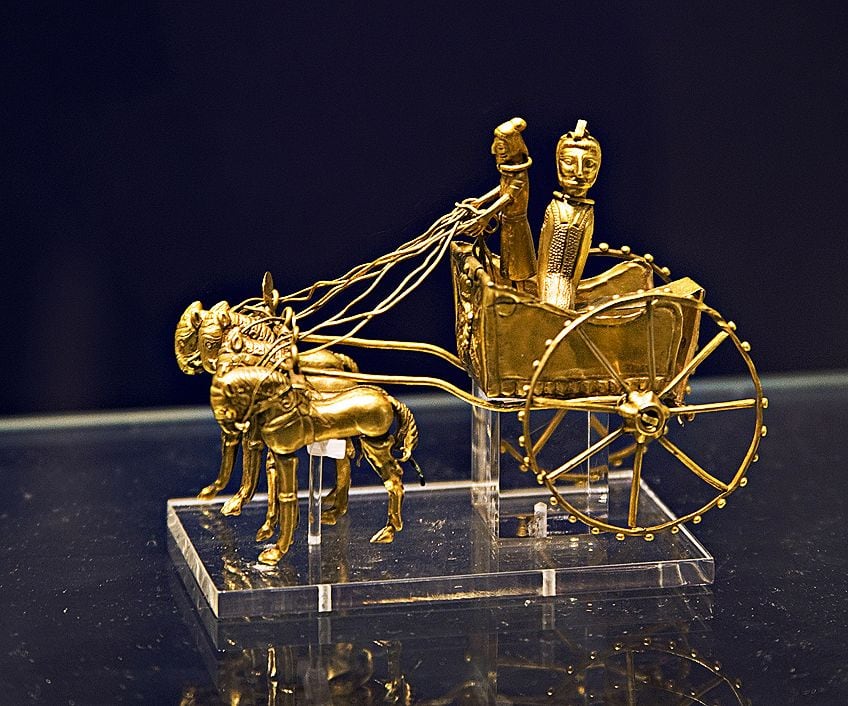
Model chariot made of gold from the Oxus Treasure in the British Museum, 5th-4th century BC; British Museum, CC BY-SA 3.0, via Wikimedia Commons
The British Museum identifies the gold chariot as Achaemenid. Four horses draw a vehicle with two figures; the Egyptian god Bes appears on its front. The object shows how imperial luxury work could combine imagery from different regions. Its discovery around 1877 is not its creation date.
Kamāl al-Dīn Bihzad (c. 1450–1535/36)
Bihzad’s career bridges the late Timurid and early Safavid periods. Later sources celebrate him as a master, but individual attributions must be evaluated through inscriptions, provenance, comparison, and workshop practice.
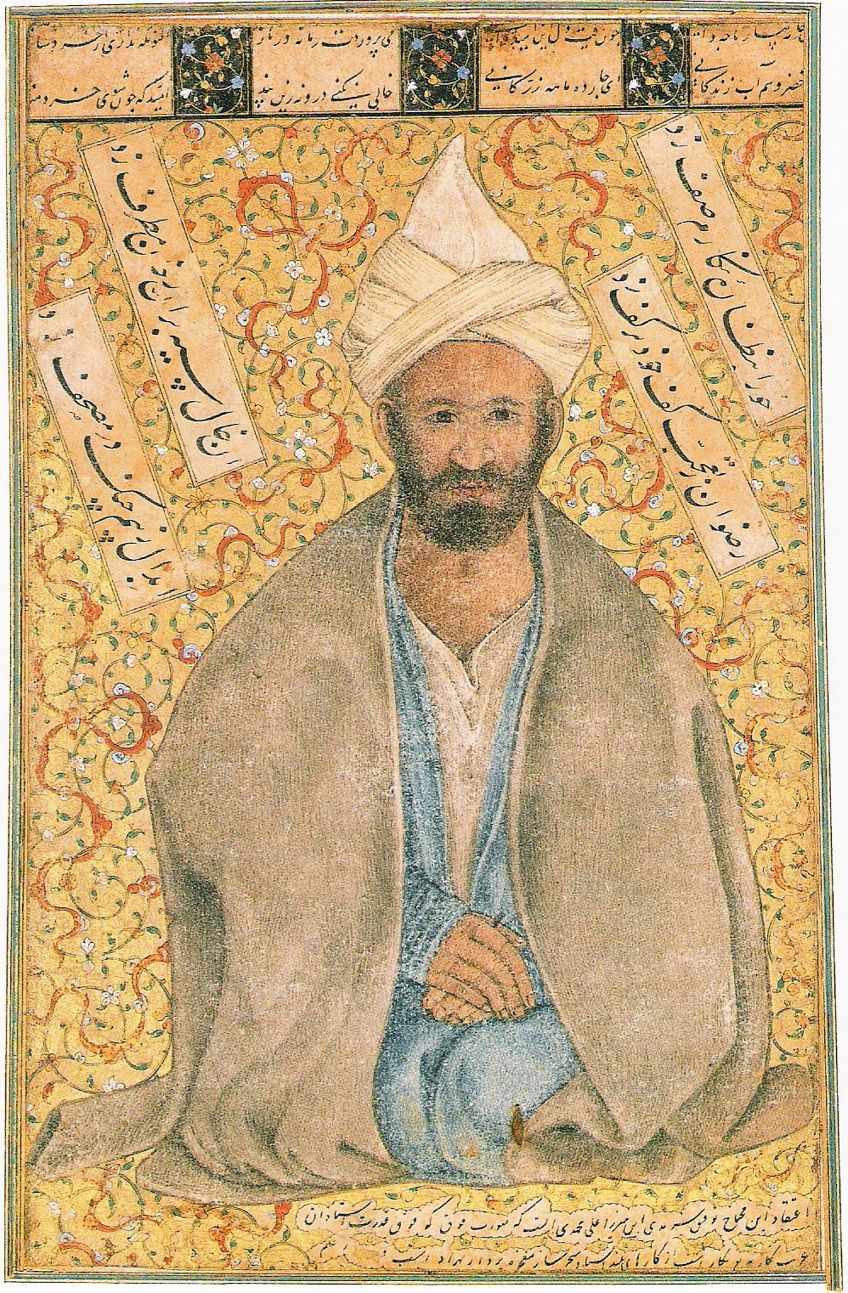
The work traditionally called Portrait of a Dervish uses economical line and a restrained setting to concentrate attention on pose and character. The supplied source treats it as public domain, but the exact institutional object record and attribution should be confirmed before publication.
Reza Abbasi (c. 1565–1635)
Reza Abbasi was a leading artist at the Safavid court of Shah Abbas I. He is especially associated with calligraphic drawings and paintings of elegant youths, lovers, dervishes, and courtly figures made for albums. The Metropolitan Museum of Art emphasizes how his subjects and linear style reshaped painting in 17th-century Iran.
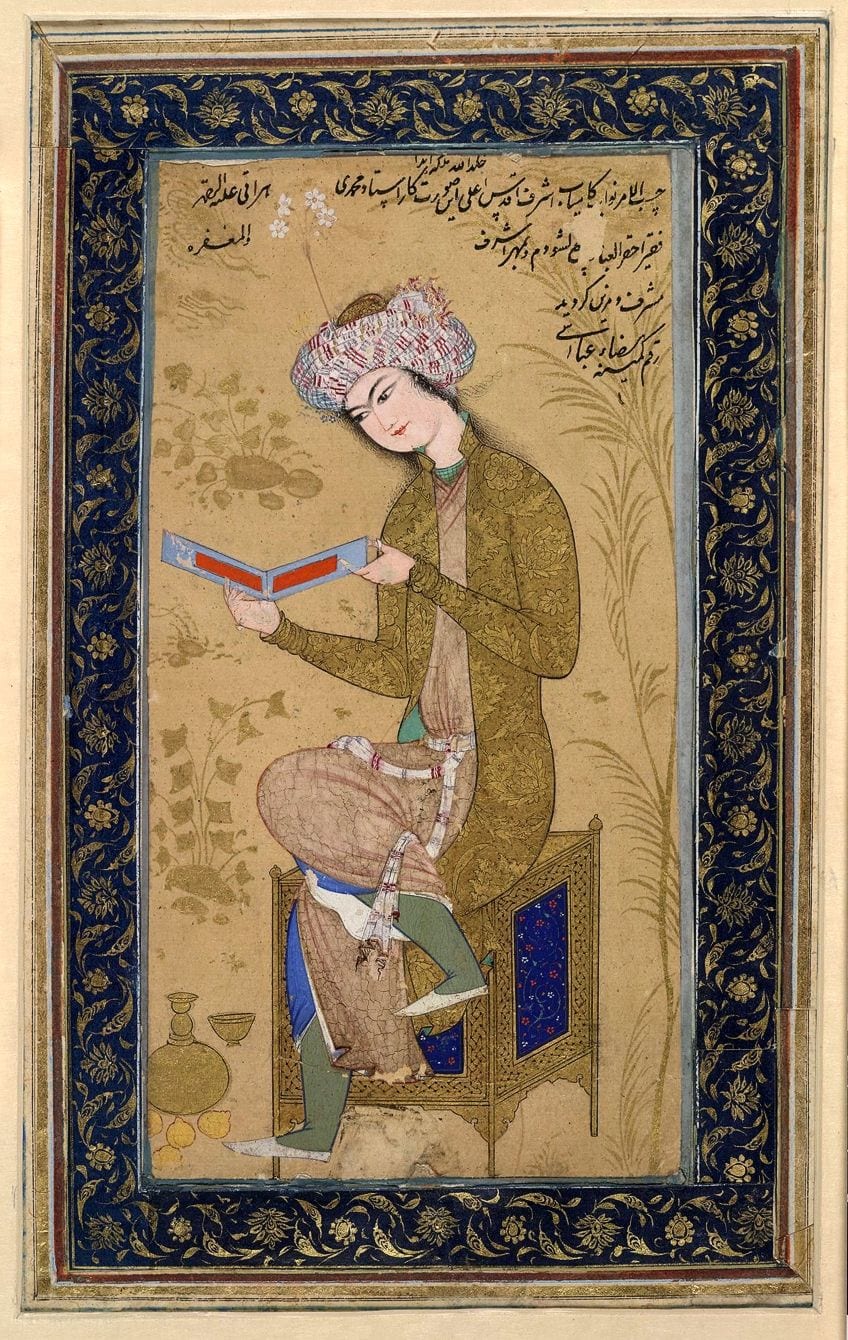
Youth Reading demonstrates the intimacy of an album page: a single figure, modeled with delicate line and limited color, occupies a shallow field. Works assigned to Reza and his circle also present attribution problems because signatures, workshop participation, and later copying complicate authorship.
The Emergence of Persian Carpets
Carpet weaving is both an art and a living practice. Iranian pile carpets are knotted; flat-woven textiles such as kilims use different structures and should not all be collapsed into one technical category. Workshops ranged from nomadic and village production to urban and court manufacture.
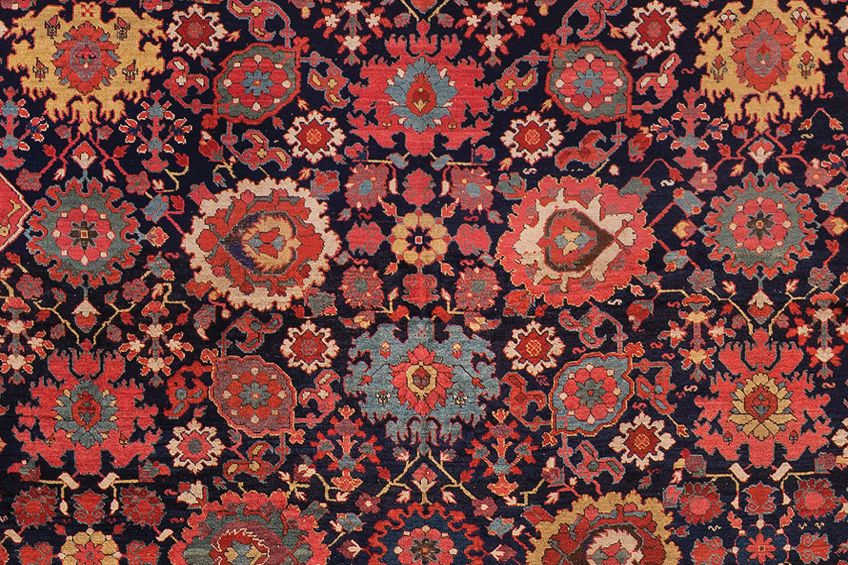
Designs may use medallions, repeating fields, gardens, animals, flowers, arabesques, inscriptions, or geometric structures. Materials can include wool, cotton, silk, and metal-wrapped thread. Regional labels such as Kashan, Kerman, Tabriz, Isfahan, and Fars refer to traditions and markets, not absolute guarantees of origin or quality.
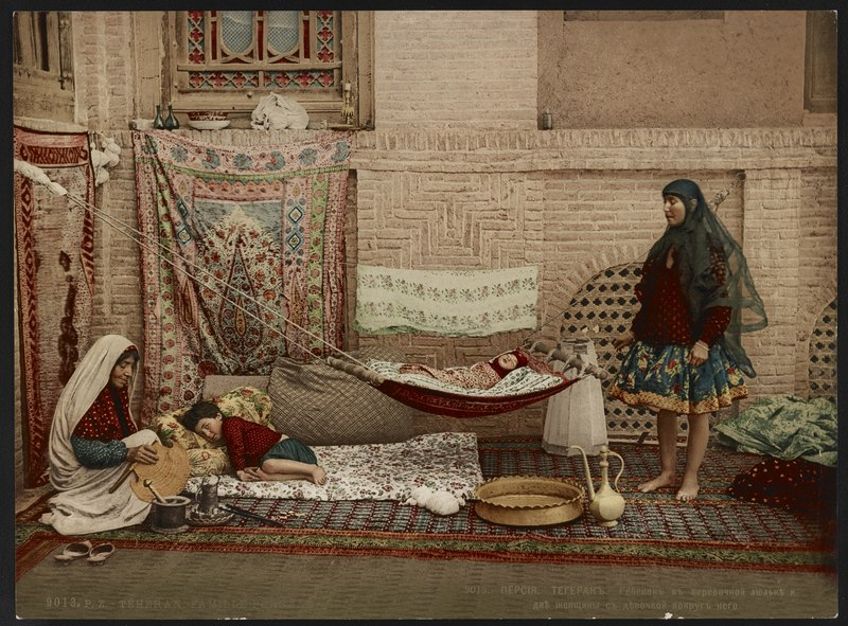
The family photograph above documents people in Tehran, not carpet construction itself. It remains in its inherited position as a historical contextual image.
Safavid court patronage helped make Iranian carpets celebrated internationally. Surviving 16th- and 17th-century carpets show sophisticated planning, dyeing, and weaving, but domestic and nomadic traditions were equally important. Synthetic dyes and global commerce changed production in the 19th century; the results cannot be described only as decline, because workshops adapted in different ways.
UNESCO inscribed the traditional carpet-weaving skills of Fars and Kashan in 2010. These inscriptions recognize knowledge transmitted through apprenticeship, including design, dye preparation, loom work, knotting, and finishing.
The Legacy of Ancient Persian Arts
Iranian art cannot be reduced to an ancient golden age followed by decline. Achaemenid and Sasanian forms were repeatedly studied and reinterpreted, while Islamic Iranian art generated new architectural, literary, pictorial, and craft traditions. Political conquest, religious change, migration, trade, and modern nation-building all reshaped how the past was used.
Living practices include carpet weaving, calligraphy, ceramics, metalwork, book arts, architecture, photography, cinema, installation, and contemporary painting. Their makers may engage historical forms, reject them, or place them in dialogue with global modern and contemporary art.
The most useful way to understand Persian art is as a long, diverse history of exchange and reinvention: rooted in Iranian places and languages, connected to neighboring cultures, and continually redefined by artists and audiences.

Isabella studied at the University of Cape Town in South Africa and graduated with a Bachelor of Arts majoring in English Literature & Language and Psychology. Throughout her undergraduate years, she took Art History as an additional subject and absolutely loved it. Building on from her art history knowledge that began in high school, art has always been a particular area of fascination for her. From learning about artworks previously unknown to her, or sharpening her existing understanding of specific works, the ability to continue learning within this interesting sphere excites her greatly.
Her focal points of interest in art history encompass profiling specific artists and art movements, as it is these areas where she is able to really dig deep into the rich narrative of the art world. Additionally, she particularly enjoys exploring the different artistic styles of the 20th century, as well as the important impact that female artists have had on the development of art history.
Learn more about Isabella Meyer and the Art in Context Team.
Cite this Article
Isabella, Meyer, “Persian Art – A History of Ancient Persian Paintings and Iranian Art.” Art in Context. May 19, 2021. URL: https://artincontext.org/persian-art/
Meyer, I. (2021, 19 May). Persian Art – A History of Ancient Persian Paintings and Iranian Art. Art in Context. https://artincontext.org/persian-art/
Meyer, Isabella. “Persian Art – A History of Ancient Persian Paintings and Iranian Art.” Art in Context, May 19, 2021. https://artincontext.org/persian-art/.