


MoMA, Centre Pompidou and M+ Turn Museum Loans Into a Long-Term Alliance

MoMA, Centre Pompidou and M+ signed a framework agreement in Hong Kong on October 30, 2026, to share their collections through long loans, co-organize exhibitions and coordinate curatorial and conservation work. The consequential change is not a new branch museum: it is a three-continent network intended to keep works in partner galleries for years, with the first announced displays beginning in 2027.
What the Three-Museum Alliance Actually Adds
The framework agreement announced by MoMA joins three independent collecting institutions in New York, Paris and Hong Kong. Their stated work covers collection access, jointly organized exhibitions and programs, curatorial research, conservation and support for living artists. The museums put their combined reach at 10 million in-person visitors a year and 125 million online visitors.
The alliance was not built from scratch. M+ and MoMA signed a bilateral memorandum in February 2025 covering artwork loans, collection management, sustainability, professional development and exhibition exchange. That relationship had already produced a concrete result: Janet Cardiff’s forty-speaker sound installation The Forty Part Motet opened at M+ in August 2026 as the first project under the memorandum.
M+ and Centre Pompidou had an even more detailed road map before the three directors met on October 30. Their May 2026 strategic partnership, itself built on a 2024 memorandum, set out joint exhibitions, research, co-commissions and collection exchange from 2027 onward.
The three-way framework builds on M+’s two recent memoranda and on a formal MoMA–Centre Pompidou exchange agreement dating to 1975. That matters because it lets curators compare three collections at once and potentially revise the predominantly European and North American narratives through which modern art has often been displayed.

The Announced Commitments, Venue by Venue
The official announcement defines the alliance broadly but does not name a single artwork. The first implementation details come from the institutions’ earlier agreements and from contemporaneous coverage. They should not all be treated as equally final.
| Venue | Public commitment | Timing |
|---|---|---|
| MoMA, New York | Gallery devoted to the M+ collection | Planned for 2027; reported by SCMP |
| M+, Hong Kong | MoMA and Pompidou works integrated into exhibitions | Over the next 18 months; reported by SCMP |
| Massy, France | Moving-image co-commissions connecting the M+ Facade and Pompidou’s new site | From 2027; in the May M+–Pompidou plan |
| Network-wide | “What Is Contemporary?” research symposium at MoMA | May 2027; reported by The Standard |
The South China Morning Post reported the New York gallery, the 18-month Hong Kong rollout and the use of M+ facade commissions at Centre Pompidou’s Massy facility. Those specifics do not appear in the short joint release, so they remain announced plans rather than a published checklist of contracted loans. The Standard separately reported a joint Kandinsky exhibition in 2028, the May 2027 symposium and continuing curatorial and conservation research.
Centre Pompidou’s situation makes the partnership unusually consequential. Its public loan policy places ordinary requests under a moratorium until the Paris building reopens in 2030, but the policy expressly exempts partnerships signed for the closure period. The alliance therefore creates an institutional route for Pompidou works to circulate while ordinary borrowers cannot submit requests; it does not yet identify which works will use that route.
At MoMA, the reported M+ gallery would reverse the usual direction of prestige lending: the youngest museum’s collection would enter the galleries of the oldest. The earlier Cardiff installation at M+ shows that exchange can already move the other way. The test will be whether future displays embed partner works throughout collection narratives or isolate them as visiting highlights.
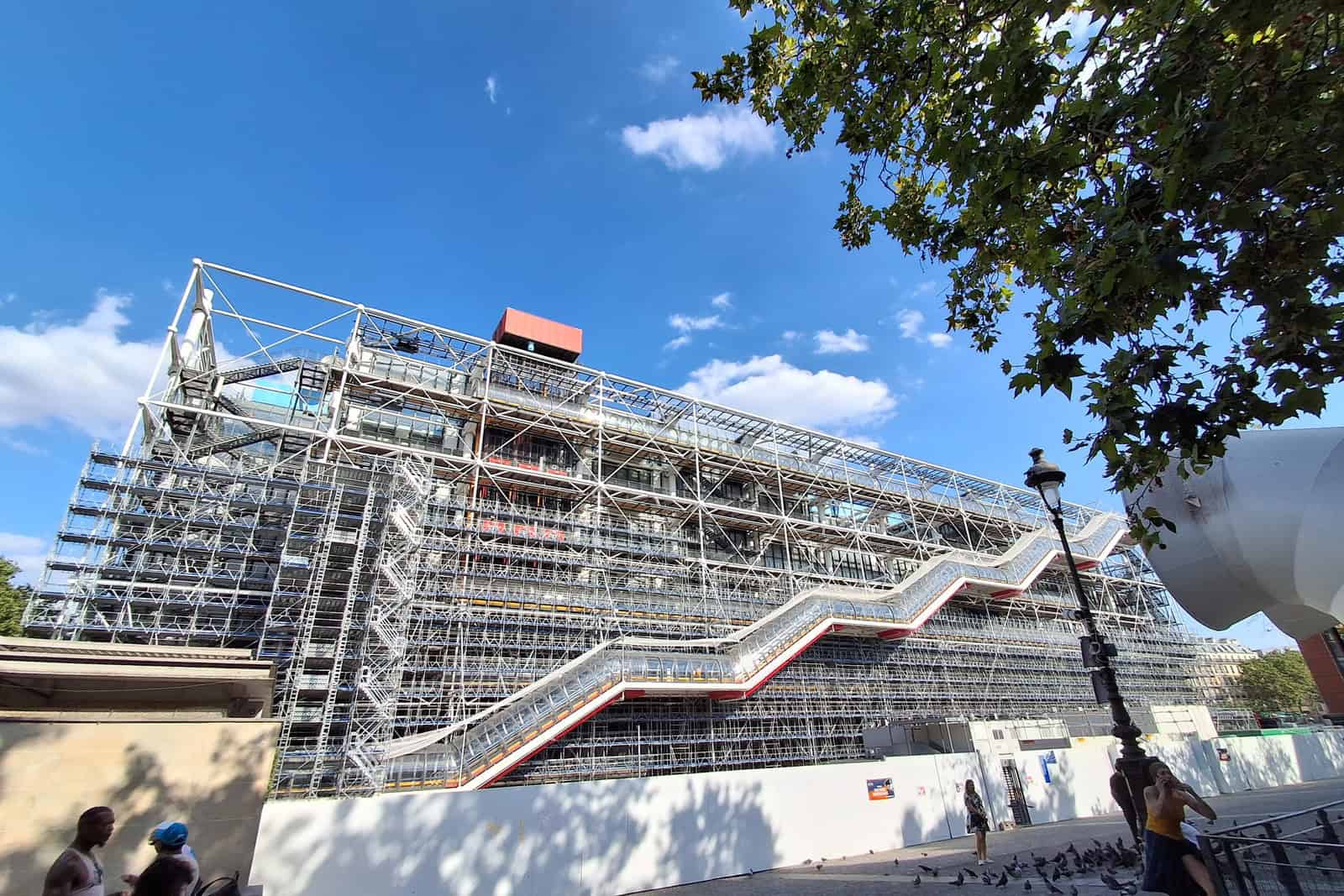
Centre Pompidou under renovation in Paris in July 2026. Photograph by JeremyJeanguenin via Wikimedia Commons, Creative Commons Attribution-ShareAlike 4.0 International.
Long Loans Are Different From Cost-Free Loans
SCMP described the arrangement as a departure from short blockbuster tours and paid satellite franchises, with no money changing hands between the three museums. The official release reinforces one part of that distinction: MoMA, Centre Pompidou and M+ retain their independence and identities. No partner is announced as licensing its name to a branch operated by another body.
Long loans can also change interpretation. A work present for years can rotate through multiple displays, enter teaching programs and be studied alongside objects that rarely travel together. A four-month exhibition normally arrives with a fixed thesis; an extended loan can participate in successive acts of curating. That is the model’s most credible art-historical promise.
“No money changing hands,” however, does not mean that moving art has no cost. The alliance announcement does not say whether its fee arrangement overrides M+’s standard rule that borrowers cover packing, shipping, insurance, conservation and courier costs. Nor do they say whether the museums will waive only loan fees or also absorb one another’s logistical costs. Calling the alliance fee-free is supported by SCMP’s account; calling it cost-free would go beyond the disclosed terms.
The sustainability claim also remains a proposal, not a measured result. Fewer journeys and longer stays could reduce repeated shipping, but the benefit will depend on the number, fragility and routes of the works selected. No baseline, emissions method or reporting schedule accompanies the announcement.

The Museum of Modern Art in New York. Photograph by Bradley Weber via Wikimedia Commons, Creative Commons Attribution 2.0 Generic.
Selection Power Is the Unresolved Core
The public announcement does not include the framework agreement itself, a list of candidate works or rules for deciding where a work will be shown. The release promises aligned programming while preserving institutional independence, but it does not explain who has final authority when curatorial, conservation or legal judgments differ.
That question is especially important because the collections are not interchangeable. M+ brings concentrated holdings in Asian visual culture, architecture, design and moving image; Centre Pompidou holds the French national collection of modern and contemporary art; MoMA’s collection has helped define the modernist canon in the United States. The value of the alliance will depend less on the quantity of loans than on whether these different histories alter one another’s displays.
The same uncertainty applies to conservation. The alliance announcement does not set out a shared conservation protocol, while M+’s public rules assign condition reporting and conservation responsibility for works it lends. Those are not reasons to doubt the agreement; they are the terms that will determine whether its long-loan model can work beyond the first installations.
A Three-Way Framework Built on Earlier Exchanges
The October 30 agreement establishes a continuing alliance among MoMA, Centre Pompidou and M+, while the 2025 MoMA–M+ memorandum and the 2026 M+–Pompidou plan show that collection exchange was already under way. SCMP supplied the clearest near-term schedule: an M+ presentation at MoMA in 2027 and partner works entering M+ displays over 18 months.
Centre Pompidou’s own loan policy confirms that signed partnerships are exempt from its ordinary moratorium through the Paris closure, giving this framework practical weight before 2030. The “no money changing hands” description establishes an absence of inter-museum fees, not an absence of transport, insurance or conservation costs. The alliance has not identified individual future loans or its dispute process, while M+’s standing policy generally defines long-term loans as three to five years and gives its museum director final approval for outgoing loans.

Isabella studied at the University of Cape Town in South Africa and graduated with a Bachelor of Arts majoring in English Literature & Language and Psychology. Throughout her undergraduate years, she took Art History as an additional subject and absolutely loved it. Building on from her art history knowledge that began in high school, art has always been a particular area of fascination for her. From learning about artworks previously unknown to her, or sharpening her existing understanding of specific works, the ability to continue learning within this interesting sphere excites her greatly.
Her focal points of interest in art history encompass profiling specific artists and art movements, as it is these areas where she is able to really dig deep into the rich narrative of the art world. Additionally, she particularly enjoys exploring the different artistic styles of the 20th century, as well as the important impact that female artists have had on the development of art history.
Learn more about Isabella Meyer and the Art in Context Team.
Choose Art in Context as a preferred source to see more of our reporting in Google Top Stories and other Google Search experiences.
Cite this Article
Isabella, Meyer, “MoMA, Centre Pompidou and M+ Turn Museum Loans Into a Long-Term Alliance.” Art in Context. October 30, 2026. URL: https://artincontext.org/moma-centre-pompidou-m-plus-long-loan-alliance/
Meyer, I. (2026, 30 October). MoMA, Centre Pompidou and M+ Turn Museum Loans Into a Long-Term Alliance. Art in Context. https://artincontext.org/moma-centre-pompidou-m-plus-long-loan-alliance/
Meyer, Isabella. “MoMA, Centre Pompidou and M+ Turn Museum Loans Into a Long-Term Alliance.” Art in Context, October 30, 2026. https://artincontext.org/moma-centre-pompidou-m-plus-long-loan-alliance/.


