

Dutch State Will Return Nazi-Looted Van Goyen to Goudstikker Heirs

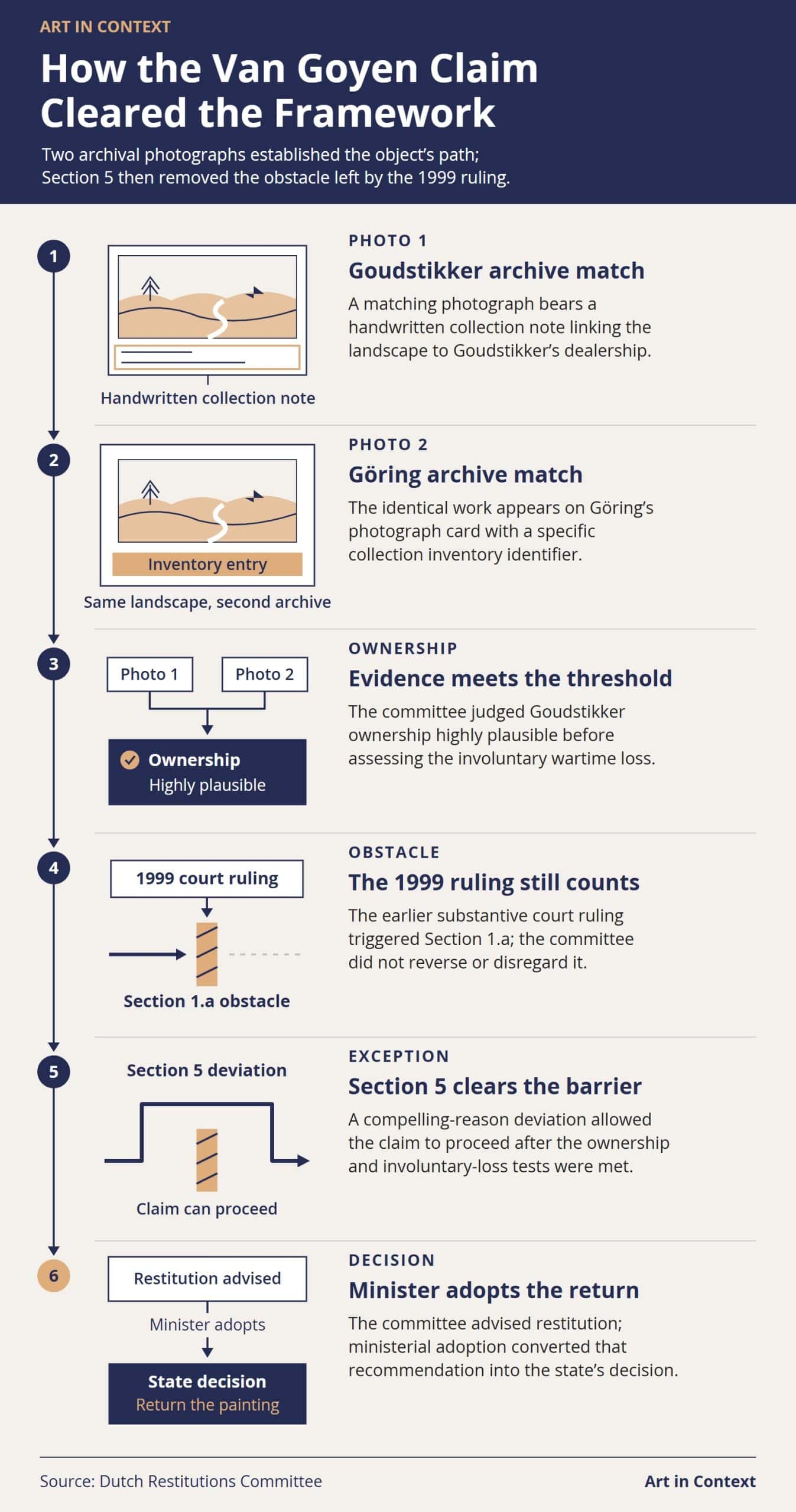
The Netherlands will return Jan van Goyen’s 1651 Fishermen by the Lakeshore from the Dutch National Art Collection to Jacques Goudstikker’s heirs after the culture minister adopted a June restitution recommendation. The decision surmounts a procedural obstacle left by a 1999 court ruling and rests on unusually specific visual evidence tying the small landscape first to Goudstikker and then to Hermann Göring.
The Minister, Not the Committee, Made the Return Decision
The Dutch Restitutions Committee’s announcement, published on September 18, 2026, says the minister of Education, Culture and Science adopted its recommendation to return the painting to Goudstikker’s legal successors. That adoption—not the recommendation by itself—is the new decision.
The distinction matters because the same-day NOS report described the committee as having determined that the state must return the work. Under the official procedure, the committee advises; the minister decides. The Mauritshuis holds the painting for the national collection but does not decide restitution claims.
The advice itself was adopted by the committee on June 30. Publication on September 18 disclosed the minister’s acceptance, turning a recommended return into state policy. Neither the announcement nor the full recommendation gives a date for the physical handover, so the legal decision is established while the transfer timetable remains unstated.
A Small Brown Landscape Identified by Two Photographs
Van Goyen made Fishermen by the Lakeshore in 1651. The 25-by-34-centimeter work is a brunaille, a painting restricted largely to brown tones, executed on paper reinforced with canvas. Three figures and a dog stand by the water beneath two large trees; two more figures sit in a small boat. The lower center bears the monogram and date “vG 1651.”
Those modest dimensions made identification harder, not easier. Van Goyen produced several closely comparable landscapes in 1651, and descriptions in old inventories vary. The committee’s full Goudstikker III recommendation notes that not every catalog entry aligns neatly: archival records use the Goudstikker inventory numbers 1797 and 2965, and the committee says both may refer to this one painting.
The strongest evidence is visual. One photograph in the Jacques Goudstikker archive shows a work identical to the Mauritshuis painting and is marked “J. v. Goyen Coll. Goudstikker.” A second, identical image survives in the Göring collection archive, carrying Göring inventory number RM 360 and the earlier designation KG 149. Accounting records, Goudstikker’s black notebook, and a 1936–1937 exhibition description add support.
That evidentiary chain explains the committee’s deliberately calibrated finding: Goudstikker ownership is “highly likely,” not described as absolute certainty. The remaining ambiguity concerns which Goudstikker inventory number belongs to the work, not whether the two archival photographs depict the Mauritshuis painting.
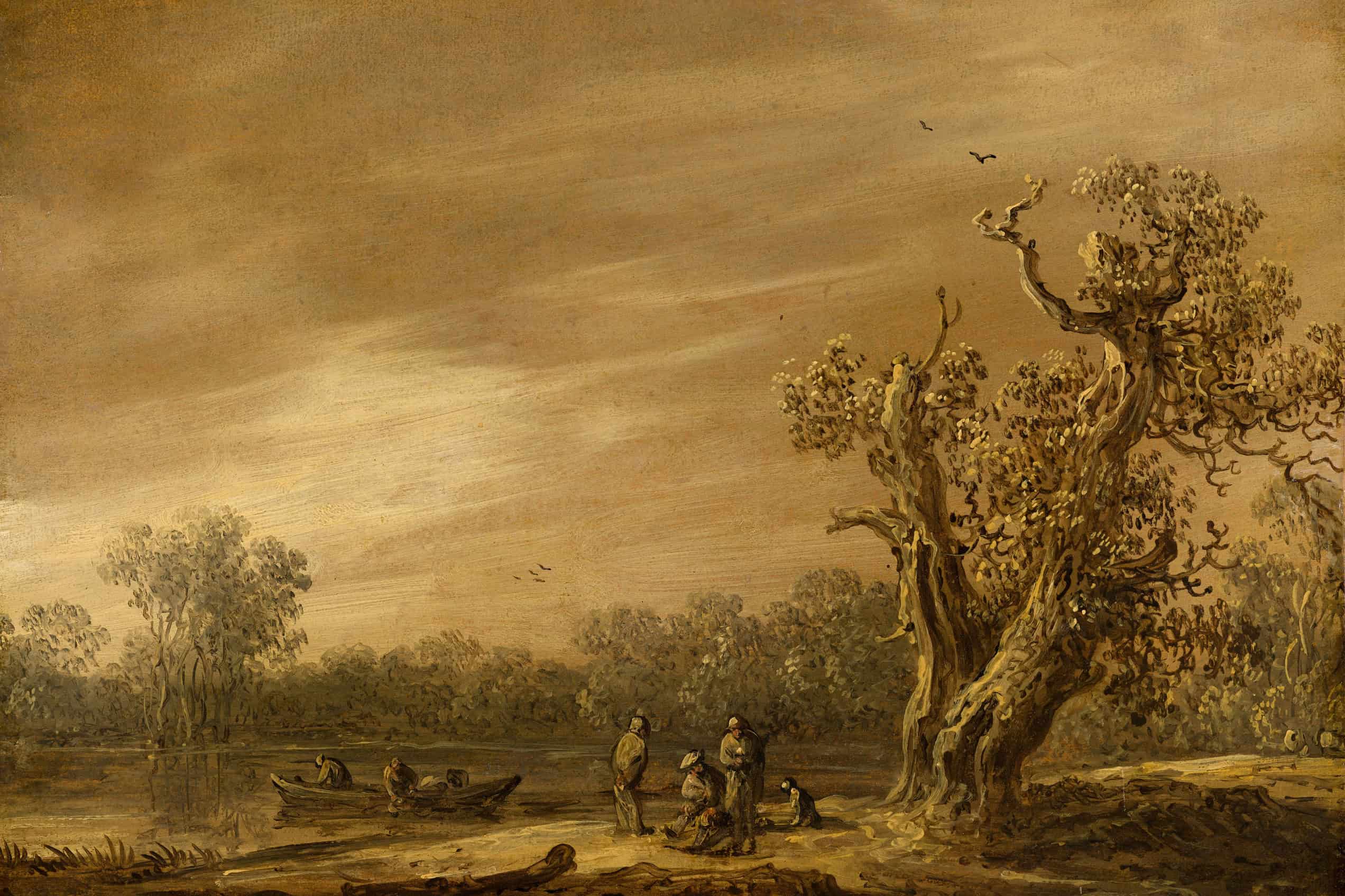
Fishermen by the Lakeshore (1651) by Jan van Goyen, Mauritshuis, The Hague. Photograph by Margareta Svensson, hosted by Wikimedia Commons. Public Domain Mark 1.0. Cropped.
From Goudstikker to Göring and Back onto the Market
Archival sources place the painting in Goudstikker’s trading stock before the war. A 1935 inventory entry, his black notebook, and a 1936–1937 exhibition description all appear to refer to it; earlier ownership remains incomplete because no documentation shows how or when collector Eduard August Veltman acquired it. Goudstikker, a Jewish dealer known for Dutch, Flemish, and Italian Old Masters, fled the Netherlands with his family after the German invasion. He died in an accident aboard the ship during the night of May 15–16, 1940.
His Amsterdam dealership was left with 1,113 inventoried works. On July 13, 1940, employee Arie ten Broek—appointed managing director at a shareholders’ meeting that the committee found invalid for decision-making—entered agreements with Alois Miedl and Hermann Göring. Goudstikker’s widow, Dési, held a majority of the shares and did not consent. Göring acquired rights to the dealership’s wholly owned artworks, while Miedl took other assets and the trade name.
The Van Goyen had already entered Göring’s collection in June, before the contract was signed. That sequence supports the finding that the transaction gave a legal appearance to a loss already occurring under Nazi coercion. The committee found the loss involuntary because Dési Goudstikker rejected the deals and because Ten Broek’s appointment enabled them.
The postwar trail is less complete. The painting appears on a list of works moved to Veldenstein and may have been among objects stolen from Göring’s train at Unterstein in May 1945, but the recommendation presents that only as a possibility. A Mauritshuis documentation card places the work with “G. Sprengel” in Berlin around 1948, plausibly the frame maker Georg Sprengel; it later surfaced at a Leo Spik gallery sale in 1957, passed to Van Goyen scholar Hans-Ulrich Beck, and then to dealer Saam Nijstad.
The Dutch government bought it from Nijstad in January 1967 for 58,000 guilders for the Mauritshuis. The official 1967 acquisition notice did not supply its earlier provenance. The state therefore acquired a painting that archival evidence now connects to both Goudstikker’s stock and Göring’s collection.

Hermann Göring leaving the Goudstikker art dealership at Herengracht 458, Amsterdam, in 1941. Photograph: unknown; Nationaal Archief, via Wikimedia Commons (public domain).
Why the 1999 Court Ruling Did Not End the Claim
The return required more than proving wartime loss. A 1999 judgment by the Court of Appeal in The Hague counted as a substantive judicial ruling for Section 1.a of the restitution framework, ordinarily an obstacle to considering the claim. The court had found a direct request untimely and saw no compelling reason to grant restoration of rights on its own initiative.
The committee did not erase that ruling. It used Section 5, which allows deviation when there is a compelling reason, after separately finding that the ownership and involuntary-loss tests were met. That is the procedural significance of Goudstikker III: the result comes through an express exception within the framework, not through a finding that the earlier judgment never existed.
The distinction between two 1940 transactions was also decisive. Dési Goudstikker’s 1952 settlement with the Dutch state covered works delivered to Miedl; artworks supplied to Göring were outside it. In 2006, the state secretary likewise concluded that the 1999 ruling had settled the legal-redress question but nevertheless returned 202 works because of the circumstances of the loss and the state’s severe, formalistic postwar handling. In 2013, the committee recommended returning three more works, and the minister accepted its advice. The committee applied that established reasoning to this Van Goyen, which belonged to the Göring side rather than the settled Miedl side.
The Mauritshuis Held the Work but Could Not Return It
The institutional roles help explain why the process took nearly three years after the claim. Marei von Saher, widow of Goudstikker’s only son, submitted the request on November 17, 2023. The state referred it to the committee in December. NIOD’s restitution expertise center then researched the provenance, the parties commented on drafts, and a hearing took place in October 2025 before the recommendation was completed in June 2026.
The Mauritshuis had already explained its position: it collaborated with the heirs’ research team and concluded that the painting came from Goudstikker’s trading stock, but as custodian of a national-collection work it could not order a return. That authority belonged to the minister acting on committee advice.
This state-administered path differs from the recent return of another Goudstikker painting from Argentina, where discovery in a private home and a court-backed settlement drove the outcome. Together, the cases show how widely the dealer’s stock dispersed and why each object’s route back depends on its present ownership and jurisdiction.

The Mauritshuis in The Hague. Photograph: Hanno Lans, CC BY 4.0, via Wikimedia Commons.
What the Decision Establishes—and What It Does Not
The ministerial adoption resolves the Dutch state’s position on the painting, while the record preserves several limits that should not be overstated.
- The June 30 committee recommendation became a government decision when the minister adopted it, as announced on September 18.
- Two matching archival photographs link the same 1651 landscape first to Goudstikker’s stock and then to Göring’s collection; the disputed inventory number does not break that identification.
- Section 5 overcame the Section 1.a obstacle because this work came through the Göring transaction and met the framework’s ownership and involuntary-loss tests.
- The physical transfer date has not been announced, and the painting’s precise route between Göring’s train in 1945 and Berlin around 1948 remains unknown.

Isabella studied at the University of Cape Town in South Africa and graduated with a Bachelor of Arts majoring in English Literature & Language and Psychology. Throughout her undergraduate years, she took Art History as an additional subject and absolutely loved it. Building on from her art history knowledge that began in high school, art has always been a particular area of fascination for her. From learning about artworks previously unknown to her, or sharpening her existing understanding of specific works, the ability to continue learning within this interesting sphere excites her greatly.
Her focal points of interest in art history encompass profiling specific artists and art movements, as it is these areas where she is able to really dig deep into the rich narrative of the art world. Additionally, she particularly enjoys exploring the different artistic styles of the 20th century, as well as the important impact that female artists have had on the development of art history.
Learn more about Isabella Meyer and the Art in Context Team.
Choose Art in Context as a preferred source to see more of our reporting in Google Top Stories and other Google Search experiences.
Cite this Article
Isabella, Meyer, “Dutch State Will Return Nazi-Looted Van Goyen to Goudstikker Heirs.” Art in Context. September 22, 2026. URL: https://artincontext.org/dutch-state-returns-van-goyen-goudstikker-heirs/
Meyer, I. (2026, 22 September). Dutch State Will Return Nazi-Looted Van Goyen to Goudstikker Heirs. Art in Context. https://artincontext.org/dutch-state-returns-van-goyen-goudstikker-heirs/
Meyer, Isabella. “Dutch State Will Return Nazi-Looted Van Goyen to Goudstikker Heirs.” Art in Context, September 22, 2026. https://artincontext.org/dutch-state-returns-van-goyen-goudstikker-heirs/.


