

Why Wuppertal Returned Max Slevogt’s ‘Paradiesvögel’

Wuppertal’s Von der Heydt Museum has returned Max Slevogt’s 1900 painting Paradiesvögel to the heirs of Eduard Fuchs after determining that the work’s 1937 auction was a loss caused by Nazi persecution. The painting’s documented provenance also shows that dealer Hildebrand Gurlitt bought it at that sale—and that it is already scheduled to return to auction in December.
Wuppertal Returned a Museum Painting, Not Just a Market Object
The return was announced on November 9, 2026. Deutschlandfunk Kultur reported that the Wuppertal City Council had approved it after provenance research classified the 1937 sale as a loss caused by Nazi persecution. ArtDaily published its account on November 10.
The Von der Heydt Museum acquired Paradiesvögel from Kunsthaus Lempertz in 2006. Returning it therefore removes a painting that had been in the public collection for almost two decades, but it also resolves a question attached to the work before the museum bought it.
The signed and dated oil on canvas measures 71 by 100.5 centimeters. Its subject is not living wildlife in a landscape: provenance researcher Ulrich Weitz describes Slevogt’s birds-of-paradise pictures as studies of taxidermied specimens in natural-history display cases and as precursors to his Frankfurt zoo paintings. The museum object is thus also an early work from the period in which Slevogt developed the light, broken handling associated with German Impressionism.
That artistic identity matters. Paradiesvögel is not interchangeable evidence in a general history of Nazi persecution; it is a painting through which Slevogt turned a museum display into an experiment in white plumage, shadow, and artificial enclosure. Fuchs collected the artist before Slevogt’s position in German modernism was secure.

The Provenance Runs Through Hildebrand Gurlitt
The most specific public chronology now appears in Ketterer Kunst’s lot record. It places the painting in Fuchs’s collection by 1909 at the latest, probably acquired directly from Slevogt. The record notes a Gestapo confiscation between 1933 and 1935, followed by consignment to Rudolph Lepke’s Kunst-Auctions-Haus in Berlin.
Lepke offered the painting as lot 92 on June 16–17, 1937. Hildebrand Gurlitt acquired it there. Ketterer then records a transfer to the collection of Fritz Slevogt in Hamburg in 1939, cites the work’s appearance in a 2004 Lempertz auction catalogue, and records the Von der Heydt Museum’s 2006 acquisition from Lempertz. Ketterer records Fritz Slevogt’s 1939 acquisition and the museum’s 2006 purchase, but it does not identify the intervening owners.
Two propositions should remain separate. The auction record documents that Gurlitt bought the painting at Lepke; it does not by itself establish whether Fuchs sold freely. The museum’s restitution decision addresses that second question by treating the sale as inseparable from Fuchs’s persecution. The presence of an auctioneer, a lot number, and a buyer did not make the transaction ordinary.
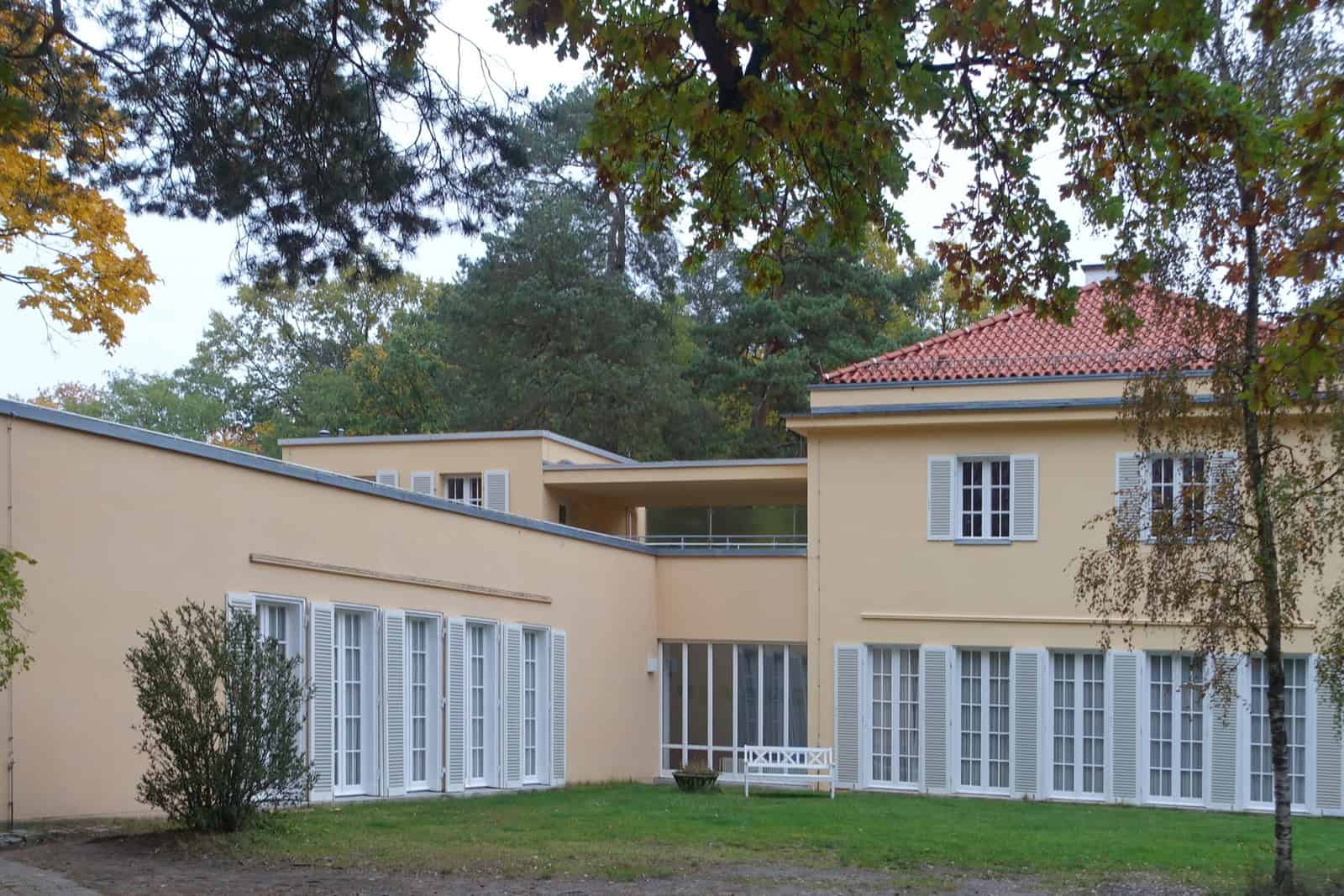
Haus Perls in Berlin-Zehlendorf, where Eduard Fuchs housed his collection. Photograph by Bodo Kubrak, CC BY-SA 4.0, via Wikimedia Commons.
Why a Public Auction Can Still Be a Forced Loss
Fuchs was a writer, cultural historian, collector, and political activist. An official Staatsgalerie Stuttgart record says that police sought him immediately after the Reichstag fire, that the Gestapo looted his Berlin villa and confiscated parts of his collection in March 1933, and that he fled with his wife Margarete to Paris. His prohibited books were burned, cutting off royalties. By December 1936, illness and financial pressure led him to ask his daughter Gertraud to liquidate the remaining assets; six auctions dispersed the collection in 1937 and 1938.
German restitution guidance explains why that sequence can outweigh the formal appearance of a sale. For property transferred through a legal transaction during persecution, the federal, state, and municipal guidelines apply a rebuttable presumption that the loss was persecution-related. Rebuttal requires evidence of a fair price and the seller’s freedom to use the proceeds. For a sale after September 15, 1935, it also requires showing that the transaction would have occurred without Nazi rule or that it protected the victim’s financial interests in a substantial way.
This is the crucial distinction in the Wuppertal decision: restitution does not require a painting to have been seized permanently from a wall and transferred directly into a state collection. A coerced liquidation can qualify. At the same time, the decision is not a finding that every later holder committed wrongdoing, nor is it a judicial verdict against Gurlitt; it is the city and museum’s conclusion about the cause of Fuchs’s loss.

The Von der Heydt Museum in Wuppertal, which returned Max Slevogt’s Paradiesvögel in 2026. Photograph by Ökologix, via Wikimedia Commons, licensed under Creative Commons Attribution-Share Alike 3.0 Germany; cropped.
A Second Slevogt Return Reveals the Collection-Wide Pattern
Wuppertal’s return is not an isolated Slevogt case. In October 2024, the Staatsgalerie Stuttgart returned Slevogt’s 1899 triptych Der verlorene Sohn (The Prodigal Son) to the same heirs. Fuchs had owned that work from 1911. It failed to sell at Lepke in 1937 and was offered there again in June 1938; the Staatsgalerie says it probably sold afterward for about 1,700 RM, below value.
The triptych later reached the Staatsgalerie through a 1956 bequest. After restitution, Ketterer sold it in December 2024 for €558,800 including premium. Paradiesvögel followed a different postwar route and entered a different museum, but both works passed out of the same collection through the auction program created by Fuchs’s forced liquidation.
That comparison strengthens the Wuppertal finding without turning one case into proof of the other. Each object still requires its own identification and ownership chain. Together, however, the two restitutions show that the liquidation operated across the collection and that museum acquisition decades later did not erase the circumstances under which the works first left Fuchs.
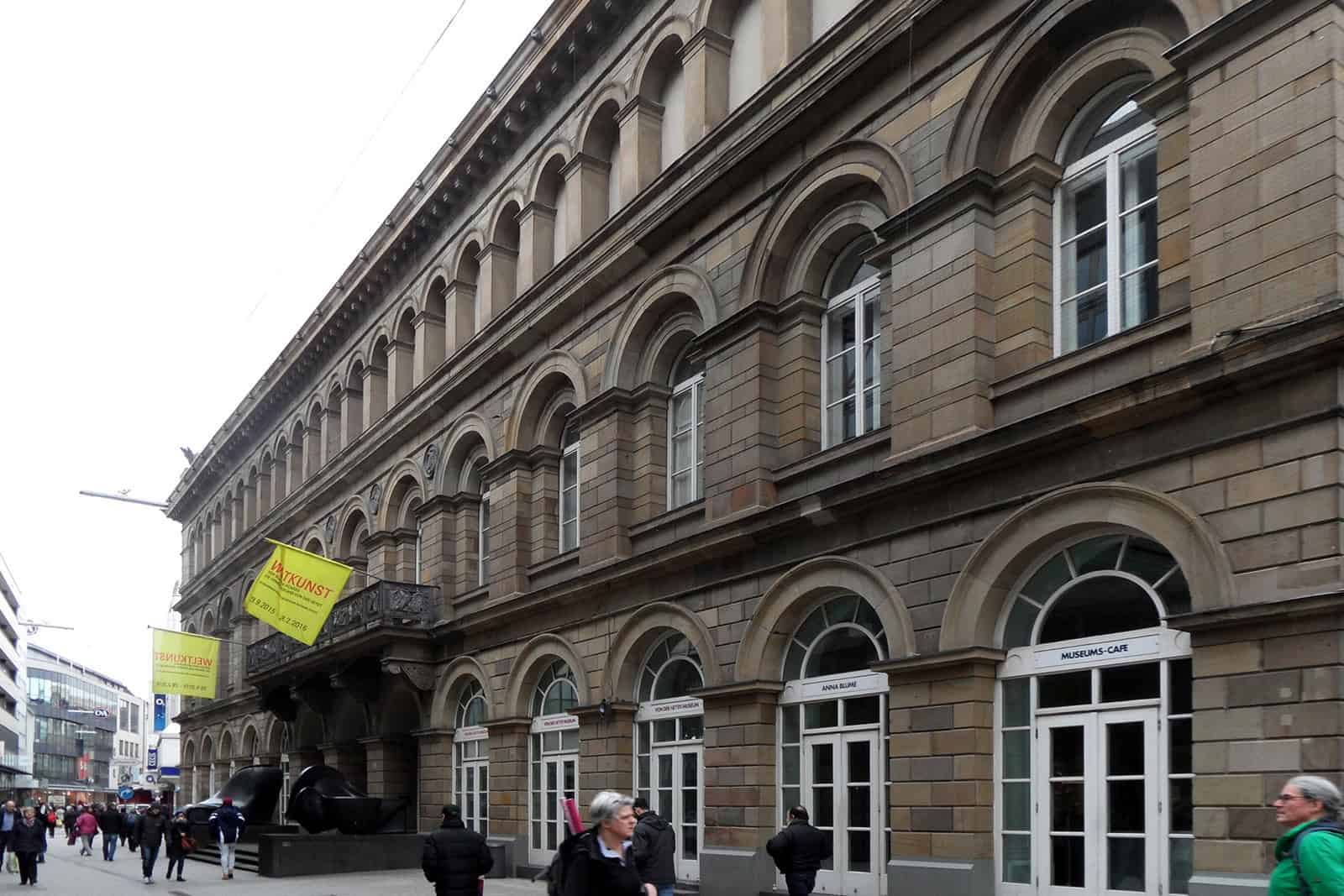
The Von der Heydt Museum in Wuppertal. Photograph by onnola, CC BY-SA 2.0, via Wikimedia Commons.
Restitution Restored Choice Before the Painting’s Next Sale
Paradiesvögel is scheduled for Ketterer Kunst’s Day Sale in Munich on December 5, 2026, as lot 152. The estimate is €40,000 to €60,000, and the catalogue states that the work is free of restitution claims. The listing does not publicly identify the consignor.
A return to market does not undo a restitution. The remedy transfers authority over the object back to the heirs; it does not require them to preserve a museum’s display plans or hold the work indefinitely. That distinction—restitution as restored decision-making power rather than a guarantee of permanent public display—also matters in the recent return of a Nazi-looted Goudstikker portrait from Argentina.
The €40,000-to-€60,000 estimate is far below the €558,800 result for Der verlorene Sohn, but estimates are nonbinding indications of market value and the works are not directly comparable. The Stuttgart work is a monumental triptych associated with Slevogt’s breakthrough; Paradiesvögel is a smaller, single canvas. Restitution joins their histories, not their prices.
The 1937 Loss Is Settled; the December Result Is Not
The record now establishes that Fuchs owned Paradiesvögel by 1909, Lepke auctioned it in June 1937, Gurlitt bought it, and the Von der Heydt Museum acquired it from Lempertz in 2006. Wuppertal’s provenance review classified the 1937 transfer as a persecution-related loss, and the City Council approved restitution to Fuchs’s heirs.
Germany’s restitution guidelines explain why a documented auction does not rebut coercion on its own, while the 2024 return of Der verlorene Sohn shows the same forced liquidation affecting another major Slevogt in Fuchs’s collection. The identity of any buyer and the hammer price remain unknown until the December 5 sale.

Isabella studied at the University of Cape Town in South Africa and graduated with a Bachelor of Arts majoring in English Literature & Language and Psychology. Throughout her undergraduate years, she took Art History as an additional subject and absolutely loved it. Building on from her art history knowledge that began in high school, art has always been a particular area of fascination for her. From learning about artworks previously unknown to her, or sharpening her existing understanding of specific works, the ability to continue learning within this interesting sphere excites her greatly.
Her focal points of interest in art history encompass profiling specific artists and art movements, as it is these areas where she is able to really dig deep into the rich narrative of the art world. Additionally, she particularly enjoys exploring the different artistic styles of the 20th century, as well as the important impact that female artists have had on the development of art history.
Learn more about Isabella Meyer and the Art in Context Team.
Choose Art in Context as a preferred source to see more of our reporting in Google Top Stories and other Google Search experiences.
Cite this Article
Isabella, Meyer, “Why Wuppertal Returned Max Slevogt’s ‘Paradiesvögel’.” Art in Context. November 11, 2026. URL: https://artincontext.org/max-slevogt-paradiesvoegel-restitution-fuchs-heirs/
Meyer, I. (2026, 11 November). Why Wuppertal Returned Max Slevogt’s ‘Paradiesvögel’. Art in Context. https://artincontext.org/max-slevogt-paradiesvoegel-restitution-fuchs-heirs/
Meyer, Isabella. “Why Wuppertal Returned Max Slevogt’s ‘Paradiesvögel’.” Art in Context, November 11, 2026. https://artincontext.org/max-slevogt-paradiesvoegel-restitution-fuchs-heirs/.


