


Marc Chagall’s Palais Garnier Ceiling Faces Lawsuit Threat

A descendant of Jules-Eugène Lenepveu says he has instructed a lawyer to seek the removal of Marc Chagall’s 1964 painted ceiling at the Palais Garnier and re-expose Lenepveu’s original, completed in 1871. The reported instruction marks an escalation, but it is not a verified court filing or an official decision to alter the protected auditorium.
The Legal Threat Is Real, but No Case Is Yet Public
The Guardian reported on October 12 that Arnaud Carayon, a Lenepveu descendant and president of the Friends of Lenepveu Society, had instructed a lawyer to take the dispute to court. The statement is attributable to Carayon. The report does not identify the lawyer, a court, a filing date, a case number or a pleaded cause of action, but says the intended action would seek to uncover and restore the original ceiling.
That distinction matters. Instructing counsel can precede litigation, but it is not the same event as lodging a claim.
The escalation follows a documented campaign. Le Monde reported on August 30 that Carayon had written to President Emmanuel Macron on February 23, proposing that the two ceilings alternate every ten years. The president’s chief of staff replied on March 6 that Macron was particularly attentive to the request. At that stage, Carayon was considering action that might reach the Conseil d’État, France’s highest administrative court.
The October statement is therefore new, but narrower than an announced lawsuit. Neither report identifies a filed proceeding, and neither quotes the Paris Opera as agreeing to uncover Lenepveu’s work. Le Monde reported only that Chagall’s heirs were in contact with the culture ministry and Carayon’s association.

Two Monumental Paintings Occupy the Same Dome
The dispute is possible because the paintings coexist physically. Lenepveu created an allegorical ceiling commonly called The Muses and the Hours of Day and Night for the opera house inaugurated in 1875. It is oil painted on copper plates, not a fresco in the strict technical sense.
Chagall’s intervention did not scrape away that surface. His composition consists of 24 canvases mounted on a polyester support a few centimeters below Lenepveu’s painting. Le Monde reported that removability was part of the project from the outset; Chagall’s son David McNeil recalled that his father insisted on preserving the earlier work.
The commission came late in Marc Chagall’s career. Working with three assistants, he translated a small model into a 220-square-meter composition that was installed in September 1964. Its five main color zones honor 14 composers through figures and scenes drawn from opera and ballet.
The floating performers, animals, Paris landmarks and saturated color connect the ceiling to motifs found across Chagall’s paintings. Yet its meaning also depends on its location: the modern canvas is surrounded by Charles Garnier’s gilded Second Empire auditorium while concealing the 19th-century allegory designed for that room.

Jules-Eugène Lenepveu’s 1872 final model for the original Palais Garnier auditorium ceiling, hosted by Wikimedia Commons and marked with the Creative Commons Public Domain Mark 1.0.
Historic-Monument Status Does Not Choose a Winner
Carayon has described Lenepveu’s ceiling as a classified historic monument. The authoritative Mérimée record maintained by France’s Ministry of Culture is broader and more precise: an order dated October 16, 1923, classified the theater’s architecture and its exterior and interior décor. The record also identifies the building as state property assigned to the culture ministry.
That classification recognizes the heritage value of the original decorative ensemble, but it does not itself produce an order selecting which painting must be visible. Article L621-9 of the French Heritage Code requires administrative authorization for restoration, repair or modification of a classified building. Any project that changes the auditorium would consequently involve the state’s monument-control process, regardless of a private claimant’s preferred outcome.
A separate question concerns artists’ moral rights. Maryvonne de Saint-Pulgent, an honorary section president at the Conseil d’État, characterized the situation to Le Monde as a conflict between the moral rights attached to the two artists. That is an expert assessment, not a judgment in this dispute. The Guardian identifies neither a filed proceeding nor the legal theory Carayon’s lawyer may pursue.
The layered construction makes exposure technically conceivable, but it does not make removal legally or conservationally automatic. Carayon told the Guardian that the ceiling “hasn’t been seen for 60 years” and said its condition is unknown.
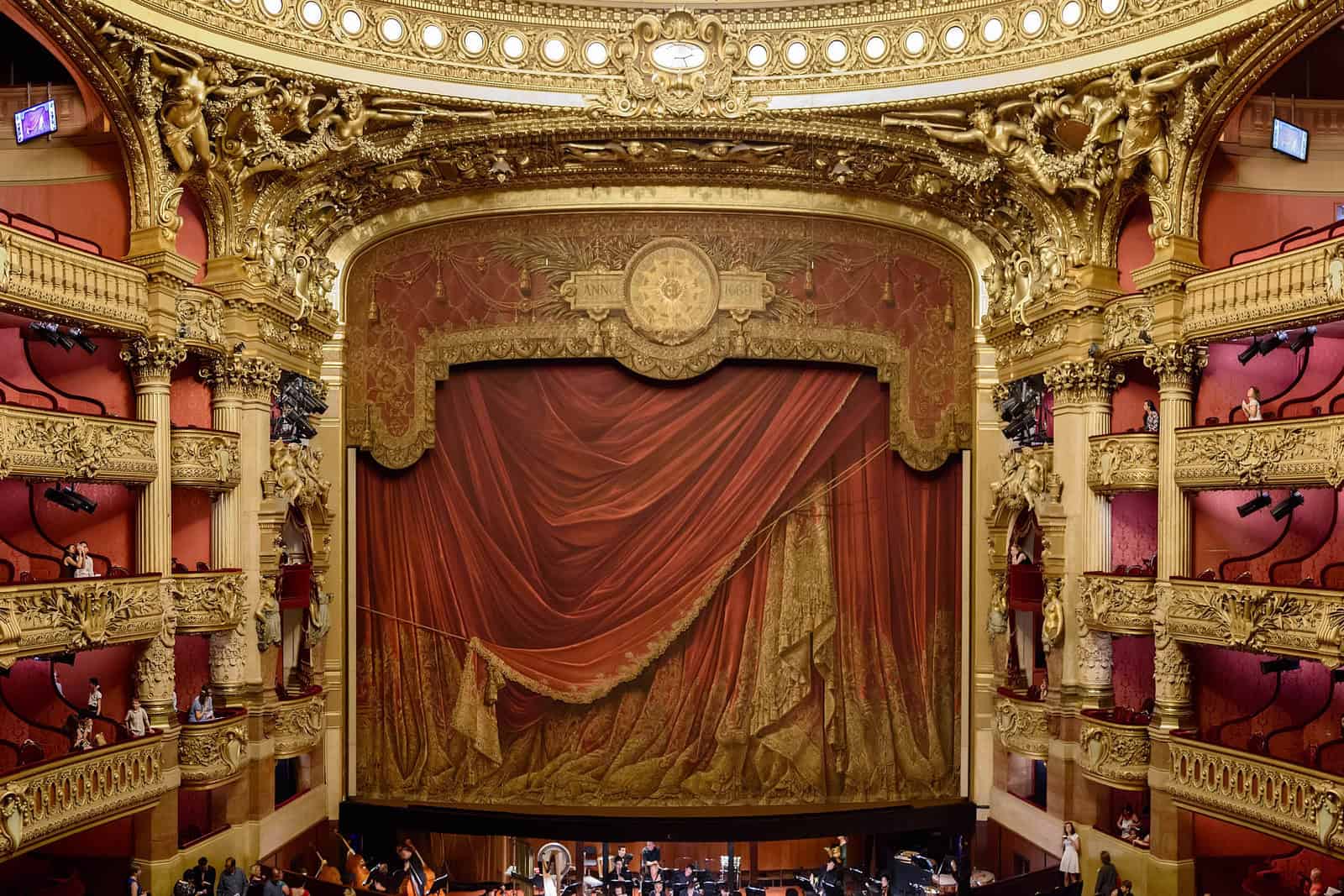
The architecture and interior décor of the Palais Garnier auditorium. Photograph by Joe deSousa, via Wikimedia Commons, released under CC0 1.0.
The Reported Renovation Timeline Needs Correction
The Guardian says the Palais Garnier will be closed for renovation between 2027 and 2032. The Paris Opera’s official renovation announcement gives a different and more limited schedule: the Palais Garnier stage is to close from summer 2027 to summer 2029, while visitor areas remain open throughout the work.
The same announcement places a temporary two-season closure of the Opéra Bastille’s stage around 2030. The 2027–32 span therefore combines work at two venues; it is not the stated closure period for the entire Palais Garnier. The renovation is frequently presented as the immediate opportunity to exchange the ceilings.
The official project describes continued façade restoration and modernization of the Palais Garnier stage house. It does not announce work on either auditorium ceiling. That omission does not prove that ceiling work could never be added, but it means Carayon’s proposal is not presently part of the published renovation program.
His alternating-ceiling plan also remains a proposal. The Paris Opera’s September 2025 renovation announcement gives no ceiling-removal timetable and announces no condition survey.
What Is Established—and What Is Not
The available institutional and contemporary records support four conclusions:
- The Guardian newly attributes an instruction to a lawyer directly to Carayon, but no court filing, forum or requested remedy has been made public.
- Le Monde establishes that the campaign preceded the October report: Carayon proposed a ten-year rotation in February and was considering legal action by August.
- The Ministry of Culture’s 1923 record classifies the theater and its interior décor, while the Heritage Code requires authorization for changes to a classified building; neither fact independently awards victory to one set of heirs.
- The Paris Opera says the Palais Garnier stage will close from summer 2027 to summer 2029 while visitor areas remain open, contradicting the Guardian’s description of a 2027–32 closure of the Palais Garnier.

Isabella studied at the University of Cape Town in South Africa and graduated with a Bachelor of Arts majoring in English Literature & Language and Psychology. Throughout her undergraduate years, she took Art History as an additional subject and absolutely loved it. Building on from her art history knowledge that began in high school, art has always been a particular area of fascination for her. From learning about artworks previously unknown to her, or sharpening her existing understanding of specific works, the ability to continue learning within this interesting sphere excites her greatly.
Her focal points of interest in art history encompass profiling specific artists and art movements, as it is these areas where she is able to really dig deep into the rich narrative of the art world. Additionally, she particularly enjoys exploring the different artistic styles of the 20th century, as well as the important impact that female artists have had on the development of art history.
Learn more about Isabella Meyer and the Art in Context Team.
Choose Art in Context as a preferred source to see more of our reporting in Google Top Stories and other Google Search experiences.
Cite this Article
Isabella, Meyer, “Marc Chagall’s Palais Garnier Ceiling Faces Lawsuit Threat.” Art in Context. October 12, 2026. URL: https://artincontext.org/marc-chagall-palais-garnier-ceiling-lawsuit-threat/
Meyer, I. (2026, 12 October). Marc Chagall’s Palais Garnier Ceiling Faces Lawsuit Threat. Art in Context. https://artincontext.org/marc-chagall-palais-garnier-ceiling-lawsuit-threat/
Meyer, Isabella. “Marc Chagall’s Palais Garnier Ceiling Faces Lawsuit Threat.” Art in Context, October 12, 2026. https://artincontext.org/marc-chagall-palais-garnier-ceiling-lawsuit-threat/.


