


Mark Bradford – Excavating the Hidden Social Life of the City

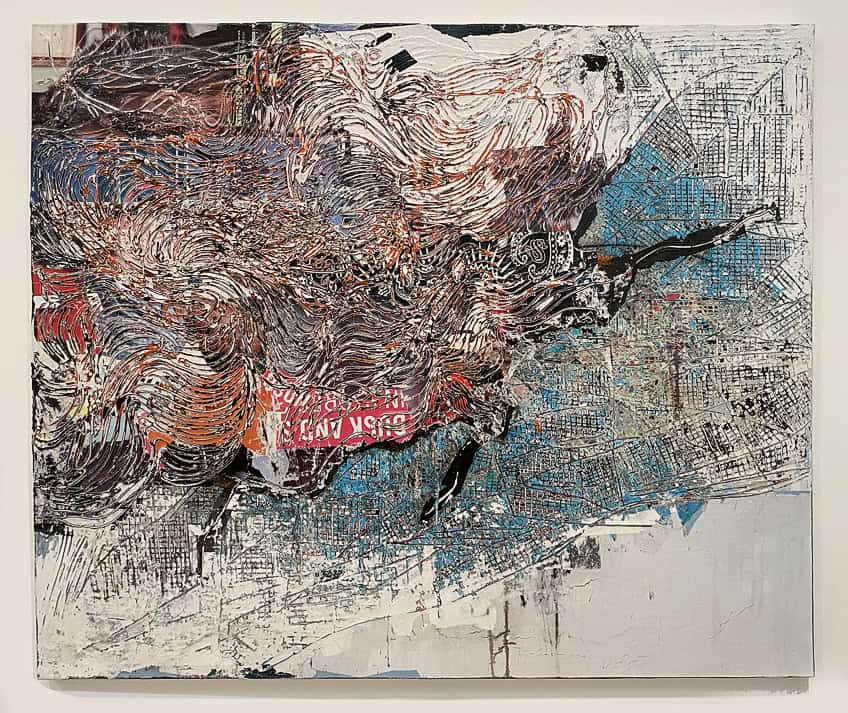
Mark Bradford transforms paper gathered from the visual life of cities into monumental abstract paintings. Maps, advertisements, billboards, comic books and neighborhood merchant posters are layered, cut, sanded and excavated until fragments of language and color resemble damaged streets, aerial views or geological formations. Although Bradford’s paintings are often visually spectacular, their scale is never the whole story. Their materials connect abstraction to race, class, sexuality, migration, commerce and the uneven development of American cities. Across paintings, videos, installations and community initiatives, he asks who occupies public space, whose histories remain visible and what can be discovered beneath an apparently familiar surface.
Key Takeaways
- Mark Bradford is a Los Angeles artist born in 1961 and is best known for large abstract paintings made primarily from paper.
- His early use of translucent hairdressing end papers emerged from his experience working in his mother’s beauty salon.
- Merchant posters, maps and street advertisements give his paintings a direct material connection to urban economies and neighborhood life.
- Bradford builds his surfaces through accumulation and then creates images by sanding, tearing, cutting and removing material.
- His practice extends beyond painting through video, sculpture, public installations and long-term social projects such as Art + Practice.
Who Is Mark Bradford?
Mark Bradford was born in Los Angeles in 1961. He grew up in South Los Angeles and moved with his mother to Santa Monica when he was eleven. As a young adult, he worked as a hairdresser in the beauty salon his mother operated in the Leimert Park neighborhood.
Bradford did not follow the conventional path of an artist who entered art school immediately after high school. He began his formal education at the California Institute of the Arts in his early thirties, receiving a BFA in 1995 and an MFA in 1997. The experiences he brought with him—from beauty culture and service work to the streets and commercial spaces of Los Angeles—became integral to his artistic language.

His first solo exhibition, Floss, was presented at the San Francisco Art Institute in 1998. In 2001, his participation in Freestyle at the Studio Museum in Harlem introduced his work to a wider museum audience. Bradford subsequently appeared in the 2006 Whitney Biennial, where he received the Bucksbaum Award, followed by the Whitney Museum exhibition Neither New nor Correct in 2007.
How Does Mark Bradford Make His Paintings?
End Papers and the Beauty Salon
The origins of Bradford’s mature technique can be traced to an ordinary material from the hairdressing profession. End papers are small, thin sheets of translucent tissue used to protect hair during permanent-wave treatments. Bradford began incorporating them into his work while studying at CalArts in the late 1990s.
Early paintings such as Click, 43G Spring Honey and Eve, all from 2001, arrange end papers into grids, fields and flickering accumulations.
Their restrained surfaces can initially recall Minimalism or postwar monochrome painting. Yet the material brings another history into that formal conversation: the labor, conversations, rituals and economic networks of Black beauty salons. Bradford’s end papers therefore perform two roles at once. They function as visual units within an abstract composition, but they also retain associations with a specific workplace and community. This double identity became fundamental to his later practice.
Merchant Posters and Social Papers
Bradford gradually expanded his vocabulary from end papers to what he has called social papers. These include maps, advertisements, billboards, movie posters, comic books and merchant posters connected to the streets around his studio.
Merchant posters are inexpensive notices advertising services such as child care, cash loans, bail bonds, divorce assistance, car sales and the purchase of distressed homes. They are commonly attached to walls, fences, utility poles and temporary surfaces in economically pressured neighborhoods. Their urgent promises reveal how businesses target residents according to local needs, insecurities and financial conditions.

Bradford collects, copies or otherwise incorporates this commercial language into his work. English and Spanish text may appear briefly before being obscured by another layer. Phone numbers, prices and promotional phrases become pieces of a larger visual system. Even when they are no longer legible, they carry evidence of the communities and informal economies from which they emerged.
Building by Removing
Bradford’s paintings develop through a sustained cycle of construction and destruction. He adheres paper to canvas, combines it with paint and other materials, and may use cords or caulk to establish lines beneath the surface. More paper is added until the composition contains a compressed history of its own making.
He then cuts, tears, sands, scrapes and peels the accumulated surface. This removal is not merely a finishing effect. It is one of the principal ways the image is produced. Buried colors return, fragments of words become visible and incisions turn underlying lines into ridges, streets or scars.
The results can resemble weathered walls, burned land, urban plans or landscapes seen from above. Yet Bradford’s pictures are not simply collages of found paper. Through repeated processing, paper becomes pigment, structure and terrain. The boundary between material and image begins to disappear.
How to Recognize a Mark Bradford Painting
- Large surfaces containing many compressed layers of paper and color
- Linear networks resembling roads, boundaries, transit routes or digital diagrams
- Partially concealed words, numbers and fragments of advertising
- Areas that appear scraped, eroded, burned, cracked or excavated
- A tension between distant map-like order and close-up physical disorder
- Materials carrying traces of specific neighborhoods, industries or social histories
Why Are Maps Important in Bradford’s Art?
Maps give Bradford a structure through which he can connect abstract painting to lived experience. Street grids, transit systems and zoning patterns organize movement, but they also reflect political decisions. Highways can divide neighborhoods. Commercial corridors reveal patterns of investment. Boundaries determine access to housing, education and public services. Bradford does not normally reproduce these systems as neutral diagrams. He breaks them apart, overlays them and subjects them to physical pressure. A street-like line may suddenly vanish beneath a dense field. A district may become a void. From a distance, the composition can appear organized; closer inspection reveals instability and damage.

The term social abstraction is frequently used to describe this approach. It does not mean that every color or mark possesses a fixed symbolic translation. Instead, Bradford creates abstraction from materials and structures already embedded in social life. The painting remains open-ended, but it is not detached from history. Bradford’s maps do not simply show where people live. They examine the systems that determine how people move, gather, trade, remember and become separated from one another.
Major Mark Bradford Artworks
Los Moscos
Created in 2004, Los Moscos is an important early example of Bradford’s expanding urban vocabulary. The painting incorporates numerous pieces of printed paper associated with the area around his South Central Los Angeles studio, including posters, flyers and product packaging.
Its lines and clusters evoke a city seen simultaneously from the street and from above.
Words are present but difficult to stabilize, while color appears to have accumulated through countless separate encounters. Now in Tate’s collection, the work helped establish Bradford’s reputation for turning the everyday visual debris of the city into complex abstract space.
Scorched Earth
Bradford’s 2006 painting Scorched Earth resembles an aerial map whose central territory has been blackened or erased. The work refers to Tulsa’s Greenwood district, a prosperous Black community known as Black Wall Street before white mobs devastated it during the 1921 Tulsa Race Massacre.

Rather than illustrate the attack directly, Bradford represents historical destruction through altered geography. Roads, property divisions and dense layers surround an expanse that seems burned into the surface. The absence becomes a form of evidence: a community’s physical destruction is registered as a rupture in the map.
Helter Skelter I
At nearly 34 feet wide, Helter Skelter I from 2007 overwhelms ordinary expectations of painting. Its restless bands, ruptures and densely worked passages extend across the viewer’s field of vision, making it difficult to absorb the entire composition from a single position. The work marked Bradford’s increasingly ambitious engagement with scale. Its title invokes a phrase burdened by the sensational history of Charles Manson and Los Angeles mythology, but the painting refuses to resolve into a single narrative.
Instead, it stages the city as a fractured field of movement, memory and competing associations.
Tomorrow Is Another Day
Bradford represented the United States at the 2017 Venice Biennale with Tomorrow Is Another Day. The exhibition transformed the neoclassical United States Pavilion through paintings and imposing installations that altered how visitors entered and moved through its rooms. The title painting, created in 2016, combines paper, bleach, caulk and other materials in a field of blue, red and yellow. Grooves and orb-like shapes interrupt its surface. Its title comes from the closing line of the film Gone with the Wind, connecting an apparently optimistic phrase to a romanticized portrayal of the American South.

Other works in the presentation drew upon the story of Hephaestus, the Greek god cast from Olympus because of his disability. The suspended mass of Spoiled Foot forced visitors toward the edges of the room, making physical exclusion part of the viewing experience. The exhibition’s importance also extended outside the pavilion. Bradford initiated Process Collettivo, a six-year collaboration with the Venetian nonprofit Rio Terà dei Pensieri, supporting employment and skills development for people incarcerated in Venice and those returning to society.
Pickett’s Charge
Pickett’s Charge, unveiled at the Smithsonian’s Hirshhorn Museum in 2017, is one of Bradford’s most extensive installations. Eight paintings, each more than 45 feet long, surround the museum’s circular interior and cover almost 400 linear feet. The work begins with reproductions of Paul Philippoteaux’s nineteenth-century cyclorama depicting Pickett’s Charge, the failed Confederate assault during the Battle of Gettysburg.
Bradford overlays the reproductions with colored paper and then cuts, tears and scrapes them. Soldiers and landscapes emerge in fragments before disappearing into abstract fields. Historical paintings often present themselves as windows onto the past, even when they transform events into patriotic spectacle.
Bradford makes that process visible. By damaging and reorganizing the cyclorama, he asks how images create historical memory, which narratives receive monumental treatment and why conflicts over the past continue in the present.
We The People
Created in 2017 and installed at the United States Embassy in London the following year, We The People consists of 32 canvases, each approximately ten feet square. Together they fill the embassy’s multi-story atrium.

The composition contains fragments and complete articles from the United States Constitution, beginning with the preamble in the upper-left section. Bradford’s familiar layering and abrasion make portions of the document difficult to read. The Constitution appears simultaneously foundational and contested: a living text whose promises have repeatedly been interpreted, expanded, restricted and challenged.
Video, Sculpture and Installation
Painting remains central to Bradford’s reputation, but his practice has never been confined to a flat surface. His videos and installations allow bodies, voices and architectural space to become part of the work. In the 2005 video Niagara, a young Black man named Melvin walks away from the camera with a deliberate movement that recalls Marilyn Monroe in the 1953 film of the same title. The work quietly complicates conventions of race, gender, sexuality, celebrity and who is permitted to command the camera’s gaze.
Pinocchio Is On Fire combines Bradford’s voice with memories of the AIDS crisis and the social worlds surrounding it. Rather than treating queer history as an abstract theme, the work draws attention to the losses, conversations and cultural pressures experienced by particular communities.
Installations such as Spoiled Foot place material directly in a visitor’s path. The viewer must negotiate the work rather than stand comfortably before it. In this way, Bradford translates questions of access, exclusion and movement into physical situations.
Scorched Earth at the Hammer Museum
Bradford’s 2015 Hammer Museum exhibition Scorched Earth was his first solo museum presentation in Los Angeles. Through paintings and multimedia works, it examined the city in the aftermath of the 1992 uprising while addressing Black identity, gender, queer politics, homophobia and the AIDS crisis.
For Finding Barry, Bradford removed more than 100 layers of paint from the museum’s lobby wall. The resulting image mapped state-by-state rates of HIV diagnoses using 2009 data. Institutional decoration was physically stripped away to expose another kind of national picture—one shaped by health, inequality and the uneven visibility of suffering.
Art + Practice and Community Engagement
Bradford’s concern with social structures also takes organizational form. In 2014, he co-founded Art + Practice in Leimert Park with Allan DiCastro and Eileen Harris Norton. The nonprofit presents museum-curated exhibitions and free public programs while working with partner organizations to support young people affected by the foster-care system. Art + Practice is not simply an illustrative extension of Bradford’s paintings. It is a sustained institution with its own partnerships, staff and responsibilities.
Its location is significant: Leimert Park is both a historic center of Black cultural life in Los Angeles and the neighborhood where Bradford once worked in his mother’s salon.
His other collaborations have similarly accompanied major exhibitions. Process Collettivo grew from the Venice Biennale presentation, while the Baltimore iteration of Tomorrow Is Another Day included a partnership with the Greenmount West Community Center and support for a community screen-printing facility. These projects demonstrate the breadth of Bradford’s practice, but they should not be used to reduce his paintings to social-service messages. The paintings and the organizations operate differently.
One creates ambiguous visual experiences; the other establishes practical relationships, resources and spaces.
How Has Bradford’s Art Continued to Develop?
Bradford has continued to test the familiar association between his work and urban cartography. In Exotica, presented in Hong Kong from 2024 to 2025, he drew upon images from a 1968 encyclopedia of exotic plants. Agaves, tangled woods and shadow-like impressions introduced a more visibly organic vocabulary. The series employed fabric dye, inked or oxidized paper and a staining process involving caulk. Its plants are not neutral botanical subjects. The language of the “exotic” carries a colonial history in which distant places, people and species were categorized through an outsider’s gaze.

The traveling survey Keep Walking, shown in Berlin, Seoul and Bern between 2024 and 2026, brought together paintings, installations, sculptures and videos from more than two decades. Its inclusion of works visitors could move around or even walk upon emphasized Bradford’s continuing interest in unstable ground and embodied viewing. In 2026, Bradford’s monumental City of the Big Shoulders became part of the Obama Presidential Center in Chicago. Spanning a three-story atrium wall, the commissioned painting approaches Chicago through fragmented maps, memory and accumulated history. It extends his long investigation of the city while responding to a specific public site.
Race, Class, Gender and Sexuality in Bradford’s Work
Bradford’s work is inseparable from his experience as a Black gay man, but it rarely offers autobiography in a straightforward form. Personal history enters through materials, cultural references, voices and spaces rather than conventional self-portraiture.
Race appears through histories of segregation, destroyed communities and the unequal organization of cities. Class becomes visible in merchant posters directed toward residents facing debt, legal difficulty or insecure housing. Gender and sexuality enter through beauty culture, performance, film, the AIDS crisis and the politics of visibility.
The abstraction is crucial because it prevents these subjects from becoming simple illustrations. Viewers encounter beauty, confusion and physical force before they can assign a single meaning. Bradford allows historical and social information to remain present without turning a painting into a diagram with one correct interpretation.
A Common Misconception About Bradford’s Paintings
Because Bradford uses street-related paper and map-like structures, his paintings are sometimes described as direct portraits of particular neighborhoods. That description is too narrow. A composition may draw upon an actual map or local advertisement, but the finished image is extensively reconstructed.
Its apparent streets may be cords buried beneath paper. Its districts may combine unrelated source materials. Words can migrate away from their original context. Bradford uses the city as material, structure and historical pressure—not simply as scenery.

It is therefore more useful to ask how a painting behaves than to search for a complete geographical key. Where does movement become blocked? Which fragments survive? What has been covered, and what has been forcibly brought back to the surface?
Exhibitions, Collections and Recognition
A major survey organized by the Wexner Center for the Arts opened in 2010 and traveled to the Institute of Contemporary Art in Boston, the Museum of Contemporary Art Chicago, the Dallas Museum of Art and the San Francisco Museum of Modern Art. Later presentations at the Hammer Museum, the Venice Biennale, the Baltimore Museum of Art, the Hirshhorn Museum and Hamburger Bahnhof further demonstrated the range of his practice.
Bradford’s work is represented in major public collections including Tate, the Museum of Modern Art, the Whitney Museum of American Art and The Broad. His honors include a MacArthur Fellowship in 2009, the United States Department of State Medal of Arts in 2014 and the 2023 National Medal of Arts, presented in 2024. He also received the Getty Prize in 2024.
Why Mark Bradford Matters
Mark Bradford has expanded the possibilities of abstraction by giving its surfaces a material connection to public life. Paper is never merely paper in his work. It can be a trace of labor, a commercial appeal, a political boundary, a discarded promise or the remains of an image that someone tried to conceal.
His paintings reward both distance and proximity. From across a gallery, they can resemble cities, landscapes or vast energetic systems. Up close, their authority begins to fracture into fibers, incisions, advertisements and incomplete words. That movement between overview and fragment is central to their power.

Bradford does not present the city as a stable subject that can be mastered from above. He treats it as a surface continually written, damaged and rebuilt by human decisions. By excavating that surface, he reveals history not as something finished, but as a force still shaping the ground beneath us.
Frequently Asked Questions
What Kind of Art Does Mark Bradford Make?
Bradford creates abstract paintings, works on paper, sculptures, videos and architectural installations. He is best known for monumental paper-based paintings whose layered surfaces evoke maps, streets and eroded urban walls.
What Materials Does Mark Bradford Use?
His materials include end papers, merchant posters, maps, billboards, advertisements, comic books, reproductions, paint, caulk, cord, bleach, ink and fabric dye. The exact combination changes between projects.
What Does Social Abstraction Mean in Relation to Bradford?
Social abstraction describes his use of abstract form in combination with materials and spatial systems carrying social histories. A painting may remain nonrepresentational while its paper, language and map-like structures connect it to race, labor, commerce, sexuality or urban inequality.
What Are Mark Bradford’s Best-known Works?
Frequently discussed works include Los Moscos, Scorched Earth, Helter Skelter I, Tomorrow Is Another Day, Pickett’s Charge and We The People.
Why Did Bradford Use Hairdressing End Papers?
He knew the material from working in his mother’s beauty salon. End papers gave him an inexpensive and visually adaptable material while connecting formal abstraction to Black beauty culture, service work and his personal history.
Is Mark Bradford’s Work a Form of Collage?
Collage is part of his process, but the term does not fully describe the results. Bradford transforms paper by layering, sanding, cutting and excavation until it functions like paint, skin or terrain rather than remaining a collection of clearly separate pasted images.
Where Can Mark Bradford’s Art Be Seen?
His work belongs to museums including Tate, the Museum of Modern Art and The Broad. Pickett’s Charge remains installed at the Hirshhorn Museum, while We The People occupies the atrium of the United States Embassy in London. Public commissions also include City of the Big Shoulders at the Obama Presidential Center in Chicago.
Cite this Article
artincontext, , “Mark Bradford – Excavating the Hidden Social Life of the City.” Art in Context. September 25, 2026. URL: https://artincontext.org/mark-bradford/
, a. (2026, 25 September). Mark Bradford – Excavating the Hidden Social Life of the City. Art in Context. https://artincontext.org/mark-bradford/
, artincontext. “Mark Bradford – Excavating the Hidden Social Life of the City.” Art in Context, September 25, 2026. https://artincontext.org/mark-bradford/.


