

UK Pauses Llannerch Park Painting Export Until 2027

The UK has deferred a decision on an export-licence application for A birds-eye view of Llannerch Park, Denbighshire, giving a domestic buyer until February 19, 2027, inclusive, to pursue the painting at £550,000 plus £11,000 VAT. The intervention matters because the large anonymous canvas is not merely a view of a surviving estate: it is a key visual record of a seventeenth-century Welsh garden whose original design has vanished.
The Export Licence Is Paused, Not Refused
The Department for Digital, Culture, Media and Sport announced the deferral on November 20, 2026. The Art Newspaper’s report followed on November 24. Those are publication dates; the operative event is the government’s November 20 decision to postpone ruling on the licence.
This is a temporary intervention, not a government purchase or a final refusal to export. A UK museum, gallery, or other appropriate purchaser now has an initial window to pursue a matching offer. The government’s recommended price is £550,000, with £11,000 VAT on top, making the stated total £561,000.
The Reviewing Committee on the Export of Works of Art and Objects of Cultural Interest found that the painting met the first and third Waverley criteria. Arts Council England’s guidance defines those tests as a close connection with British history and national life, and outstanding significance for the study of a branch of art, learning, or history. The government specifically cites Welsh and British garden history, landscape design, mid-seventeenth-century travel, and artistic activity around Chester. Its release identifies no reliance on the second criterion, outstanding aesthetic importance; that is not the same as declaring that the picture lacks aesthetic value.

Why the Painting’s Date Is Less Simple Than “1662”
The government identifies the work as English School, dated 1662, and gives its dimensions as 1,600 by 2,318 millimeters—about 5.25 by 7.6 feet. Its maker is unknown. The elevated view arranges a house, service buildings, terraces, orchards, and waterworks into a single, unusually expansive field.
The current official date is not the only one in the record. Sotheby’s 2014 catalogue headed the lot “English School, circa 1665.” Its note says an inscription visible in a 1943 reproduction, but apparently removed by 2014, suggested 1662; the cataloguer considered that year more likely to mark the garden’s beginning. “The 1662 painting” is therefore the government’s current designation, not an uncontested conclusion about when every part of the canvas was completed.
The image’s art-historical force comes from its density of observable design. Sotheby’s catalogued a mounted visitor approaching the entrance, stone vases on an upper terrace, garden houses, a semicircular stair, a flower garden, a central fountain, summer houses, a Neptune pool, and a bridge leading toward the River Clwyd. The bird’s-eye device makes the estate readable almost as a plan while retaining the scale and color of a painting.
Mutton Davies, the estate’s owner, developed the garden after continental travel. The government describes visits to France and Italy; Sotheby’s places his Italian journey between 1654 and 1658 and attributes the commission to him. The arrangement translated continental ideas into a Welsh setting before such country-estate views became common in Britain.
The seventeenth-century design is gone, but the site itself was not erased. Cadw’s official register records earthworks, a formal terraced garden with a canal, and later layers, including a 1927–1929 garden by Percy Cane. The canvas matters because it preserves the lost early layout, not because no trace or later garden history survives on the ground.
The Yale Version Is Related, but It Is Not a Substitute
Sotheby’s records two versions of the composition. Sotheby’s says the smaller version was acquired from Leggatt Brothers in 1968; it is now recorded in the Yale Center for British Art’s Paul Mellon Collection as B1976.7.115. It is similar in broad arrangement but includes St Asaph’s Cathedral on the horizon, a feature Sotheby’s says is absent from the larger canvas now under export deferral.
A related image of Llannerch is already held by a public collection in Connecticut, so the garden’s appearance would not disappear from institutional study if the larger painting left Britain. But the Yale work cannot stand in for the larger canvas under deferral: it differs in scale, detail, and ownership history. Sotheby’s further suggests that the larger version hung early at Gwysaney, another Davies property, while the smaller work followed a separate route.
The government’s scholarship case consequently concerns this particular object as well as its subject. Comparison between the two canvases could clarify how the composition developed, what was added or omitted, and how patrons used estate views across family properties. Export control addresses the location and accessibility of the larger work; it does not establish that the two paintings are interchangeable.
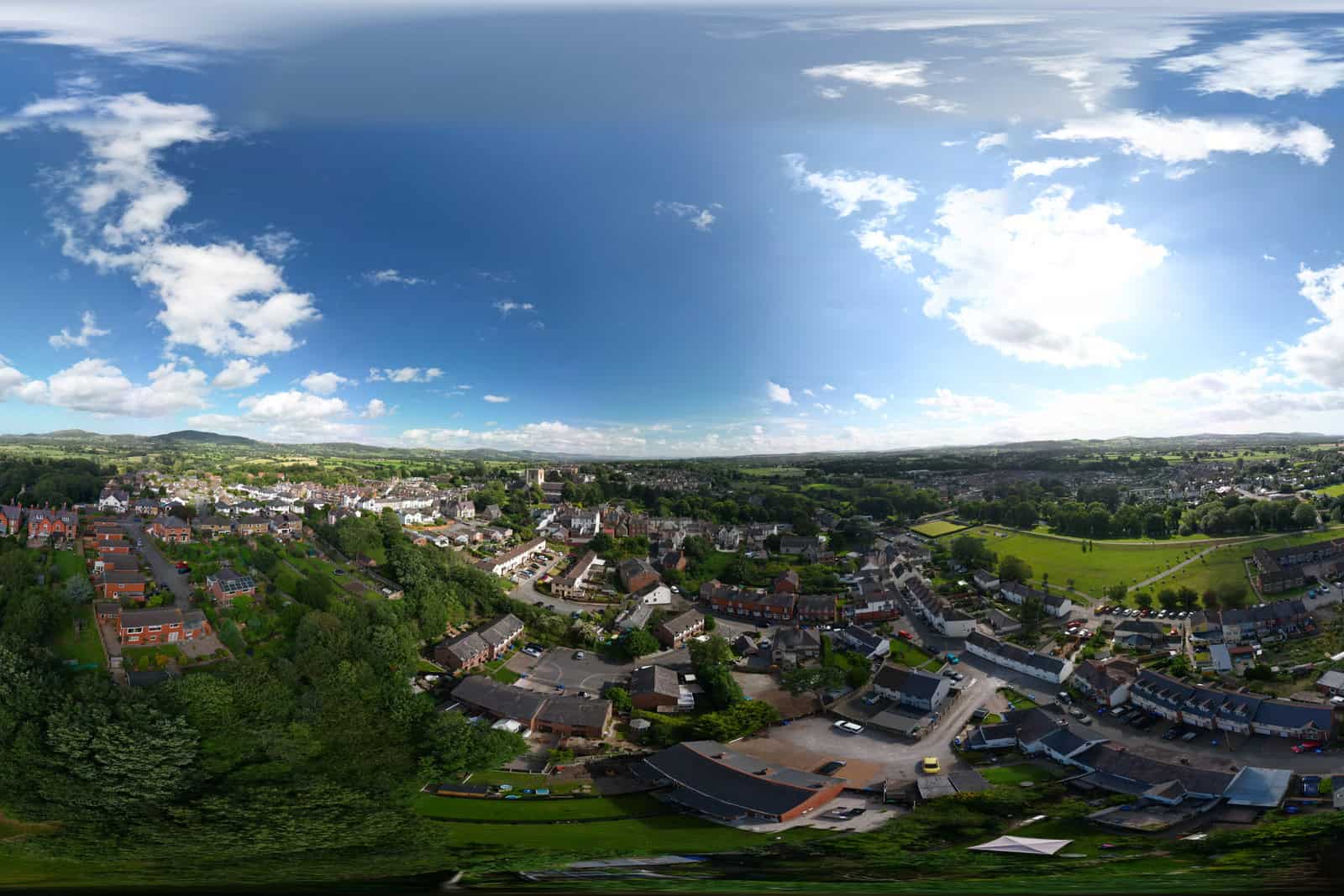
St Asaph’s Cathedral, the horizon feature Sotheby’s identifies in the Yale Llannerch canvas but not in the larger version. Photo: Llywelyn2000, via Wikimedia Commons, CC BY-SA 4.0.
The 2014 Auction Record Does Not Fully Align
Sotheby’s provenance begins with a commission circa 1662 and subsequent family descent, although its catalogue note presents Mutton Davies’s role as an attribution rather than a certainty. The picture was then offered as lot 41 in Sotheby’s Old Master and British Paintings evening sale on December 3, 2014, with an estimate of £400,000 to £600,000. The new £550,000 recommended price sits inside that twelve-year-old estimate, although an estimate and an export-case fair-market price are not the same kind of figure.
The lot failed to sell in 2014, with a contemporaneous sale report recording that bidding stopped at £360,000; the government’s later provenance note incorrectly describes it as sold. Sotheby’s public lot page shows the estimate and closed bidding but no realized price. The records establish that the work was offered in 2014, but not that a sale occurred.
The government has not identified the present owner. The Art Newspaper says a department spokesperson declined to provide further ownership details. The intended export destination is also undisclosed in the cited records. Those gaps matter because they prevent a complete ownership chronology, but they do not alter the validity or terms of the current deferral.
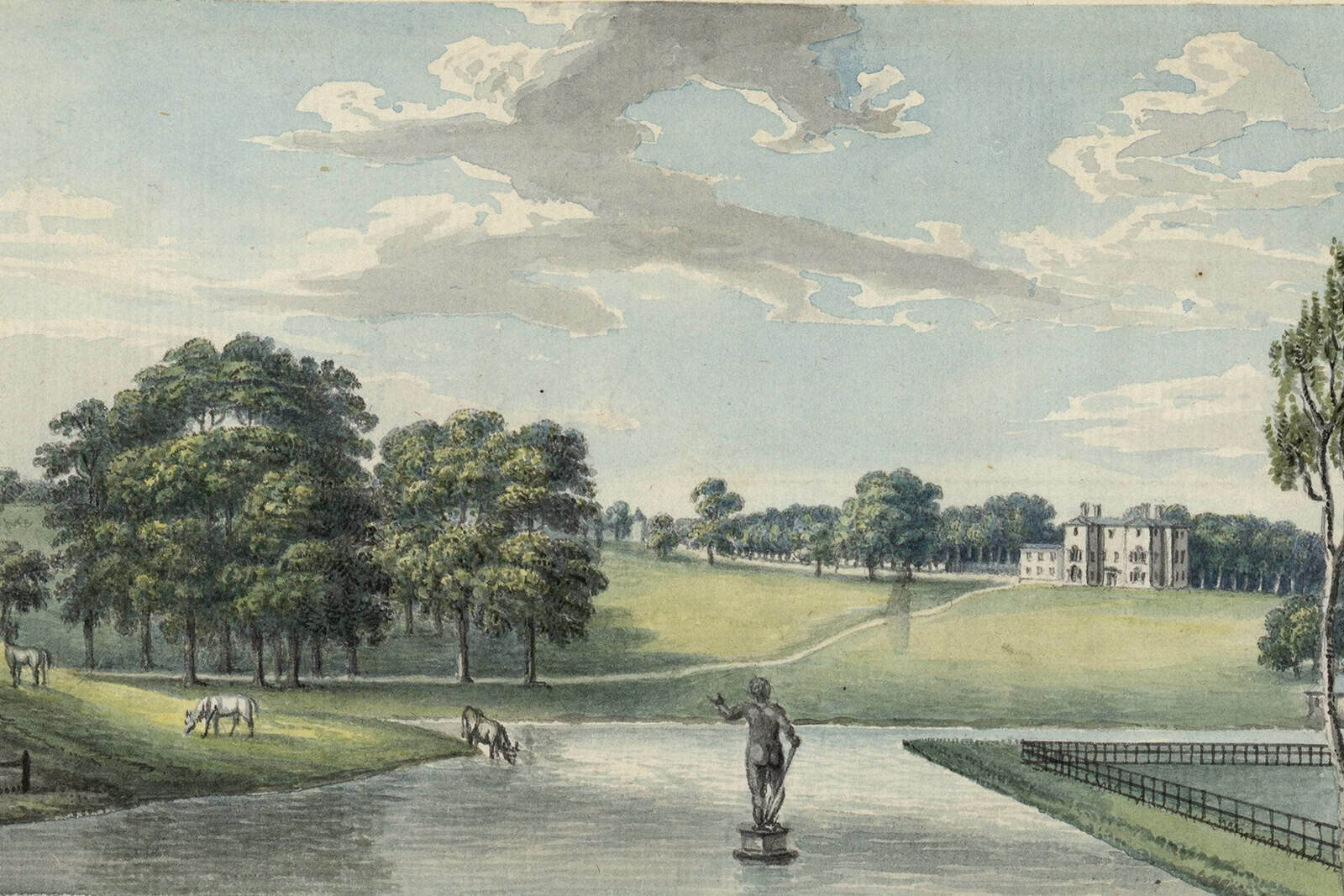
A later historical view of Llannerch Hall from Thomas Pennant’s extra-illustrated A Tour in Wales. National Library of Wales, via Wikimedia Commons (public domain).
What Happens by February 19, 2027
Expressions of interest are due during the initial period ending February 19, inclusive. That date is not a completed-sale deadline and it is not the date on which a four-month extension begins automatically. After the first period, the owner receives 15 business days to consider qualifying offers at the recommended price.
A second deferral begins only after an Option Agreement is signed, and it lasts four months. That additional period is designed to permit fundraising and completion. Any UK institution or private supporter prepared to secure public benefit would need to provide £561,000 including the stated VAT.

The smaller Yale version of Llannerch, Denbighshire, Wales, by an unknown artist, differs from the canvas under export deferral. Yale Center for British Art, via Wikimedia Commons, Public Domain Mark 1.0. Cropped.
What Is Settled—and What Is Not
The temporary export-licence deferral runs through February 19, 2027, under the history and scholarship criteria, at £550,000 plus £11,000 VAT. The present owner, intended destination, and prospective UK buyer remain undisclosed or unclear; the lot failed to sell in 2014, despite the government’s incorrect description of it as sold.

Isabella studied at the University of Cape Town in South Africa and graduated with a Bachelor of Arts majoring in English Literature & Language and Psychology. Throughout her undergraduate years, she took Art History as an additional subject and absolutely loved it. Building on from her art history knowledge that began in high school, art has always been a particular area of fascination for her. From learning about artworks previously unknown to her, or sharpening her existing understanding of specific works, the ability to continue learning within this interesting sphere excites her greatly.
Her focal points of interest in art history encompass profiling specific artists and art movements, as it is these areas where she is able to really dig deep into the rich narrative of the art world. Additionally, she particularly enjoys exploring the different artistic styles of the 20th century, as well as the important impact that female artists have had on the development of art history.
Learn more about Isabella Meyer and the Art in Context Team.
Choose Art in Context as a preferred source to see more of our reporting in Google Top Stories and other Google Search experiences.
Cite this Article
Isabella, Meyer, “UK Pauses Llannerch Park Painting Export Until 2027.” Art in Context. November 24, 2026. URL: https://artincontext.org/llannerch-park-painting-export-bar-2027/
Meyer, I. (2026, 24 November). UK Pauses Llannerch Park Painting Export Until 2027. Art in Context. https://artincontext.org/llannerch-park-painting-export-bar-2027/
Meyer, Isabella. “UK Pauses Llannerch Park Painting Export Until 2027.” Art in Context, November 24, 2026. https://artincontext.org/llannerch-park-painting-export-bar-2027/.


