

France’s 2027 Museum Budget Favors Pompidou, Cuts Louvre

France’s proposed 2027 budget raises the broad museum-heritage and visual-arts lines; the Centre Pompidou’s increase nearly matches the first line’s gross rise, while Louvre support falls. The figures are appropriations in a draft law, not enacted funding, but they reveal a clear hierarchy among France’s art institutions.
France’s Museum Increase Is Really a Reallocation
The government presented the budget bill on October 1, 2026. In the official comparison sent to the National Assembly, payment credits for the four-program Culture mission fall from €3.7445 billion in the 2026 finance law to €3.6492 billion in the 2027 proposal. That is a €95.35 million reduction, or 2.55 percent.
Payment credits are the amounts available to pay bills during the year. They are the most useful figures for comparing what institutions and programs may actually receive, but the totals below still mix sector-wide actions with grants to individual operators.
| Budget line | 2026 | 2027 draft | Change |
|---|---|---|---|
| Museums | €437.5m* | €454.6m | +3.92% |
| Visual arts | €152.4m* | €155.7m | +2.18% |
| Centre Pompidou | €113.0m | €129.8m | +14.9% |
| Louvre payment credits | €100.4m | €88.4m | −12.0% |
*Approximate 2026 baselines calculated from the published 2027 amounts and percentage changes; totals are rounded.
The detailed museum and visual-arts figures were reported by Le Journal des Arts on October 2. At the level of those rounded figures, the museums line gains about €17.1 million while the Centre Pompidou alone gains €16.8 million. In other words, nearly all of the gross museum increase is numerically matched by the rise for one institution.
That comparison does not prove that every additional euro in the museums action is reserved for Beaubourg; operator grants and action totals are not interchangeable accounting categories. It does show how little of the headline uplift remains visible after the Pompidou increase is set beside it.

Why the Centre Pompidou Dominates the Increase
The Centre Pompidou is in the middle of a full closure and renovation, with the Beaubourg building due to reopen in 2030. Its own project funding plan puts the renovation at €463 million: €283 million from the state and €180 million to be raised by the institution. The center said €100 million of its share had been secured and €80 million still had to be found.
The Court of Accounts published a higher €469 million estimate in June 2026 and warned that France faces more than €5 billion in major cultural-building needs through 2035. The audit called for multiyear prioritization rather than project-by-project decisions. The €6 million difference between the court’s figure and the center’s press kit may reflect timing or scope; neither project-cost estimate is directly comparable to the €129.8 million annual operator line.
That distinction matters. The €129.8 million figure is an annual grant to the operator, and the published budget summary does not assign the entire increase to a single construction payment. During the closure, the institution also continues exhibitions and collection loans through its Constellation program. Private giving remains part of the renovation plan—an extension of the long relationship between museums and art patronage—but money raised for a defined building project is not automatically available for recurring museum costs.
The Louvre Cut Is More Complicated Than One Number
Le Journal des Arts reports that Louvre payment credits fall from €100.4 million to €88.4 million, a €12 million decline. Separately, Le Monde reports a €3 million cut to the museum’s operating subsidy while saying the Louvre retains €10 million for its urgent multiyear master plan. Those statements describe different layers of the budget: total payment credits, recurring operating support, and a specified capital allocation.
The ministry told Le Monde that the Louvre’s higher ticket rate for visitors who are neither residents nor citizens of the European Economic Area would cushion the operating reduction. Le Monde noted that the more expensive tickets had initially been presented as a way to finance works. This leaves the Louvre with greater dependence on revenue it earns itself, even as the institution faces building and security demands. For context on the scale and history behind that financial exposure, see our guide to the Louvre Museum.
The distinction also prevents a misleading conclusion: retaining a €10 million master-plan allocation does not cancel out the reported €12 million fall in total payment credits, because the figures do not describe the same budget component. Nor does a fall in state support establish that the museum’s total annual resources will decline by the same amount; ticket sales, donations, and other own-source income sit outside the appropriation alone.

The Louvre Pyramid in Cour Napoléon. Photograph by Aliva Sahoo, via Wikimedia Commons. Licensed under CC BY-SA 4.0; cropped.
Why the Same Budget Is Down 2.55%, 1.6%, or 0.6%
The three percentages circulating in French coverage do not use one common baseline. The 2.55 percent figure is directly reproducible from the parliamentary mission table: compare the €3.7445 billion in Culture payment credits enacted for 2026 with the €3.6492 billion proposed for 2027.
Le Monde reported on October 2 that the proposal presents a 1.6 percent reduction, while Culture Minister Catherine Pégard argued at a briefing that the decline is only 0.6 percent after accounting for €64 million canceled during 2026. Her rate therefore compares the 2027 request with a reduced 2026 spending base, not with the amount Parliament originally enacted.
The cleanest measure of the year-to-year legislative choice is 2.55 percent. The 0.6 percent figure answers a different question—how the proposal compares with 2026 after in-year cuts. The 1.6 percent headline cannot be reproduced from the four-program Culture mission payment-credit totals published in the bill, so it should not replace the transparent mission-table calculation without a matching scope and denominator.
None of those overall percentages describes the distribution inside the budget. The Creation program falls 3.50 percent to about €963 million even as its visual-arts action rises 2.18 percent to €155.7 million. A protected visual-arts line is therefore real, but it does not mean every artist, art school, regional collection, or center receiving public support will gain.

Centre Pompidou in Paris. Photograph by Fred Romero, via Wikimedia Commons. Licensed under CC BY 2.0; cropped.
What Parliament Can Still Change
The October 1 document is a proposed finance law. Parliamentary amendments can change program totals and operator grants before a final law is enacted, and execution can later diverge through freezes or cancellations. The €129.8 million for the Centre Pompidou and €88.4 million in Louvre payment credits should therefore be treated as the government’s opening allocation, not guaranteed 2027 receipts.
The stakes are unusually visible because both museums have major capital needs. The Centre Pompidou is already closed for its transformation, while the Louvre is preserving a master-plan line even as its operating subsidy is reduced. France is not simply choosing “museums” over other cultural fields; within museums, it is prioritizing one active renovation while expecting the Louvre to absorb more pressure through its own income.
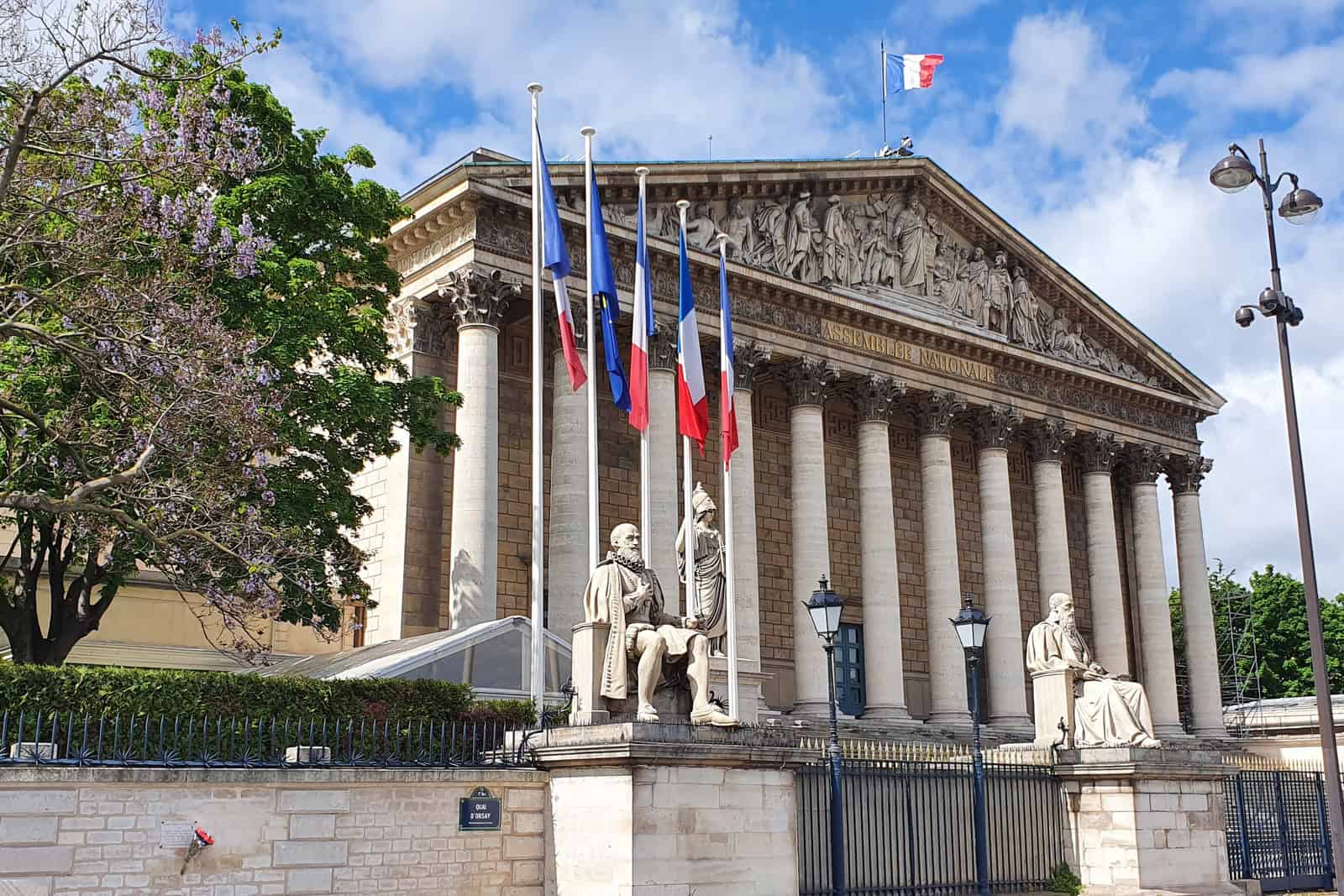
The French National Assembly at the Palais Bourbon. Photograph by BirchLog, via Wikimedia Commons. Licensed under CC BY-SA 4.0; cropped.
The Allocation the Draft Establishes
The official bill establishes a €95.35 million year-to-year cut to Culture mission payment credits, not the smaller rate produced by adjusting the 2026 baseline after cancellations. The published action figures show museums and visual arts rising, but almost the entire gross increase in the museums line is matched by the Centre Pompidou’s €16.8 million gain.
The Louvre’s reported total payment credits fall by €12 million; its operating subsidy loses €3 million while a separate €10 million master-plan allocation remains. The Centre Pompidou’s own project cost and the Court of Accounts estimate still differ by €6 million. What remains unknown is the allocation Parliament will finally enact and whether later execution measures will preserve the priorities visible in this draft.

Isabella studied at the University of Cape Town in South Africa and graduated with a Bachelor of Arts majoring in English Literature & Language and Psychology. Throughout her undergraduate years, she took Art History as an additional subject and absolutely loved it. Building on from her art history knowledge that began in high school, art has always been a particular area of fascination for her. From learning about artworks previously unknown to her, or sharpening her existing understanding of specific works, the ability to continue learning within this interesting sphere excites her greatly.
Her focal points of interest in art history encompass profiling specific artists and art movements, as it is these areas where she is able to really dig deep into the rich narrative of the art world. Additionally, she particularly enjoys exploring the different artistic styles of the 20th century, as well as the important impact that female artists have had on the development of art history.
Learn more about Isabella Meyer and the Art in Context Team.
Choose Art in Context as a preferred source to see more of our reporting in Google Top Stories and other Google Search experiences.
Cite this Article
Isabella, Meyer, “France’s 2027 Museum Budget Favors Pompidou, Cuts Louvre.” Art in Context. October 2, 2026. URL: https://artincontext.org/france-2027-museum-budget-pompidou-louvre/
Meyer, I. (2026, 2 October). France’s 2027 Museum Budget Favors Pompidou, Cuts Louvre. Art in Context. https://artincontext.org/france-2027-museum-budget-pompidou-louvre/
Meyer, Isabella. “France’s 2027 Museum Budget Favors Pompidou, Cuts Louvre.” Art in Context, October 2, 2026. https://artincontext.org/france-2027-museum-budget-pompidou-louvre/.


