


Jaume Plensa – How Monumental Faces Make Space for Silence

Jaume Plensa is best known for monumental heads with closed eyes and bodies assembled from letters, but his practice is broader than those immediately recognizable forms. Since the 1980s, he has moved among iron, bronze, glass, marble, resin, light, sound, water, video, and language to explore how an individual relates to a community. His public works turn plazas, shorelines, campuses, and former industrial sites into places for meeting, play, listening, or temporary withdrawal.
Key Takeaways
- Plensa was born in Barcelona in 1955 and studied at the Llotja School of Art and Design and the Sant Jordi School of Fine Arts.
- His early work emphasized heavy materials and abstract forms; later installations increasingly incorporated light, sound, words, transparent structures, and the human figure.
- Letters from different alphabets usually function as visual building units rather than sentences to be read in sequence.
- Crown Fountain, completed in Chicago in 2004, transformed his international public profile by combining architecture, video portraits, glass, light, and water.
- Large portrait works such as Dream, Echo, Behind the Walls, and Water’s Soul use altered proportions and restrained gestures to create moments of stillness within busy public settings.
Who Is Jaume Plensa?
Born in Barcelona in 1955, Plensa trained at two of the city’s art schools before holding his first exhibition there in 1980. He later lived and worked in Berlin, Brussels, England, France, and the United States before returning to Barcelona. That international career is relevant to an artist whose sculptures repeatedly consider how distinct languages and people occupy a shared space.
Plensa describes himself primarily as a sculptor, although his work includes drawing, printmaking, video, opera, and theater.
He has taught at the École nationale supérieure des Beaux-Arts in Paris and worked with the School of the Art Institute of Chicago as a guest professor. Since 1996, he has also designed for opera and theater; for the Gran Teatre del Liceu’s 2023 production of Verdi’s Macbeth, he served as stage director and designed the sets and costumes.

Literature, music, spiritual traditions, psychology, and the physical body recur throughout his practice. These interests are joined by a practical concern with materials and engineering. A sculpture might begin with a line of poetry, a filmed face, a found stone, or a model’s portrait, but its meaning changes through fabrication, scale, site, light, and the actions of viewers.
How His Sculptural Language Developed
Weight, Heat, and the Early Abstract Work
Plensa’s work of the 1980s and early 1990s often relied on iron, bronze, aluminum, and other physically assertive materials. Pieces such as Prière, 1989, belong to a period in which forged or cast forms, containers, architectural fragments, and bodily references appeared without the serene portrait heads now associated with his name. Heat, pressure, weight, and transformation were not merely production methods; they were part of how the sculpture communicated.
The 2000 exhibition Chaos-Saliva at the Museo Reina Sofía surveyed ten years in which his material vocabulary changed radically. Iron gave way at times to paraffin, alabaster, nylon, glass, sound, and light.
Sculpture became less an autonomous object and more an environment that a viewer entered or activated. The development was not a permanent shift from solid to immaterial: Plensa still works with bronze, stone, steel, and cast materials. Instead, he enlarged the range of ways a sculpture could occupy space.
Language Becomes Material
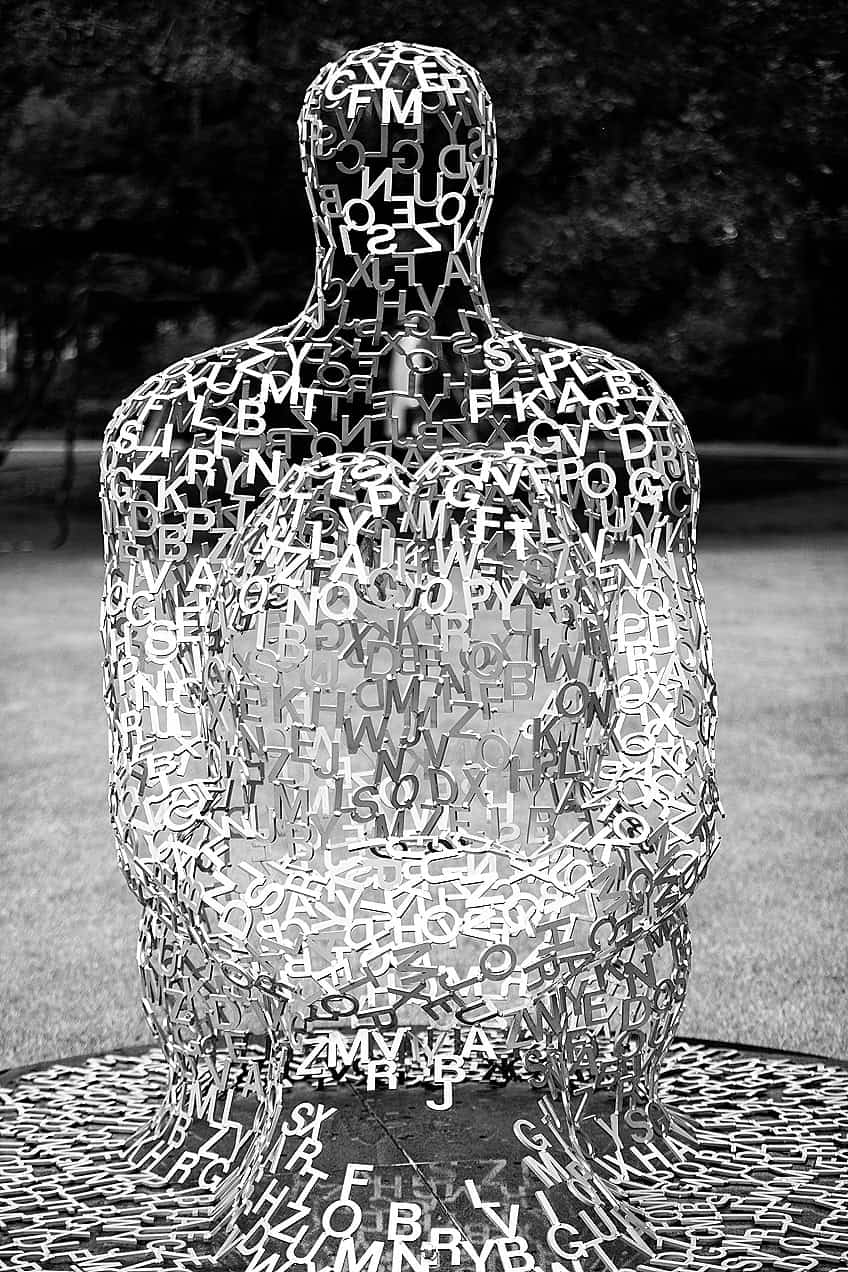
Words entered this practice through Plensa’s sustained engagement with poetry and literature. Some works use identifiable passages or titles drawn from writers such as Shakespeare, Blake, Baudelaire, and Eliot. In other sculptures, individual characters from Latin, Arabic, Hebrew, Greek, Cyrillic, Chinese, Japanese, and other writing systems are detached from sentences and welded into open skins.

These alphabet sculptures are not codes with one hidden translation. The characters often remain random and do not combine into a readable statement. Their shapes become structural units that let light and air pass through a seated body, head, roof, or curtain. Language is therefore both culturally particular and physically shared: each alphabet carries a history, while every letter also becomes line, aperture, shadow, and support.
From the Body to the Face
The human figure has appeared across Plensa’s career, but the monumental portrait head became especially prominent after Crown Fountain. He frequently works from scans or photographic information, then alters the proportions digitally.
Seen from the front, a face may appear long and narrow; from the side, its depth can be unexpectedly compressed. The distortion compensates for scale while denying the fixed viewpoint associated with a conventional portrait bust.
Many models are girls or young women depicted with closed eyes. Their identities are specific, and titles sometimes preserve their names, yet the smooth surfaces and altered proportions reduce anecdotal detail. Closed eyes redirect the expression away from outward performance. This can suggest listening, dreaming, or concentration, but those are visual possibilities rather than proof of a model’s inner state.
Why Silence, Listening, and Duality Recur
Plensa often places apparently opposite conditions in dialogue: material and spirit, light and darkness, speech and silence, interior and exterior, individuality and collectivity. His works do not necessarily resolve those pairings. A head can be monumental yet withdrawn, and a body made from language can remain literally open and silent. Water may create noise while the face beside it requests quiet. Silence in this work is not simply the absence of sound. It is a spatial interval that allows attention to shift.

The closed eyes of a portrait, the hollow interior of a letter figure, or the gap between two facing towers can create such an interval. Viewers supply movement, voices, memories, and interpretations, which means the calm appearance of the sculpture may coexist with a socially active site. This balance helps explain Plensa’s statement that sculpture is a way to ask questions. The works rarely deliver a written argument, even when built from letters. They establish situations: Can private reflection occur in a crowd? Can difference remain visible within a collective form? Can a public monument represent attention rather than power?
Crown Fountain: A Digital Portrait of Chicago
Unveiled in Millennium Park in 2004, Crown Fountain consists of two glass-block towers, each approximately 16 meters high, facing one another across a shallow black-granite pool. LED screens inside the towers display video portraits of 1,000 Chicago residents. At intervals, a filmed face purses its lips as water projects from the tower, updating the traditional fountain gargoyle through digital imagery. The range of materials is unusually broad: glass, stainless steel, LEDs, light, wood, granite, and water form one integrated work.
The horizontal sheet of water connects the vertical towers and is shallow enough for visitors to enter. Children run through it, people sit along its edges, and the changing faces address one another across the plaza. Participation is not added to the sculpture after completion; it is part of its public form.
The fountain also marks a turning point in Plensa’s use of portraiture. Instead of presenting one commemorated individual, it gives monumental scale to an evolving group of city residents. It does not represent all of Chicago through a statistical portrait, but it replaces the singular authority of a monument with plurality, repetition, and everyday interaction.
Five Public Works That Expand the Idea of a Portrait
Dream, 2009
Dream is a 20-meter-high head of a young girl with closed eyes, made from concrete and Spanish dolomite. It stands on the former Sutton Manor Colliery site in St Helens, England, where the mine closed in 1991. Former miners, the local community, and St Helens Council participated in the consultation and commissioning process.

The brilliant surface contrasts with both coal and the industrial history beneath the site. Rather than depicting a miner or a piece of machinery, the work uses a future-oriented, inward-looking face. Its significance lies partly in that choice, but the sculpture should not be assigned a single meaning on behalf of the community that helped select it.
Nomade, 2010
Installed permanently on the Bastion Saint-Jaume in Antibes, Nomade is a monumental seated figure assembled from an open lattice of white letters. Visitors can enter its body and look through the characters toward the Mediterranean and Port Vauban.
From a distance, the figure reads as a single person; up close, it dissolves into many signs and framed views.
The work makes the contrast between individual and collective physically accessible. Its title suggests movement, while its location anchors it like a figurehead above the harbor. Inside, the sculpture becomes a temporary shelter without sealing visitors away from the landscape.
Alchemist, 2010
Created for the Massachusetts Institute of Technology’s 150th anniversary, Alchemist is a five-meter-high seated figure constructed from stainless-steel numbers and mathematical symbols coated in white enamel. Plensa intended it as an homage to researchers and scientists. The signs come from formulas but are not arranged as one equation to solve.

The bowed posture and open construction combine contemplation with exchange. Students can see and move through the figure, while illumination changes it after dark. Scientific notation becomes a building material for a human form, bringing technical and humanistic languages into the same object.
Echo, 2011
Originally commissioned for Madison Square Park in New York, Echo was installed at the Seattle Art Museum’s Olympic Sculpture Park in 2014. The 46-foot head is made from resin, steel, and marble dust and was modeled on a nine-year-old girl. Digital elongation gives the face its narrow, vertical proportions. The title refers to the mythological nymph Echo, whose speech was reduced to repeating the words of others.
In Seattle, the closed-eyed head faces Puget Sound in the direction of Mount Olympus, joining mythology to the existing geography. Its apparent stillness is altered by weather, moving water, and the viewer’s changing angle.
Water’s Soul, 2020
Water’s Soul opened on the Jersey City waterfront in 2021. The roughly 80-foot head, made from polyester resin, fiberglass, and marble dust, faces the Hudson River and Manhattan. Its index finger rests against its lips in a recognizable request for quiet.

Plensa has described water as a public space that belongs to everyone and no one. The gesture connects silence with listening rather than command alone, asking the waterfront visitor to attend to a river usually crossed, developed, or viewed as scenery. The work’s scale competes with surrounding architecture, but its expression refuses the triumphant pose of a traditional civic monument.
What the Hands and Closed Eyes Do
Plensa’s portrait sculptures often limit the outward functions of the face. Eyes close, lips remain still, or hands interrupt vision. In Behind the Walls, 2018, a young woman covers her eyes with both hands. The nearly 25-foot work, made from polyester resin and marble dust, is permanently installed outside the University of Michigan Museum of Art after earlier appearing at Rockefeller Center.
The museum presents the gesture as deliberately open to interpretation.
It may suggest protection, refusal, introspection, or a challenge to recognize what remains unseen. Plensa has observed that hands can become walls when they blind us to events around us. The title turns a simple bodily action into a question about psychological and social barriers, while the model’s identity prevents the head from becoming entirely abstract.
Beyond Monumental Heads
Reducing Plensa to large faces misses the sensory range of his installations. Sound has entered through gongs, bells, voices, and falling water. Light may glow through resin, glass, or steel letters and project patterns onto the surrounding ground. At Yorkshire Sculpture Park in 2011, a 50-meter curtain of suspended steel letters formed a field of poetry, while engraved gongs invited visitors to strike them.

His architectural project Ogijima’s Soul, 2010, functions as an exchange building and gathering place for an island community in Japan. Its translucent enclosure supports a roof composed of letters from multiple alphabets. The characters do not form words; daylight projects their shadows downward, while evening light carries them outward. Here, the alphabet is not a skin for a figure but a canopy mediating between residents, visitors, and the sea. Drawing and printmaking provide a more intimate counterpart. Plensa combines conventional marks with collage, embossed paper, photography, written fragments, and references to poets. These works are not merely plans for sculpture.
They test how bodies, maps, words, and translucent layers can occupy a flat surface, keeping the relationship between material and thought active at a smaller scale.
How to Recognize Jaume Plensa’s Work
- Elongated portraits: heads may appear narrow from the front and unusually compressed from the side because their proportions have been digitally altered.
- Closed eyes and restrained gestures: faces often appear withdrawn from the activity around them, while a finger or hands may redirect attention toward silence and perception.
- Letters as structure: characters from several alphabets form open bodies, heads, curtains, or roofs without necessarily spelling a message.
- Material oppositions: heavy stone or metal may evoke immaterial ideas, while transparent resin, glass, light, or open steel can give a monumental form visual lightness.
- Public interaction: many works allow people to enter, touch, hear, walk through, play in, or gather around the sculpture.
- Named individuals within collective themes: titles such as Echo, Julia, Laura, or Rui Rui preserve particular identities even when the works address shared human experience.
A Common Misconception: The Heads Are Interchangeable
The calm expressions and elongated proportions create a strong family resemblance, but the works are not replicas of a single ideal face. Plensa works with different models, materials, gestures, scales, and sites. A resin head beside Puget Sound responds differently from a dolomite-covered head on a former colliery or a filmed Chicagoan whose mouth releases water.

Site is not a decorative setting added afterward. It changes the work’s orientation, visibility, weathering, audience, and associations. The recurring portrait format is better understood as a flexible structure through which Plensa tests different relationships between private consciousness and public space.
Exhibitions, Awards, and Institutional Context
Institutional exhibitions have traced the parts of Plensa’s practice that public commissions can overshadow. The Reina Sofía’s Chaos-Saliva in 2000 emphasized his movement from object-based sculpture toward installation, language, sound, and light. The Nasher Sculpture Center presented Genus and Species in 2010, followed by a large indoor and outdoor survey at Yorkshire Sculpture Park in 2011.
His 2015 project Together occupied the Basilica of San Giorgio Maggiore during the Venice Biennale, and MACBA organized a retrospective in Barcelona in 2018–19.
Jaume Plensa: A New Humanism, presented at Frederik Meijer Gardens and later at Denver Botanic Gardens in 2025–26, was the first United States career retrospective of his work. Its four-decade scope placed monumental portraits beside early, intimate, and two-dimensional pieces. In 2026, the Museum Küppersmühle in Duisburg presented more than 50 sculptures alongside works on paper and new wall drawings, again demonstrating the practice’s breadth. Plensa received France’s distinction of Chevalier des Arts et des Lettres in 1993, Catalonia’s National Prize for Fine Art in 1997, Spain’s National Prize for Visual Arts in 2012, and the Velázquez Prize for the Arts in 2013.
Such recognition followed sustained work across museums and public sites, but the clearest measure of his practice remains the range of encounters his sculptures construct.
Making a Public Space Feel Interior
Plensa’s most characteristic achievement is not simply making faces enormous. It is using scale, silence, language, and material to create an interior pause in an exposed setting. His works can be playful fountains, walk-in bodies, listening figures, architectural shelters, or dense objects. Across those forms, the individual remains distinct while becoming part of a larger exchange among viewers, cultures, and places.
Frequently Asked Questions
What Is Jaume Plensa Best Known For?
He is best known for monumental public sculptures, especially elongated heads with closed eyes and human figures built from letters or symbols. Crown Fountain in Chicago, Dream in St Helens, Echo in Seattle, and Water’s Soul in Jersey City are among his most recognized works.
Why Does He Use Letters From Different Alphabets?
Plensa treats alphabets as visual expressions of distinct cultures and as modular sculptural forms. The characters can connect into a body while preserving their different shapes. They often do not spell complete words, so viewers should not assume that every letter sculpture contains a sentence waiting to be translated.
Why Are the Faces Elongated?
The artist digitally alters portrait information to create proportions suited to monumental scale and multiple viewpoints. The distortion makes a head change noticeably as a viewer walks around it. It also separates the work from conventional naturalistic portraiture without eliminating the individual model.
What Materials Does Jaume Plensa Use?
His materials include iron, bronze, aluminum, stainless steel, marble, alabaster, concrete, resin, fiberglass, wax, glass, paper, and stone. He also works with water, light, video, sound, text, and digital modeling. Materials are selected according to the spatial and conceptual demands of each project.
Where Can His Sculptures Be Seen in the United States?
Permanent public works include Crown Fountain in Chicago, Alchemist at MIT in Cambridge, Echo at Seattle’s Olympic Sculpture Park, Behind the Walls at the University of Michigan Museum of Art, Water’s Soul in Jersey City, and Utopia at Frederik Meijer Gardens in Grand Rapids.
Cite this Article
artincontext, , “Jaume Plensa – How Monumental Faces Make Space for Silence.” Art in Context. October 4, 2026. URL: https://artincontext.org/jaume-plensa/
, a. (2026, 4 October). Jaume Plensa – How Monumental Faces Make Space for Silence. Art in Context. https://artincontext.org/jaume-plensa/
, artincontext. “Jaume Plensa – How Monumental Faces Make Space for Silence.” Art in Context, October 4, 2026. https://artincontext.org/jaume-plensa/.


