

Adramytteion Roman Mosaic Names a Cat and Dog

A Roman mosaic uncovered at Adramytteion in western Türkiye depicts a cat and dog with inscribed names, according to scientific adviser Hüseyin Murat Özgen, head of the Adramytteion Research Team. The names are the intimate hook, while the larger find is a 15-panel reception-room floor combining animal and mythological imagery with a winged-horse motif known from Adramytteion’s coinage.
The Adramytteion Mosaic Was Excavated Before the Headlines
The attention is new; the excavation record is older. Özgen’s published first assessment places the two field phases it discusses within the 2025 season, and the journal published the study on May 31, 2026. Anadolu Agency released a photo report on August 27, followed by an English-language Hürriyet Daily News report on August 29.
The paper establishes the house’s plan, archaeological phases, and mosaic composition. In the later interview, Özgen interprets the inscriptions, the owner, and possible connections beyond the city.
| Finding | Evidence status |
|---|---|
| Fifteen figural panels in the North Hall | Published excavation record |
| A named cat and dog | Animals documented in the paper; names reported from Özgen’s interview |
| Winged horse as a lasting city emblem | Özgen’s interpretation |
| Owner connected to North Africa | Unresolved hypothesis |
The floor includes two named animals, but an inscription alone does not prove that they were pets. Likewise, the images may have helped construct the owner’s identity without identifying that person for modern researchers.
What the Names Actually Add
The paper places a dog and cat among the 15 framed panels in the North Hall. It does not publish the inscriptions’ full epigraphic analysis; that work is explicitly reserved for a separate study. In the later interview, Özgen said the cat’s name means “Emerald” and gave the dog’s name as “Okyanos.”
Names change the animals’ role in the composition. Anonymous birds, fish, and predators can belong to a broad decorative repertoire; labeling two animals makes them particular. That supports a personal or household reading, but “named animal” remains more precise than “beloved pet” until the inscriptions and imagery receive full publication.
What survives is not a written household inventory but a deliberately ordered work of Roman mosaic art, made to be encountered in a formal room.
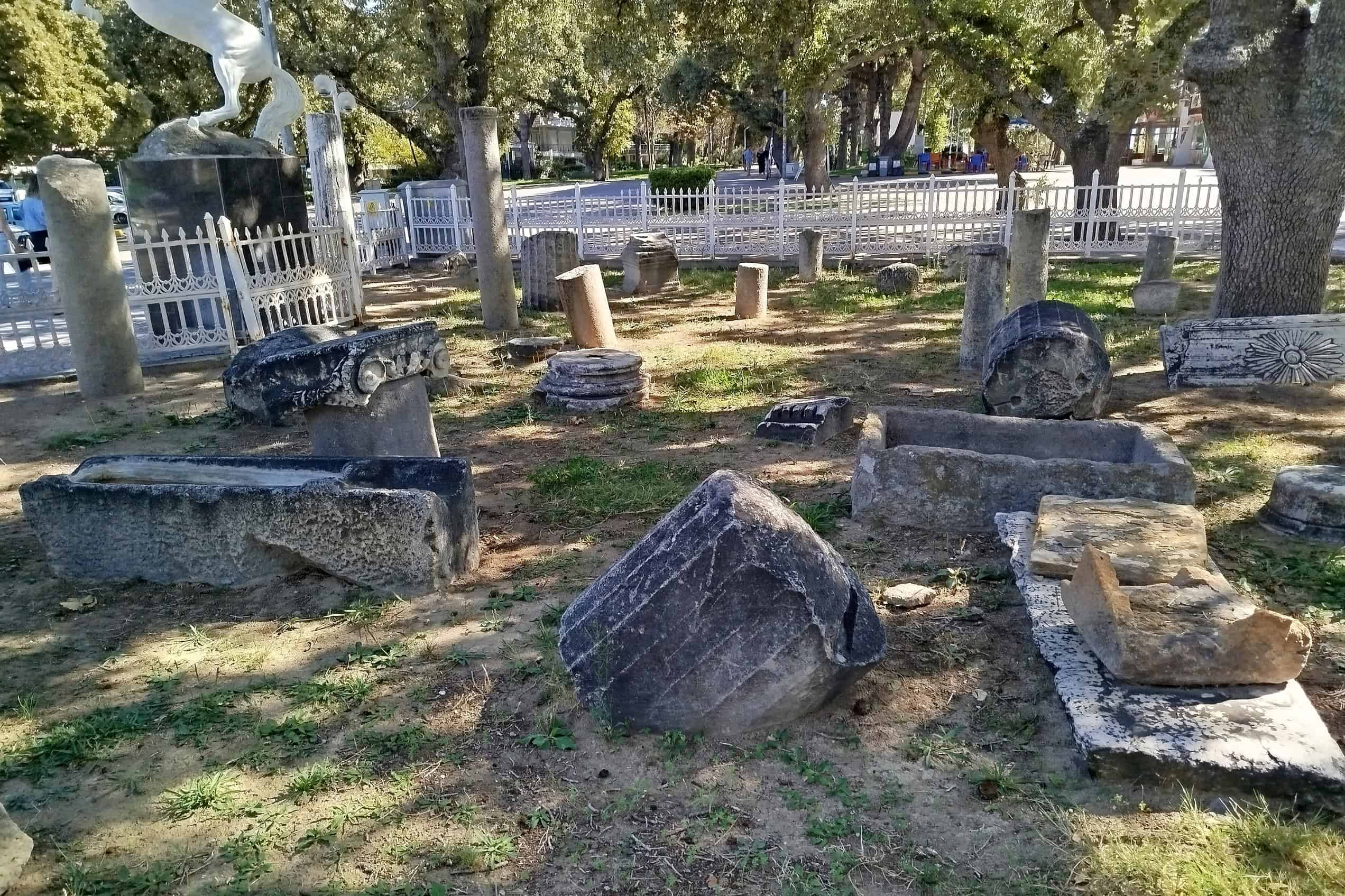
Ancient remains at Adramytteion in western Türkiye, photographed by Tolanor. Hosted by Wikimedia Commons and licensed under the Creative Commons Attribution-Share Alike 4.0 International license; cropped.
A 15-Panel Floor Mixed Household, Myth, and City
The North Hall was approximately 7.7 by 4.7 meters and opened from the atrium through an aligned principal threshold, with a second, offset access point interpreted as a service entrance. Its floor was not a loose assortment of pictures. Fifteen panels formed a three-by-five grid with alternating black and white backgrounds, dotted frames, a continuous multicolored guilloche, and surrounding borders.
Red, orange, black, white, blue, green, yellow, and burgundy tesserae supplied the palette. The paper records birds, a fish, a dog, a cat, a feline predator, a winged horse, a Medusa head, a pygmy figure, and a winged youth possibly representing Eros. Mythological, animal, and potentially civic images consequently occupied the same carefully ranked visual field.
That mixture is the discovery’s strongest art-historical feature. The named animals are not isolated curiosities pasted onto an ordinary floor; they sit inside an image system that moved between the household’s particular world and a shared language of status and myth. The geometric structure made those differences legible while unifying them as a single commission.
The room’s setting supports that reading. The excavation paper calls it a representational space and treats the pavement as evidence of status and spatial hierarchy. This is a claim about how the decorated room worked, not proof of the owner’s profession, origin, or biography.
The Winged Horse Does Not Identify the Owner
According to Özgen’s interview, the winged horse recalls a motif on coins minted at Adramytteion in the fourth century B.C. He interprets its appearance roughly five centuries later as evidence that the image continued to represent the city. The excavation paper confirms that a winged horse is present in the mosaic, but it defers the full iconographic argument.
An Adramytteion coin photographed at a Burhaniye museum pairs Zeus with Pegasus. It supplies a useful visual comparison for the older winged-horse type without resolving what the later mosaic’s maker or patron intended.
The same caution applies to the pygmy scene. Özgen told Anadolu Agency that such motifs are especially associated with North African mosaic traditions and proposed that the residence may have belonged to a merchant with North African connections. The city’s two ports and eastern Mediterranean orientation could support such a connection but do not establish the owner’s identity.
A motif can travel through pattern books, workshops, objects, or patronal taste; it does not function like a passport stamp. The May study neither confirms nor refutes the merchant hypothesis because it intentionally postpones stylistic, iconographic, and epigraphic analysis. The North African connection therefore remains possible rather than established.

Coin of Adramytteion with Zeus and Pegasus, photographed by Ollios. Hosted by Wikimedia Commons and licensed under the Creative Commons Attribution-Share Alike 3.0 Unported license.
The Mosaics Belonged to a Working, Changing House
The principal Roman phase covered about 730 square meters, excluding later additions. An elongated, stone-paved atrium organized movement among three mosaic-paved reception halls and nearby service spaces. A basin-like feature, a depressed strip, gradients, channels, drains, and terracotta pipes led the excavators to interpret water management as part of the original design.
That infrastructure sharpens the meaning of the decorated rooms. Visitors encountered expensive-looking surfaces, controlled thresholds, and figurative imagery, while drainage and wet-use systems supported the residence around them. The imagery was part of domestic performance, but it operated inside a building engineered for circulation, cleaning, water, and service.
The East Hall used a different visual scheme: black-and-white circles, polychrome guilloche and lozenge borders, and a central vessel filled with fruit and flanked by birds, including roosters. Together, the North and East halls show that display extended beyond a single spectacular pavement.
The house then changed after a destructive episode. Excavators found burnt deposits and collapse material, followed by repairs and reorganization. A later South Hall received a more schematic mosaic centered on a stylized vessel with symmetrical vine tendrils and animal figures. Its design is closer to Late Roman traditions than the North and East halls’ second- to third-century phases.
Later occupants also cut through earlier decoration. A higher pipeline crossed the East Hall mosaic and disturbed fresco remains, while the neighboring complex passed from Hellenistic foundations through Roman technical adaptation to storage or workshop use with large pithoi. The mosaics are therefore evidence of several moments in a long-lived urban plot, not one frozen “villa age” within Roman art.
Named Animals Are Certain; Their Story Is Not
Until it appears, the firm discovery is already substantial: a Roman reception floor at Adramytteion included depictions of a cat and dog whose names were written into the mosaic.

Isabella studied at the University of Cape Town in South Africa and graduated with a Bachelor of Arts majoring in English Literature & Language and Psychology. Throughout her undergraduate years, she took Art History as an additional subject and absolutely loved it. Building on from her art history knowledge that began in high school, art has always been a particular area of fascination for her. From learning about artworks previously unknown to her, or sharpening her existing understanding of specific works, the ability to continue learning within this interesting sphere excites her greatly.
Her focal points of interest in art history encompass profiling specific artists and art movements, as it is these areas where she is able to really dig deep into the rich narrative of the art world. Additionally, she particularly enjoys exploring the different artistic styles of the 20th century, as well as the important impact that female artists have had on the development of art history.
Learn more about Isabella Meyer and the Art in Context Team.
Choose Art in Context as a preferred source to see more of our reporting in Google Top Stories and other Google Search experiences.
Cite this Article
Isabella, Meyer, “Adramytteion Roman Mosaic Names a Cat and Dog.” Art in Context. September 6, 2026. URL: https://artincontext.org/adramytteion-roman-mosaic-cat-dog/
Meyer, I. (2026, 6 September). Adramytteion Roman Mosaic Names a Cat and Dog. Art in Context. https://artincontext.org/adramytteion-roman-mosaic-cat-dog/
Meyer, Isabella. “Adramytteion Roman Mosaic Names a Cat and Dog.” Art in Context, September 6, 2026. https://artincontext.org/adramytteion-roman-mosaic-cat-dog/.


