

Blood Proteins Helped Preserve China’s Huashan Rock Art

A new study of fallen fragments from China’s Zuojiang Huashan rock paintings reports that a lime mortar containing blood proteins locked red nano-hematite pigment to limestone, offering a plausible explanation for the images’ survival. The chemical model is substantial; the authors’ further proposal that some human blood came from childbirth is not established.
Blood Was the Binder, Not the Red Color
The Journal of Archaeological Science study, available online ahead of its September 2026 issue, examines how the exposed paintings endured roughly two millennia in Guangxi’s hot, wet monsoon climate. Meng Wu of Shandong University is first author; the research team also included specialists from the Guangxi Museum of Nationalities and local heritage agencies.
The team analyzed five fragments that had already fallen from painted cliffs at three locations. Raman spectroscopy, scanning electron microscopy with energy-dispersive spectroscopy, Fourier-transform infrared spectroscopy, and proteomics gave the researchers different views of the mineral structure and surviving organic material.
Their measurements support a layered construction: limestone below; a calcium-rich mortar containing phosphate and protein residues; and a red layer made from clay rich in hematite particles only hundreds of nanometers across. The researchers also report a thin calcium oxalate film at the surface, formed through biological weathering, as an additional source of protection.
From those observations, the authors reconstruct a sequence rather than directly observe one. They propose that the painters burned limestone or shell with bone material to obtain quicklime and calcium phosphate, mixed that with water and a small amount of blood, and brushed the emulsion onto the cliff. Red-clay colloid was applied while the mortar remained partly wet. As the lime carbonated, blood proteins helped organize dense calcium carbonate crystals around the hematite and against the limestone.
That distinction matters. Blood was not what made the paintings red: hematite did. In the proposed recipe, blood was one component of the ground that helped pigment become mechanically integrated with the cliff. The bond was so tenacious that the researchers needed an electric drill to separate well-preserved paint layers from their stone substrate during sample preparation.
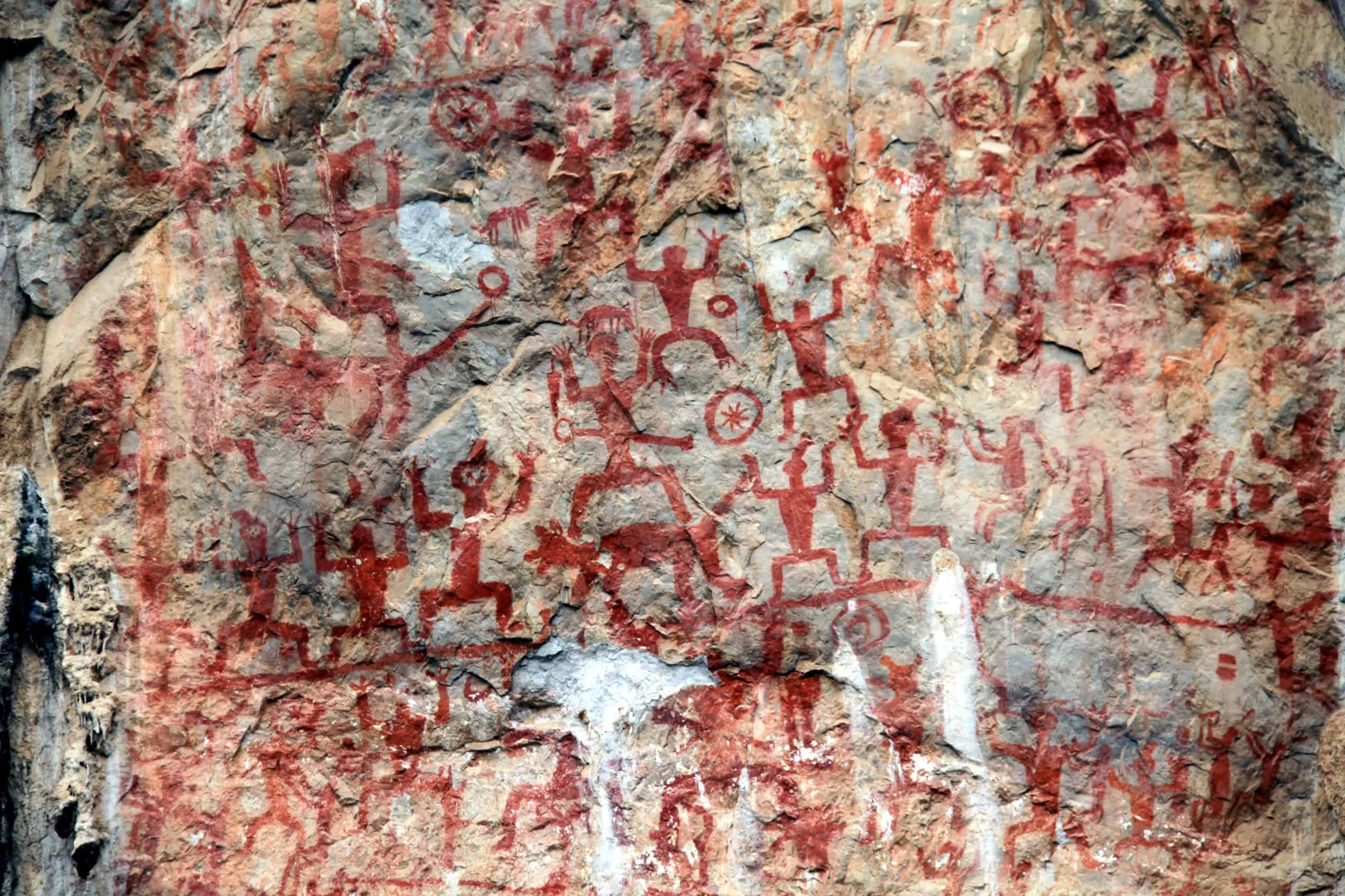
A section of the Zuojiang Huashan rock paintings on a limestone cliff in Ningming County, China. Photograph by Rolfmueller, via Wikimedia Commons, licensed under Creative Commons Attribution-Share Alike 3.0 Unported; cropped.
Five Fragments Cannot Represent an Entire Rock-Art Belt
The sample is small in relation to the monument. The paper describes more than 80 locations across the wider Huashan rock-art belt, while the UNESCO World Heritage property comprises 38 selected sites in three landscape components. UNESCO says those 38 were chosen as the best-preserved examples spanning the tradition’s phases. The study’s three sampled locations therefore do not amount to a survey of every cliff, period, or motif.
The findings fall into four levels of confidence:
- Direct observations: the fragments contain nanoscale hematite, calcium-rich mineral layers, phosphate, and protein signatures.
- Technical reconstruction: a blood-and-lime mortar beneath a separately applied red-clay pigment best explains the observed layered structure.
- Preservation explanation: biomineralized calcium carbonate probably contributed to the unusually strong bond, alongside the paintings’ mineral composition and surface film.
- Cultural interpretation: some human blood may have come from childbirth and may have carried a fertility meaning.
The first two levels rest most directly on laboratory results. The third is a causal explanation consistent with the fragments’ structure and exceptional adhesion, but it has not been tested across the whole belt. The fourth depends on identifying an ancient human donor, a physiological state, intentional selection, and ritual meaning in succession. Each step introduces another uncertainty.
Why the Childbirth-Ritual Claim Is Still Unproven
Proteomics returned matches that the authors assigned to humans, cattle, and other large herbivores. They also identified prolactin-inducible protein and lactotransferrin in one group of samples. Because those proteins can occur at elevated levels late in pregnancy and after birth, the team proposed that some blood could have been collected during childbirth and connected to female fertility.
The markers do not establish that scenario. Archaeologist Jose-Miguel Perez-Gomez, who was not involved in the research, told The Art Newspaper that the proteins are not exclusive to childbirth. He also emphasized that no ancient DNA was recovered and that only three sites were sampled.
A separate concern is whether every faint human protein signal is ancient. University of Cambridge archaeologist Matthew Collins told Smithsonian Magazine that laboratory contamination could explain signals that appeared surprisingly unaffected by the paintings’ age and environment. The study itself reports that DNA extraction failed, possibly because the strongly alkaline fresh mortar destroyed DNA early.
Even ancient human blood would not, by itself, prove childbirth or ritual purpose. Some Huashan figures have been interpreted in relation to sex, pregnancy, and fertility, but iconographic resemblance is not a chemical association. The current five fragments do not show human markers concentrated beside relevant motifs, different recipes used for different subjects, or another archaeological context tying the material to a specific rite.
A Materials Discovery About Monumental Ancient Art
Zuojiang Huashan is not a single mural. Its red, largely frontal figures occupy steep limestone cliffs along the Zuojiang and Mingjiang rivers, accompanied by drums, bells, weapons, animals, and boats. UNESCO dates the tradition from around the fifth century BCE to the second century CE and identifies it with the Luoyue people and southern China’s bronze-drum culture. The setting is part of the work: painted cliff, river, karst, and tableland form one cultural landscape.
A short report from CGTN’s official channel, made when the landscape entered the World Heritage List in 2016, shows the height and scale that close-up photographs flatten.
The new analysis adds a material chapter to the history of ancient art. The study proposes that the images’ apparently simple red silhouettes were made through controlled preparation of lime, phosphate-bearing material, protein, and fine mineral pigment, followed by timed application in layers. That is evidence of practiced technical knowledge, even if the precise social organization of the painters remains uncertain.
The conservation implication is diagnostic, not a treatment prescription. If the mortar, limestone, pigment, and oxalate skin function as a connected mineral system, future condition studies need to distinguish failure within that system from loss of the host rock itself. Broader sampling is essential before assuming that every Huashan panel shares one recipe.
A Durable Recipe, an Unsettled Ritual
The five fragments establish a red layer rich in nano-hematite over a calcium-based mortar with protein evidence that the researchers interpret as blood. Their layered model explains why the pigment can remain bonded even when limestone itself flakes away.
The evidence does not establish childbirth as the source of human blood: the protein markers are not exclusive to pregnancy, ancient DNA was not recovered, and contamination remains a live concern. Nor does it show that all 38 UNESCO sites, or the wider belt of more than 80 locations, used an identical recipe.

Isabella studied at the University of Cape Town in South Africa and graduated with a Bachelor of Arts majoring in English Literature & Language and Psychology. Throughout her undergraduate years, she took Art History as an additional subject and absolutely loved it. Building on from her art history knowledge that began in high school, art has always been a particular area of fascination for her. From learning about artworks previously unknown to her, or sharpening her existing understanding of specific works, the ability to continue learning within this interesting sphere excites her greatly.
Her focal points of interest in art history encompass profiling specific artists and art movements, as it is these areas where she is able to really dig deep into the rich narrative of the art world. Additionally, she particularly enjoys exploring the different artistic styles of the 20th century, as well as the important impact that female artists have had on the development of art history.
Learn more about Isabella Meyer and the Art in Context Team.
Choose Art in Context as a preferred source to see more of our reporting in Google Top Stories and other Google Search experiences.
Cite this Article
Isabella, Meyer, “Blood Proteins Helped Preserve China’s Huashan Rock Art.” Art in Context. August 26, 2026. URL: https://artincontext.org/huashan-rock-art-blood-protein-binder-study/
Meyer, I. (2026, 26 August). Blood Proteins Helped Preserve China’s Huashan Rock Art. Art in Context. https://artincontext.org/huashan-rock-art-blood-protein-binder-study/
Meyer, Isabella. “Blood Proteins Helped Preserve China’s Huashan Rock Art.” Art in Context, August 26, 2026. https://artincontext.org/huashan-rock-art-blood-protein-binder-study/.


