
Hyperrealism Art – The Best Hyper-Realistic Paintings and Artists
Hyperrealism art makes painted and sculpted surfaces appear startlingly present, but technical precision is only part of its effect. Artists use photographic cues, lifelike materials, altered scale, and controlled detail to make viewers look twice—and to notice where an image or body stops feeling natural. Because museums, scholars, and galleries do not always use “Hyperrealism” and “Photorealism” in the same way, the most useful approach is to understand their shared history and judge each work by its sources, methods, and purpose.
What Is Hyperrealism Art?
Hyperrealism is a descriptive label for paintings and drawings that intensify the appearance of reality. In painting, an artist may retain photographic effects such as cropping, reflections, glare, or sharp focus while enlarging and refining details. The term also applies to Hyper-realistic sculptors, whose cast bodies, silicone skin, glass eyes, and individually applied hair can create a physical presence that no photograph can provide.
The term does not describe one required technique or a single organized group. Some writers use it broadly for unusually lifelike contemporary work. Others reserve it for art that develops beyond 1960s and 1970s Photorealism by changing scale, heightening surface information, combining sources, or introducing a psychological or conceptual tension.
That distinction matters. A carefully observed portrait can be realistic without belonging to Hyperrealism, and a Hyperrealist work can include deliberate distortions. The label concerns the relationship among the subject, the source, the material, and the viewer—not detail alone. It also differs from the historical realism movement , which developed in 19th-century Europe around contemporary life and ordinary subjects.
Hyperrealism art does more than imitate what the eye sees: it makes the act of looking feel unusually conscious.
The Hyperrealism Movement
Hyperrealism has no single founder or uncontested starting date. Its history is tied to American Photorealism, which emerged in the late 1960s as painters worked directly from photographs and depicted cars, storefronts, reflective glass, portraits, and other subjects associated with everyday urban and suburban life. Within the broader history of Modernism, this return to recognizable imagery challenged the period’s dominant association of advanced art with abstraction.
The 1972 documenta 5 exhibition in Kassel gave this camera-based realism a prominent international group presentation. In 1973, Belgian dealer Isy Brachot used the French title Hyperréalisme for an exhibition in Brussels. That event helped popularize “Hyperrealism” in Europe, but it did not establish a clean border around the term. Contemporary writing may treat Hyperrealism as a later development, an expanded category, or simply another name used for Photorealism.
Sculpture followed a related path. From the 1960s and 1970s, artists such as George Segal, John DeAndrea, and Duane Hanson used casts, paint, clothing, and props to bring ordinary human figures into the viewer’s space. Later artists retained the lifelike body while manipulating scale, pose, and material so that recognition could shift into empathy, unease, or uncertainty.
Themes
Hyperrealist artists often revisit familiar subjects—faces, bodies, food, vehicles, shop windows, and domestic objects—because viewers already know how those things should look. Some works use figurative art to explore age, vulnerability, isolation, or the social reading of bodies. Others turn reflective packaging or polished metal into a study of consumer culture and visual desire. These are recurring possibilities, not universal meanings.
The historical label is useful only when it clarifies a work’s sources and effects; it should not replace close looking.
Notable Hyperrealist and Photorealist Artists
Artist lists often blur Photorealism, Hyperrealism, and realistic representation. The groupings below make that overlap explicit: the sculptors are central to the expansion of Hyperrealism in three dimensions, while the painters established or extended the camera-based practices from which the later label developed.
Hyperrealist Sculpture
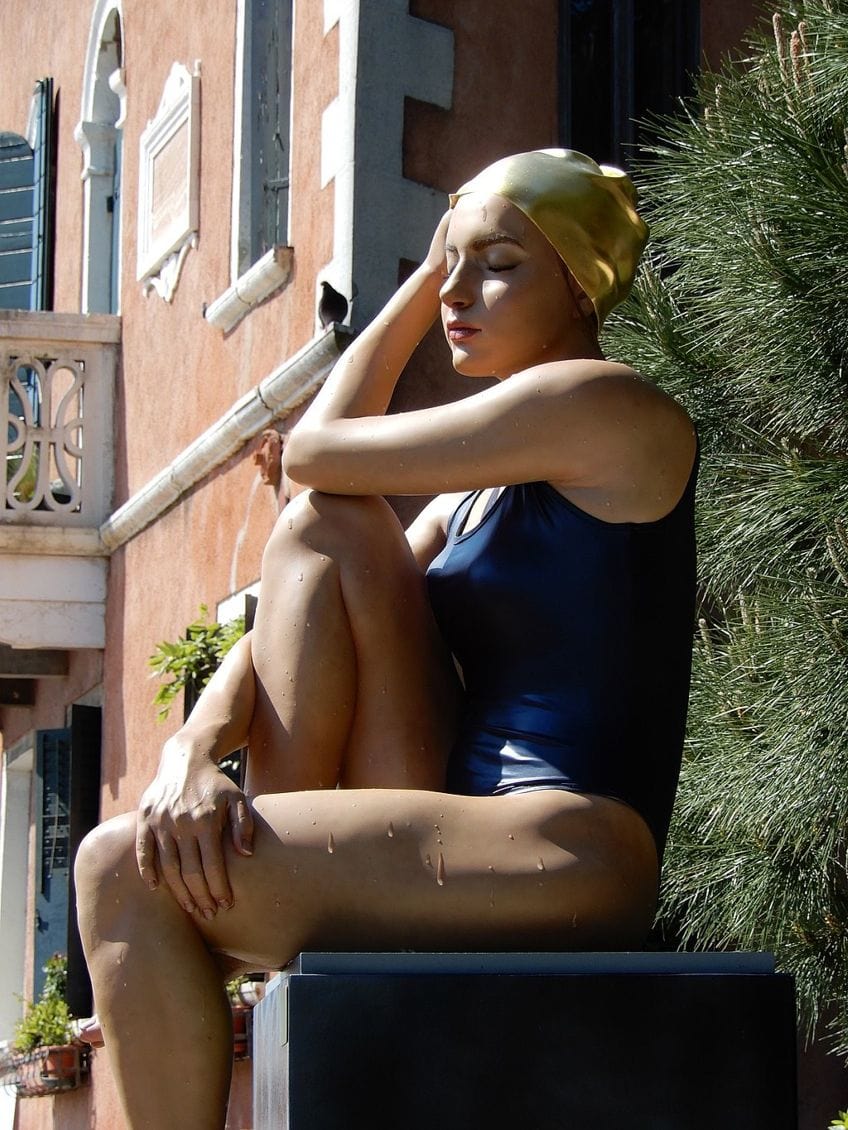
Carole Feuerman has worked with the human figure since the 1970s and is particularly associated with swimmers and the visual effects of wet skin. Her figures combine casts and modeled forms with carefully painted surfaces. Water droplets, closed eyes, and suspended gestures make still bodies appear caught between exertion and rest.
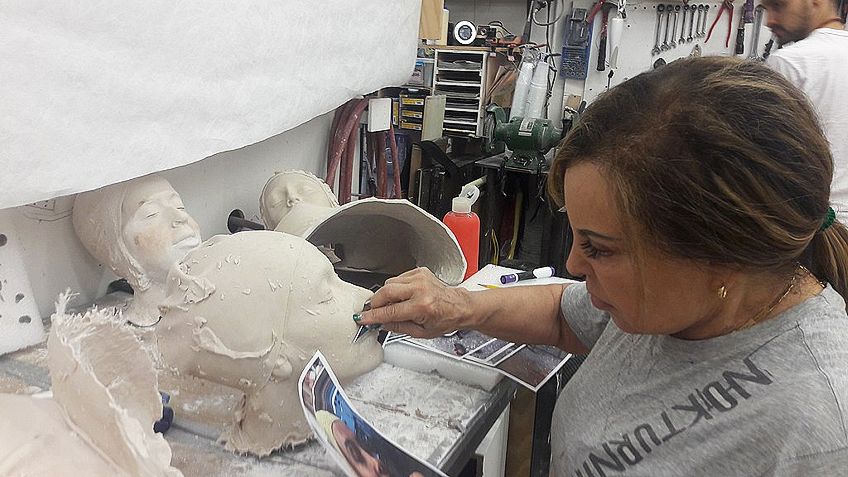
Ron Mueck builds figures from detailed models and molds, then changes their scale. The result is not a waxwork substitute for a person: the viewer recognizes a convincing body while remaining aware of its impossible size and constructed surface. That tension is central to works ranging from intimate couples to monumental heads and seated figures.
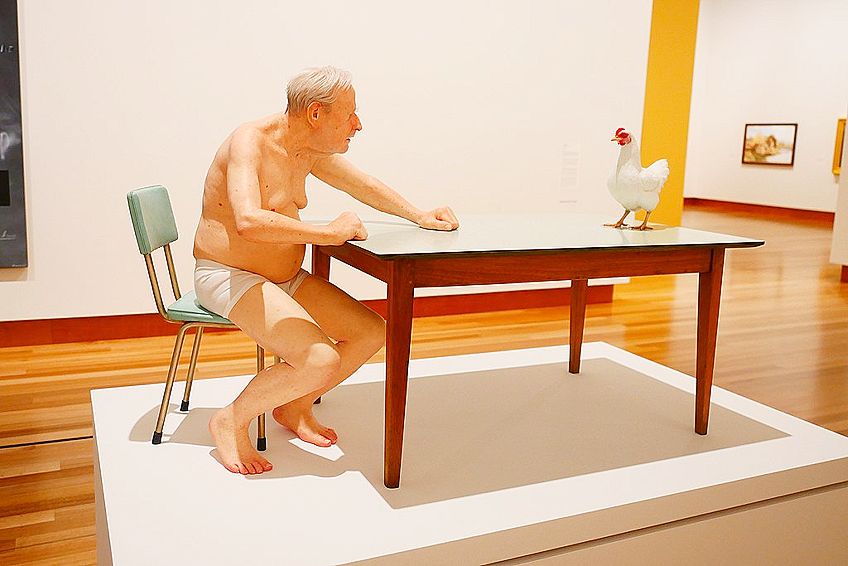
Sam Jinks uses silicone, resin, hair, and techniques informed by prosthetic production to create figures that meditate on birth, aging, and death. Evan Penny takes a different route: his stretched, compressed, or blurred bodies examine what happens when the distortions of two-dimensional photographic media are translated into three-dimensional form.
Photorealist Foundations in Painting
Richard Estes, Ralph Goings, Audrey Flack, and Chuck Close are closely associated with American Photorealism, although their subjects and procedures differ. Estes is known for layered city reflections, Goings for vehicles and diner interiors, Flack for symbolically charged still lifes, and Close for large portraits built through systematic grids. Calling them all “Hyperrealists” can conceal those historical differences, so Photorealism is the more precise first label.
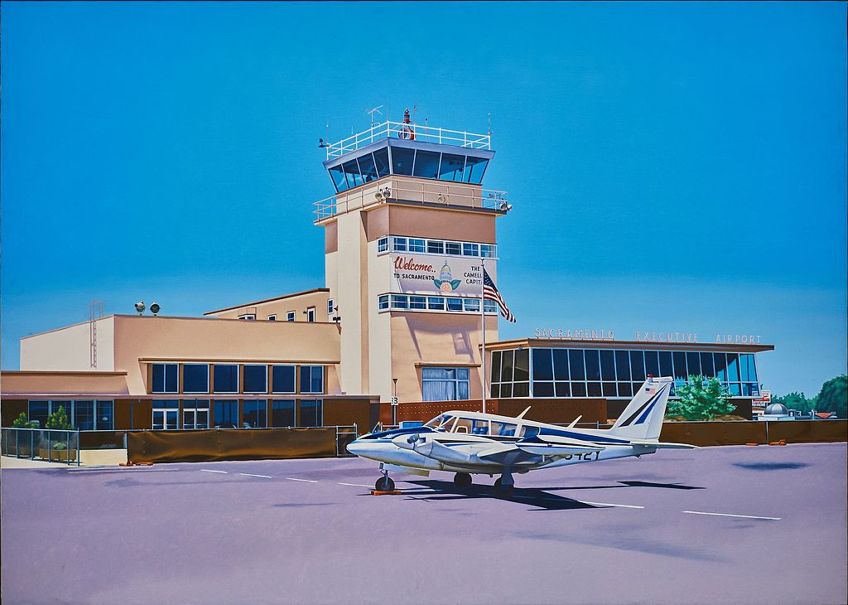
Ralph Goings used photographs as working material rather than treating direct observation as the only route to truth. In Sacramento Airport (1970), the ordinary subject, isolated vehicle, smooth tonal transitions, and camera-like framing turn a familiar place into a sustained exercise in attention.
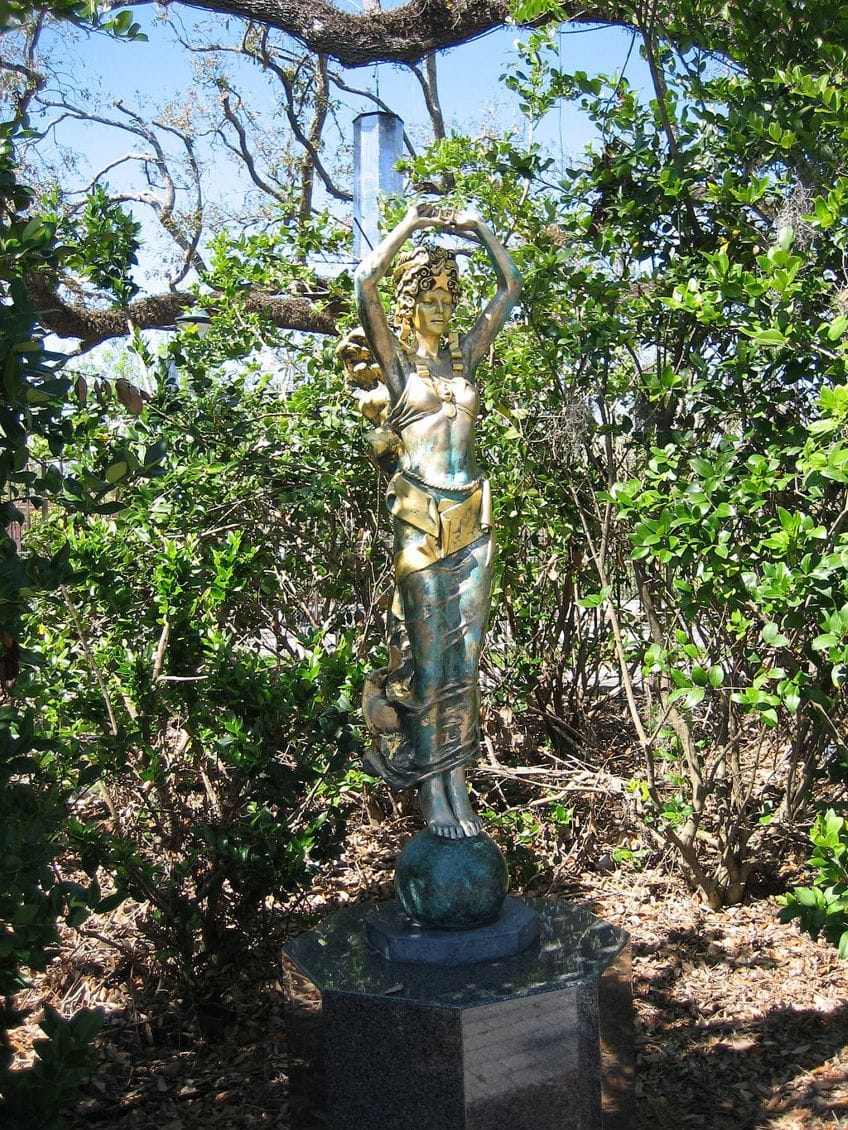
Audrey Flack was a pioneering Photorealist who used her own color photographs to plan paintings filled with reflective objects, cosmetics, fruit, jewelry, and reminders of mortality. She also worked in sculpture. Her career is a useful warning against treating an artist’s style label as a restriction on medium or subject.
How to Recognize Hyperrealism Art
The easiest feature to notice is finish, but smooth execution is not a sufficient test. First identify the work’s source relationship. Does it preserve the crop, lens distortion, depth of field, glare, or reflection of a photograph? Does a sculpture reproduce the color and translucency of skin while changing the figure’s scale? The source may be a single image, several combined images, a live model, a cast, or a digital study.
Next look for intensification. A painter may enlarge crumbs, pores, condensation, or reflections beyond what a casual glance would register. A sculptor may use silicone, resin, hair, fabric, and painted veins to simulate living tissue. These decisions slow down perception: the viewer moves from instant recognition to an examination of surfaces.
Then ask what has been manipulated. Scale is the most obvious device, but focus, color, pose, cropping, and the density of information can also depart from ordinary vision. Hyperrealism is often most compelling where the work is convincing and impossible at the same time.
Finally, check the historical and curatorial context. Museum labels, the artist’s own account, date, medium, and relationship to Photorealism are stronger evidence than online superlatives such as “the world’s most realistic painting.” An accurate description should allow for overlap instead of forcing every highly finished work into the same movement.
A practical test is to look for three things together: a mediated source, intensified reality, and a purposeful tension between likeness and artifice.
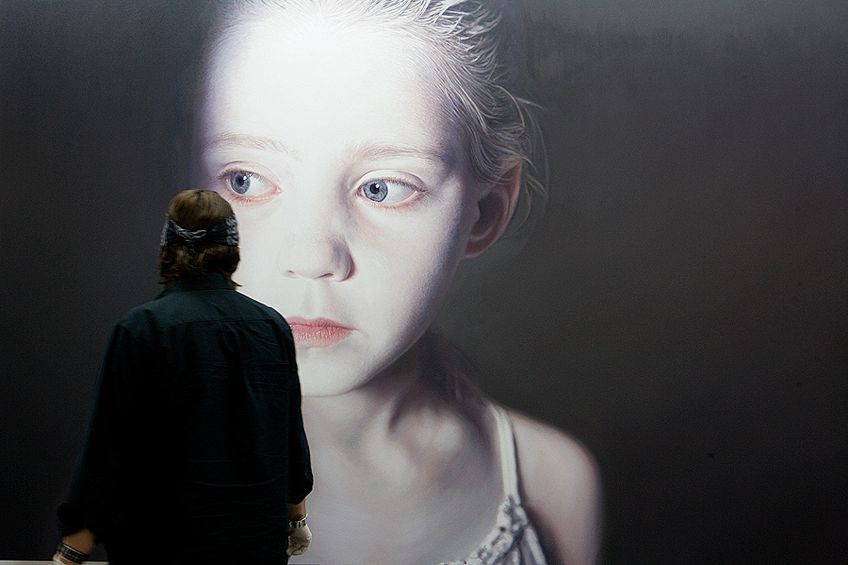
Hyperrealism vs. Photorealism and Realism
Realism, Photorealism, and Hyperrealism are related terms, but they answer different questions. Realism can describe recognizable representation in general, yet it also names a 19th-century movement. Photorealism has a more specific historical connection to artists working from photographs around the late 1960s and 1970s. Hyperrealism is the most fluid of the three labels.
| Term | Historical frame | Typical source or method | Useful distinguishing question |
| Realism | A broad mode of representation and a 19th-century European movement. | Often observation of contemporary life, without a required photographic source. | Is the term describing recognizable representation or the historical movement? |
| Photorealism | Associated especially with American painting of the late 1960s and 1970s. | A photograph is translated through controlled, often systematic painting or drawing procedures. | How does the work preserve, edit, or expose photographic vision? |
| Hyperrealism | Popularized as a label in Europe in 1973 and widely applied to later painting and sculpture. | Photographic cues, combined sources, lifelike materials, intensified detail, or altered scale. | What has been made more intense, more physical, or less plausible than ordinary perception? |
This comparison is a working guide, not a universal rule. Historical exhibitions sometimes used “Hyperrealism,” “Radical Realism,” “New Realism,” and “Photorealism” for overlapping practices. Today, “Hyperrealism” often signals expanded media and intensified effects, especially in sculpture, but individual artists and institutions may prefer another term.
Color, Focus, and the Photographic Look
Hyperrealism has no fixed palette. Some artists use saturated color to amplify polished packaging, reflected light, food, or skin; others reduce color to keep attention on tone and form. A claim that one hue has a universal emotional meaning is therefore less useful than asking how color operates within a specific work.
Photographic cues can be more diagnostic. Cropping may cut through a body or vehicle, shallow focus can make one plane unusually crisp, and reflections can layer several spaces into one surface. Extreme enlargement reveals information that the eye would normally pass over. In a painting, these effects expose the camera’s mediation; in a sculpture, lifelike color and texture can make an obviously fabricated object feel momentarily alive.
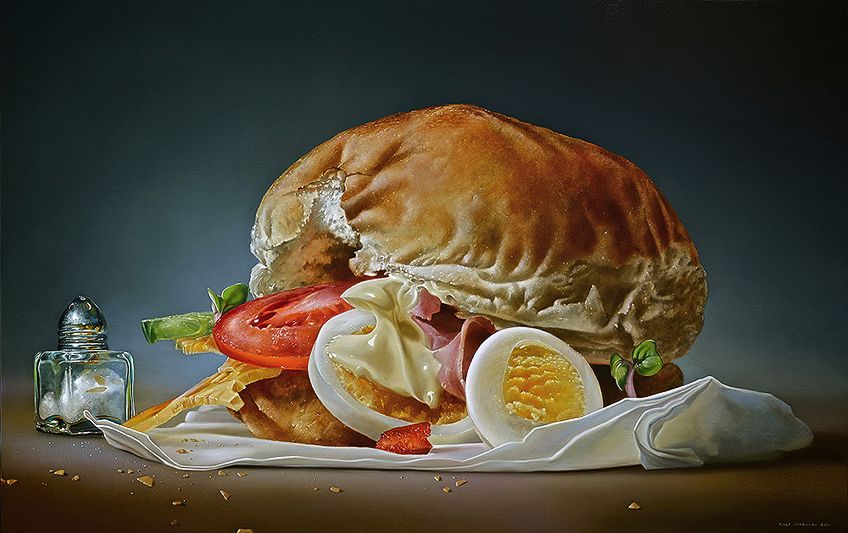
Tjalf Sparnaay’s Sandwich Ham-Egg (2014) shows how a commonplace subject can become visually strange through enlargement. Highlights on the egg, minute crumbs, wrinkles in the ham, and the compressed crop turn a snack into a surface that demands the kind of inspection usually reserved for a monumental subject.
How Scale Changes Hyperrealist Sculpture
Scale is not merely a spectacle in Ron Mueck’s sculpture. An enlarged face can become a landscape of pores, hair, and folds, while a reduced pair of bodies can seem private and unreachable. The physical size of the work determines where viewers stand and how they relate their own bodies to the figure.
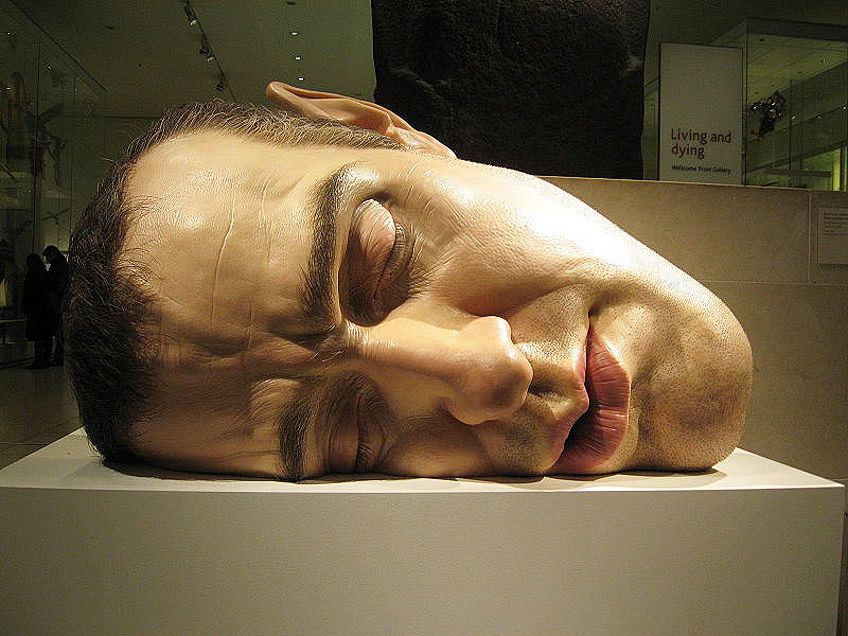
Mask II (2001–2002)
Mask II is a sleeping self-portrait enlarged to nearly four times life size. From the front, closed eyes and individual hairs encourage an intimate reading of a resting face. A view from behind reveals that the head is hollow. The object therefore moves between apparent human presence and an unmistakably fabricated shell.
Spooning Couple (2005)
At only 14 centimeters high and 65 centimeters long, Spooning Couple reverses the monumental strategy. The two figures share a bed-like plane, but their gazes and gestures do not resolve into simple tenderness. Their reduced size makes the scene visible as a whole while preserving an emotional distance that the viewer cannot cross.
Wild Man (2005)
Wild Man is approximately 2.85 meters high. Although the naked seated figure towers over viewers, his clenched grip, lifted toes, and watchful expression convey fear rather than dominance. The reversal is the point: enlarged anatomy produces vulnerability, not heroic power.
Materials and Techniques in Hyperrealism
No recipe guarantees Hyperrealism. The appropriate process depends on whether the artist wants to reproduce a photographic look, combine several views, alter scale, or create the physical impression of a body. Accurate planning supports those choices, but technique becomes meaningful only when it serves the work’s visual argument.
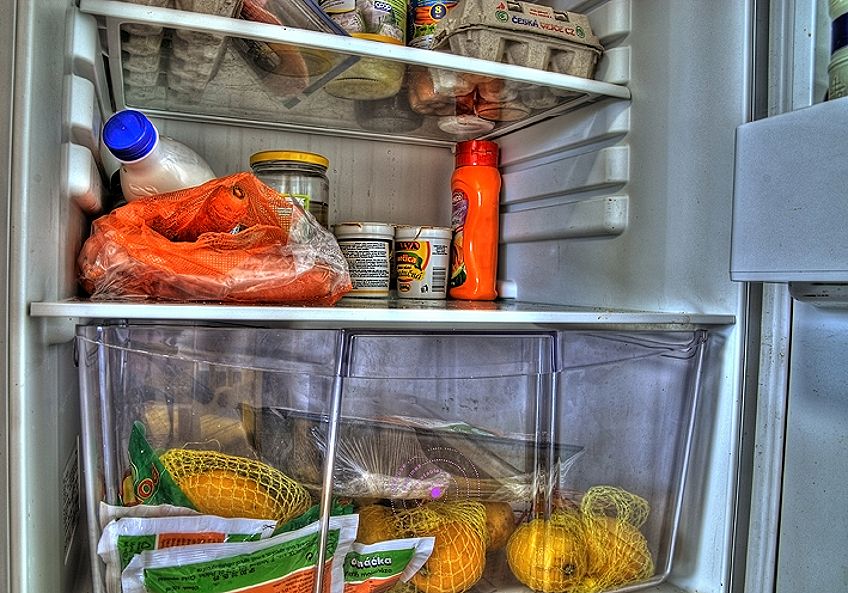
The image above is a photograph, not a painting. That boundary is useful: a photograph may be a source, a study, or an independent artwork, but its precision alone does not make it a Hyperrealist painting. Medium and process remain part of classification.
Painting and Drawing
Painters commonly begin by selecting or making high-resolution reference photographs. They may correct lens distortion, combine elements, adjust color, or plan a crop before transferring the composition. A projector, tracing, or the decision to draw a grid can establish proportion, but none of these tools determines the quality or meaning of the result.
The image is then developed through controlled layers. Broad value relationships come first; edges, transitions, reflections, and small surface changes follow. Airbrushes can produce smooth gradients, while fine brushes, pencils, erasers, and glazing can restore irregularities. Uniform sharpness often looks less convincing than carefully varied edges because cameras and human attention both select some information over the rest.
A useful workflow separates accuracy from emphasis: establish proportion, compare values, decide where the focal plane lies, and then add only the detail that supports that decision. Copying every visible mark with equal force can flatten the image, even when the copy is painstaking.
Sculpture
A Hyperrealist figure may begin with measurements, photographs, life casts, or a small clay model. Ron Mueck, for example, develops clay studies before building larger figures over armatures and producing molds. Silicone or fiberglass can form the final skin or shell; paint creates veins, discoloration, and shifts in translucency; hair may be inserted or attached individually. Clothing, posture, and installation complete the illusion.
The materials do not simply disguise construction. Translucent silicone can imitate skin, but a visible seam, hollow reverse, compressed body, or impossible scale can keep the sculpture from collapsing into pure illusion. The strongest works coordinate anatomical observation with the emotional and spatial effect of the finished figure.
Frequently Asked Questions
What Is Hyperrealism Art?
Hyperrealism art is painting, drawing, or sculpture that intensifies the appearance of reality through photographic cues, lifelike materials, enlarged detail, altered scale, or combined sources. The term overlaps with Photorealism, so date, medium, method, and the artist’s context all help determine whether the label is appropriate.
What Is the Difference Between Hyperrealism and Photorealism?
Photorealism is closely associated with late-1960s and 1970s artists who translated photographs through controlled painting or drawing methods. Hyperrealism is often used for later or more expansive work that intensifies detail, changes scale, combines sources, or extends into lifelike sculpture. Museums and writers sometimes use the terms interchangeably, so the boundary is not absolute.
How Do Hyperrealist Artists Create Their Work?
Painters and draftspeople may work from high-resolution photographs, transfer proportions with a grid or projector, and build values, edges, color, and surface detail in layers. Sculptors may use life casts or clay models, molds, resin, fiberglass, silicone, paint, hair, and fabric. The exact process depends on the intended visual and psychological effect.
Is Every Highly Realistic Artwork Hyperrealist?
No. Realistic skill appears across many periods and traditions. A useful Hyperrealism classification usually involves more than close resemblance: it considers the work’s historical context, mediated source, intensified detail, altered scale or materials, and the tension it creates between convincing likeness and visible artifice.

Heidi Sincuba was the Head of Painting at Rhodes University from 2017 to 2020 and part of the first Artist Run Practice and Theory course at Konstfack in Stockholm, 2021. They completed their BFA at Artez Arnhem in the Netherlands, MFA at Goldsmiths University of London, and are currently a Ph.D. candidate at the University of Cape Town.
Heidi Sincuba’s own practice explores fugitivity through painting, drawing, text, textiles, performance, and installation. This praxis is founded on a conceptual intersection of biomythographic experimentation, existential automatism, and African ancestral knowledge systems. These methodologies of multiplicity result in a fluid and speculative aesthetic, continually manifesting and metamorphosing its material conditions.
Learn more about the Art in Context Team.
Cite this Article
Thembeka Heidi, Sincuba, “Hyperrealism Art – The Best Hyper-Realistic Paintings and Artists.” Art in Context. January 22, 2021. URL: https://artincontext.org/hyperrealism-art/
Sincuba, T. (2021, 22 January). Hyperrealism Art – The Best Hyper-Realistic Paintings and Artists. Art in Context. https://artincontext.org/hyperrealism-art/
Sincuba, Thembeka Heidi. “Hyperrealism Art – The Best Hyper-Realistic Paintings and Artists.” Art in Context, January 22, 2021. https://artincontext.org/hyperrealism-art/.