
Greek Art – Gems in Ancient Greek Art History

Ancient Greek art developed across the Aegean and Mediterranean through pottery, metalwork, sculpture, painting, mosaics, and architecture. From Bronze Age palace cultures to the Geometric, Archaic, Classical, and Hellenistic periods, artists used exchange, experiment, ritual, civic identity, and patronage to rethink bodies, stories, objects, and built space.
A Little Bit About Hellas
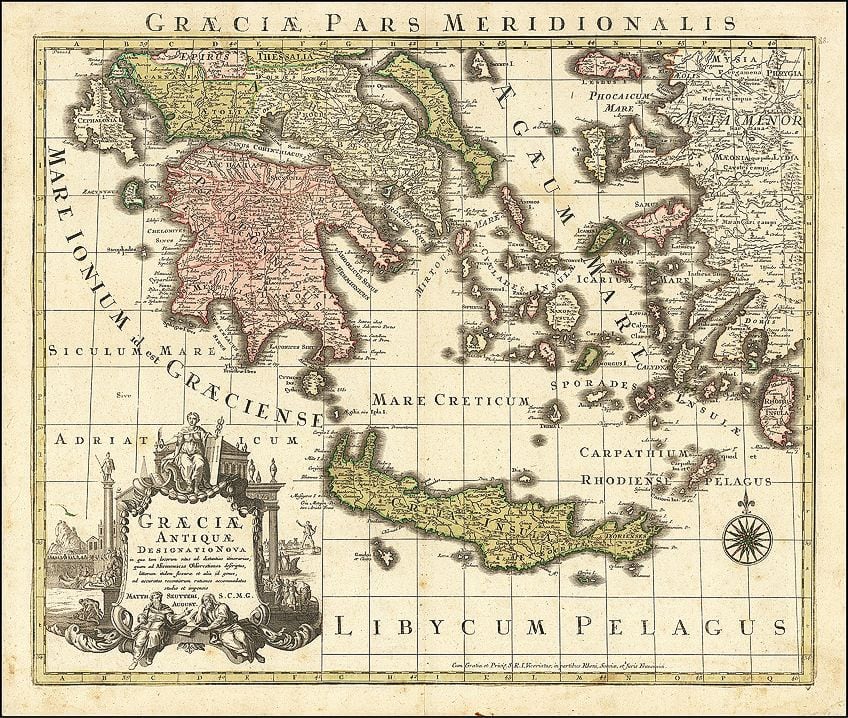
The ancient Greek world was larger than the borders of modern Greece. Greek-speaking communities lived around the Aegean, on the coast of Asia Minor, in the Black Sea region, southern Italy and Sicily, North Africa, and elsewhere. The term Hellas refers to a shared Greek cultural world, but that world was politically fragmented into city-states and kingdoms.
Mountains, islands, and sea routes shaped travel and exchange. Athens, Sparta, Corinth, Thebes, Miletus, Syracuse, and hundreds of other communities had different institutions and artistic traditions. “Greek art” is therefore a convenient category, not a single uniform national style.
Ancient Greek objects were made for sanctuaries, graves, houses, public buildings, banquets, theaters, athletic festivals, and trade. Marble statues dominate modern museum displays, but bronze was prestigious and widely used; paint, metal attachments, textiles, and other additions originally made sculpture far more colorful than its weathered surfaces suggest.
Historical Foundations: What Are the Origins of Ancient Greece?
Greek art did not begin abruptly in 650 BCE. Prehistoric communities in mainland Greece, Crete, and the Cyclades developed distinct material cultures. Later Greek speakers remembered and reused parts of this past, but Minoan and Mycenaean art should not simply be treated as early versions of Classical Athens.
The Stone Age
Human activity in Greece reaches deep into the Paleolithic period. During the Neolithic, beginning in the seventh millennium BCE in many parts of the region, farming communities built settlements, made pottery, worked stone and bone, and created figurines and ornaments. Dates and sequences vary by site.
The megaron—a rectangular hall with a hearth and porch—is important in later Bronze Age palaces, especially on the mainland. It is too simple, however, to derive every Greek temple directly from one Neolithic house type. Temples developed through many local experiments in timber, mudbrick, stone, cult practice, and monumental planning.
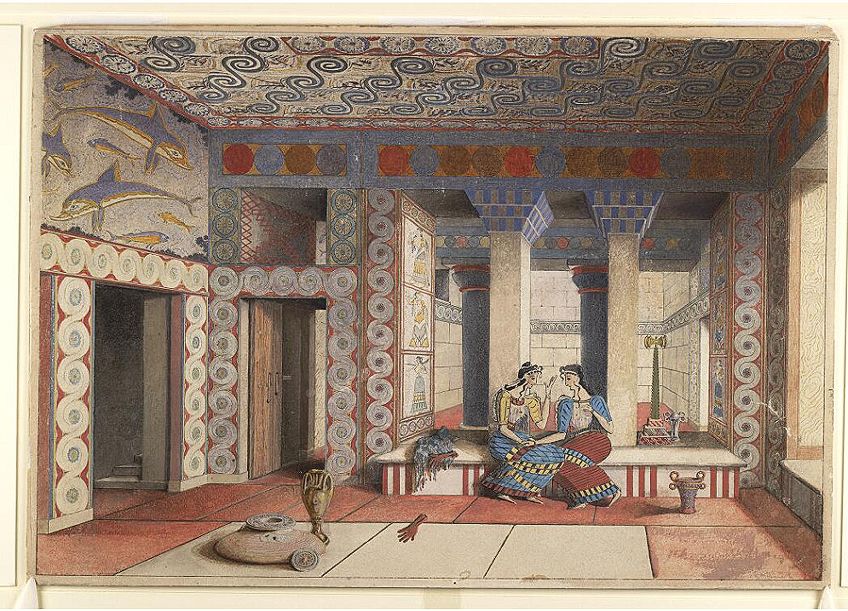
The watercolor above is a 20th-century “romantic reconstruction” associated with Arthur Evans’s excavations at Knossos, not an ancient Greek painting. Reconstructions reveal the assumptions of their makers as well as archaeological evidence and should be read critically.
Into the Bronze Age of Greece – The Aegean Civilizations
Aegean Bronze Age art is commonly studied through Cycladic, Minoan, and Helladic or Mycenaean traditions. These labels organize evidence but do not describe isolated peoples. Maritime exchange carried metals, ceramics, seals, motifs, and techniques between Crete, the Cyclades, mainland Greece, Egypt, Anatolia, and the Near East.
Minoan palaces on Crete included courts, storage areas, workshops, cult spaces, painted plaster, and sophisticated water systems. The famous Bull-Leaping Fresco from Knossos is substantially reconstructed from fragments. Its figures, bull, and flowing forms suggest a performance, but the event’s precise ritual or athletic meaning remains debated.
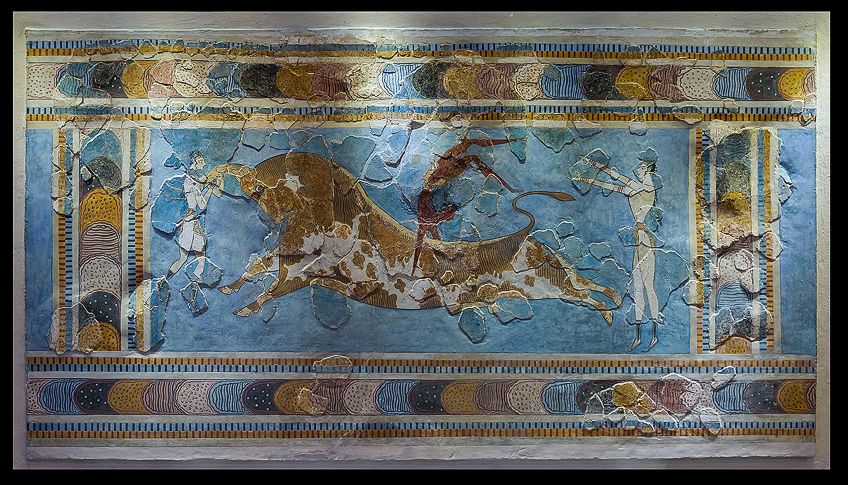
Mycenaean centers such as Mycenae, Tiryns, Pylos, and Thebes were ruled through palatial systems recorded in Linear B, an early written form of Greek. Fortifications, shaft graves, tholos tombs, goldwork, weapons, seals, and painted pottery show both local power and Aegean connections.
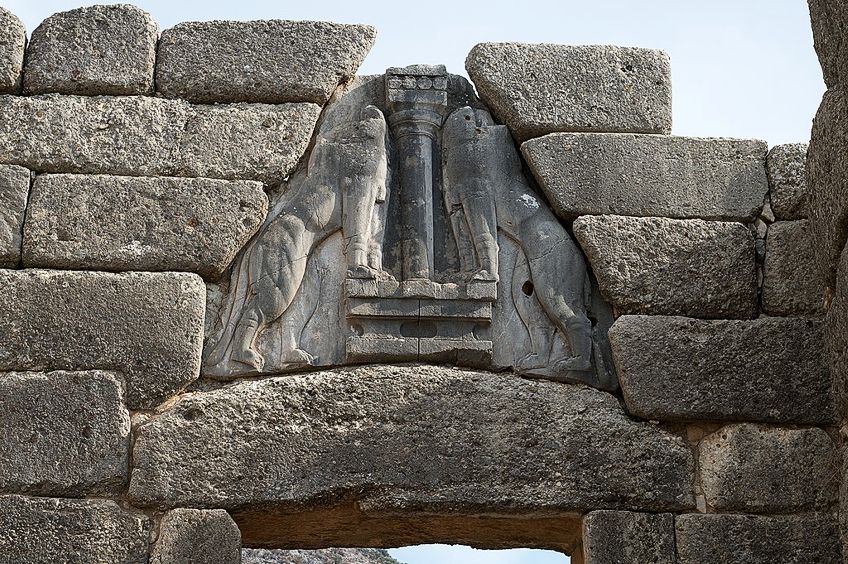
The Lion Gate at Mycenae, built around 1250 BCE, places two heraldic felines above the entrance. Their missing heads were probably made separately. The relief’s column and animals turn architecture into a concentrated image of authority, though the animals’ exact identity and symbolism remain debated.
The Greek Early Iron Age and the Start of the Polis
Palatial systems collapsed around 1200 BCE through processes that remain debated, including conflict, political fragmentation, mobility, and environmental stress. “Greek Dark Ages” is an older term for roughly 1100–800 BCE; “Early Iron Age” better avoids implying that the period lacked culture or innovation.
Settlement patterns changed, iron technology expanded, and long-distance connections contracted and later revived. The Geometric period, conventionally c. 900–700 BCE, saw new pottery systems, bronze figurines, sanctuary activity, burial display, the Greek alphabet, overseas settlement, and the gradual formation of the polis.
Geometric vessels organize surfaces through meanders, triangles, concentric circles, and later human and animal scenes. Monumental funerary kraters from Athens show mourning and procession as public social acts. Homeric poetry was shaped through oral traditions before being written down; it is not a straightforward documentary record of the Mycenaean world.
Greek Art and Architecture Characteristics
Ancient Greek art is often reduced to white marble, ideal beauty, and mathematical harmony. Those features matter, but so do color, narrative, humor, violence, disability, age, gender, labor, regional identity, and the practical functions of objects.
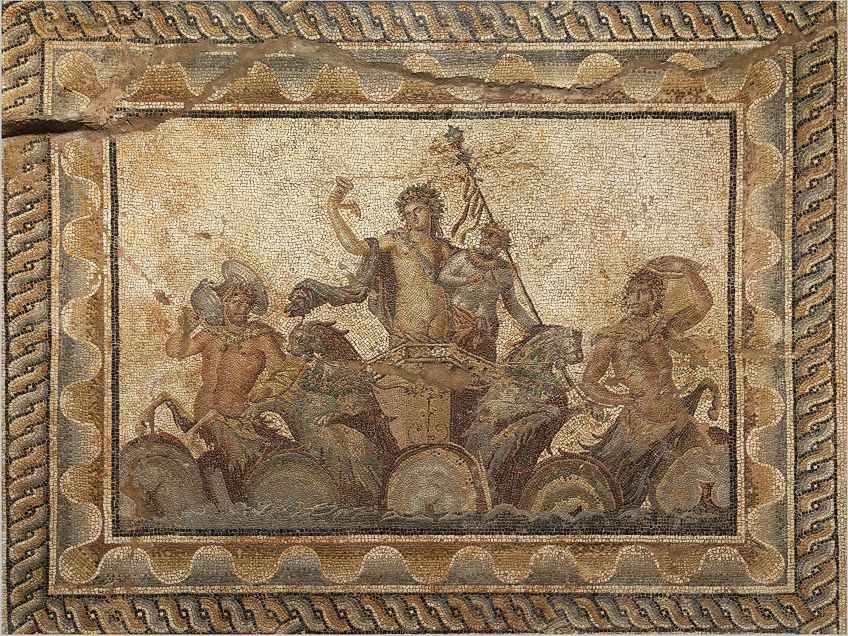
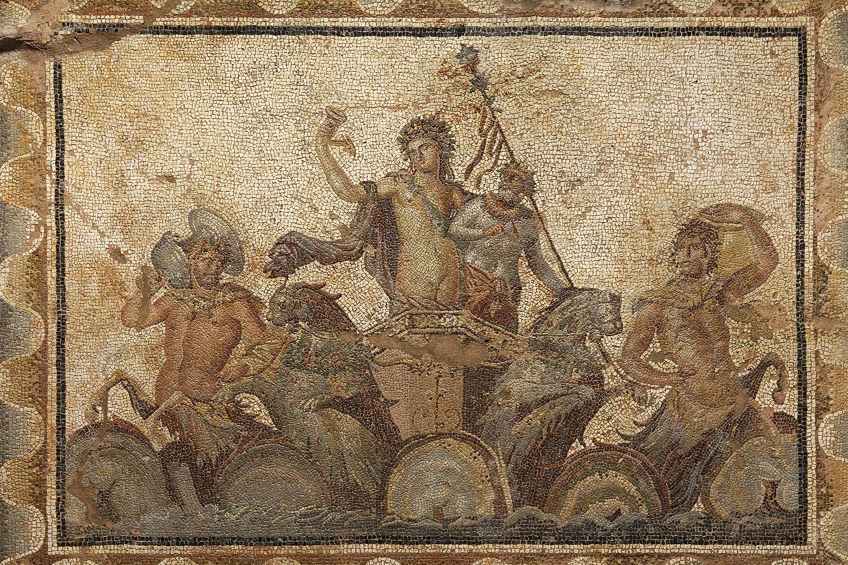
The Dionysus mosaic above dates to the Roman imperial period, centuries after the conventional Hellenistic era. It demonstrates the continued life of Greek myth and pictorial traditions under Roman rule rather than serving as a pure example of Classical art.
| Period | Approximate Dates | Selected Developments |
|---|---|---|
| Geometric | c. 900–700 BCE | Patterned pottery, bronze figurines, sanctuaries, funerary display |
| Archaic | c. 700–480 BCE | Kouroi and korai, black- and red-figure pottery, stone temples |
| Classical | 480–323 BCE | Severe Style, contrapposto, major civic building, varied naturalism |
| Hellenistic | 323–31 BCE | Royal patronage, cosmopolitan centers, theatrical space, expanded subjects |
The Archaic Period (c. 700–480 BCE)
The Archaic period saw expanding trade, colonization, sanctuaries, law codes, warfare, and new political forms. Greek artists engaged Egyptian and Near Eastern objects and techniques during an “Orientalizing” phase. Influence was not one-way: workshops selected and transformed foreign motifs such as sphinxes, lions, rosettes, and composite creatures.
Black-figure vase painters incised details through a glossy slip; red-figure painters, beginning in late sixth-century Athens, reversed the process and used brushes for interior lines. Pottery gives unusually rich evidence for mythology, ritual, work, athletics, warfare, music, gender, and social encounter.
Kouroi are standing nude male figures; korai are clothed female figures. They served as votive dedications and grave monuments, not generic portraits of athletes or prizes. Their frontality and step stance engage Egyptian models, while Greek sculptors increasingly explored anatomy and movement.
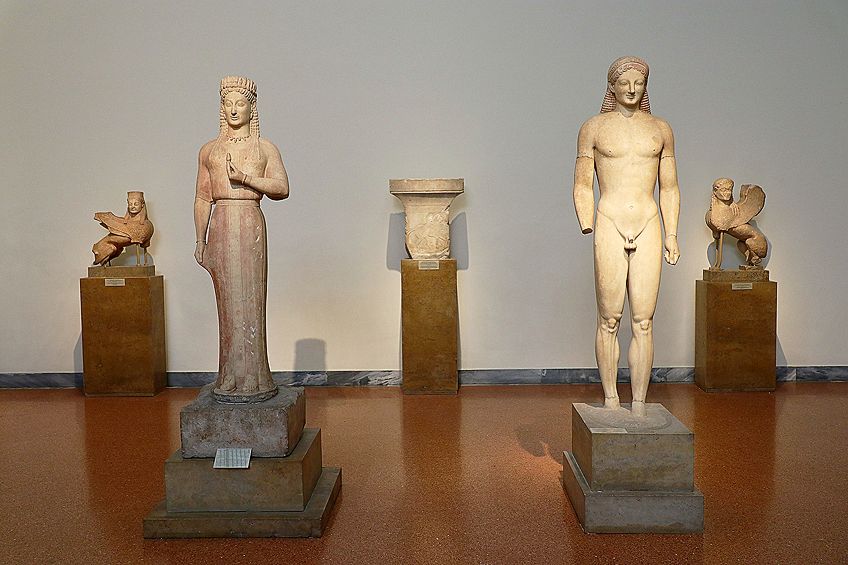
The paired display above includes Phrasikleia, a kore made as a grave monument, and the Kouros of Merenda. Their surviving color and inscriptions are essential evidence. The “Archaic smile” is a stylistic convention rather than proof that the figures feel serene.
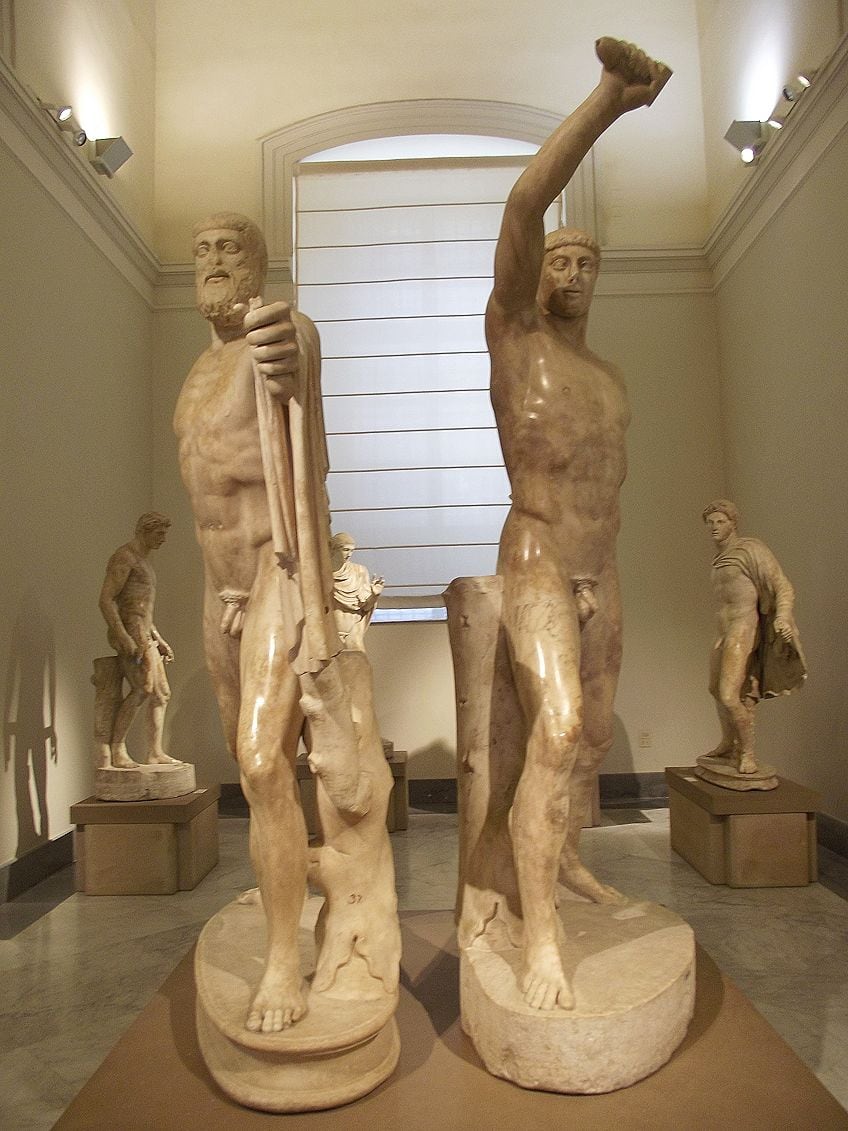
The Tyrannicides commemorate Harmodius and Aristogeiton, who killed Hipparchus in 514 BCE. Antenor’s original group was reportedly taken by Xerxes; Kritios and Nesiotes created a replacement in 477/476 BCE. The surviving statues in Naples are Roman versions, so they preserve a Greek civic image through later copying.
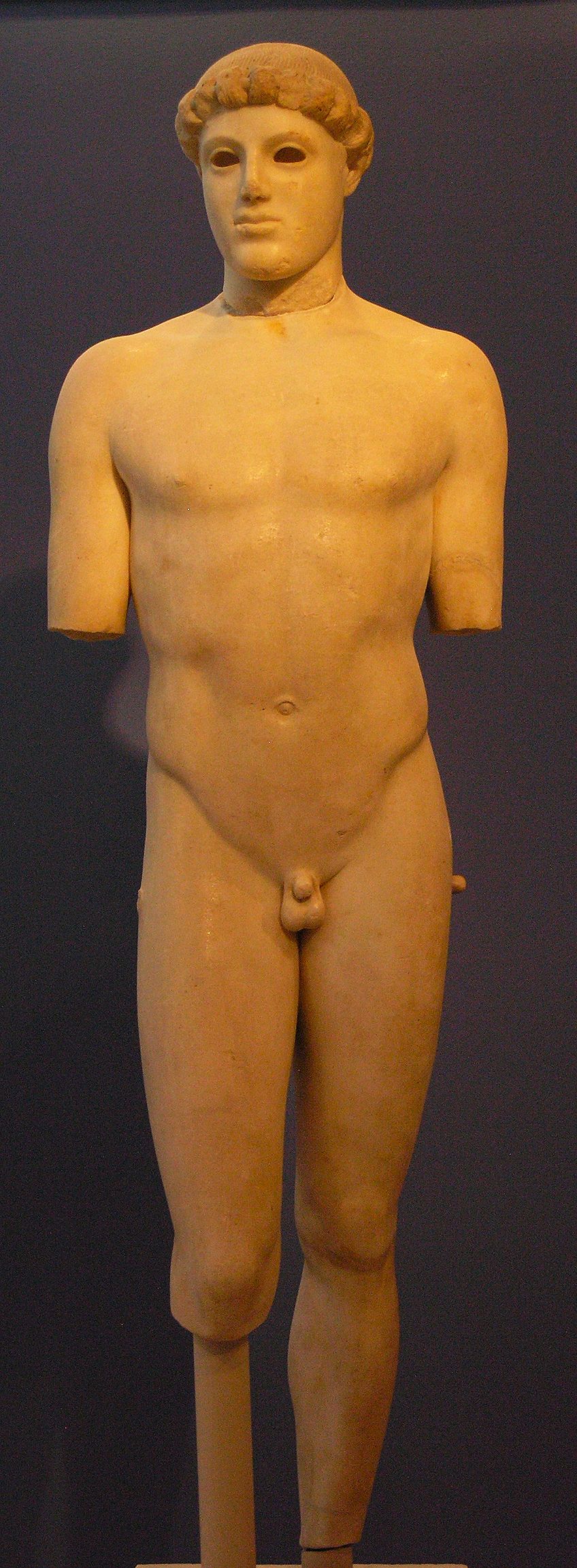
The Kritios Boy belongs just after 480 BCE and is central to the transition known as the Severe Style. Its weight rests on one leg, changing the relationship between hips, shoulders, and spine. The Acropolis Museum cautiously says the statue is named after the sculptor believed to have made it; authorship is not certain.
Classical Period (480–323 BCE)
The Classical period begins conventionally after the Persian Wars and ends with Alexander’s death. Athens produced famous monuments during the fifth century, but “Classical Greek art” includes many city-states and later fourth-century developments. Nor was the era continuously peaceful: wars, imperial power, slavery, and political exclusion shaped its culture.
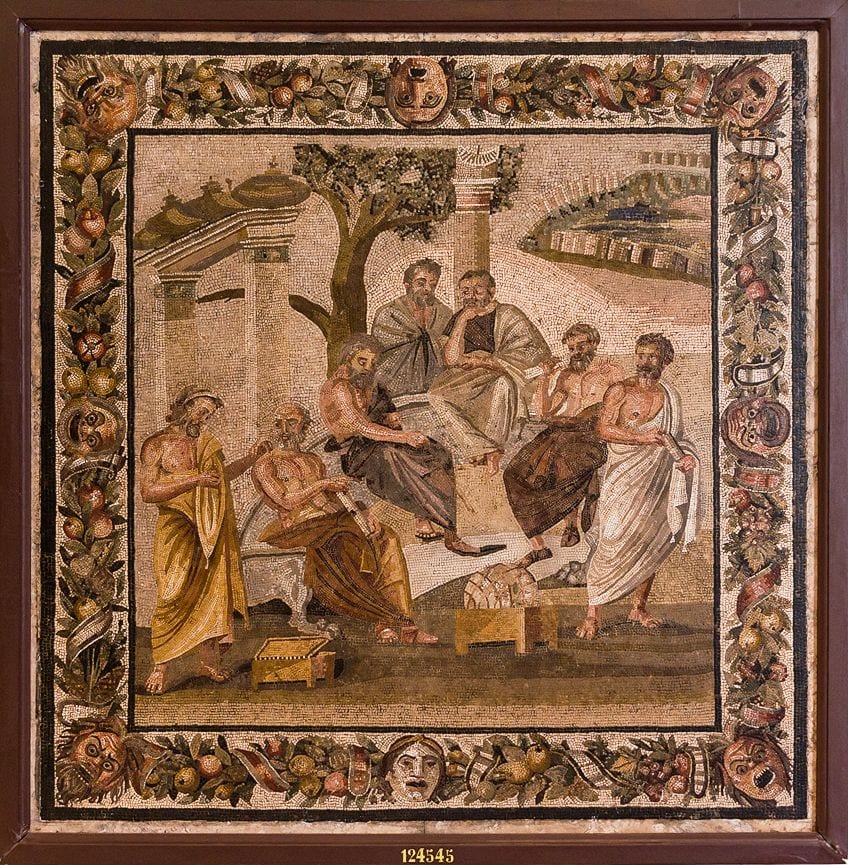
This Roman mosaic from Pompeii imagines Plato’s Academy and belongs to the later reception of Classical philosophy. It should not be mistaken for a contemporary portrait of Plato’s circle.
Classical Greek Sculpture
Classical sculptors developed varied systems for representing balance, movement, anatomy, clothing, expression, age, and divinity. Polykleitos wrote a Canon about proportion and embodied its principles in the bronze Doryphoros. The text and original statue are lost; Roman marble copies allow partial reconstruction, but no simple numerical formula survives intact.
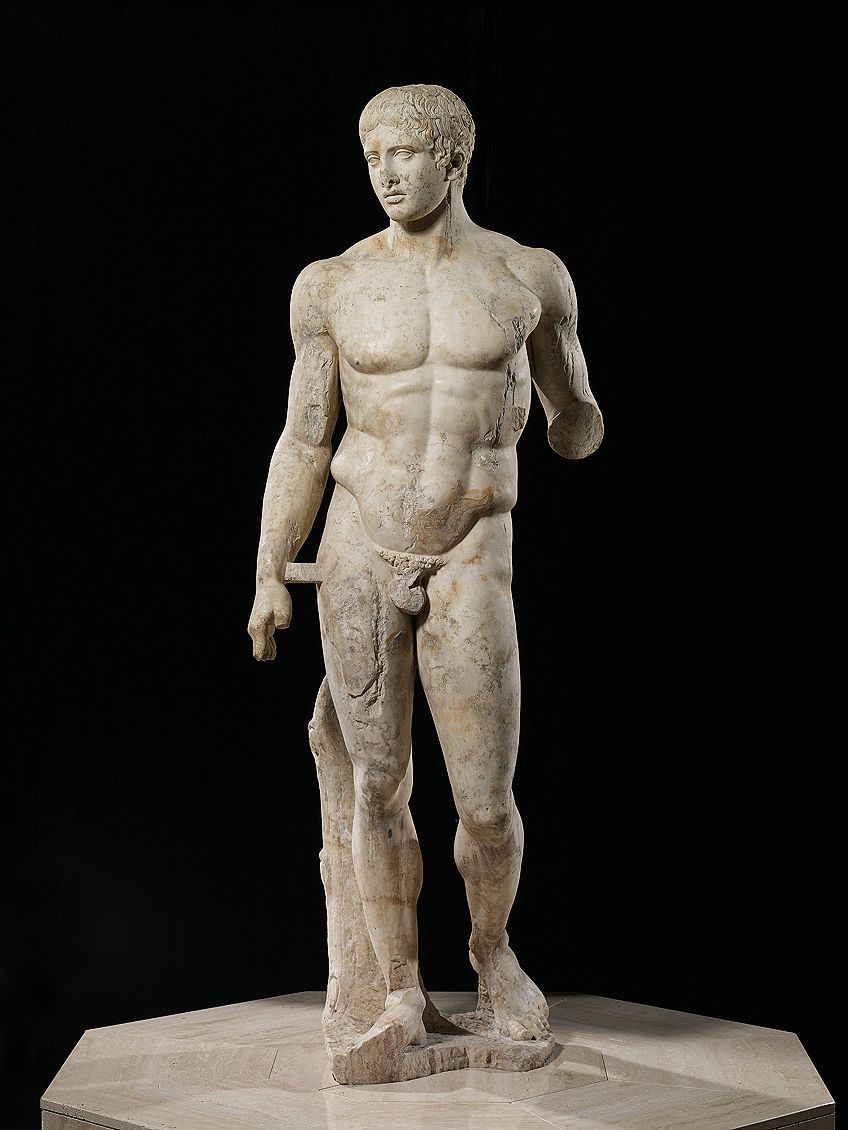
The Doryphoros coordinates tense and relaxed limbs through a balanced stance often described as contrapposto. Modern viewers should remember that the copy’s support strut, marble surface, missing spear, and lost color differ from the Greek bronze.
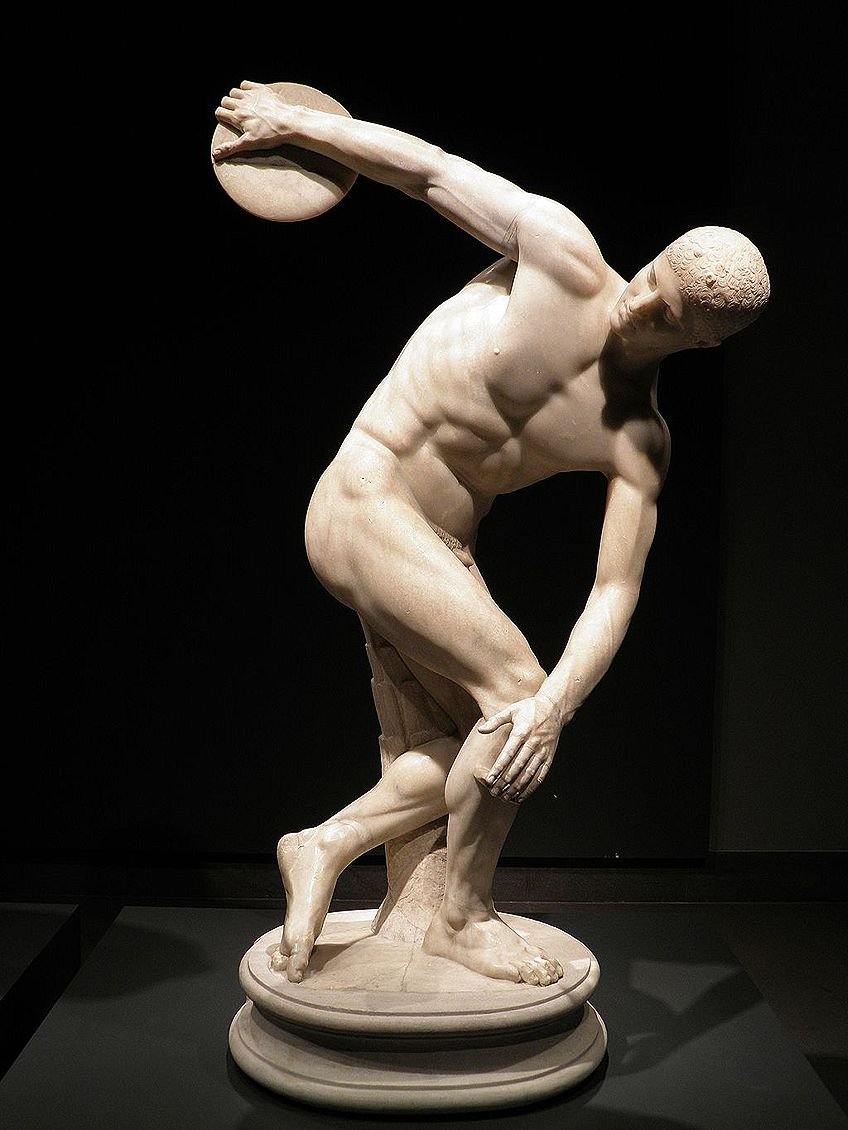
Myron’s Discobolus survives through Roman copies. The athlete’s body forms an intricate arc at a compressed instant. This is not ordinary standing contrapposto; it is a deliberately composed athletic action designed for viewing from selected angles.
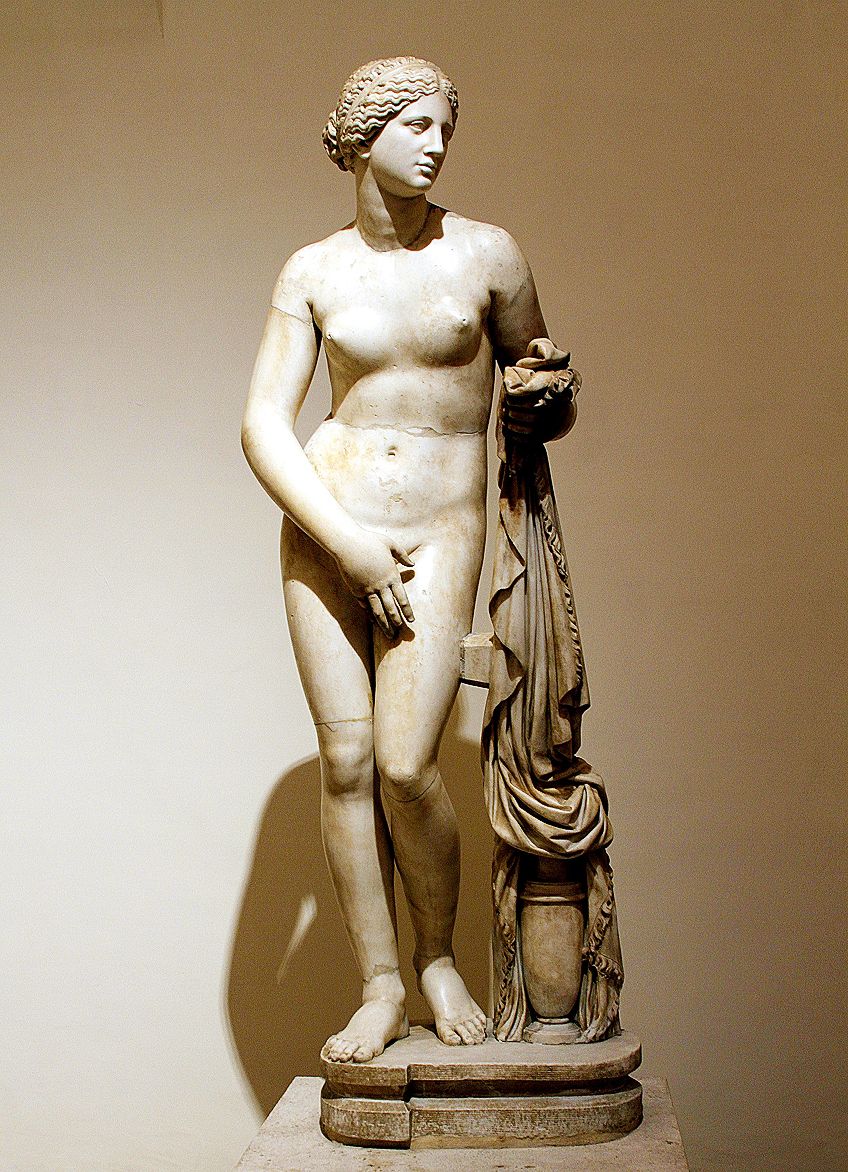
Praxiteles’s Aphrodite of Knidos, created in the fourth century BCE, was celebrated in antiquity as a monumental nude goddess. The original is lost and the image is known through later copies and texts. The statue did not introduce all female nudity into Greek art, but it established an enormously influential full-scale sculptural type.
Classical Greek Architecture
Greek architectural orders coordinate columns, capitals, entablatures, spacing, and proportion. Doric and Ionic were the principal orders in Archaic and Classical monumental architecture; Corinthian emerged in the late fifth century BCE and became especially prominent later. The differences are structural and regional as well as decorative.
The Parthenon was constructed on the Athenian Acropolis mainly between 447 and 432 BCE under the architects Iktinos and Kallikrates. It housed Phidias’s colossal chryselephantine Athena Parthenos and carried Doric metopes, an Ionic frieze, and pedimental sculpture. Its design used subtle curvature and variation rather than perfectly straight, mechanically repeated parts.
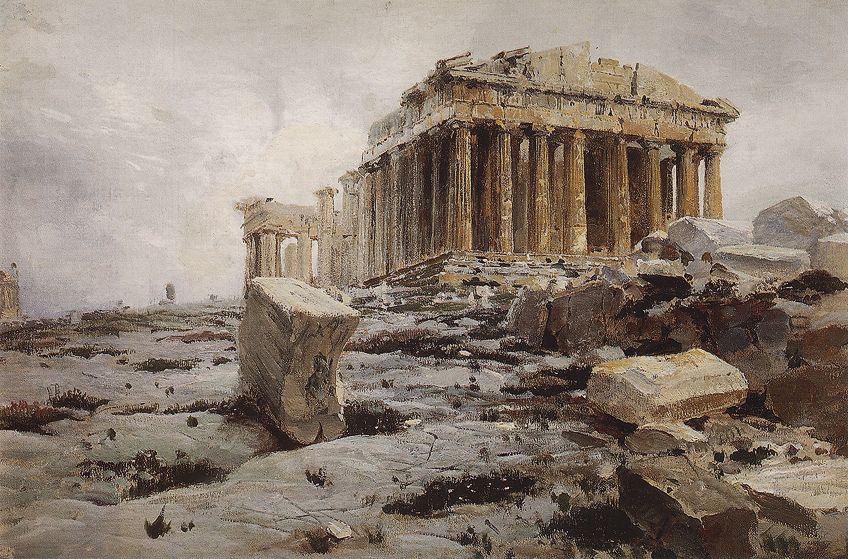
The painting above is Vasily Polenov’s 19th-century view, evidence for modern reception rather than ancient appearance.
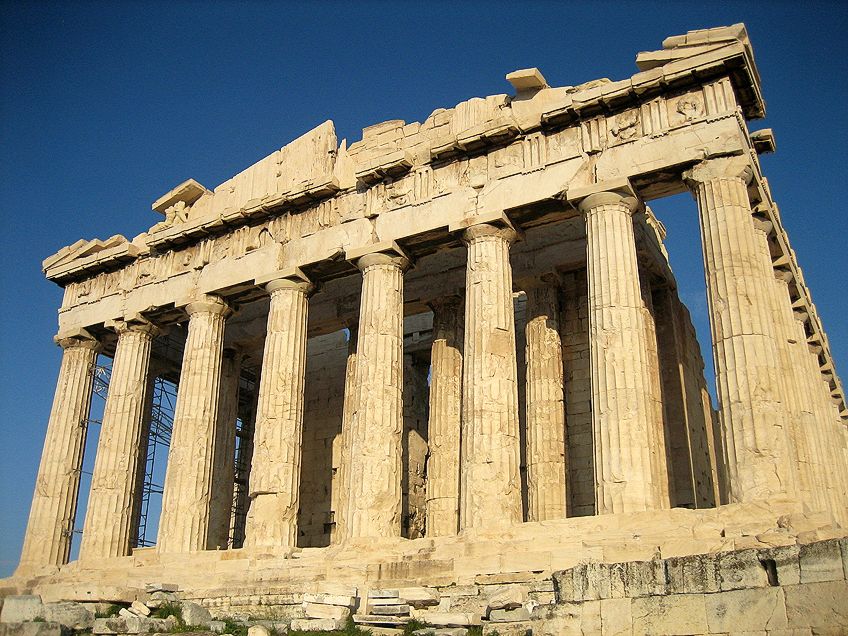
The temple has undergone conversion, war damage, removal of sculpture, excavation, restoration, pollution, and mass tourism. Discussion of the Parthenon sculptures also involves contested legal histories, museum stewardship, cultural property, and Greece’s continuing request for reunification.
The Hellenistic Period (323–31 BCE)
After Alexander’s death, successor kingdoms governed territories from Macedonia and Egypt to western Asia. Athens and mainland Greece remained important, but centers such as Alexandria, Pergamon, Antioch, Rhodes, and cities farther east reshaped Greek visual culture. The conventional endpoint is the Battle of Actium in 31 BCE, although Greek art continued under Roman rule.
Hellenistic art did not abandon idealism for universal realism. It expanded the range of patrons, subjects, scales, spaces, and emotional effects. Rulers commissioned cities, sanctuaries, portraits, and luxury objects; domestic patrons collected sculpture, mosaics, metalwork, and terracottas.
Hellenistic Greek Sculpture
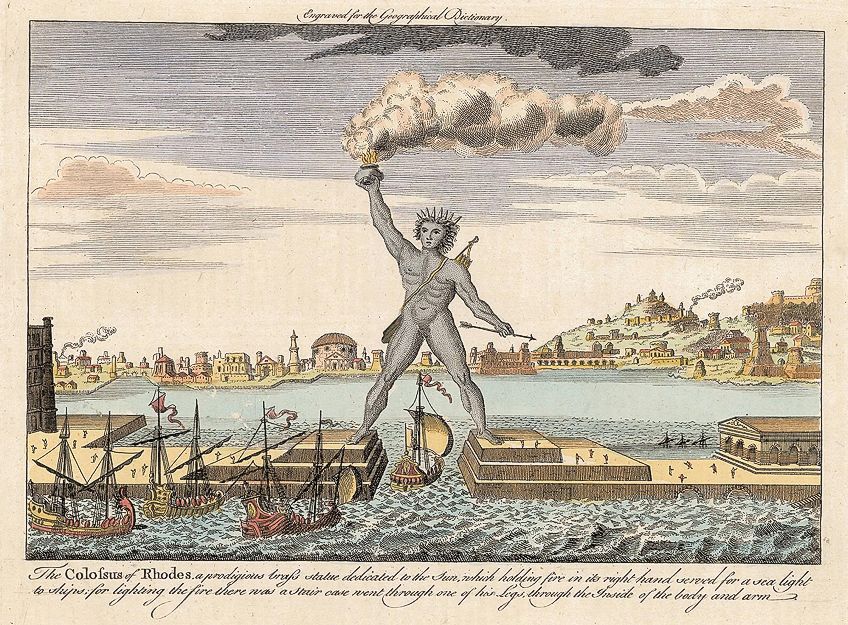
The Colossus of Rhodes was a colossal bronze image of Helios made by Chares of Lindos in the early third century BCE. It collapsed in an earthquake around 226 BCE. No secure ancient image survives, so later pictures showing it straddling a harbor entrance are imaginative reconstructions.
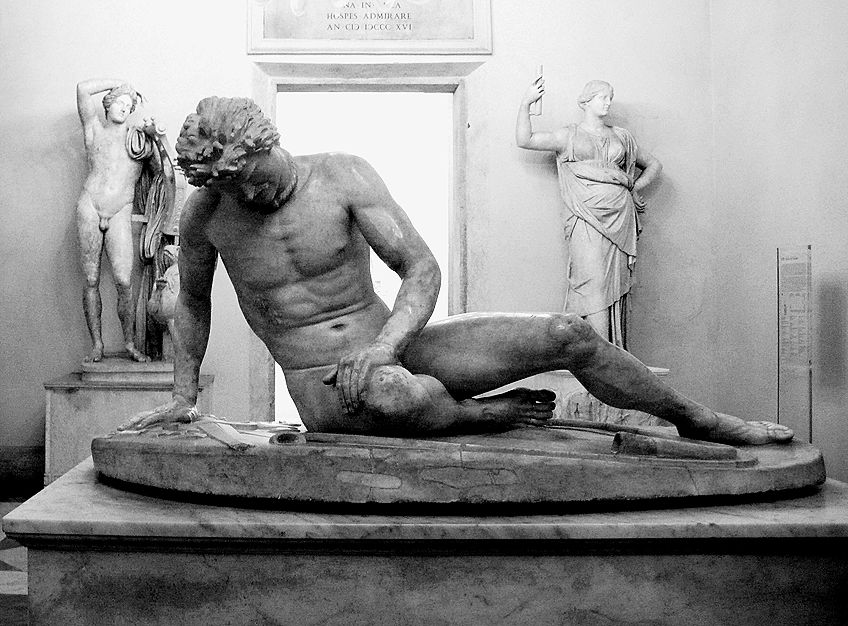
The Dying Gaul is a Roman marble version associated with a lost Pergamene bronze monument commemorating victories over Galatians. The torque, hair, weapons, and wounded body distinguish the defeated figure while granting him physical dignity. Direct attribution to Epigonos remains debated.
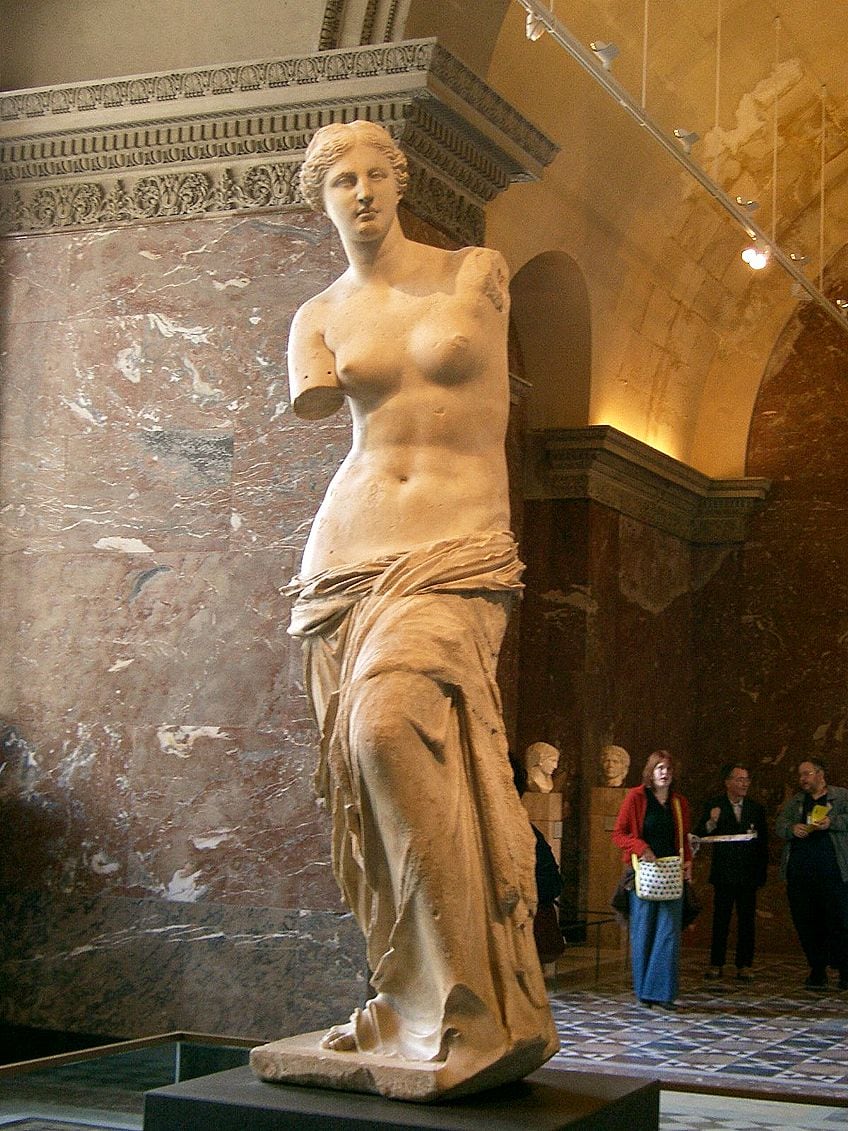
The Venus de Milo—more accurately Aphrodite of Melos—was made around 150–125 BCE and found on Melos in 1820. Her missing arms prevent certainty about pose and attributes. The Louvre record lists Melos as probable place of creation and discovery; identifying her as Aphrodite is persuasive but not absolutely proven.
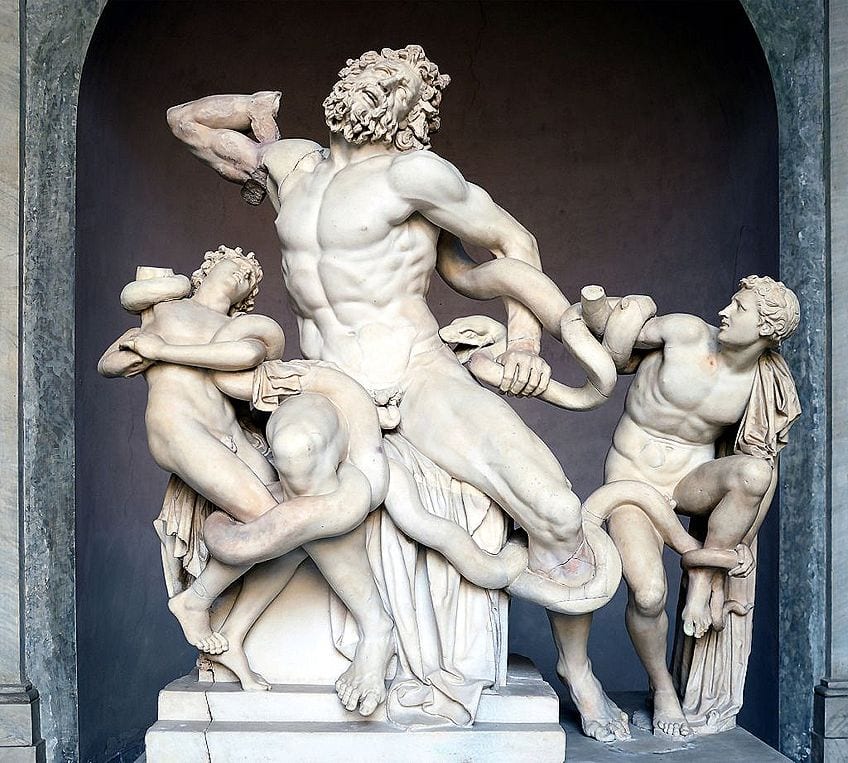
The Laocoön Group presents a Trojan priest and his sons attacked by serpents. Its date, relationship to a lost Hellenistic model, and identification with the work described by Pliny remain debated. The surviving marble was found in Rome in 1506 and became a major reference for Renaissance and later artists.
Hellenistic Greek Architecture
Hellenistic architects designed monumental terraces, stoas, theaters, sanctuaries, palaces, and planned cities for royal and civic patrons. Doric and Ionic forms continued, while Corinthian capitals and complex scenographic planning gained visibility.
The Great Altar at Pergamon, built in the second century BCE under the Attalid dynasty, joined a broad stair with an Ionic colonnade and a high-relief Gigantomachy frieze. Its modern presentation in Berlin is a reconstruction using ancient fragments and modern architectural elements.

The frieze makes gods, giants, animals, and drapery break across the relief field. Deep carving creates strong shadows, while figures sometimes interact with the stairs and architectural frame.
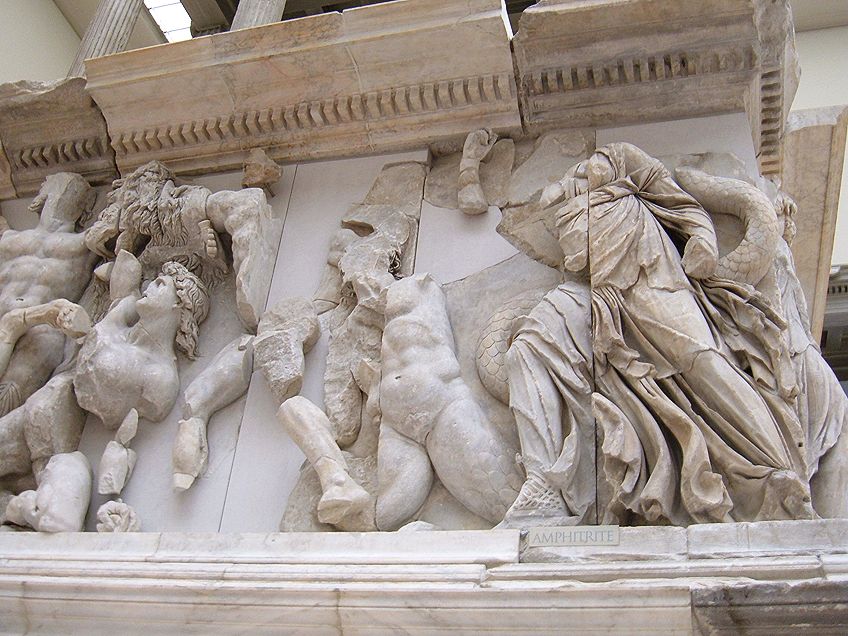
The altar also has a modern history of excavation, division, reconstruction, conservation, and contested ownership. Its archaeological and museum contexts are both part of how it is seen today.
To Rome and Beyond
Greek and Roman art were never isolated traditions. Greek artists worked for Roman patrons, Roman collectors moved Greek works, and sculptors made new versions in Greek styles. Roman copies are not transparent photographs of lost originals: materials, supports, scale, display, and meaning could change.
After antiquity, Greek visual traditions were preserved, transformed, forgotten, excavated, and reinvented through Byzantium, Islamic collections and scholarship, the Renaissance, Neoclassicism, archaeology, modern museums, nationalism, education, and popular culture. The idea of a pure “Classical ideal” is itself part of that reception history.
The surviving record is uneven. Bronze was melted down; paint faded; buildings were reused; excavations separated objects from sites; and modern collecting dispersed ensembles. Reading Greek art well therefore means comparing original context, later copies, restoration, museum display, and present-day cultural claims.
Frequently Asked Questions
What Were the Different Periods in Greek Art?
A common framework is Geometric (c. 900–700 BCE), Archaic (c. 700–480 BCE), Classical (480–323 BCE), and Hellenistic (323–31 BCE). Bronze Age Cycladic, Minoan, and Mycenaean cultures provide important Aegean foundations, while Greek artistic traditions continued under Roman rule.
What Does Classical Order Mean in Greek Art?
An architectural order is a coordinated system of column, capital, entablature, proportion, and ornament. Ancient Greek architecture principally used Doric and Ionic orders; Corinthian developed later from the Ionic tradition and became especially prominent in Hellenistic and Roman buildings.
What Are Some Greek Art Characteristics?
Greek art is diverse, but recurring features include narrative pottery, attention to the human body, changing systems of proportion and movement, architectural orders, mythological and civic subjects, regional exchange, and the integration of sculpture with sanctuaries, graves, houses, and public space. Many works were originally brightly colored.
Which Museum Has the Largest Collection of Greek Art?
“Largest” depends on whether one counts objects, gallery area, or chronological scope. Greece’s National Archaeological Museum holds one of the world’s most important collections of Greek antiquities and describes its sculpture collection as tracing Greek sculpture from about 700 BCE to the fifth century CE.

Isabella studied at the University of Cape Town in South Africa and graduated with a Bachelor of Arts majoring in English Literature & Language and Psychology. Throughout her undergraduate years, she took Art History as an additional subject and absolutely loved it. Building on from her art history knowledge that began in high school, art has always been a particular area of fascination for her. From learning about artworks previously unknown to her, or sharpening her existing understanding of specific works, the ability to continue learning within this interesting sphere excites her greatly.
Her focal points of interest in art history encompass profiling specific artists and art movements, as it is these areas where she is able to really dig deep into the rich narrative of the art world. Additionally, she particularly enjoys exploring the different artistic styles of the 20th century, as well as the important impact that female artists have had on the development of art history.
Learn more about Isabella Meyer and the Art in Context Team.
Cite this Article
Isabella, Meyer, “Greek Art – Gems in Ancient Greek Art History.” Art in Context. May 19, 2021. URL: https://artincontext.org/greek-art/
Meyer, I. (2021, 19 May). Greek Art – Gems in Ancient Greek Art History. Art in Context. https://artincontext.org/greek-art/
Meyer, Isabella. “Greek Art – Gems in Ancient Greek Art History.” Art in Context, May 19, 2021. https://artincontext.org/greek-art/.