

Frankfurt Proposes a Full Parthenon East-Pediment Reconstruction

Frankfurt’s Liebieghaus has unveiled an archaeologically grounded proposal for the complete sculptural program of the Parthenon’s shattered east pediment. The reconstruction makes a lost birth-of-Athena scene visible again—but its central figures and several identities remain interpretations assembled from fragments, technical traces, ancient texts, and later Roman works.
What the Liebieghaus Has Reconstructed
The exhibition opened on November 18, 2026, after a November 17 press preview; the Liebieghaus issued its detailed release on October 14, and Deutschlandfunk reported the exhibition on November 17.
The east pediment was the approximately 30-meter-wide triangular field above the temple’s principal entrance, a key element of ancient Greek temple architecture. It showed Athena’s birth from the head of Zeus. The center was largely destroyed, while 11 smaller sculptures at the corners are partially preserved, according to the Liebieghaus.
The numbers describe different bodies of evidence and should not be treated as interchangeable. In particular, “around 60 fragments” is not a count of everything that survives; it is the subset the Frankfurt team says it reexamined with 3D scanning.
| Evidence | Amount or status | Role in the proposal |
|---|---|---|
| Corner sculptures | 11 partly preserved | Anchor the ends and symmetry |
| Historical fragment corpus | About 240 known in 1910 | Broader documentary base |
| Frankfurt study set | About 60 rescanned | New joins, figures, and positions |
| Roman works | Comparative material | Suggest lost poses and motifs |
| Complete arrangement | Digital and physical models | Research synthesis, not a recovered original |
Arthur Hamilton Smith’s 1910 publication gathered the roughly 240 east-pediment fragments known at that time. The new project therefore revisits part of a much larger historical record; it does not imply that the remaining pieces were rejected or found irrelevant.
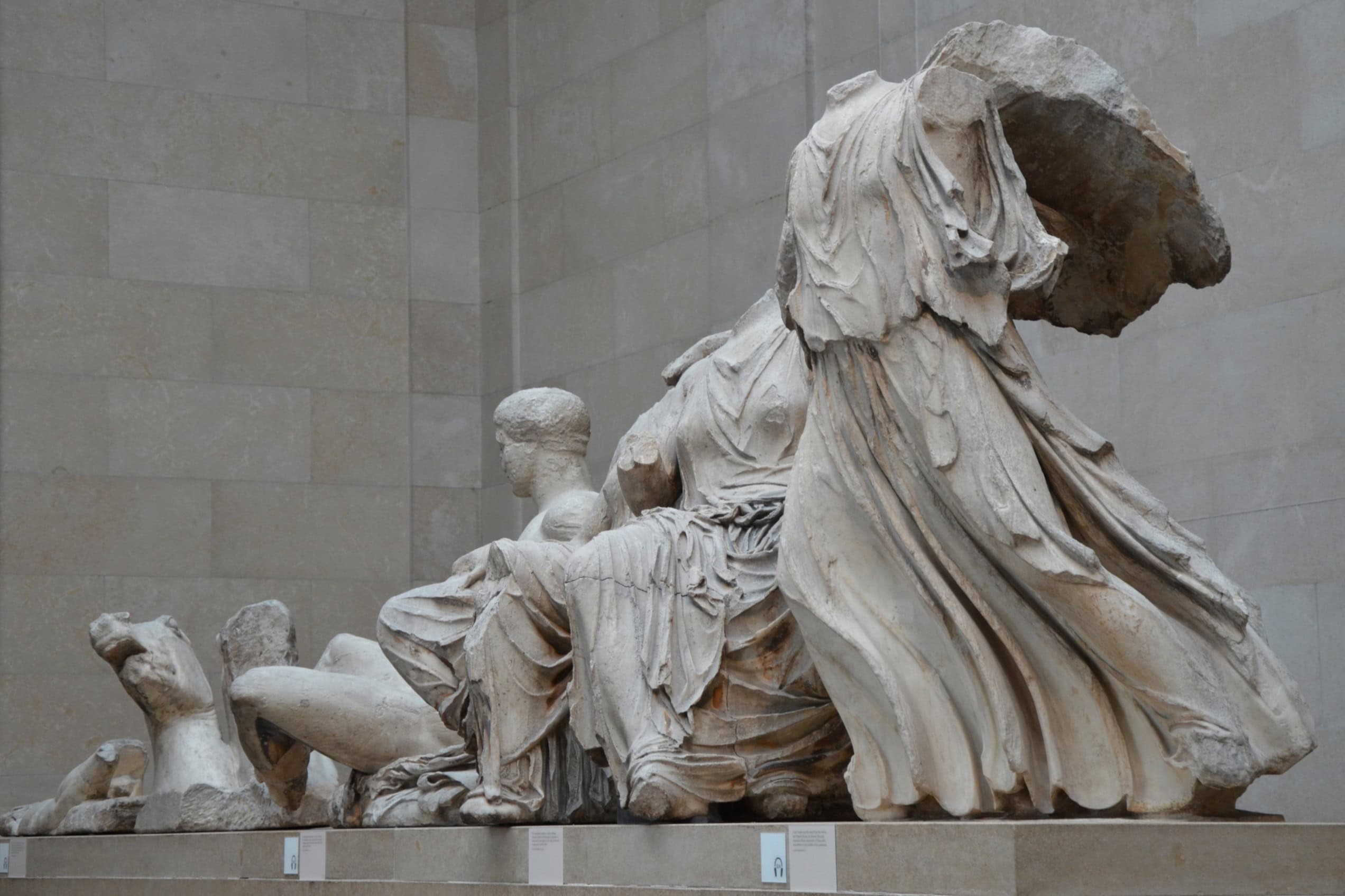
Surviving sculptures from the Parthenon’s east pediment at the British Museum. Photograph by Carole Raddato via Wikimedia Commons, CC BY-SA 2.0, cropped.
How a Fragment Becomes a Figure
The strongest evidence begins on the marble itself. Curator Vinzenz Brinkmann says the team examined drill holes, broken edges, and working traces. The museum adds that mortise-and-tenon holes, once used to secure sculptures weighing several tons, helped place fragments within the triangular architecture. Digital scanning allows researchers to test joins and geometry, but a scan does not by itself name a god.
One proposed identification joins a Parthenon fragment bearing a tortoise shell and a remnant of windblown drapery to Roman repetitions of the so-called Hermes Ludovisi. The repeated combination supports a Hermes figure in the pediment. Another argument compares Castor and Pollux with their horses to the colossal horse tamers on Rome’s Quirinal Hill; the Frankfurt team concludes that the Roman figures enlarge a motif from the lost Greek composition.
A second- or third-century Roman sarcophagus supplies a broader compositional parallel. Its lid arranges figures in a way the researchers consider close to the east-pediment scene. This evidence can support a pose, grouping, or iconographic relationship, but it is not the same thing as a physical join to the fifth-century BCE marble. That distinction is essential: the completed ensemble combines direct material evidence with comparative interpretation.
The surviving corners provide another control. Helios rises with his chariot at one end while Selene descends at the other, framing the action as a transition from night to day. Their placement, and paired figures such as Olympus and Gaia, led the team to organize the whole design symmetrically around the center.
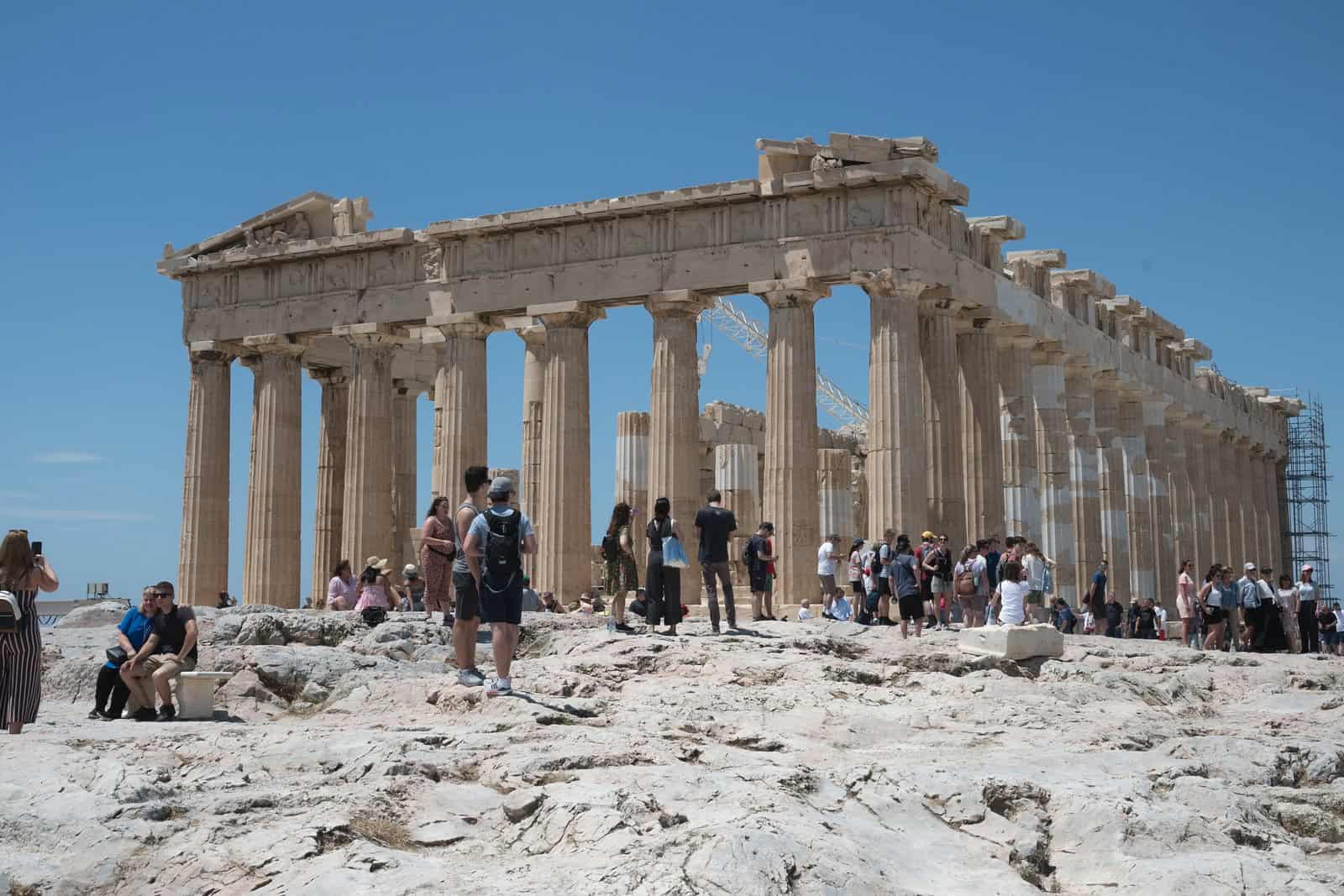
The Parthenon’s eastern front and pediment in Athens. Photograph by Zde via Wikimedia Commons, CC BY-SA 4.0, cropped.
The New Center: Zeus, Athena, and Hera
In Frankfurt’s proposed center, Zeus sits on an altar while Uranus spreads a starry canopy below him. Athena stands beside Zeus already full-sized and armed. Hera holds a sacrificial bowl; the team interprets her action as welcoming Athena into the divine community. The arrangement is the Frankfurt team’s reading, not a newly recovered ancient description of every figure.
The team’s life-size 3D print of Zeus combines surviving parts assigned to his legs, right shoulder, and left hand. A Louvre statue of the “Medici-Ingres” Athena type is used to illustrate a more ambitious theory: that the Paris sculpture originally served as an ancient replacement for the lost Athena in the pediment. The museum cites its dimensions, marble, weathering, and an earlier association made by archaeologist Adolf Furtwängler. Those converging clues make the proposal testable, but the statue’s role remains a theory.
The completed scene adds the Fates, Prometheus or Hephaestus, the Dioscuri, Nike, Tyche, and other deities and personifications. A color reconstruction and animation then turn these assignments into a continuous dramatic event: wind catches garments, horses rear, and Hermes reaches for his hat as Athena’s birth shakes the world.
The audio-guide page says 38 figures, but the press release and curator Vinzenz Brinkmann’s breakdown of 25 human figures and 14 animals give a total of 39.
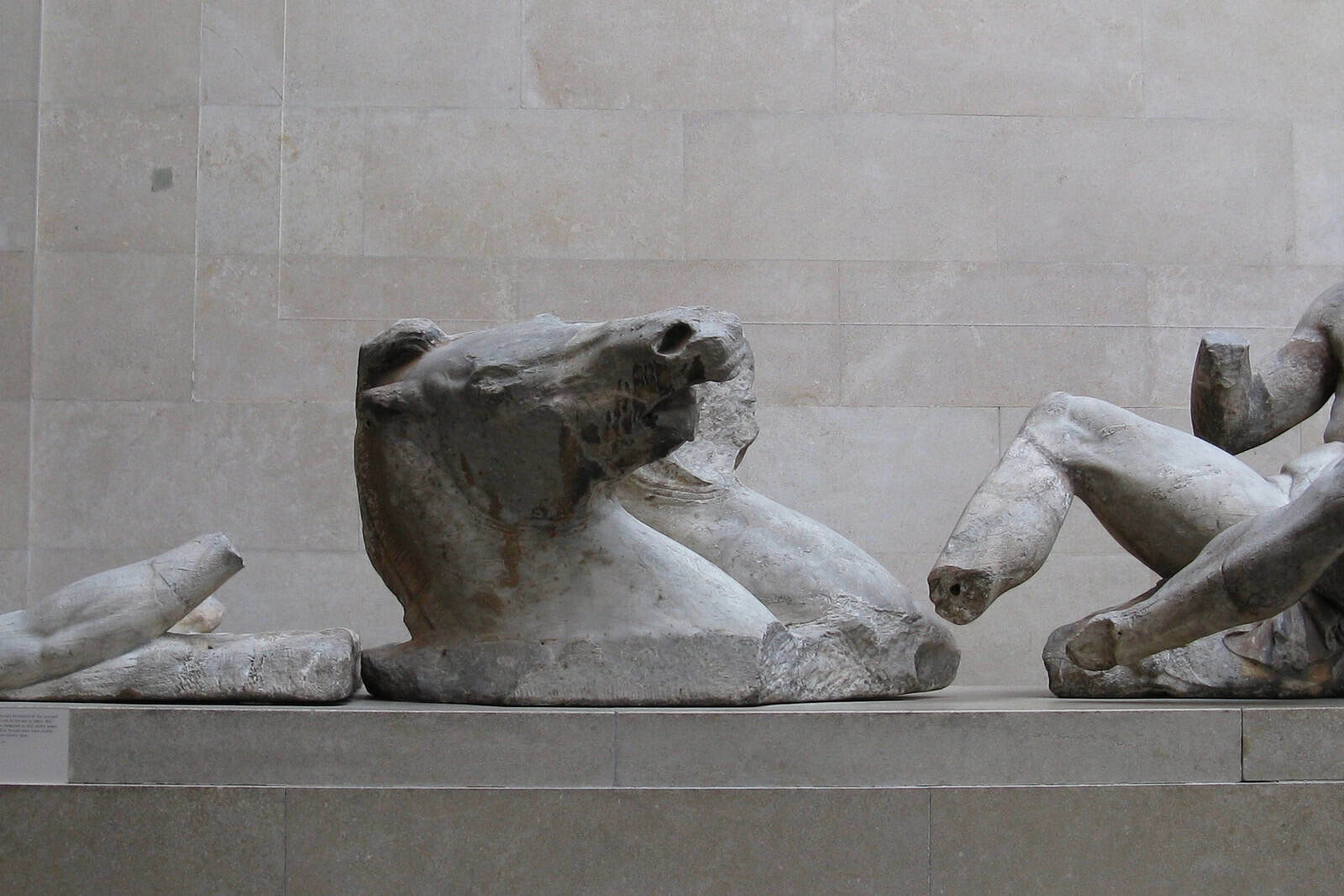
Surviving sculptures from the left corner of the Parthenon’s east pediment, including Helios’s horses and a reclining figure. Photograph by Yair Haklai via Wikimedia Commons, CC BY-SA 4.0, cropped.
A Reconstruction, Not a Reunification
The project brings scattered evidence together intellectually, not physically. Surviving east-pediment sculptures remain divided principally between Athens and London, and the Frankfurt display uses originals, casts, loans, 3D prints, scale models, and animation in different roles. The wider ownership dispute is addressed in Art in Context’s report on Greece’s rejection of a Parthenon Sculptures loan proposal.
That distinction also prevents the familiar phrase “Parthenon Sculptures” from swallowing the actual finding. The Frankfurt research concerns the east pediment—the triangular sculptural group above one end of the temple—not every surviving metope, frieze block, or pedimental figure associated with the Parthenon. Its achievement is a proposed iconographic and spatial program for one devastated ensemble.
What the Evidence Now Establishes
The evidence supports a narrower, but still major, claim than the idea that a lost masterpiece has simply been recovered.
- The Frankfurt proposal reassigns about 60 scanned fragments within a corpus that already numbered about 240 pieces in 1910.
- Eleven partly preserved corner sculptures anchor the ends; the mostly lost center depends more heavily on joins, architectural traces, ancient texts, and Roman comparisons.
- Zeus enthroned, armed Athena, and sacrificial Hera form the team’s proposed central triad, not an established consensus announced by an independent scholarly body.
- The institution’s own current materials give conflicting totals of 38 and 39 figures.
- No independent peer-reviewed assessment cited by the museum has yet resolved the new placements, but the exhibition makes the evidence and the complete hypothesis available for scrutiny.

Isabella studied at the University of Cape Town in South Africa and graduated with a Bachelor of Arts majoring in English Literature & Language and Psychology. Throughout her undergraduate years, she took Art History as an additional subject and absolutely loved it. Building on from her art history knowledge that began in high school, art has always been a particular area of fascination for her. From learning about artworks previously unknown to her, or sharpening her existing understanding of specific works, the ability to continue learning within this interesting sphere excites her greatly.
Her focal points of interest in art history encompass profiling specific artists and art movements, as it is these areas where she is able to really dig deep into the rich narrative of the art world. Additionally, she particularly enjoys exploring the different artistic styles of the 20th century, as well as the important impact that female artists have had on the development of art history.
Learn more about Isabella Meyer and the Art in Context Team.
Choose Art in Context as a preferred source to see more of our reporting in Google Top Stories and other Google Search experiences.
Cite this Article
Isabella, Meyer, “Frankfurt Proposes a Full Parthenon East-Pediment Reconstruction.” Art in Context. November 18, 2026. URL: https://artincontext.org/frankfurt-parthenon-east-pediment-reconstruction/
Meyer, I. (2026, 18 November). Frankfurt Proposes a Full Parthenon East-Pediment Reconstruction. Art in Context. https://artincontext.org/frankfurt-parthenon-east-pediment-reconstruction/
Meyer, Isabella. “Frankfurt Proposes a Full Parthenon East-Pediment Reconstruction.” Art in Context, November 18, 2026. https://artincontext.org/frankfurt-parthenon-east-pediment-reconstruction/.


