


Fox Coloring Pages – Discover 54 Free Fox Coloring Sheets

Discover the fascinating world of foxes with our brand new Fox Coloring Pages! Whether for young or old, coloring fox pictures is a beautiful way to explore the natural beauty of these clever and elegant animals. We have created 54 free Fox Coloring Pages for you, suitable for both beginners and experienced painters. Dive into the world of foxes and let your creativity run wild!
Our 54 Free Fox Coloring Pages

A front-facing fox head with tall pointed ears, a lotus-style ornament on the forehead and a fluffy cheek ruff, framed below by flowers, leaves and paisley swirls. Very fine, dense detail.

A cartoon fox kit sits upright facing forward, with oversized pointed ears, big glossy eyes and a small smile. Its fluffy tail curls to the right, and the black ear tips and paws are solid. Bold, open shapes make it easy to color.

A fox lies in tall grass with its head turned left, ears upright and whiskers drawn in. Its body is built from dense pencil-style fur strokes, with seed-topped grass blades in front and behind.

A red fox bounds to the right with one front paw raised, ears pricked and a long bushy tail trailing behind. Its fur is drawn in fine pencil hatching, with a scribbled ground shadow below.

Three small kits gather around a large vixen who sits upright and faces forward, her long bushy tail sweeping to the right. The fine pencil-style fur strokes make this a detailed sheet for patient colorers.

A tall cartoon fox with a tilted head and a big curled tail stands over three small kits, while about twenty leaves and petals drift down around them. Bold outlines and open shapes keep it easy to color.

Seen from the side, a fox leaps upward with its snout raised, front legs tucked and a long bushy tail trailing behind. Dense ink hatching covers the fur, and scattered dots and dashes mark flying dust below.

A front-facing fox head with tall pointed ears, almond eyes and a solid black nose. Paisley swirls, scales and dotted patches fill the forehead and cheeks, while flowing fur strands frame the face. Very fine detail suits patient colorers.

A fox lies on its belly with head turned to the side, large pointed ears upright and a thick bushy tail curled along its flank. Tall grass blades and seed heads surround it.

Big glossy eyes with white highlights and a tiny heart-shaped nose give this front-facing kit a sweet look. Oversized pointed ears, two fluffy tails and small paws are drawn in thick, open outlines.

A red fox sleeps curled into a tight ring, closed eyes and black nose resting on its flank beneath a dark bushy tail. Dense pencil-style shading models the fur, ears and whiskers.

In profile, a fox lifts its nose with eyes closed, standing on a mossy rise among tall bare pine trunks and fir saplings. This dense ink-style sheet suits patient colorers.

A round-bodied fox sits facing forward with its head tilted slightly down, pointed ears with inner fur lines, narrow eyes and a small round nose. A tall fluffy tail curves up behind it.

A fox lies on its belly with its head turned toward the viewer, ears upright and a long bushy tail stretched out behind. Loose hatching marks the cheeks, chest and dark tail tip.

Front-facing fox head drawn as a stylized emblem, with tall pointed ears, solid black inner-ear fur strokes, slanted narrow eyes and a small black nose. The large white face is left open for coloring.
Autumn Fox Coloring Pages and More New Sheets
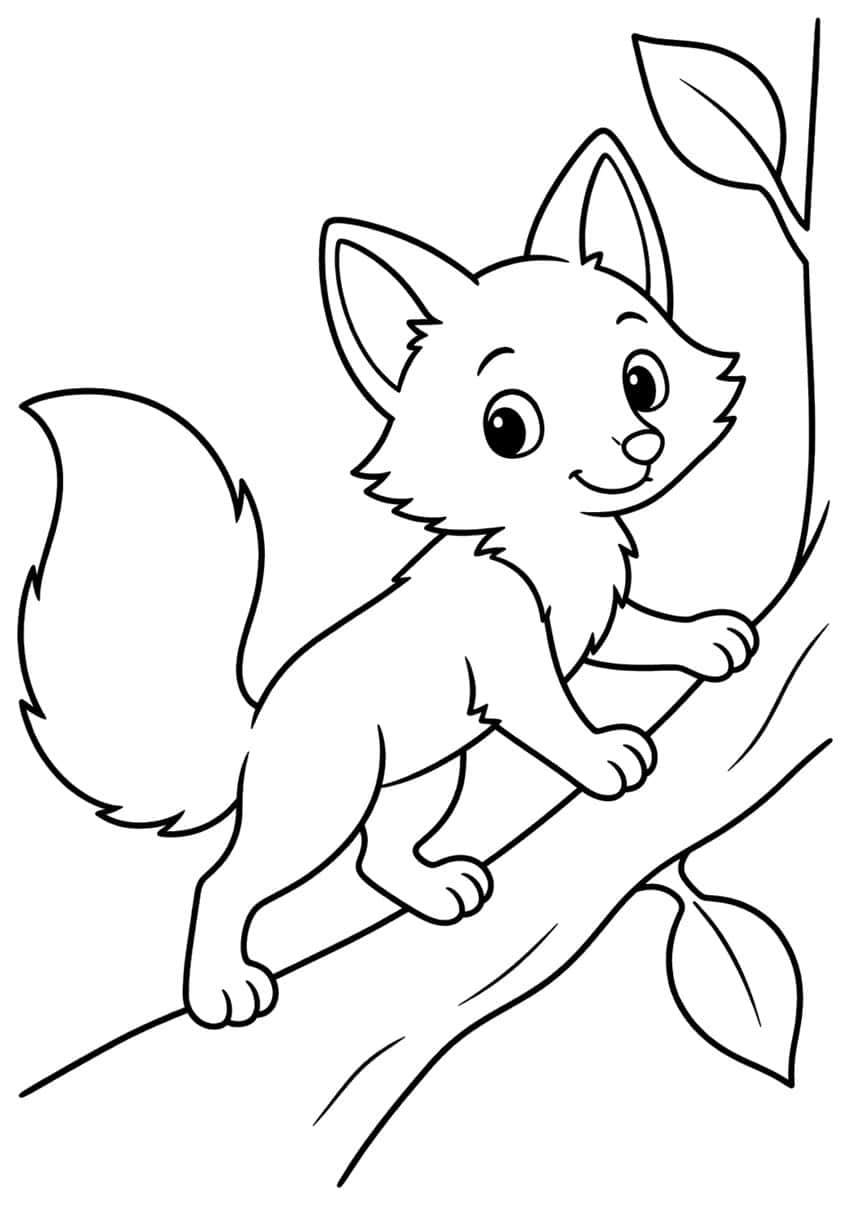
These 39 sheets are brand new and show foxes in everyday moments: a city fox on a wheelie bin, a fox crossing a wooden bridge, one sitting among autumn leaves, two cubs playing in a wheat field and a sleeping fox in a hollow log. The outlines are clear enough for younger children and detailed enough for older ones. Each one prints as a PDF in A4, so you can download it and start coloring right away.


🖍️ Color it online

🖍️ Color it online

🖍️ Color it online

🖍️ Color it online

🖍️ Color it online

🖍️ Color it online

🖍️ Color it online
🖍️ Color it online

🖍️ Color it online

🖍️ Color it online

🖍️ Color it online

🖍️ Color it online

🖍️ Color it online

🖍️ Color it online

🖍️ Color it online

🖍️ Color it online

🖍️ Color it online
🖍️ Color it online

🖍️ Color it online

🖍️ Color it online

🖍️ Color it online

🖍️ Color it online

🖍️ Color it online

🖍️ Color it online

🖍️ Color it online

🖍️ Color it online

🖍️ Color it online

🖍️ Color it online

🖍️ Color it online

🖍️ Color it online

🖍️ Color it online

🖍️ Color it online

🖍️ Color it online

🖍️ Color it online
Important Facts about Foxes
Foxes belong to the dog family and are closely related to wolves, coyotes, and foxes. There are many different species of foxes that vary in appearance and behavior, but most foxes have long, bushy tails and dense, furry bodies. Foxes are known for their intelligence and keen sense of smell. They are very adaptable and can live in a variety of habitats, including forests, grasslands, and even cities. Foxes are omnivores and feed on a variety of prey and plant materials. In some cultures, foxes are considered a symbol of cunning and craftiness.

Positive Aspects of Fox Coloring Sheets for Children
Coloring fox pictures can have many benefits for children. It promotes fine motor skills, hand-eye coordination and concentration as children have to pay attention to small details while coloring. It also helps children develop their creativity and imagination by allowing them to choose the colors and patterns they want to use. Coloring fox pictures can also be a relaxing and calming activity that helps children relieve stress and regulate their emotions. In addition, fox pictures can help children increase their knowledge about these fascinating animals and foster their interest in nature.
Fox Facts for Parents and Teachers
The red fox is the animal that most coloring pages show, so most of the facts below describe it, with notes on its relatives where they differ. The numbers are typical values, because individual foxes vary with region and season.
Fox Species and Where They Live
True foxes belong to the genus Vulpes, which includes about a dozen species, among them the red fox, Arctic fox, fennec fox, swift fox, kit fox and corsac fox. Some animals with fox in their names, such as the gray fox and the bat-eared fox, sit in different genera but are still part of the dog family.
- Red fox: lives across North America, Europe and Asia and in parts of North Africa. It was brought to Australia in the nineteenth century, where it is now treated as an invasive pest. It copes with forests, farmland, mountains and suburbs.
- Arctic fox: lives on the tundra near the top of the world. It has dense fur, short legs and small, rounded ears that lose little heat, and its coat is white in winter and brownish or gray in summer.
- Fennec fox: lives in the Sahara and other deserts of North Africa. It is the smallest fox species, weighing about two to three pounds, and its ears can reach roughly six inches long. The large ears help it shed heat and hear prey moving underground.
- Gray fox: lives across much of the United States and Central America. Its curved claws let it climb trees, which is unusual among members of the dog family.
Body, Senses and Behavior
An adult red fox usually has a head and body length of about 18 to 35 inches, and the tail adds another 12 to 22 inches. Most weigh between about 7 and 15 pounds, which is about the weight of a large house cat or a small dog.
The tail is called a brush. A fox uses it for balance when running and turning, wraps it around its nose and paws like a blanket when it rests in cold weather, and shows its mood to other foxes with it. Red foxes have vertical, slit-shaped pupils like a cat’s, which help them see at dusk and at night, and their sharp hearing lets them pick up small animals rustling under leaves, grass or snow.
Foxes are most active around dusk, at night and around dawn, although foxes in cities are often seen during the day. They rest and raise their young in dens called earths, often enlarging burrows that other animals dug first. They communicate with barks, yips and a high, drawn-out scream that is most often heard in winter, during the mating season.
Food, Family Life and Lifespan
A red fox eats whatever is available: mice, voles, rabbits, birds, eggs, insects, earthworms, fruit and berries. It finds small animals by listening, then leaps high and pounces down on them with its front paws. In cities, foxes also scavenge food scraps.
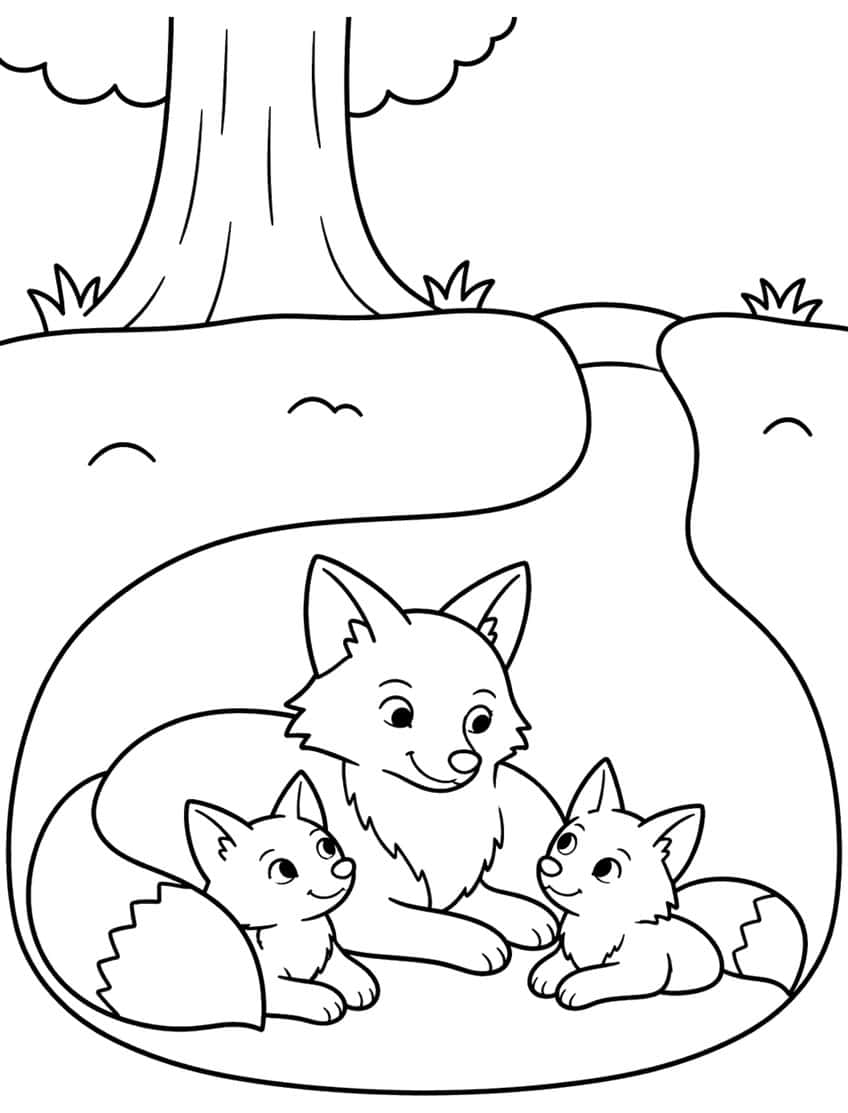
A female fox is called a vixen and a male is called a dog fox. Pairs mate in winter, and the young are born in spring in a den, in a litter that commonly holds four to six kits. Kits are also called pups or cubs. They are born with their eyes closed and with dark, grayish brown fur that turns reddish over the following weeks. The male brings food to the vixen and, later, to the kits, and many young foxes leave the family area by autumn. A family group is sometimes called a skulk.
Life in the wild is hard, and many red foxes live only two to five years. In captivity they can live around ten years or more.
Which Colors Work Best for Fox Coloring Pages
The classic red fox is built from four colors, and a pencil set that has all of them covers most of the sheets above.
- Orange or rust red: the main coat color. Start with a medium orange and add a darker reddish brown along the back and tail so the fur has depth.
- White or cream: the chest, throat, cheeks, belly and the tip of the tail are white. Leave the paper bare there, or use a pale cream so the white stays bright next to the orange.
- Black or dark brown: red foxes have dark “stockings” on their lower legs and dark backs on their ears. Use black or very dark brown for those and for the nose.
- Light gray or tan: useful for soft shadows on the white areas and for the thicker fur around the neck.
Other species call for different colors. An Arctic fox looks right in white with pale blue-gray shadows, or in brown and gray for a summer coat. A fennec fox needs sandy tan and cream, with a dark tip on the tail. A gray fox is silver gray along the back, with rusty orange on the sides and neck and a black stripe down the top of the tail.
The backgrounds matter as well. On the autumn leaves sheet, use yellow, burnt orange, red and brown for the leaves, and keep the fox a different shade of orange so it does not blend in. The wheat field suits golden yellow and light brown, with a blue sky and a yellow sun. The snowy hollow log works with white, light blue and gray for the snow and warm brown for the wood. On the park bridge sheet, green for the grass and bushes and blue for the stream make the orange fox stand out.
Frequently Asked Questions
What do foxes eat?
Foxes are omnivores, and the red fox eats mostly small animals such as mice, voles and rabbits, plus birds, eggs and insects. When meat is scarce, it turns to fruit, berries and earthworms. Foxes in cities scavenge scraps from bins and bird feeders. A fox that finds more food than it needs often buries the extra in a shallow hole and returns to it later.
What is a baby fox called?
A baby fox is called a kit, and the words pup and cub are also used. Kits are born in spring, usually four to six in a litter, with their eyes closed and with dark, grayish brown fur. They stay in the den for about the first month and then begin to play outside near the entrance. Their parents feed them until they learn to hunt for themselves.
Are foxes dangerous to people?
Wild foxes are shy and normally run away from people, and attacks are very rare. A fox that seems unafraid, behaves strangely or lets you walk up to it may be sick, and rabies occurs in foxes in some parts of the world. Never feed, touch or corner a wild fox, and keep small pets and poultry secure at night. If a fox bites or scratches someone, wash the wound well and contact a doctor.
Can a fox be kept as a pet?
Foxes are wild animals, not domesticated ones. They dig, chew, mark territory with strong-smelling urine and are hard to house-train. Laws differ by country and state, and in many places owning a fox is illegal or requires a permit. A well-known breeding experiment in Russia, begun in 1959 by Dmitri Belyaev, produced tamer silver foxes only after many generations of selecting for friendly behavior.
Why do foxes have bushy tails?
The tail, or brush, does several jobs. It helps a fox balance when it runs, jumps and changes direction quickly. In cold weather the fox curls up and covers its nose and paws with it, which keeps in warmth. Foxes also use the tail to signal to one another, and the white tip of a red fox’s tail is worth remembering when you pick your colors.

Matthew Matthysen is an educated multidisciplinary artist and illustrator. He successfully completed his art degree at the University of Witwatersrand in South Africa, majoring in art history and contemporary drawing. The focus of his thesis was to explore the philosophical implications of the macro and micro-universe on the human experience. Matthew uses diverse media, such as written and hands-on components, to explore various approaches that are on the border between philosophy and science.
Matthew organized various exhibitions before and during his years as a student and is still passionate about doing so today. He currently works as a freelance artist and writer in various fields. He also has a permanent position at a renowned online gallery (ArtGazette) where he produces various works on commission. As a freelance artist, he creates several series and successfully sells them to galleries and collectors. He loves to use his work and skills in various fields of interest.
Matthew has been creating drawing and painting tutorials since the relaunch in 2020. Through his involvement with artincontext.org, he has been able to deepen his knowledge of various painting mediums. For example, watercolor techniques, calligraphy and lately digital drawing, which is becoming more and more popular.
Learn more about Matthew Matthysen and the Art in Context Team.
Cite this Article
Matthew, Matthysen, “Fox Coloring Pages – Discover 54 Free Fox Coloring Sheets.” Art in Context. April 16, 2023. URL: https://artincontext.org/fox-coloring-pages/
Matthysen, M. (2023, 16 April). Fox Coloring Pages – Discover 54 Free Fox Coloring Sheets. Art in Context. https://artincontext.org/fox-coloring-pages/
Matthysen, Matthew. “Fox Coloring Pages – Discover 54 Free Fox Coloring Sheets.” Art in Context, April 16, 2023. https://artincontext.org/fox-coloring-pages/.


