


Flower Coloring Pages – 62 Gorgeous Motifs to Print and Color

A flower is a popular, colorful, and fun option if you are looking for something to draw or color. To make it a little easier, there are also flower coloring pages for both young and old. There are many flowers to choose from, so we have created a list of printable flower coloring pages for you.
Flower Coloring Pages
Printable flower coloring pages can be an enjoyable craft activity that can be done all year round. However, if you are looking for an educational, springtime activity, then finding flowers to color is a great idea. Adults can have just as much fun coloring, and it can provide a way to de-stress from a hectic world.
Flower coloring sheets are also the perfect way to keep the kids busy on a rainy day. We have included some interesting facts about each flower, so you can make the printable flower coloring pages into a fun learning experience as well. Take a look at our collection of flowers to color and if you wish to make it more challenging, why not try some of our flower drawing tutorials.
Flower Coloring Pages


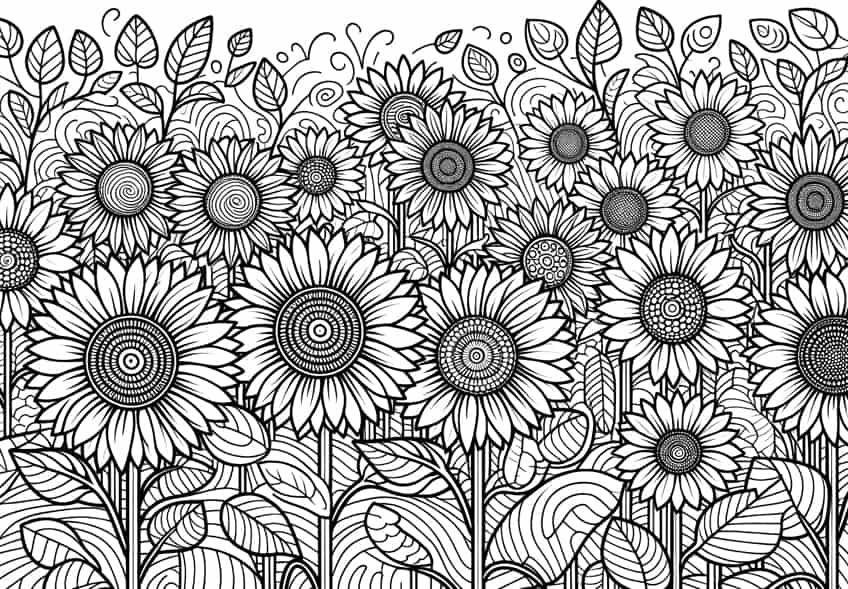 A field of sunflowers


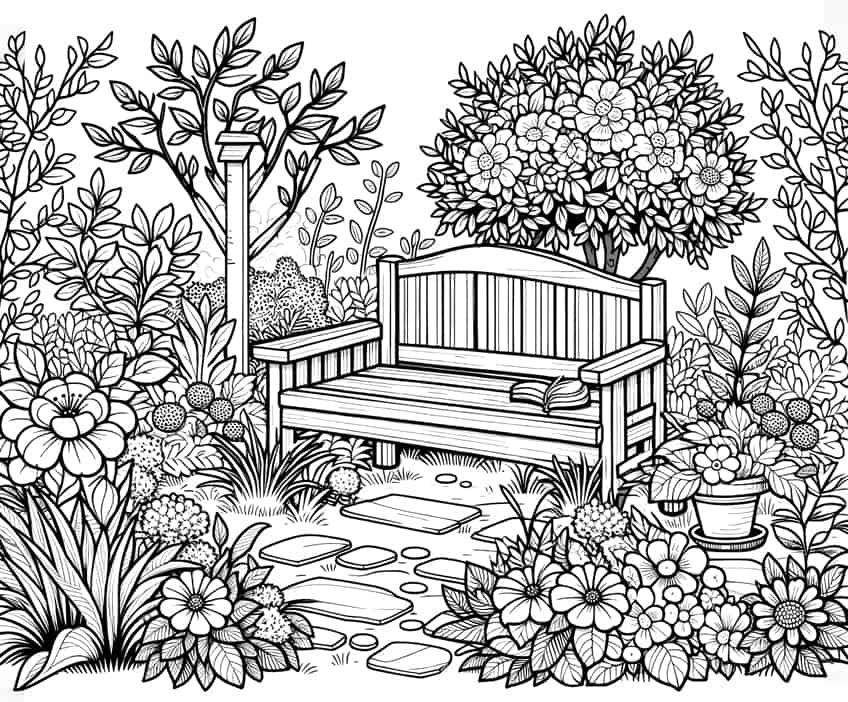 Features a garden scene with a bench and flowering shrubs


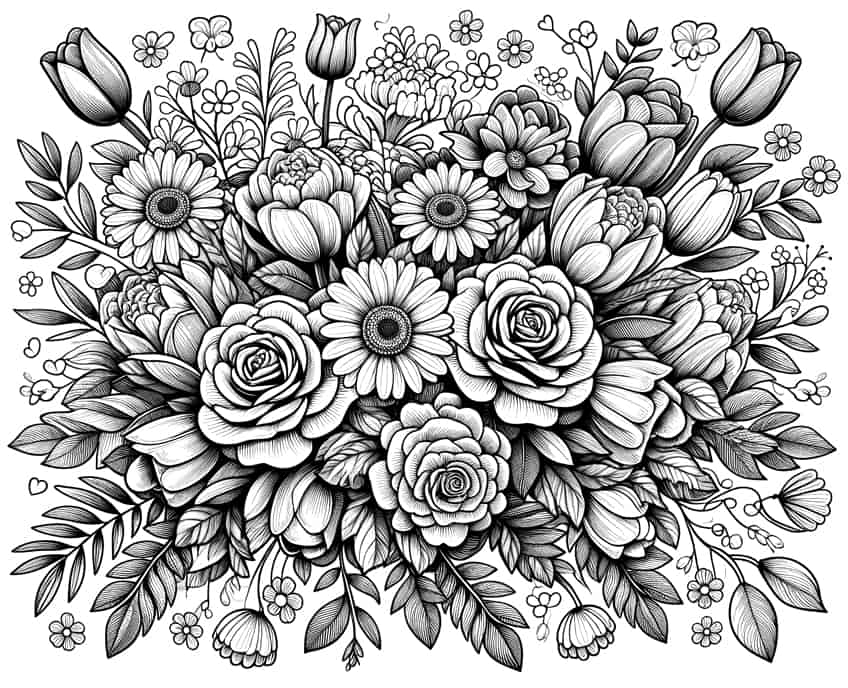 A lavish bouquet of roses, tulips, and daisies


Two calla lilies with large, flowing spathes and slender upright spadices, joined by long crossing stems. The folded petal edges and wide open shapes are bold and easy to color, with a gentle curl at the tip.
Download this Calla Lily Coloring Page here to print out and color!

A diagonal cherry branch carries about a dozen five-petaled blossoms, some in clusters, with thin stamens tipped by dots and a few small buds. The fine stamen lines and overlapping petals suit patient coloring.
Download this Cherry Blossom Coloring Page here to print out and color!

A single daffodil seen from the front, with six pointed petals around a wide, ruffled trumpet. Tiny stamens sit inside the cup, and a short stem runs off the bottom edge. The ruffled rim takes two shades of yellow well.
Download this Daffodil Flower Coloring Page here to print out and color!

A daisy tilted toward the viewer, with a large blank oval center ringed by about thirty long, narrow petals of uneven length. A thin stem angles off toward the lower right.
Download this Daisy Flower Coloring Page here to print out and color!

A round dandelion seed head on a long double stem, with about a dozen feathery seeds drifting off to the upper right. Very fine, dense hairlines fill the globe. Best for experienced colorers.
Download this Dandelion Flower Coloring Page here to print out and color!

Five wavy-edged hibiscus petals fan out from a small green bud base, while a long curved stamen column rises to a tip with five round-headed stigmas and a cluster of tiny pollen dots. Large open petals are easy to color.
Download this Hibiscus Flower Coloring Page here to print out and color!

A rounded hydrangea cluster made of dozens of overlapping four-petal florets, each with a tiny dot at its center. Two serrated leaves branch from a tall, gently curved stem.
Download this Hydrangea Flower Coloring Page here to print out and color!

A lily in full bloom, seen from the side, with six broad petals and a fan of long stamens tipped with oval anthers. A closed, ribbed bud lies at the lower left. The wide petals leave plenty of room for blending.
Download this Lily Flower Coloring Page here to print out and color!

A lotus in full bloom, shown from the side, with about a dozen smooth pointed petals in layered rings. A dotted seed pod sits at the center, ringed by fine stamen strokes. The petals are broad and open, so they suit a soft blend from pink to white.
Download this Lotus Flower Coloring Page here to print out and color!

A single magnolia flower on a slender twig, with three tall upright petals in front and four long petals spreading outward. Two small buds sit near the base. The clean, open shapes are easy to fill with solid color.
Download this Magnolia Flower Coloring Page here to print out and color!

Front view of a moth orchid with a large triangular upper petal, two rounded side petals and a small central lip with curled edges. Overlapping outlines create many separate areas, so it suits patient colorers.
Download this Orchid Flower Coloring Page here to print out and color!

A full peony with ruffled, densely layered petals and wide outer petals, drawn with two closed buds and long pointed leaves on slender stems. The fine, crowded center demands patience and a sharp pencil.
Download this Peony Flower Coloring Page here to print out and color!
Poppy Flower Coloring Pages

Wide-open poppy seen from the side, with wavy, crinkled petal edges, one folded petal curling on the right, and a short stem below. The center holds a bristly seed pod ringed by fine stamens.
Download this Poppy Flower Coloring Page here to print out and color!
Sunflower Coloring Pages

A single sunflower with about two dozen pointed petals in overlapping rings around a large stippled center, standing on a long thin stem with three serrated, heart-shaped leaves. The dotted seed disk is the finest area.
Download this Sunflower Coloring Page here to print out and color!
Tulip Flower Coloring Pages

A single closed tulip bud tilts slightly on a slender, gently curved stem, flanked by two long, pointed leaves with thin vein lines. Bold open shapes and little detail make this an easy sheet.
Download this Tulip Flower Coloring Page here to print out and color!
We hope these printable flower coloring pages bring you joy and that you create some amazing and fun works of art. Finding some delightful flowers to color is not only fun but also an activity that provides some stress relief.
New Flower Coloring Pages With Bouquets and Butterflies
Five new motifs have just joined the collection: a florist tying a bouquet, a windowsill with three flower pots, a bicycle on a sunflower path, a wildflower meadow full of butterflies and a potted orchid with aerial roots. They range from clear, simple outlines for younger children to finer detail for practised colourists. Each new sheet prints as a PDF in A4 format, ready to use straight away.


Flower Facts for Parents and Teachers
What a Flower Is and How It Is Built
A flower is the reproductive part of a flowering plant, and its job is to help the plant make seeds. Flowering plants, called angiosperms, are the most species-rich group of land plants, with more than 300,000 known species. Roses, tulips, sunflowers, and orchids belong to this group, and so do grasses, oak trees, and apple trees, which all produce flowers even though most people rarely look at them closely.
Most flowers are built from four rings of parts, and finding them makes a quick lesson. The sepals are the small, usually green leaves that wrap the bud. The petals are the showy part, and all the petals together are called the corolla. The stamens are the male parts, thin stalks topped with anthers that hold pollen. The pistil is the female part in the center, made of a sticky tip called the stigma, a stalk called the style, and an ovary at the base. After pollination, the ovary swells into the fruit and the ovules inside become seeds.
Not every flower follows that plan. A sunflower or daisy head is not one flower but a tight cluster of many tiny ones. The brown or yellow center is made of small disk florets, and the parts that look like petals around the edge are ray florets. A sunflower head can hold well over a thousand florets arranged in spirals, a detail worth pointing out when you color one.
Where Flowers Grow and How They Live
Flowering plants grow on every continent, including Antarctica, where two native species survive on the milder Antarctic Peninsula. Flowers rely on pollinators to carry pollen from one bloom to the next. Bees, butterflies, moths, beetles, hummingbirds, and bats all do this work, and flowers attract them with color, scent, and sweet nectar. Grasses and many trees skip the advertising and let the wind carry their pollen, so their flowers are usually small and plain.
Life spans differ too. Annuals such as sunflowers, zinnias, and marigolds grow, bloom, and set seed in a single season. Perennials such as peonies, daylilies, and lavender return year after year from the same roots. Bulb flowers such as tulips, daffodils, and hyacinths store food underground and bloom in early spring, which is why gardeners plant their bulbs in the fall.
Sizes range from a daisy that fits in a child’s palm to some truly enormous blooms. Rafflesia arnoldii, a rainforest plant from Southeast Asia, produces one of the largest single flowers in the world, up to about 3 feet (1 meter) across, and it smells like rotting meat. The titan arum from Sumatra sends up a flower cluster that can reach about 10 feet (3 meters) tall. Giant garden sunflowers can also top 10 feet.
Famous Flowers and How People Use Them
Tulips reached Europe from the Ottoman Empire in the 1500s, and by the 1630s Dutch buyers were paying such high prices for rare bulbs that the period is remembered as tulip mania. Cherry blossoms are celebrated in Japan with the spring custom of hanami, or flower viewing, and the blooms last only a week or two. In 1912, Tokyo gave Washington, D.C. about 3,000 cherry trees, and the city still holds a blossom festival every spring.
The lotus is sacred in Buddhism and Hinduism, and its seeds, stems, and roots are eaten in many Asian dishes. Young sunflower buds turn to follow the sun across the sky, while mature blooms mostly face east, and the seeds are eaten and pressed for cooking oil. The red poppy is worn in several countries around November 11 to remember soldiers who died in war.
Flowers also end up on the dinner table and in the pantry. Broccoli and cauliflower are flower buds, saffron comes from the stigmas of a crocus, and chamomile and hibiscus are brewed as tea. Roses, lavender, and jasmine are used in perfume, and nearly every culture uses cut flowers for weddings, holidays, and celebrations.
Best Colors for Flower Coloring Pages
Real flowers get their colors from pigments. Carotenoids make yellow and orange, anthocyanins make red, pink, purple, and blue, and chlorophyll makes leaves and stems green. Matching those colors keeps a page looking natural, although a purple sunflower is just as valid if the colorist wants one.
- Tulips: red, yellow, pink, orange, and deep purple, with leaf green stems. Tulips come in almost every color except true blue.
- Sunflowers: golden yellow petals, a dark brown center, and olive green leaves.
- Roses: red, pink, white, and peach, with dark green leaves. Shade the gaps between petals with deeper crimson.
- Daisies: leave the petals white or shade them with light gray or pale blue, then add a bright yellow center.
- Lavender and bluebells: violet, lavender, and blue, with soft green stems.
- Cherry blossoms: pale pink and white petals on dark brown branches.
- Poppies: bright red or orange petals with a black center.
- Butterflies: orange and black for a monarch, or sky blue and yellow for a swallowtail.
To add depth, use two or three greens, such as lime, leaf green, and olive. Press harder near the center of a flower and lighter toward the tips of the petals, and leave small white spots for highlights.
How Flowers Are Shaped and Grouped
Symmetry and Petal Counts
A flower’s outline follows one of two plans. Flowers with radial symmetry, such as buttercups, cherry blossoms, and tulips, can be cut into matching halves along several lines. Flowers with bilateral symmetry, such as orchids, snapdragons, and sweet peas, have only one line that splits them into mirror images. You can see this on the moth orchid page, where the left and right petals match but the top and bottom do not.
Petal numbers also follow patterns. Lilies, tulips, and irises are monocots, and their flower parts usually come in threes or sixes. Roses in the wild, cherry blossoms, and hibiscus have five petals, and the mustard family has four. Tulips and lilies have tepals, which means the outer sepals look almost the same as the inner petals, giving three of each.
Some “petals” are not petals at all. The white funnel of a calla lily is a spathe, a modified leaf wrapped around a spike of tiny real flowers called the spadix. The colorful parts of a hydrangea cluster are mostly sepals.
Big Families and Old Roots
- The daisy family, Asteraceae, has more than 30,000 species, including sunflowers, dandelions, and chrysanthemums.
- The orchid family has around 28,000 accepted species, and vanilla comes from the seed pods of one of them.
- The rose family includes apples, pears, strawberries, cherries, and almonds, so a cherry blossom and a rose are close relatives.
- Archaefructus, a fossil water plant from China, is about 125 million years old and is one of the earliest known flowering plants.
Signals for Pollinators
Bees see ultraviolet light but not red, and many flowers carry ultraviolet lines or patches, called nectar guides, that point bees toward the nectar. Hummingbird flowers are often red and tube-shaped with little scent, since birds see red well but have a weak sense of smell. Flowers pollinated by moths, such as evening primrose and moonflower, tend to be white or pale, open at dusk, and give off strong scent at night. Some Ophrys orchids go further and grow a lip shaped and patterned like a female bee to lure males.
Choosing Colors for Each Flower on These Pages
Match the colors to the real plant and the sheets double as a botany lesson. Sunflowers take golden yellow rays around a dark brown disk with touches of olive green where the seeds are young. Daffodils look most natural with a pale lemon outer ring and a deeper orange-yellow trumpet. Field poppies are scarlet with a black blotch at the base of each petal.
Hydrangeas let you pick, because the same plant blooms blue in acidic soil and pink in alkaline soil, with lilac in between. Bluebells and cornflowers call for violet-blue, and lavender works best in purple mixed with a little gray-green for the stems. Cherry blossoms and lotus petals blend from soft pink at the tips to white at the base. The deepest tulips, such as ‘Queen of Night,’ are a dark maroon-purple, not true black. Roses have no natural blue pigment, so a blue rose is a fun way to show your colors don’t have to follow nature.
For a realistic finish, give leaves two greens, a yellow-green on the side facing the light and a blue-green in the shadows, and keep stamens and pollen dots yellow or orange so they stand out against the petals.
Frequently Asked Questions
What Is the Easiest Flower to Draw and Color?
Many flowers are simple to draw and color. The first choice for many is the poppy flower. However, when it comes to printable flower coloring pages, it does not have to always be realistic, you can use whatever color and techniques you like.
Why Should You Try Flower Coloring Pages for Adults?
Coloring is not only for children, as there are a lot of benefits for adults as well. When using flower color pages, this can be a form of art that is easy and fun to do. Coloring is also something that can help to reduce stress.
What Can You Use for Coloring Details?
When coloring flowers, you can use pencils or crayons, or even watercolors. However, for those pictures that have details, you might want to consider using finely sharpened colored pencils or a fine-tip marker. These will help you to stay within the lines of the drawing.
What Is the Color Orchid?
The orchid is a distinctive flower and now you can get an orchid color you can use on our website. There are various color orchids you can find, but the one chosen as a color name has pink, blue, and gray tones and is a result of blending red with blue and then mixing in white.
How Many Kinds of Flowers Are There?
Botanists have described more than 300,000 species of flowering plants. Gardeners have bred many thousands of varieties on top of that, including countless roses, tulips, and daylilies. No coloring book could cover them all, so the pages here focus on the favorites children and adults ask for most.
Why Do Flowers Come in So Many Colors?
Color is an advertisement for pollinators. Bees see yellow, blue, and purple well and also see ultraviolet patterns that people cannot, while hummingbirds are drawn to red and orange. Pigments called carotenoids and anthocyanins produce the yellows, oranges, reds, and purples we see.
What Is the Difference Between Annual and Perennial Flowers?
An annual, such as a sunflower or zinnia, lives for one growing season and must be planted again from seed. A perennial, such as a peony or lavender, comes back every year from the same roots. Bulb flowers like tulips and daffodils are perennials that rest underground between seasons.
Which Flowers Bloom in Spring?
Tulips, daffodils, hyacinths, cherry blossoms, and magnolias are some of the first to bloom. Summer brings sunflowers, daisies, lavender, and many roses, while chrysanthemums carry the color into fall. Matching the page to the season makes a good classroom or family activity.
Are Any Flowers Poisonous?
Yes, and it helps to know which. True lilies are dangerous to cats, and daffodil bulbs, foxglove, and hydrangea can make people and pets sick if eaten. Coloring a picture of these flowers is completely safe, but it is a good chance to remind children not to taste garden plants.

Matthew Matthysen is an educated multidisciplinary artist and illustrator. He successfully completed his art degree at the University of Witwatersrand in South Africa, majoring in art history and contemporary drawing. The focus of his thesis was to explore the philosophical implications of the macro and micro-universe on the human experience. Matthew uses diverse media, such as written and hands-on components, to explore various approaches that are on the border between philosophy and science.
Matthew organized various exhibitions before and during his years as a student and is still passionate about doing so today. He currently works as a freelance artist and writer in various fields. He also has a permanent position at a renowned online gallery (ArtGazette) where he produces various works on commission. As a freelance artist, he creates several series and successfully sells them to galleries and collectors. He loves to use his work and skills in various fields of interest.
Matthew has been creating drawing and painting tutorials since the relaunch in 2020. Through his involvement with artincontext.org, he has been able to deepen his knowledge of various painting mediums. For example, watercolor techniques, calligraphy and lately digital drawing, which is becoming more and more popular.
Learn more about Matthew Matthysen and the Art in Context Team.
Cite this Article
Matthew, Matthysen, “Flower Coloring Pages – 62 Gorgeous Motifs to Print and Color.” Art in Context. September 2, 2022. URL: https://artincontext.org/flower-coloring-pages/
Matthysen, M. (2022, 2 September). Flower Coloring Pages – 62 Gorgeous Motifs to Print and Color. Art in Context. https://artincontext.org/flower-coloring-pages/
Matthysen, Matthew. “Flower Coloring Pages – 62 Gorgeous Motifs to Print and Color.” Art in Context, September 2, 2022. https://artincontext.org/flower-coloring-pages/.


