

Biographer Traces Six Early Edward Hopper Oils to Copies

A new Edward Hopper biography argues that five catalogued oils and a sixth work attributed to Hopper, all made before he entered the New York School of Art in 1900, derive from earlier compositions; five have named published models, while Church and Landscape has only earlier parallel versions. The evidence expands a 2020 discovery and breaks the supposed link between two of the pictures and Hopper’s hometown of Nyack.
The Six Pre-Art-School Oils and Their Sources
Louis Shadwick’s Edward Hopper: A Life was published in the United States on October 13, 2026. In an excerpt published by The Art Newspaper on October 20, the biographer identifies models for five paintings and parallel versions of the sixth. His conclusion is specific: every known finished oil Hopper made before entering the New York School of Art in fall 1900 derives from an existing image.
That does not mean every row carries the same level of certainty. Five have named visual models. The ultimate source for Church and Landscape remains unknown, while Clipper Ship Being Towed by Tug was omitted from Gail Levin’s catalogue raisonné and was described by Shadwick in 2020 as not fully authenticated. The table separates those qualifications from the stronger visual matches.
| Hopper oil | Traced model | Evidence and status |
|---|---|---|
| Rowboat in Rocky Cove (1895) | Lake View, unknown artist | Published with copying instructions in Art Interchange, February 14, 1891; direct match. |
| Old Ice Pond at Nyack (c. 1898–1900) | Bruce Crane, A Winter Sunset | Published in Art Interchange, December 6, 1890; direct match. |
| Country Road (c. 1896 in 2026 account) | John Francis Murphy, A Landscape Study in Color | Published in Art Interchange, March 27, 1886; newly identified direct match. |
| Ships (c. 1898) | Edward Moran, Marine View (called A Marine in 2020) | Published in Art Interchange, August 14, 1886; identified in 2020. |
| Church and Landscape (c. 1897) | Unknown composition | Same scene appears on a Victorian porcelain plaque and in two 1893 paintings by Edgar Barnes Gilson; exact model unresolved. |
| Clipper Ship Being Towed by Tug (formerly c. 1900) | Fred Pansing, Stormy Voyage | Published by the New York Recorder, May 7, 1893; direct match, but the Hopper attribution and date remain qualified. |
The date attached to Country Road also deserves care. The new excerpt uses “around 1896,” whereas Shadwick’s 2020 paper reported that Levin’s catalogue raisonné dated it around 1897. The table follows the new account while preserving the older catalogue date as a documented difference, not an error that has yet been formally corrected.

The Edward Hopper House Museum in Nyack, New York. Photograph by Jeremy Thompson (Roller Coaster Philosophy), hosted by Wikimedia Commons, under the Attribution 2.0 Generic license; cropped.
What the 2026 Research Actually Adds
The underlying discovery is six years old. In his October 2020 study in The Burlington Magazine, Shadwick matched Old Ice Pond at Nyack to Crane, Rowboat in Rocky Cove to Lake View, and Ships to Moran. He also used the porcelain plaque to show that Church and Landscape repeated an existing composition. At that stage, he treated Country Road and Clipper Ship Being Towed by Tug as suspicious but had not found their exact models.
The 2026 advance is therefore narrower and stronger than a rediscovery of all six. It names Murphy’s A Landscape Study in Color as the model for Country Road, names Pansing’s Stormy Voyage as the model for the clipper-ship picture, and adds two paintings by Gilson to the evidence around Church and Landscape. Ships belongs to the 2020 finding, not the new tranche.
The clipper-ship work needs a further asterisk. Shadwick’s 2020 footnote said it was absent from Levin’s catalogue raisonné and therefore not fully authenticated, although an auction record and image document a route from Hopper’s collection to Reverend Arthayer R. Sanborn and then Kennedy Galleries. The 2026 excerpt calls it a “previously uncatalogued early Hopper painting.” Taken together, the responsible formulation is that Shadwick attributes the work to Hopper and has identified its model, while full catalogue status and precise dating remain unresolved.
Copying Does Not Make the Teenager a Forger
Hopper was about 13 when he dated Rowboat in Rocky Cove. Art Interchange was made for amateurs and students, and its plates came with instructions for copying; the directions for Lake View called it suitable for beginners. In that setting, replication was training rather than a claim to invention.
The physical and ownership history points the same way. The oils stayed in the attic of Hopper’s childhood home and emerged only after his death. Most are signed, but Shadwick interprets those signatures as youthful pride, not an effort to deceive a buyer. His provenance argument is that Hopper did not offer these pictures for individual sale or exhibition.
The Edward Hopper House Museum’s 2020 response likewise treated the copies as records of artistic development. It noted that young Hopper copied from textbooks, novels, drawing manuals, and later from museum masters. Copying is therefore not the scandal. The correction concerns how later owners, cataloguers, and writers classified the exercises.
That distinction also sharpens the arc described in our Edward Hopper biography and survey of Edward Hopper’s paintings: the teenager did not begin fully formed. He learned through reproduced images before formal schooling helped broaden his technique and sources.
A charcoal self-portrait dated 1903 falls just beyond the group under review. It is a useful marker of the young artist’s formal-training years, but it does not prove exactly when he first devised an original oil composition.
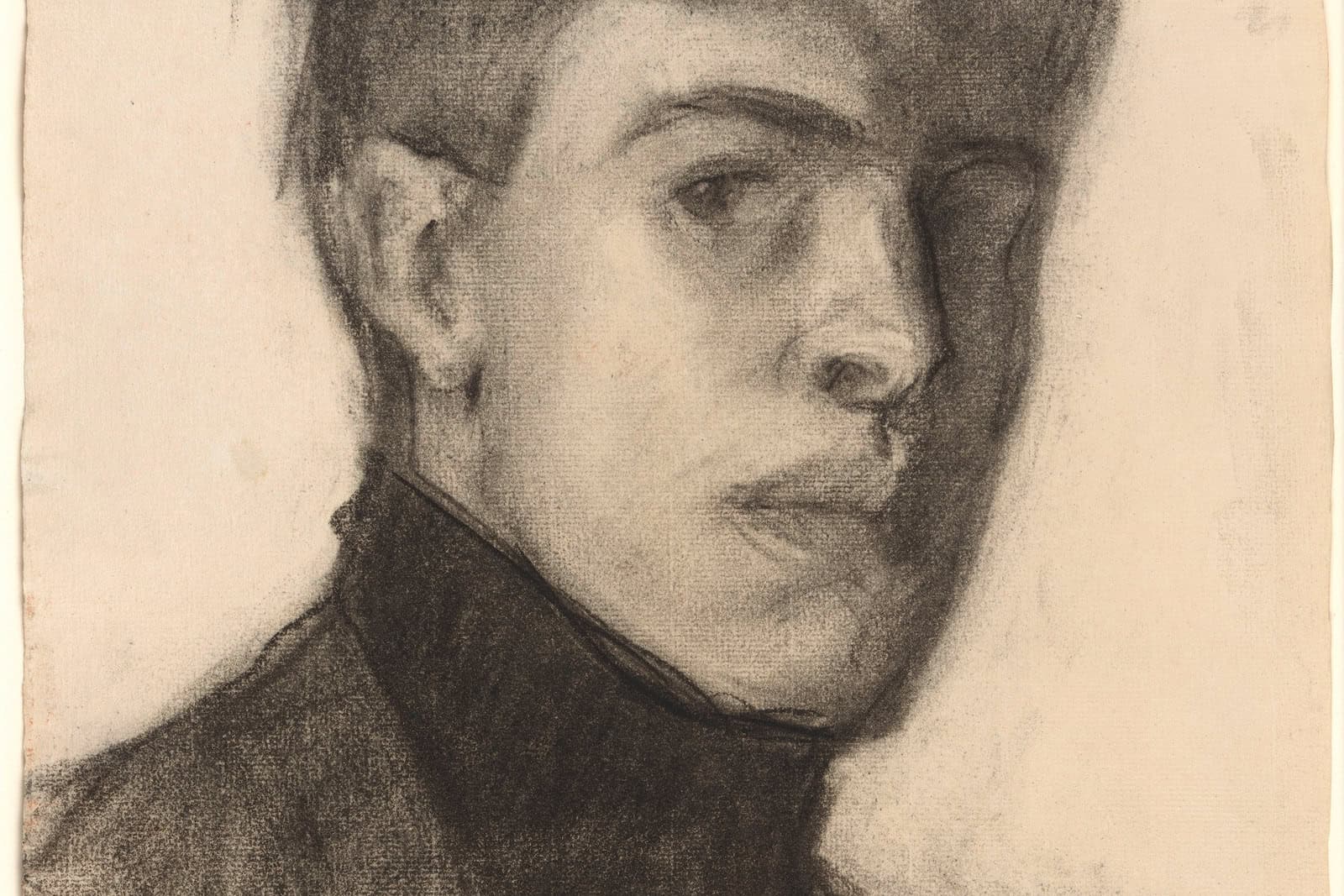
Edward Hopper, Self-Portrait, 1903, charcoal on paper. National Portrait Gallery, Smithsonian Institution; image hosted by Wikimedia Commons, public domain in the United States.
Why the Nyack Story Changes
The most consequential correction involves titles. According to Shadwick, Sanborn found the oils in the Nyack attic in the late 1960s and supplied the title Old Ice Pond at Nyack. He also called the rowboat picture Rowboat on Hudson before its title changed. Hopper did not provide either geographic identification.
Once exact published models are visible, the locality claim collapses for those two compositions. Crane’s winter landscape has been associated with Long Island or Connecticut, while Lake View bears the word “Athelstane,” possibly referring to Wisconsin or possibly to its maker. Neither image originated as Hopper’s observation of Nyack.
That changes the meaning of the works without making them meaningless. Old Ice Pond no longer supplies early evidence of Hopper discovering the dramatic local light that would define his mature work. Instead, it records how a middle-class teenager encountered American Tonalism through a mass-circulation art periodical and practiced translating a printed plate into oil.
The six works now describe access as much as talent: saved magazine plates, domestic encouragement, beginner instructions, and repeated looking. The finding replaces a solitary-genius story with a more concrete account of how visual culture entered the Hopper home.
Five Exact Models, One Source Still Unknown
Five works catalogued as Hopper oils and a sixth, uncatalogued work attributed to him by Shadwick make up the group; five have named models, while Church and Landscape is tied to earlier versions of an unidentified source. The genuinely new 2026 identifications are the models for Country Road and Clipper Ship Being Towed by Tug, plus the Gilson parallels—not the already traced Ships. Sanborn, not Hopper, supplied the Nyack-linked titles for two exact copies, so those paintings cannot securely document local observation. The clipper-ship picture’s exact date and full catalogue authentication remain open.

Isabella studied at the University of Cape Town in South Africa and graduated with a Bachelor of Arts majoring in English Literature & Language and Psychology. Throughout her undergraduate years, she took Art History as an additional subject and absolutely loved it. Building on from her art history knowledge that began in high school, art has always been a particular area of fascination for her. From learning about artworks previously unknown to her, or sharpening her existing understanding of specific works, the ability to continue learning within this interesting sphere excites her greatly.
Her focal points of interest in art history encompass profiling specific artists and art movements, as it is these areas where she is able to really dig deep into the rich narrative of the art world. Additionally, she particularly enjoys exploring the different artistic styles of the 20th century, as well as the important impact that female artists have had on the development of art history.
Learn more about Isabella Meyer and the Art in Context Team.
Choose Art in Context as a preferred source to see more of our reporting in Google Top Stories and other Google Search experiences.
Cite this Article
Isabella, Meyer, “Biographer Traces Six Early Edward Hopper Oils to Copies.” Art in Context. October 20, 2026. URL: https://artincontext.org/edward-hopper-six-early-oils-copies/
Meyer, I. (2026, 20 October). Biographer Traces Six Early Edward Hopper Oils to Copies. Art in Context. https://artincontext.org/edward-hopper-six-early-oils-copies/
Meyer, Isabella. “Biographer Traces Six Early Edward Hopper Oils to Copies.” Art in Context, October 20, 2026. https://artincontext.org/edward-hopper-six-early-oils-copies/.


