

New Albrecht Altdorfer Landscape Could Fetch £5 Million

A signed Albrecht Altdorfer landscape, dated around 1520 and previously absent from the artist’s catalogue raisonné, has surfaced from a Swiss collection. Sotheby’s will offer the tiny oil-on-vellum work in London on December 9 at £3 million to £5 million—a sale that could expand the accepted group of his figureless oil landscapes from two to three.
Why Sotheby’s Calls It a Third Altdorfer Landscape
The official sale page lists Albrecht Altdorfer and A Thickly Wooded Landscape With a Rainbow Behind the Trees and a Distant Outcrop to the Right Beneath a Cloud-Laden Sky in Sotheby’s Old Master and 19th Century Paintings Evening Auction. The auction is scheduled for 7 p.m. GMT in London on December 9, 2026.
The attribution, circa-1520 date, £3 million-to-£5 million estimate, and discovery history come from Sotheby’s specialists. The Art Newspaper reports that the signed work was not included in Altdorfer’s catalogue raisonné and was unknown to scholars before it emerged from its current owner’s collection. Sotheby’s publicly accessible sale overview does not yet show a technical report or identify an outside scholar who has endorsed the attribution. That does not disprove it; it defines the evidence currently in public view.
At roughly 23 by 20 centimeters, the picture is smaller than a sheet of US letter paper. A rain-darkened forest fills most of the surface, while a rainbow, a cloud-heavy sky, and a remote castle open narrow routes beyond the trees. There are no people and no biblical or mythological incident to explain the scene. Nature is not scenery for a story; it is the subject.
That absence of figures is why the discovery matters beyond its estimate. Within Northern Renaissance art, Altdorfer gave trees, weather, and terrain an expressive force usually reserved for human actors. If Sotheby’s attribution is accepted, the work would join the two figureless oil landscapes recognized by the National Gallery and Alte Pinakothek; Tokyo Fuji Art Museum also catalogs an oil-on-panel Mountain Range under Altdorfer’s name, though its wider scholarly status is unclear.
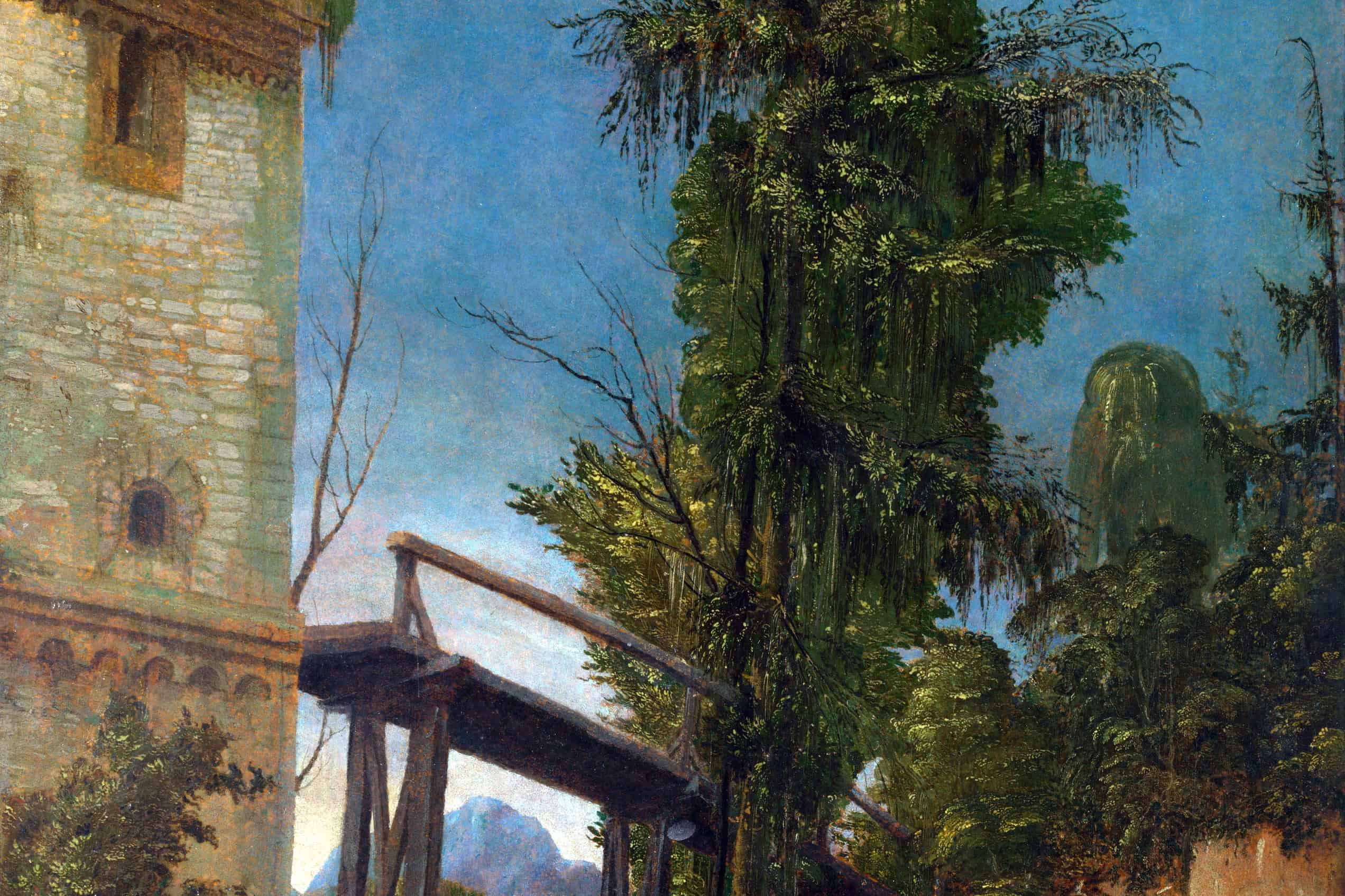
Albrecht Altdorfer, Landscape with a Footbridge (about 1518–20), National Gallery, London. Digital reproduction via The Yorck Project and Wikimedia Commons, Public Domain Mark 1.0. Cropped.
How the New Work Compares With the Museum Pair
The comparison is unusually close in date, scale, subject, and support. The National Gallery records Landscape with a Footbridge as an oil painting on parchment mounted on wood, made about 1518–20 and measuring 41.2 by 35.5 centimeters. The Bavarian State Painting Collections record Danube Landscape with Wörth Castle as parchment on beechwood, made around 1520–25 and measuring 30.5 by 22.2 centimeters.
| Work | Date and support | Size |
|---|---|---|
| New wooded landscape | c. 1520; oil on vellum, later mounted on wood | About 23 × 20 cm |
| Landscape with a Footbridge | c. 1518–20; oil on parchment mounted on wood | 41.2 × 35.5 cm |
| Danube Landscape with Wörth Castle | c. 1520–25; parchment on beechwood | 30.5 × 22.2 cm |
The newly surfaced work is therefore the smallest of the three. More importantly, it is not merely a small landscape on an unrelated support: its reported vellum-and-wood construction closely parallels the National Gallery painting. Material similarity cannot authenticate a painting by itself, but it makes the comparison more specific than a shared woodland subject.
The Munich picture looks outward across a recognizable Danube setting, while the London work compresses bridge, castle, village, and towering larch into a forest drama. The new painting appears more enclosed still: the castle is pushed into the distance and the rainbow becomes the principal opening through a dense canopy. Together, the three would show Altdorfer testing different balances between observed terrain and invented atmosphere at nearly the same moment.
The National Gallery’s current record calls Landscape with a Footbridge “one of two” Altdorfer paintings without figures. If the new attribution enters the scholarly literature, that wording will need revision. Until then, “third” is Sotheby’s claim, not yet a museum-catalogue consensus.

Albrecht Altdorfer, Danube Landscape with Wörth Castle (around 1520–25), Alte Pinakothek, Munich. Photograph by Jebulon via Wikimedia Commons, CC0 1.0 Universal Public Domain Dedication. Cropped.
Seventy Years Out of View Does Not Mean Lost
The published provenance is short but coherent. The painting belonged to the House of Harrach and was associated with the Palais Harrach in Vienna. The current owner’s father bought it from that collection in 1957, and the present owner later inherited it in Switzerland. News reports say it has not been shown publicly for about 70 years.
That history makes “rediscovered” more accurate than “recovered.” The object remained privately owned and outside Altdorfer scholarship; the public reports do not establish whether it was ever listed as stolen or missing. The publicly disclosed chain still has gaps. The reports do not state when the Harrach family acquired the work, identify an earlier owner, or provide a complete pre-1957 ownership history.
Its support also raises a conservation question separate from attribution. The work was painted on animal skin and later adhered to a wooden panel, according to the auction-house account. The publicly accessible sale overview gives no condition report describing the mounting date, later treatment, or present stability.
The 1980 Benchmark Was Not an Auction
Sotheby’s has little recent market evidence for setting the estimate. The last cited Altdorfer market event is the National Gallery’s 1980 purchase of Christ Taking Leave of His Mother, a much larger religious panel rather than a figureless landscape.
There is an important correction to the early coverage. The Guardian describes that work as the last Altdorfer painting auctioned. The National Gallery’s collection record says it was bought by private treaty from the Wernher Estates through Christie’s in 1980; the transaction therefore did not produce an auction hammer price.
Even the reported purchase figure varies: The Art Newspaper gives £2.4 million, while The Guardian gives £2.45 million. The National Gallery’s collection and archive records confirm the private-treaty acquisition but do not state a price. The 1980 purchase was a private treaty, but it was not the last Altdorfer-related market event: Colnaghi bought The Adoration of the Magi at auction in 1988 for £66,000 after it was catalogued as workshop of Altdorfer but judged probably autograph by the National Gallery.
The £3 million-to-£5 million range should be read as Sotheby’s valuation of rarity, importance, condition, and expected demand—not as proof of authorship or a price derived from a recent like-for-like sale.

Albrecht Altdorfer, Christ Taking Leave of His Mother (probably 1520), National Gallery, London. Digital reproduction via Google Art Project and Wikimedia Commons, Public Domain Mark 1.0.
What Is Established Before the December 9 Sale
Sotheby’s has catalogued a signed, circa-1520 figureless landscape from a Swiss collection and scheduled it for its December 9 London evening sale with a £3 million-to-£5 million estimate. Museum records show that the two established comparators are larger, closely dated works on parchment and wood, making the new picture materially as well as thematically relevant.
The published ownership history runs from the Harrach collection to a 1957 purchase and inheritance in Switzerland, but its earlier provenance remains undisclosed. The often-repeated 1980 “auction” precedent was actually a private-treaty museum purchase. Most consequentially, the identification is presently a Sotheby’s attribution reported in the press; neither the public sale overview nor the two initial reports names an independent scholar or publishes a technical examination.
The painting will be viewable at Sotheby’s New York from November 7 through 19 and in London from December 4 through the sale date. Its buyer, final price, and eventual standing in the Altdorfer catalogue remain unresolved.

Isabella studied at the University of Cape Town in South Africa and graduated with a Bachelor of Arts majoring in English Literature & Language and Psychology. Throughout her undergraduate years, she took Art History as an additional subject and absolutely loved it. Building on from her art history knowledge that began in high school, art has always been a particular area of fascination for her. From learning about artworks previously unknown to her, or sharpening her existing understanding of specific works, the ability to continue learning within this interesting sphere excites her greatly.
Her focal points of interest in art history encompass profiling specific artists and art movements, as it is these areas where she is able to really dig deep into the rich narrative of the art world. Additionally, she particularly enjoys exploring the different artistic styles of the 20th century, as well as the important impact that female artists have had on the development of art history.
Learn more about Isabella Meyer and the Art in Context Team.
Choose Art in Context as a preferred source to see more of our reporting in Google Top Stories and other Google Search experiences.
Cite this Article
Isabella, Meyer, “New Albrecht Altdorfer Landscape Could Fetch £5 Million.” Art in Context. November 5, 2026. URL: https://artincontext.org/albrecht-altdorfer-landscape-sothebys-auction/
Meyer, I. (2026, 5 November). New Albrecht Altdorfer Landscape Could Fetch £5 Million. Art in Context. https://artincontext.org/albrecht-altdorfer-landscape-sothebys-auction/
Meyer, Isabella. “New Albrecht Altdorfer Landscape Could Fetch £5 Million.” Art in Context, November 5, 2026. https://artincontext.org/albrecht-altdorfer-landscape-sothebys-auction/.


