


Famous Paper Sculptures – 9 Masterpieces Sculpted From Paper

Paper sculpture refers to three-dimensional or low-relief artworks in which paper is a primary material. Artists can cut, fold, layer, carve, glue, staple, or otherwise shape paper into everything from small figures and busts to large-scale installations. The works below show how contemporary artists turn an everyday material into structures with very different forms, surfaces, and meanings.
Our List of Famous Paper Sculptures
Paper can be folded, cut, layered, glued, stapled, molded, or carved, but it is also vulnerable to moisture, light, and physical damage. Paper sculptors therefore have to balance form, structure, and preservation.
Paper sculpture is a broad category, and it overlaps with other paper-based practices. Traditional origami relies primarily on folding, usually without cutting or gluing, while paper sculpture may use a much wider range of techniques. The distinction is not simply the number of sheets: modular origami can combine many folded sheets, while some paper sculptures are made from a single sheet.
The difference is mainly one of method, not simply the number of pieces: paper sculpture may involve cutting, layering, gluing, stapling, carving, or folding, while origami is defined primarily by folding.
In some works, paper is simply the material; in others, its fragility, familiarity, or everyday use becomes part of the meaning. Let’s explore notable examples of paper sculpture and the artists who created them.

The Tuileries (1974) by Gilbert and George
| Artist | Gilbert and George (est. 1967) |
| Date Completed | 1974 |
| Medium | Charcoal on paper, and charcoal on paper on wood, eight parts |
| Dimensions (cm) | Variable |
| Location | Museum of Modern Art, New York City, United States |
Gilbert & George is the artistic partnership of Gilbert Proesch and George Passmore. After developing the idea of themselves as “living sculptures” around 1969, they created a group of large works they called “Charcoal on Paper Sculptures”. Completed in 1974, The Tuileries is an eight-part installation that combines four large charcoal drawings with paper-covered furniture modeled on the artists’ own chairs and table. Rather than treating the work as a set of flat drawings, Gilbert & George turned the surrounding room into part of the sculpture.
Gilbert & George frequently appear in their own work and have long treated their public persona, matching suits, performances, and daily routines as part of their artistic practice.
The application of a grid format is one of their distinctive styles. They split their artworks into small rectangular panels, each with a unique picture or element. When these panels are merged, they form a bigger, more unified whole. They have continually challenged traditional art styles and media.
Paper Plates (2008) by Hamra Abbas
| Artist | Hamra Abbas (1976) |
| Date Completed | 2008 |
| Medium | Paper |
| Dimensions (cm) | 20 |
| Location | Multiple collections; an example is held by the British Museum, London |
Paper Plates combines traditional geometric motifs associated with Islamic visual culture with industrial paper-plate production. Abbas developed the series through collaboration with a paper-plate factory in Islamabad, bringing a disposable mass-produced object into contact with decorative traditions more often associated with craft and architecture. A 20-centimeter example from 2008 is held by the British Museum. Abbas works across paper, sculpture, painting, and video.
She regularly transforms traditional symbols and culturally charged images into often amusing compositions.
Abbas’ Paper Plates can resemble decorative doilies at first glance, but their pressed-paper format also points to manufacturing and repetition. Across her wider practice, Abbas reworks culturally charged motifs to examine identity, religion, craft, and the movement of images between different social and cultural settings.
Sorrow (2009) by Sher Christopher
| Artist | Sher Christopher |
| Date Completed | 2009 |
| Medium | Paper |
| Dimensions (cm) | Not specified |
| Location | Not specified |
Sher Christopher is a British artist whose paper works draw on literature, music, film, and personal experience. Sorrow is an unusually autobiographical work, created after her mother was diagnosed with a brain tumor in 2009. Christopher has described being unable to work during that period and repeatedly imagining the figure that became the sculpture.
This image kept appearing in her dreams and thoughts, and it was the only one that could reflect her emotional turmoil.
The sparse setting and dark clothing reinforce the work’s sense of isolation. Christopher has explained that black represented a kind of protection during grief, while the red shirt referred both to her mother’s vivid personality and to her own anger and loss. She initially considered the sculpture too personal to show, but responses from people who saw it encouraged her to share the work.
What Lies Beneath (2011) by Gabby O’Connor
| Artist | Gabby O’Connor (born 1974) |
| Date Completed | 2011 |
| Medium | Tissue paper, dye, shellac, and staples |
| Dimensions (cm) | Not specified |
| Location | Site-specific installation; first exhibited at City Gallery Wellington, New Zealand |
What Lies Beneath is a suspended installation that resembles the underside of a giant iceberg. O’Connor built the structure from blue semi-opaque tissue paper stiffened with shellac and assembled from thousands of small triangular sections. First exhibited at City Gallery Wellington in 2011, the work used natural light from above to saturate the gallery with blue and create the sensation of looking up through water. Its iceberg form also addressed climate change and the prospect of rising sea levels caused by melting land-based ice.
O’Connor’s art includes large-scale site-specific pieces using paper, rope, and light, as well as collaboration in theater.
Typically, she creates art out of common materials. O’Connor frequently collaborates with partners that include everything from scientists to community organizations. Her sculptures are intended to function both as installations and as a bridge between science and art. As a result, there can often be an intentional educational aspect to her pieces. The artist studied sculpting at the Victorian College of the Arts in Melbourne and completed her master’s degree at Sydney’s College of Fine Arts. She now lives in Wellington, New Zealand.

Vortextural (2013) by Jen Stark
| Artist | Jen Stark (born 1983) |
| Date Completed | 2013 |
| Medium | Installation of hand-cut acid-free paper, foam board, and glue |
| Dimensions (cm) | 106 x 88 x 76 |
| Location | Not specified |
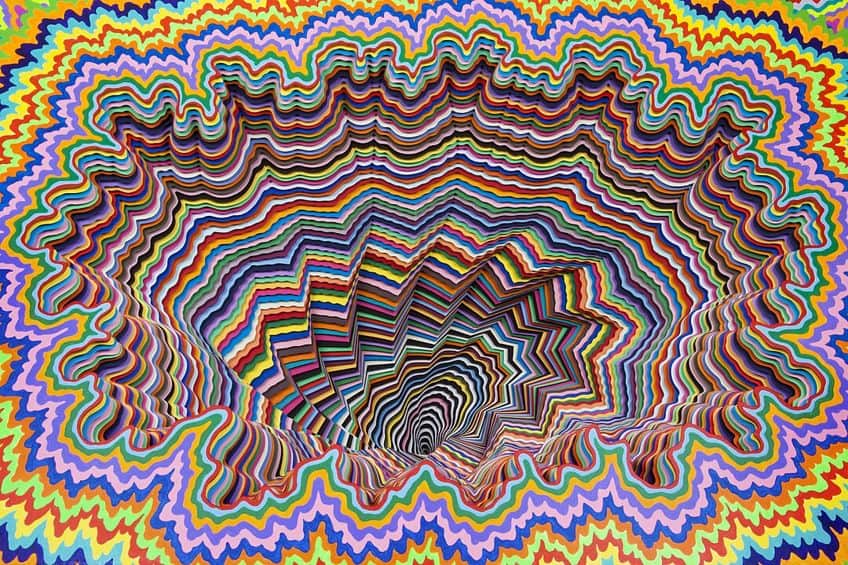
Vortextural is a layered paper sculpture by Jen Stark built around a spiraling vortex of color. Vortextural uses hand-cut sheets that radiate outward from a central opening, while repeated bands of contrasting color create a strong illusion of depth and motion. The result resembles a tunnel or cross-section whose apparent depth is produced through hundreds of carefully stacked paper layers.
Stark’s art centers around this hypnotic feeling, both in terms of its aesthetics and the time-consuming process of stacking hundreds of layers of materials.
Stark often links repeated patterns and expanding forms to ideas drawn from nature, geometry, mathematics, and fractals. Paper is central to her best-known sculptural works, although her broader practice also includes painting, animation, metal, and other materials.
No Title (Troublehead) (2015) by Peter Callesen
| Artist | Peter Callesen (born 1967) |
| Date Completed | 2015 |
| Medium | Paper |
| Dimensions (cm) | Not specified |
| Location | Not specified |
No Title (Troublehead) by Peter Callesen is a three-dimensional head cut and shaped entirely from paper. Callesen is a Danish artist who uses standard white A4 paper to make sculptures, installations, animals, people, and natural motifs.
According to Callesen, the standard white A4 sheet of paper is a material that we all have a connection to while also being indifferent, allowing us to fill it with different interpretations.
This thin white paper provides his works with a fragility that emphasizes its themes of tragedy and romance. Callesen’s paper sculptures explore the mystical transformation of a flat piece of paper into forms that grow into the space around them.
Bust of Michelangelo’s David (2015) by Li Hongbo
| Artist | Li Hongbo (born 7 January 1974) |
| Date Completed | 2015 |
| Medium | Paper |
| Dimensions (cm) | 118 × 70 × 60 |
| Location | Not specified |
Li Hongbo is among the best-known artists working in paper sculpture today. He builds solid-looking blocks of paper by gluing together up to tens of thousands of separate sheets, then carves and shapes them into figures, objects, and busts modeled on Classical Greek and Italian statues.
The Bust of Michelangelo’s David is one such example. It could easily be misidentified as a porcelain reproduction of a famous sculpture. Only upon careful inspection does one see that the sculpture is entirely constructed of paper.
Li Hongbo’s work has been presented around the globe, and it may be found in both private and public collections at many prestigious museums and art organizations. His career as a book designer and editor sparked his initial interest in all forms of paper. This, together with his sculpting background and affection for the expanded honeycomb structures of traditional Chinese paper decorations, motivated him to experiment with paper sculpture. While they appear to be solid, a little pull exposes their Slinky-like capacity to bend, stretch, and morph into a number of bizarre and funny deformations.
Magic Circle Variation (2017) by Rogan Brown
| Artist | Rogan Brown (born 1966) |
| Date Completed | 2017 |
| Medium | Hand- and laser-cut paper |
| Dimensions (cm) | 80 cm diameter |
| Location | Not publicly documented |
Bacteria, fungi, and viruses form complex microbial communities in and around the human body. Rogan Brown’s Magic Circle Variation translates that normally invisible world into a dense circular paper composition. The 2017 work measures 80 centimeters in diameter and combines hand- and laser-cut paper. Rather than reproducing a specific microscopic image, Brown uses stylized biological forms to imagine the diversity of the human microbiome.
Rogan Brown’s art combines art and science by depicting cell structures, bacteria, diseases, vegetal shapes, fossils, coral, insects, shells, and so on. Paper cutting was chosen as a medium for his investigation of our shifting experience of nature because of its simplicity and accessibility.
Brown’s process combines close observation with deliberate invention. Repeated cutting, layering, and arrangement turn fragile paper into structures that recall bacteria, coral, cells, and other organic systems. The slow construction of the work also contrasts with the microscopic scale and continuous activity of the living systems that inspired it.
Mountain Gorilla (2021) by Calvin Nicholls
| Artist | Calvin Nicholls (born 1966) |
| Date Completed | 2021 |
| Medium | Paper |
| Dimensions (cm) | 81 x 71 |
| Location | Not publicly documented |
Calvin Nicholls, a Canadian artist, produces multi-layered paper sculptures, spending anywhere from 4 weeks to 2 years on each work. Drawings are used to create a pattern for the components, which are then cut out with x-acto knives and scalpels. Nicholls’ work has been shown all around North America, and he has produced more than 500 paper sculptures over his career.
Nicholls began experimenting with paper sculpture in 1984, and the medium soon became an important part of his commercial design work before developing into his detailed wildlife practice.
He had recently finished a bird of prey with expanded wings for Noranda Recycled Papers in 1986 when he realized how well the layering of feathers matched the craft of paper sculpting. His first limited edition print series debuted in 1989 in Ontario at the Buckhorn Wildlife Festival, and in 1992, the National Trust commissioned 15 wildlife sculptures for a national campaign.
Notable Paper Sculpture Artists
Beyond the works above, many contemporary artists use paper in very different ways. UK-based Helen Musselwhite builds layered cut-paper scenes inspired by plants, animals, and the English countryside. Zoe Bradley moved toward paper sculpture after experimenting with hand-pleated paper displays while working with Japanese fashion designer Michiko Koshino in 2005.
For Bradley, paper became a bridge between fashion display, sculptural form, and large-scale installation.
Zim&Zou are two Nancy-based French artists, Lucie Thomas, and Thibault Zimmerman. They studied graphic design together but subsequently opted to focus on installations built of handcrafted things made of physical materials such as wood, paper, thread, and so on, rather than computer design. They construct all of the pieces that make up their installations by hand, from sketching to cutting and assembly.

Naomi J. Kendall began making large paper works while studying art and gradually made the material itself central to her practice. She cuts, folds, and weaves paper by hand to create layered three-dimensional surfaces, drawing inspiration from museum collections, textiles, ceramics, and everyday visual details.

Raya Sader Bujana studied architecture in Venezuela and then in Barcelona before leaving in 2008 to focus on what she does best and loves most: paper art. She has made stop-motion movies, commissioned works, and sculptures, collaborated with companies such as DOIY and Camper, and is now working on new exhibitions. Her strong foundation in architecture, as well as her appreciation of nature and its complex patterns, influenced her work.

Maud Vantours, a graduate of the Duperré school in Paris, works with color, pattern, and layered paper. By cutting and superimposing sheets in successive levels, she turns flat surfaces into reliefs with pronounced depth, rhythm, and color transitions.
These six artists work in very different registers, so here is how their practices compare at a glance:
| Artist | Based / Trained | Known For |
| Helen Musselwhite | United Kingdom | Nature-inspired, brightly colored cut-paper scenes |
| Zoe Bradley | Not specified | Hand-pleated paper sculpture with roots in fashion design |
| Zim&Zou (Lucie Thomas and Thibault Zimmerman) | Nancy, France | Handcrafted installations combining paper with wood and thread |
| Naomi J. Kendall | Not specified | Cut, folded, and woven three-dimensional paper pieces |
| Raya Sader Bujana | Trained in architecture in Venezuela and Barcelona | Architecture-influenced paper sculpture and stop-motion film |
| Maud Vantours | Paris, France (Duperré graduate) | Layered, color-driven paper reliefs |
Paper can be folded, cut, stacked, carved, woven, laser-cut, or assembled into reliefs and free-standing forms. The artists above show that paper sculpture is not one technique but a broad field defined by the transformation of paper into physical structure.
Frequently Asked Questions
What Is Paper Sculpting Art?
Paper sculpting is the creation of three-dimensional or low-relief forms in which paper is a primary material. Depending on the artist, the process may involve folding, cutting, layering, carving, weaving, gluing, stapling, or combining several of these techniques.
What Is Art Made from Paper Called?
Art made from paper can take many forms, including paper sculpture, origami, kirigami, papercutting, collage, and artists’ books. Paper sculpture specifically refers to three-dimensional or low-relief works in which paper is a primary material. It may use one sheet or many and can involve cutting, folding, layering, gluing, stapling, carving, weaving, or other construction methods.
What Materials and Tools Do Paper Sculpture Artists Use?
Paper sculptors may work with cardstock, tissue paper, archival paper, handmade paper, or industrial paper products, depending on the structure they want to create. Cutting tools range from scalpels and craft knives to scissors and laser cutters. Parts can be folded, layered, glued, stapled, slotted, woven, or mounted. Calvin Nicholls, for example, works from drawings and patterns before cutting individual components, while Rogan Brown combines hand cutting with laser cutting in some works.
How Do Paper Sculptures Avoid Degrading Over Time?
Paper is sensitive to light, humidity, pollutants, and physical handling. Artists and conservators can reduce deterioration by using stable materials where appropriate and by controlling light exposure, temperature, humidity, and handling. Some works deliberately incorporate coatings such as shellac as part of their construction, but coatings are not a universal preservation method for paper sculpture.
What Is the Difference Between Paper Sculpture and Origami?
The main difference is the method, not simply the number of sheets. Traditional origami is based primarily on folding and is often made from a single uncut sheet, while paper sculpture can use a much wider range of techniques, including cutting, layering, gluing, stapling, carving, and weaving. Modular and multi-piece origami can also combine several separate sheets, so the categories can overlap.

Isabella studied at the University of Cape Town in South Africa and graduated with a Bachelor of Arts majoring in English Literature & Language and Psychology. Throughout her undergraduate years, she took Art History as an additional subject and absolutely loved it. Building on from her art history knowledge that began in high school, art has always been a particular area of fascination for her. From learning about artworks previously unknown to her, or sharpening her existing understanding of specific works, the ability to continue learning within this interesting sphere excites her greatly.
Her focal points of interest in art history encompass profiling specific artists and art movements, as it is these areas where she is able to really dig deep into the rich narrative of the art world. Additionally, she particularly enjoys exploring the different artistic styles of the 20th century, as well as the important impact that female artists have had on the development of art history.
Learn more about Isabella Meyer and the Art in Context Team.
Cite this Article
Isabella, Meyer, “Famous Paper Sculptures – 9 Masterpieces Sculpted From Paper.” Art in Context. September 29, 2023. URL: https://artincontext.org/famous-paper-sculptures/
Meyer, I. (2023, 29 September). Famous Paper Sculptures – 9 Masterpieces Sculpted From Paper. Art in Context. https://artincontext.org/famous-paper-sculptures/
Meyer, Isabella. “Famous Paper Sculptures – 9 Masterpieces Sculpted From Paper.” Art in Context, September 29, 2023. https://artincontext.org/famous-paper-sculptures/.


