

Loie Hollowell – Art, Paintings, Process, and Biography

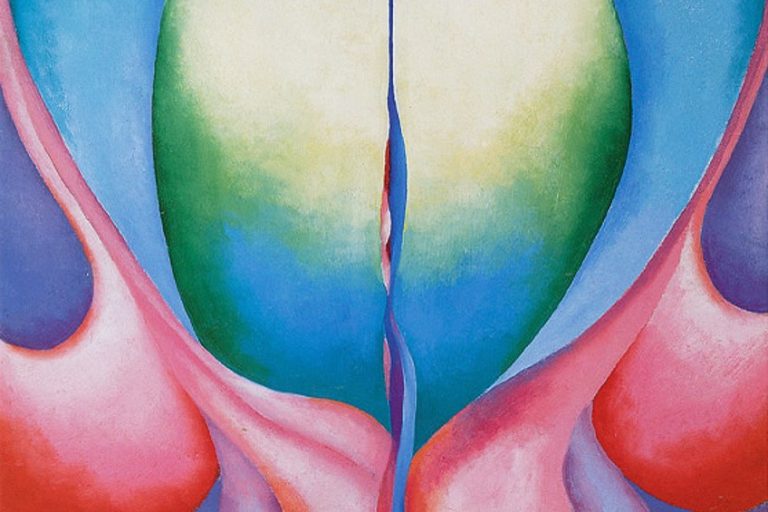
Loie Hollowell is an American painter whose luminous, geometric works transform bodily experience into abstraction. Her paintings and drawings use symmetry, color, relief, and symbolic forms to address sexuality, pregnancy, birth, postpartum change, and the shifting relation between a body and the space around it.
Key Takeaways
- Hollowell was born in 1983, raised in Woodland, California, and lives and works in New York City.
- Her visual vocabulary translates breasts, bellies, genitals, heads, and whole figures into circles, ovals, almond shapes, columns, and radiating bands of color.
- Many paintings are relief objects: built-up or recessed forms make their surfaces project, cast shadows, and change as the viewer moves.
- Her own experiences of pregnancy, birth, and motherhood are recurring subjects, but the works remain deliberately open rather than illustrative.
- Her work is held by institutions including Centre Pompidou, the Hirshhorn Museum and Sculpture Garden, LACMA, the Stedelijk Museum, and Crystal Bridges Museum of American Art.
Who Is Loie Hollowell?
Loie Hollowell was born in 1983 and raised in Woodland, California. She earned a BA from the University of California, Santa Barbara, in 2005, then an MFA in Painting from Virginia Commonwealth University in 2012. Her official CV lists New York City as the place where she lives and works.

Although her work originates in autobiography, it is not conventional self-portraiture. Hollowell begins with a bodily sensation, an encounter, or a physical change, then translates it into an invented system of shapes. A viewer may recognize breasts, a pregnant belly, a vulva, a spinal axis, or a head, but these elements are reorganized into a field of color and geometry.
The point is not anatomical description; it is to find a form adequate to an embodied experience.
The Body as an Abstract Landscape
Hollowell’s paintings are often called bodily landscapes. The phrase is useful because her images operate at several scales at once. A circular form can read as a breast, an orb, a cell, a planet, or a source of light. A vertical stripe can suggest a spine, a horizon, or an axis around which the rest of the composition turns. This instability lets the work move between the intimate scale of the body and a more cosmic sense of space.

Her approach also complicates the usual split between abstraction and figuration. Figuration depicts or suggests recognizable subjects; abstraction emphasizes formal relations such as color, shape, line, and texture. Hollowell does not treat those categories as opposites. The abstract structure carries bodily reference, while the body is made legible through its transformation into a diagram, a field, or a rhythm.
That distinction matters when viewing works that appear overtly erotic.
The paintings do not conceal their allusions to genitalia, breasts, or pregnancy, yet they resist the logic of a single viewpoint. Bodies are split, mirrored, stacked, or opened into multiple planes. Rather than offering a stable image for inspection, the work makes perception responsive to scale, angle, light, and the viewer’s own physical position.
Geometry, Symbol, and Symmetry
A Personal Vocabulary of Forms
Hollowell repeatedly uses geometric shapes with long symbolic histories. The mandorla is an almond-shaped form created where two circles overlap; it appears in religious art as a framing halo and, in her work, can carry bodily associations. An ogee is an S-shaped curve made by two opposing arcs. A lingam is a phallic form associated with the Hindu god Shiva.
These terms describe visual structures, not a fixed code. Their meaning changes with placement, color, material, and the other forms around them.
Symmetry gives the paintings an immediate clarity, but it is rarely perfect. A central line divides or anchors the composition, while paired forms may bulge at different depths, change color, or interrupt their own reflections. This controlled imbalance is one reason the work can feel both diagrammatic and unstable. The geometry offers order; the body introduces pressure, asymmetry, and change.
Color and Light
Color is an active structural element. Saturated reds, yellows, blues, pinks, and purples can establish zones of expansion or contraction, while muted grays, mauves, and flesh tones create pauses around them. Hollowell’s gradations are often carefully blended, so color appears to emit light or recede into depth rather than simply lie on the surface.

Her stated influences help clarify this use of color. She has identified Georgia O’Keeffe as an early influence, and later cited Agnes Pelton, Transcendental painters, and Neo-Tantric painters such as G. R. Santosh. The comparison is formal rather than genealogical: each offered ways to join light, spiritual association, organic form, and abstraction. Hollowell uses those resources to retain the force of lived bodily experience without illustrating it literally.
Why the Paintings Become Relief Objects
From a distance, many Hollowell paintings can look flat, almost screen-like. Close up or from the side, their construction becomes apparent. She has used materials including oil paint, acrylic medium, sawdust, high-density foam, and resin on linen over panel. Convex forms project from the support; recessed passages recede into it. The resulting shadows and highlights change as a viewer moves, making the painted image a physical object in the room.
This is not sculpture added to a painting as decoration. Relief changes how color is read.
A blue semicircle may look darker at one edge because it physically turns away from light; a painted gradient can reinforce or contradict that shadow. The work therefore produces an ongoing exchange between actual depth and painted illusion. Pace described this as a blurring of the illusory and the real, a useful way to understand why the paintings cannot be fully grasped from a single frontal view.
Boob Wheel, 2019, in the Hirshhorn Museum and Sculpture Garden, makes the method especially clear. The large vertical panel organizes five geometric shapes around horizontal and vertical lines of light. Its raised blue semicircles catch light and cast shadows, while the nearly symmetrical arrangement turns an allusion to a body into a calibrated, architectural composition.
The Hirshhorn identifies the central vertical as an abstracted spine and an axis mundi, or symbolic world axis.
Drawing as a Parallel Practice
Drawing is not secondary to Hollowell’s painting. She keeps sketches and journals, develops ideas through pastel and graphite, grids out images, and may return from paper to canvas or from canvas back to paper. The relationship is reciprocal: a drawing can become the starting point for a painting, while a painting can generate another drawing.

This process is visible in works made around pregnancy and postpartum life. Yellow Ovum, 2019, exists both as a soft pastel and graphite drawing and as a large relief painting. The shift in scale and material does not simply enlarge a preliminary image. It tests how an oval, a central opening, and surrounding color can operate differently as a drawn surface or as a built object.
Pregnancy, Birth, and Motherhood
Plumb Line and the Full-Body Format
Hollowell’s 2019 exhibition Plumb Line brought her pregnancy and postpartum experience into a series of large, vertically organized paintings. The title refers both to the central line in the compositions and to gravity’s pull during pregnancy.
The paintings divide a full standing body into modular elements such as head, breasts, belly, genitals, and buttocks, then rearrange them along a central axis.
In Birthing Dance, 2018, the scale of the panel roughly corresponds to the height of a standing person. Oil, acrylic medium, sawdust, and high-density foam on linen over panel produce a relief surface in which bodily components are abstracted into stacked, curving shapes. The work demonstrates a principle that became central to her practice: an experience can be intimately specific while its image remains formally mobile.
Going Soft and the Split Orb Paintings
The pastel drawings in Going Soft, made after Hollowell’s first pregnancy and continued around the birth of her second child in 2020, gave the work a looser, more improvised register. In Post-pregnant belly and boobs, 2020, soft pastel and graphite allow grain, smudging, and uneven pressure to remain visible. Hollowell connected that change in handling to letting go of control, rather than maintaining the more polished finish of earlier drawings.
The later Split Orb paintings convert labor into a paired geometry of head and belly-vagina region. In Split orbs in mauve, yellow, and teal, 2020, two vertically aligned forms are split apart by a central opening. Hollowell has explained that the widening split tracks cervical dilation, while alternating light and dark refer to rest and contraction. The series is therefore neither a medical illustration nor a symbolic generalization; it is an abstract score for changing bodily intensity.

Split Orbs in brown, green, crimson and purple, 2021, demonstrates how the system continued to develop. The work, now in Centre Pompidou’s collection, combines oil, acrylic, and foam on panel. Its title records the palette, but color works less as description than as a field of overlapping rhythms around the central division. The relief construction makes the “orbs” physically present, so the painting’s account of opening and separation is also enacted in its surface.
Dilation and the Overview Effect
In 2023, Hollowell made a sequence of pastel drawings titled by increments of dilation, from One Centimeter Dilated to Ten Centimeters Dilated. The sequence records time through small formal changes rather than through a narrative scene. A mark, opening, or concentric formation becomes a measure of progression.
Her Overview Effect paintings extend this concern. The title borrows the term used for astronauts’ experience of seeing Earth from space.
Hollowell connects it to moments between contractions during the home birth of her second child, when she felt able to observe herself and the process from outside her body. The 2026 paintings place two sculptural orbs vertically and use their intersecting ripples to create a mandorla between them. Convex and concave forms can recall a pregnant and emptied belly, while also resembling a pair of bodies in orbit.
Exhibitions and Public Collections
Hollowell’s first museum survey, Space Between, A Survey of Ten Years, opened at The Aldrich Contemporary Art Museum in 2024 and traveled to the Institute of Contemporary Art at Virginia Commonwealth University, where it ran through March 2025. The survey brought together a decade of paintings and works on paper, including newly exhibited pastel drawings and paintings incorporating life casts of pregnant breasts and bellies.

Other institutional solo presentations include Tick Tock Belly Clock at the Manetti Shrem Museum of Art at the University of California, Davis, in 2022–23 and Recalibrate at the Long Museum West Bund in Shanghai in 2021. In 2026, Pace Gallery presented Overview Effect in London, her first UK presentation since 2018.
Her work is held by museums and public collections in North America, Europe, and Asia. These include Centre Pompidou, the Hirshhorn Museum and Sculpture Garden, Crystal Bridges Museum of American Art, the Dallas Museum of Art, LACMA, the Stedelijk Museum, the Albertina Museum, and M+ in Hong Kong.
Such collections make it possible to encounter the work outside the contexts of a commercial exhibition or a single series.
How to Look at a Loie Hollowell Painting
Start by noticing the composition’s axis. Is a vertical line stabilizing the image, splitting it, or allowing mirrored forms to diverge? Then look at the edges of the painted shapes: a crisp boundary may behave differently from a blended gradient, and both may work against the actual cast shadow of a relief form.
Next, let the image shift scale. A rounded shape might suggest a breast, a belly, a planet, or a field of light.
The most productive reading does not force one answer. Finally, move to the side if the work is installed in person. The changing shadows reveal that the painting’s bodily references are carried not only by iconography but also by the object’s physical depth.
Conclusion
Loie Hollowell’s paintings make abstraction a way of thinking from within the body. Through geometry, color, drawing, and relief, she gives form to experiences that are difficult to represent directly without reducing them to anecdote. The results hold bodily specificity and formal ambiguity together, allowing a painting to be at once an image, an object, and a changing field of perception.
Frequently Asked Questions
What Kind of Artist Is Loie Hollowell?
Hollowell is an American artist and painter. She is known for abstract and relief paintings that use geometric forms, color, and bodily reference to explore sexuality, pregnancy, birth, and motherhood.
Where Was Loie Hollowell Educated?
She received a BA from the University of California, Santa Barbara, in 2005 and an MFA in Painting from Virginia Commonwealth University in 2012.
What Do the Shapes in Her Paintings Mean?
Her shapes often allude to parts of the body, including breasts, bellies, vulvas, penises, and heads, but they also function as abstract forms. A circle or mandorla does not have one fixed meaning; its significance changes through color, scale, depth, and placement.
Are Loie Hollowell’s Paintings Sculptures?
They are paintings that incorporate sculptural relief. Many works use foam, sawdust, resin, and layered materials beneath or within the painted surface, creating convex or concave forms that project from the panel.
What Is the Split Orb Series About?
The Split Orb paintings abstract Hollowell’s experiences of labor and birth. Paired forms stand for the head and belly-vagina region, while widening splits, color changes, and central bands register dilation, contraction, rest, and shifting consciousness.
Which Artists Have Influenced Loie Hollowell?
She has named Georgia O’Keeffe, Agnes Pelton, Transcendental painters, and Neo-Tantric painters such as G. R. Santosh as influences. Institutional accounts also place her work in conversation with artists including Hilma af Klint and Judy Chicago.
Where Can I See Loie Hollowell’s Work?
Her work is in public collections including Centre Pompidou, the Hirshhorn, Crystal Bridges, LACMA, the Stedelijk Museum, and M+. Check each institution’s current collection listings before visiting because works are not always on display.
Cite this Article
artincontext, , “Loie Hollowell – Art, Paintings, Process, and Biography.” Art in Context. September 17, 2026. URL: https://artincontext.org/loie-hollowell/
, a. (2026, 17 September). Loie Hollowell – Art, Paintings, Process, and Biography. Art in Context. https://artincontext.org/loie-hollowell/
, artincontext. “Loie Hollowell – Art, Paintings, Process, and Biography.” Art in Context, September 17, 2026. https://artincontext.org/loie-hollowell/.