

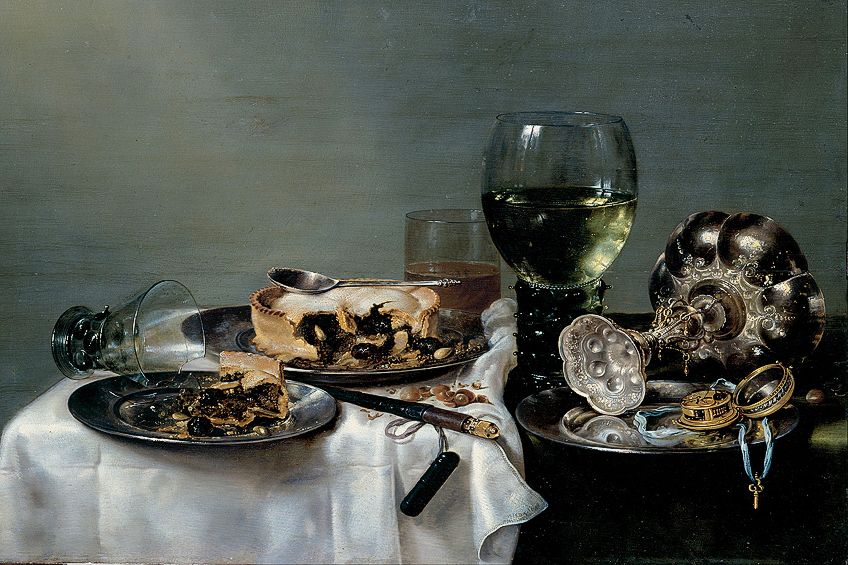
Still Life Painting – History of the Object Painting Genre

A still life is an artwork organized around objects rather than a principal narrative action or portrait sitter. Fruit, flowers, food, vessels, books, tools, specimens, luxury goods, and manufactured objects can become vehicles for close observation, formal experiment, cultural display, memory, mortality, trade, and power. Still life flourished as an independent painting specialty in early 17th-century Europe, but object arrangements appear in ancient, medieval, and global traditions, and the genre remains active across photography, sculpture, installation, and digital media.
What Is a Still Life Painting?
A useful still life definition is a composition in which inanimate or stationary things carry the main visual and conceptual weight. “Still” does not mean lifeless in a literal sense: cut flowers decay, fruit ripens, insects move, and dead game once lived. Nor must the genre exclude people. A small figure can appear, but the arranged things dominate.
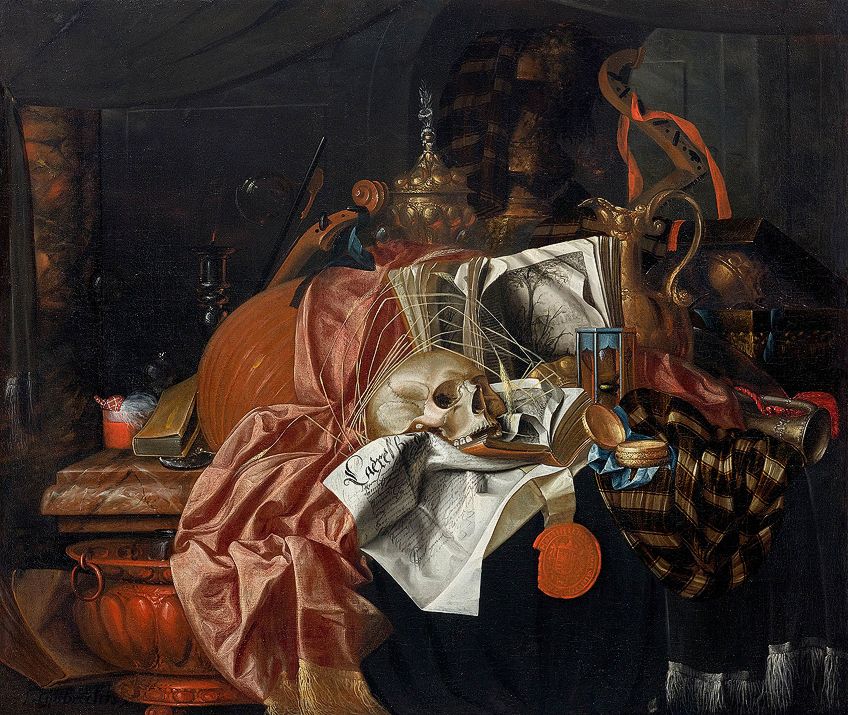
Franciscus Gijsbrechts’s vanitas gathers instruments, vessels, books, an extinguished candle, wheat, and a skull. Each object is rendered persuasively, yet the ensemble is invented to stage relationships among sensory pleasure, knowledge, time, and death.
Composition and Illusion
Artists control viewpoint, overlap, scale, lighting, focus, color, texture, and edges. A reflective cup can demonstrate handling of light; a peeled lemon can lead the eye over a table; a tilted bowl can destabilize space. Even the most convincing still life is constructed rather than a neutral record of what happened to be present.
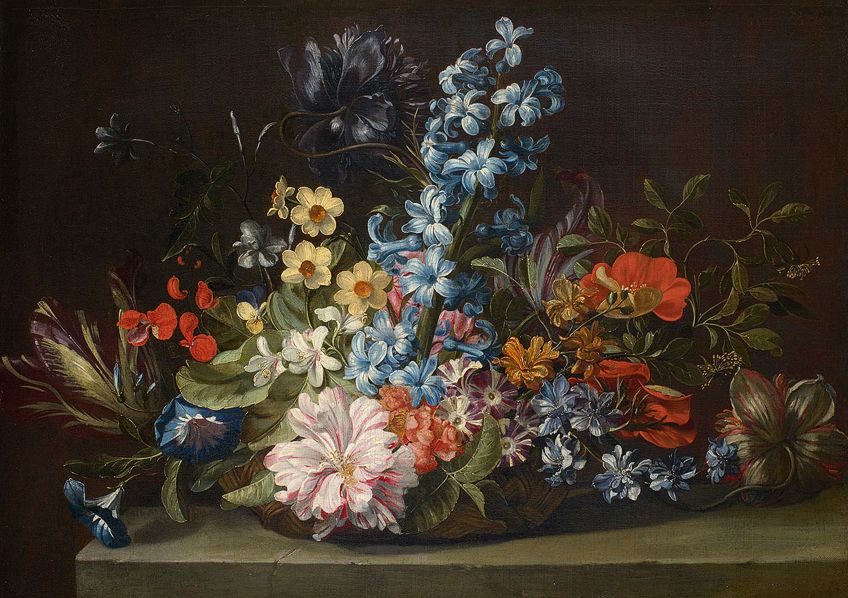
The flower basket above is attributed to Jan van den Hecke rather than securely signed by him. Attribution language matters: a current catalogue’s “attributed to” should not be simplified into certainty.
Objects, Meaning, and Context
Objects may invite symbolic readings, but there is no universal codebook. A lemon, shell, flower, watch, glass, or loaf can have religious, moral, economic, sensory, or purely compositional functions. Meaning depends on period, place, patron, surrounding objects, inscriptions, and visual evidence.
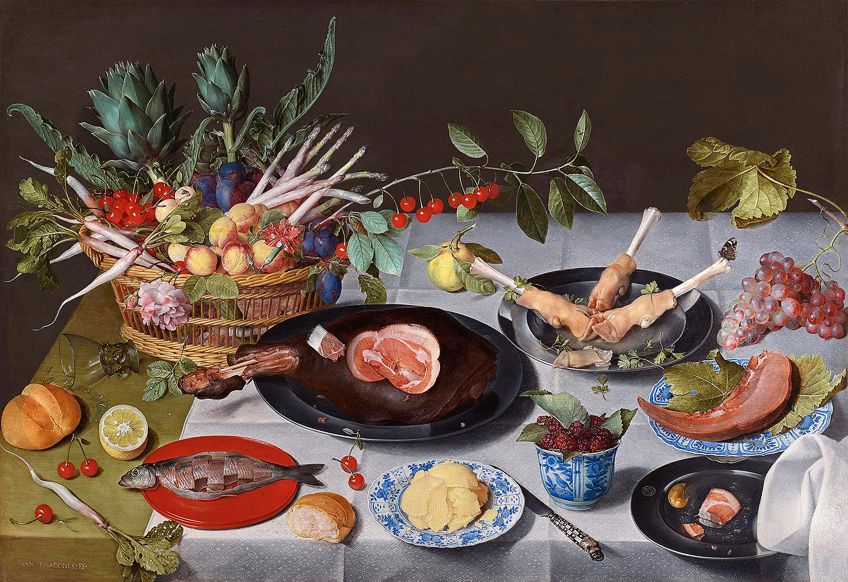
Van Hulsdonck’s elaborate food display brings abundance close to the viewer. Imported ceramics, fruit, meat, glass, and tableware can signal commerce and status, while breakage and perishability may temper that display. These works do not necessarily document an actual meal.
A Brief History of Still Life Art
Ancient Object Images
Ancient Egyptian tomb decoration, Greek and Roman painting, mosaics, and painted vessels represented offerings, food, tools, plants, and household goods for specific ritual, funerary, domestic, and decorative purposes. Calling all of them “still lifes” applies a later European genre term retrospectively, so context should remain primary.
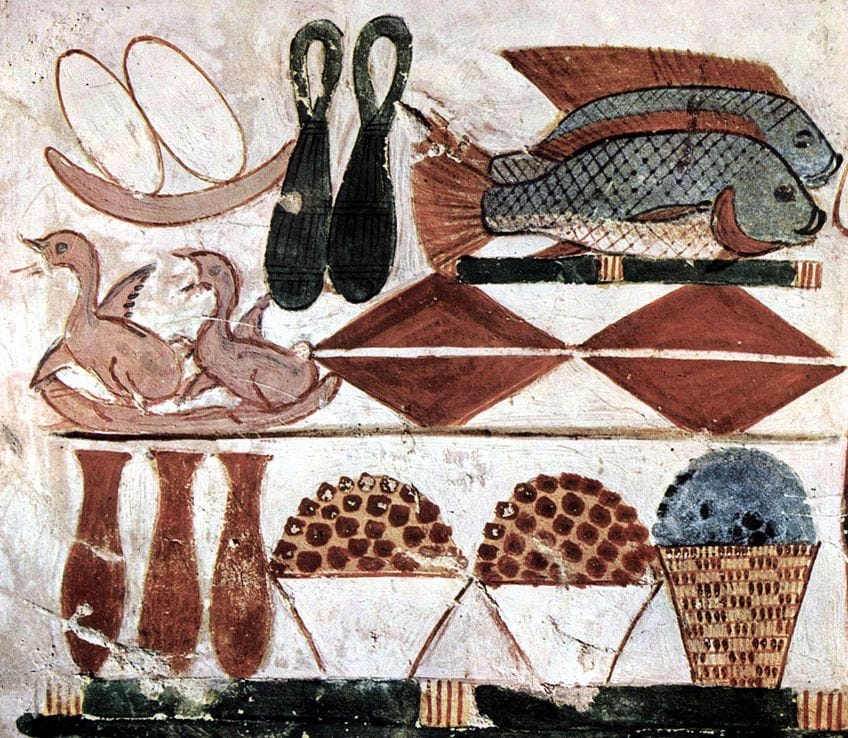
The offering scene from Menna’s tomb chamber belongs to a larger funerary program designed around status, ritual provision, and the afterlife. It is not simply an early version of a modern tabletop painting.
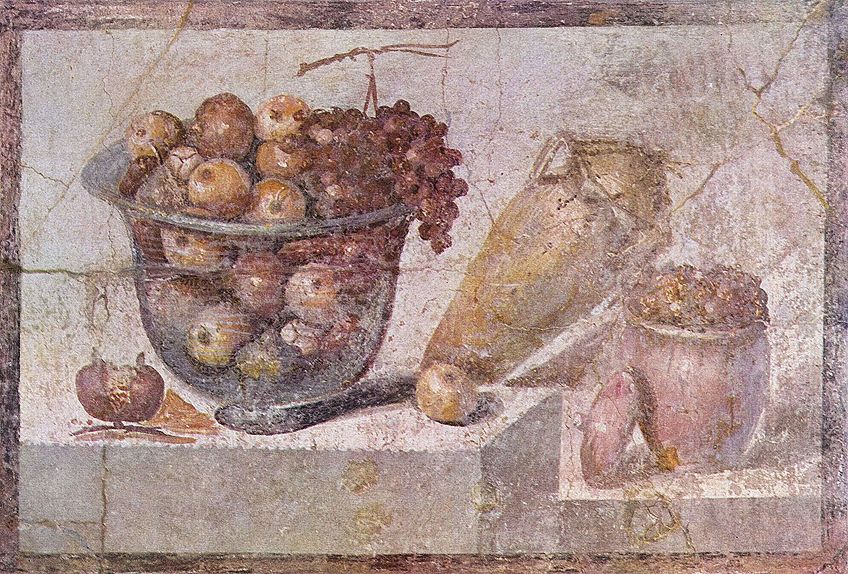
The Pompeian arrangement of fruit and vessels demonstrates ancient interest in illusion, abundance, and domestic decoration. Its survival also depends on the catastrophic burial and later excavation of Pompeii.
Medieval and Renaissance Objects
Books of hours, altarpieces, portraits, and devotional paintings often gave objects precise symbolic and material roles. Lilies, mirrors, vessels, food, books, and tools helped construct sacred narratives and social identities. Independent object pictures became more common gradually rather than appearing from nowhere around 1600.
Dutch and Flemish Still Life
Still life flourished in the Northern and Spanish Netherlands during the early 17th century. The Met’s overview relates this expansion to urbanization, domestic interiors, commerce, learning, and specialized markets. Distinctive forms included flower pieces, breakfast and banquet pictures, vanitas, market and kitchen scenes, game pieces, and luxurious pronkstilleven.
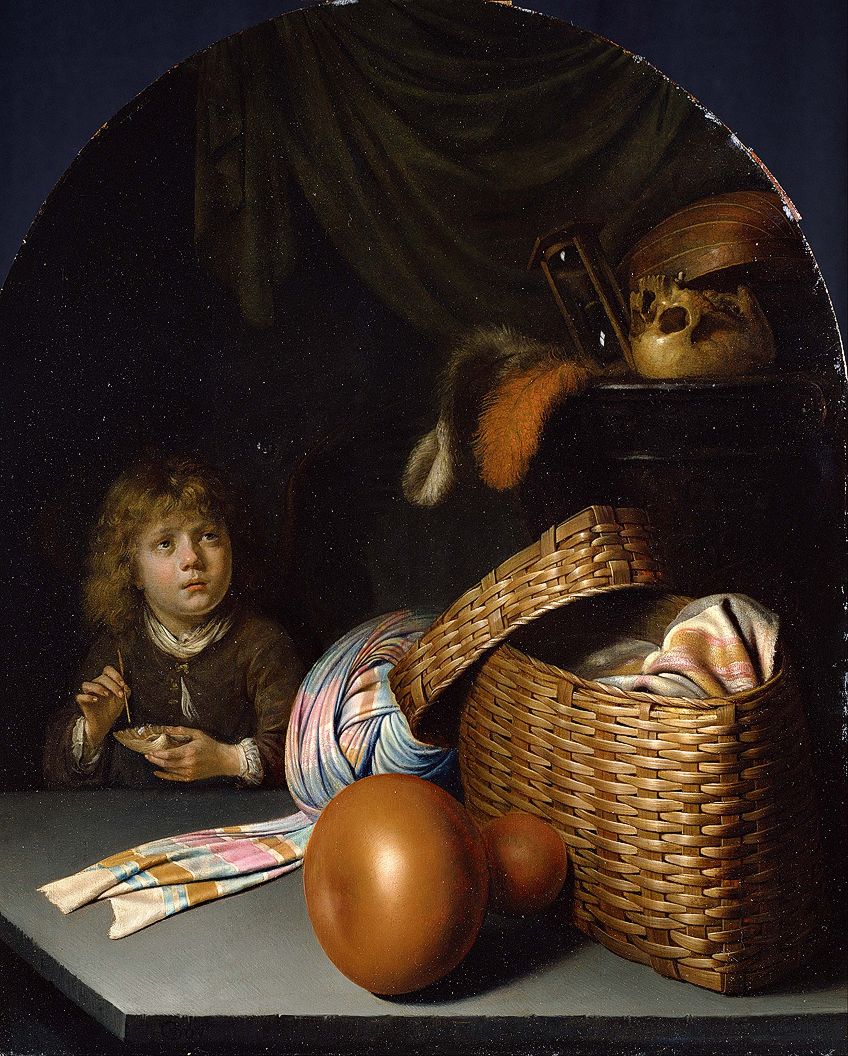
Gerrit Dou’s boy blowing bubbles joins still life, genre painting, and vanitas. The soap bubble is fragile and short-lived, but the painting’s meaning emerges from its full ensemble rather than one isolated symbol.
Modern and Contemporary Still Life
Chardin, Goya, Manet, Cézanne, Van Gogh, Picasso, Braque, Morandi, O’Keeffe, Kahlo, and many others reworked the genre. Photography changed object representation but did not make painting obsolete. Contemporary artists use found objects, food, consumer packaging, video, installation, data, and digital rendering to address consumption, ecology, identity, labor, and memory.
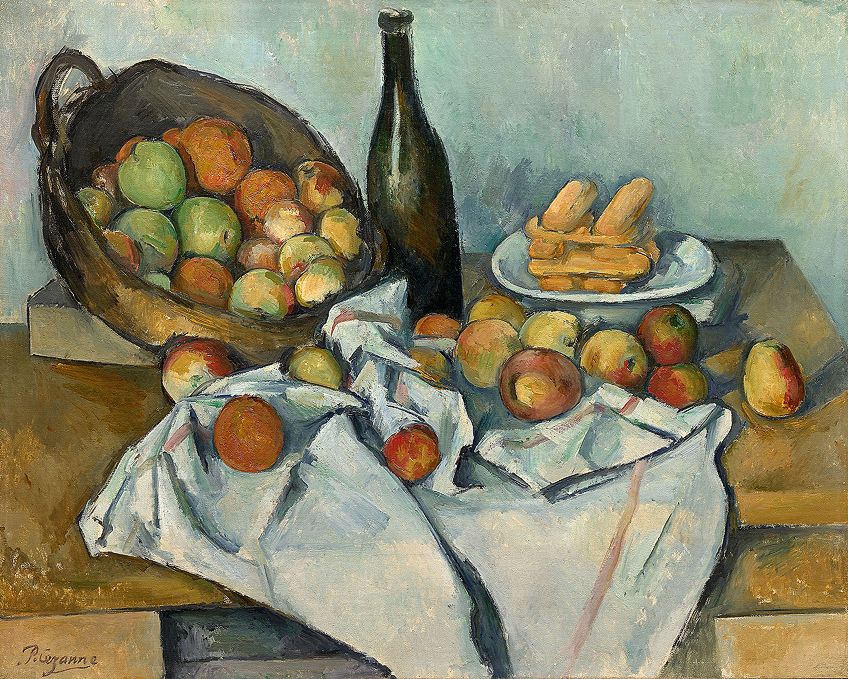
Cézanne’s Basket of Apples makes misaligned table edges, a leaning bottle, and unstable viewpoints part of its structure. The Art Institute of Chicago dates it about 1893 and explains that its solidity and spatial impossibility exceed straightforward imitation.
Types of Still Life Painting
Flower Still Life
Flower paintings could combine species that did not bloom at the same time, creating an ideal bouquet through studies, specimens, memory, and invention. Rare plants linked art to collecting, botany, trade, and wealth; insects and decay introduced time into apparent perfection.
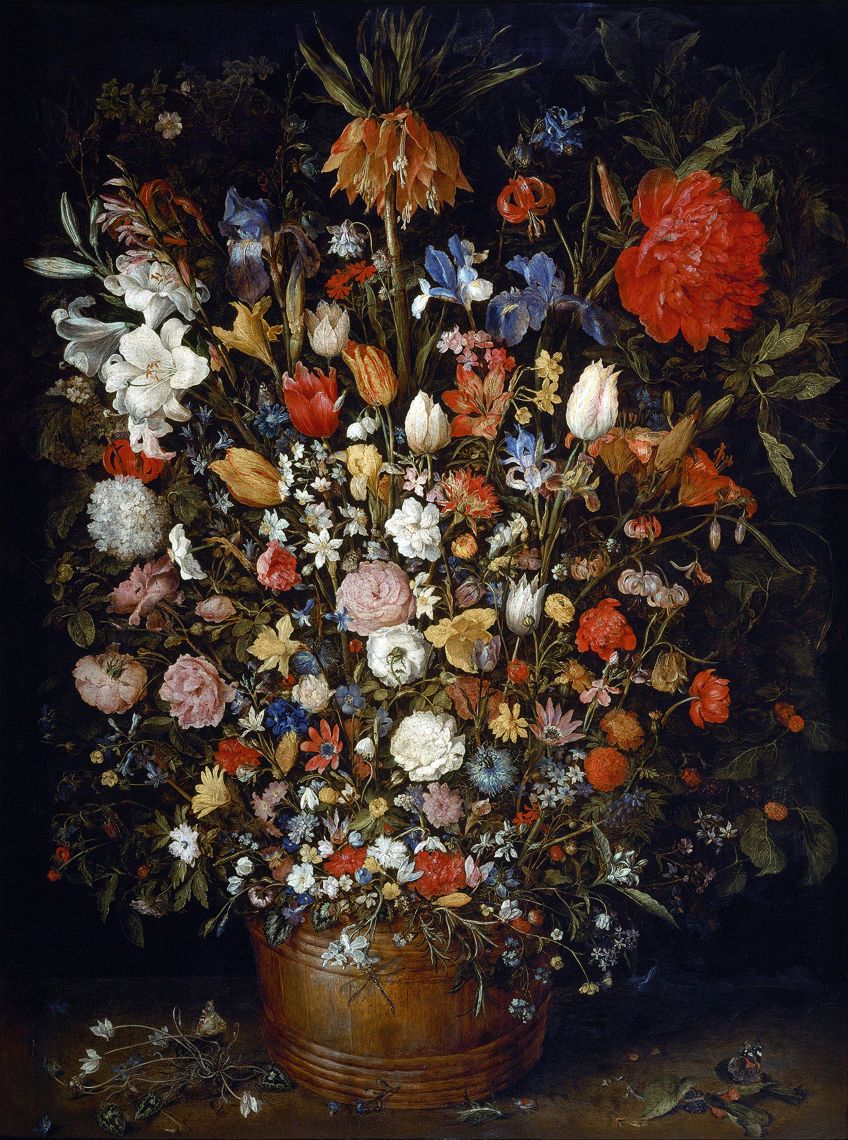
Jan Brueghel’s dense bouquet displays differentiated petals, leaves, insects, and surfaces. Its value lay in artistic selection and finish, not merely botanical identification.
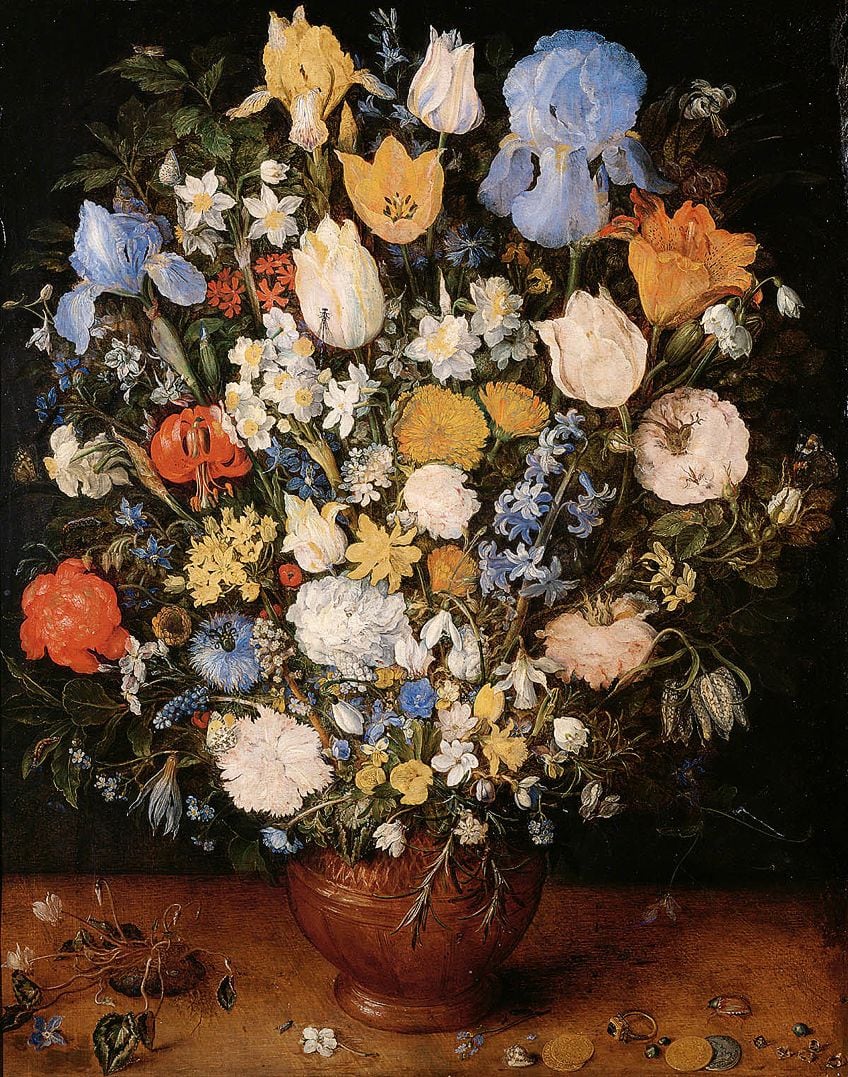
The supplied caption dates Small Bouquet of Flowers to 1599. Its current Commons record gives a broader dating history around 1599–1607, so one inscribed or proposed date should not be treated as uncontested.
Market, Pantry, and Game Pieces
Large Flemish market and pantry scenes brought meat, fish, fruit, vegetables, and animals into spectacular displays, sometimes with small figures. They could advertise skill, abundance, estate culture, and access to commodities while also suggesting appetite, excess, or mortality.

The caption’s “1579–1657” is Frans Snyders’s lifespan, not the painting date. The linked record dates Pantry Scene with a Page probably to 1612.
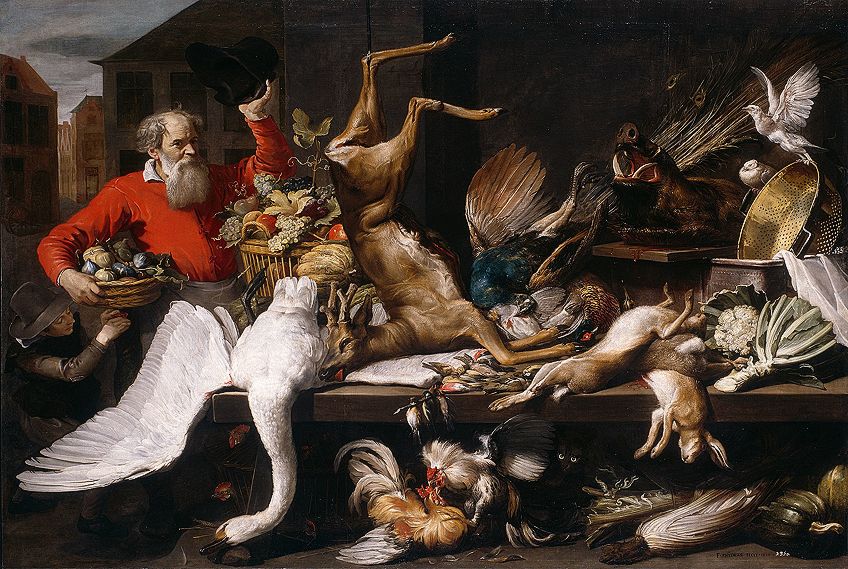
Snyders’s Still Life with Dead Game, Fruits, and Vegetables in a Market stages dead animals and produce at imposing scale. Modern viewers may respond differently to hunting trophies and animal bodies than the patrons for whom they signaled privilege and estate life.
Breakfast and Banquet Pieces
Haarlem painters such as Willem Claesz Heda and Pieter Claesz specialized in limited palettes, reflective vessels, partially eaten food, folds, and objects that project over the table edge. “Breakfast piece” does not guarantee that the arrangement records a real breakfast.
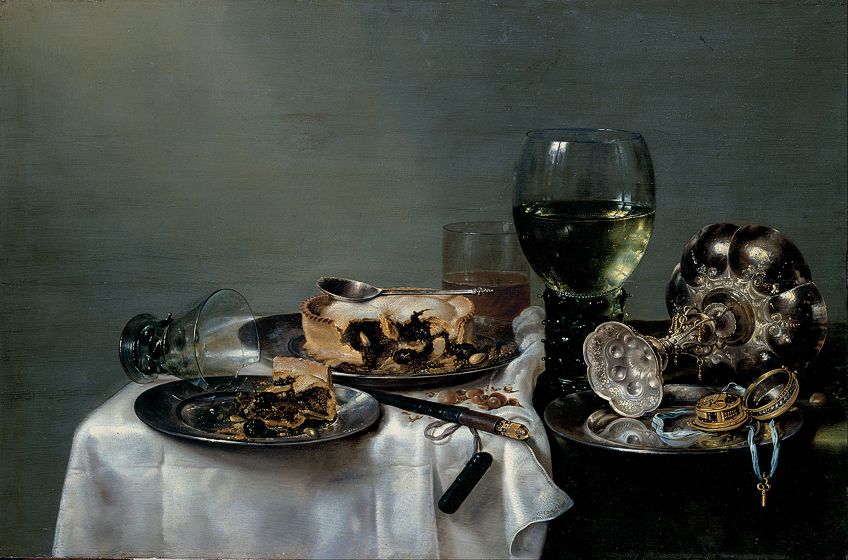
Heda’s Breakfast Table with Blackberry Pie balances luxury and interruption through tipped vessels, cut food, crumpled cloth, and glancing light.
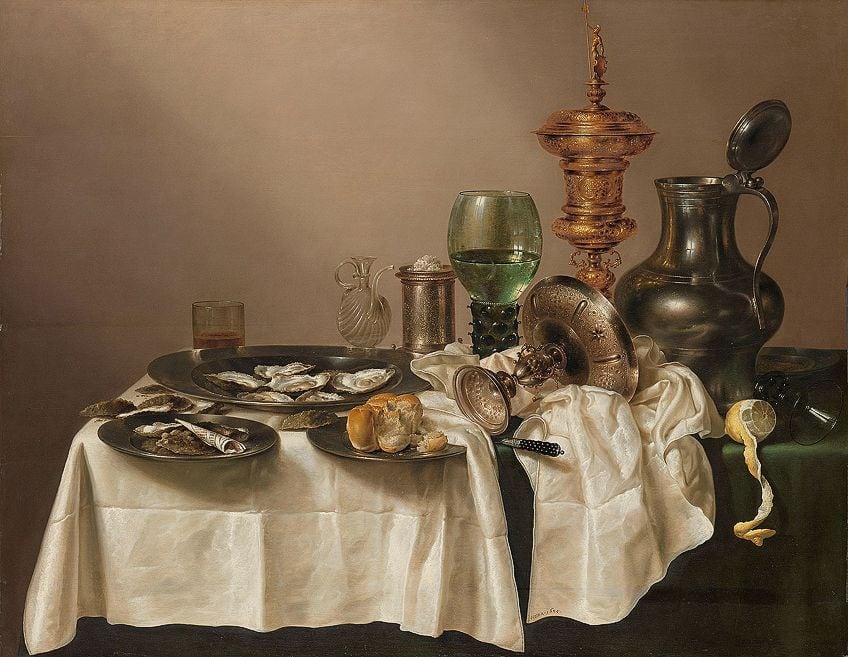
Still Life with a Gilt Cup demonstrates Heda’s control of silver-gray, gold, glass, pewter, and linen. Restricted color can heighten differences in texture rather than mute them.
Vanitas and Memento Mori
Vanitas still lifes focus on the instability of earthly achievement and pleasure. Skulls, extinguished lights, bubbles, clocks, wilting flowers, broken vessels, and books can evoke death or passing time, but not every still life containing luxury is a moral sermon.
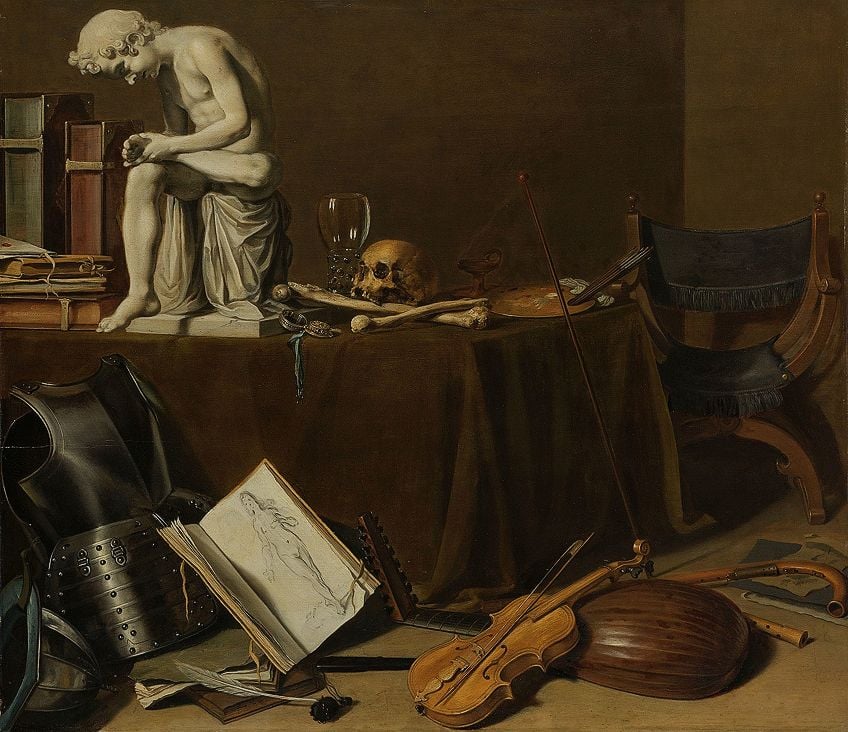
Pieter Claesz’s Vanitas Still Life with the Spinario juxtaposes a skull and lamp with a classical statuette and other markers of knowledge or accomplishment. The eye moves between beauty, learning, and their limits.
Pronk Still Life
Pronkstilleven means an ostentatious or display still life. In mid-17th-century Amsterdam, painters such as Willem Kalf assembled imported porcelain, glass, silver, fruit, textiles, and ceremonial objects in controlled darkness and gleaming light.
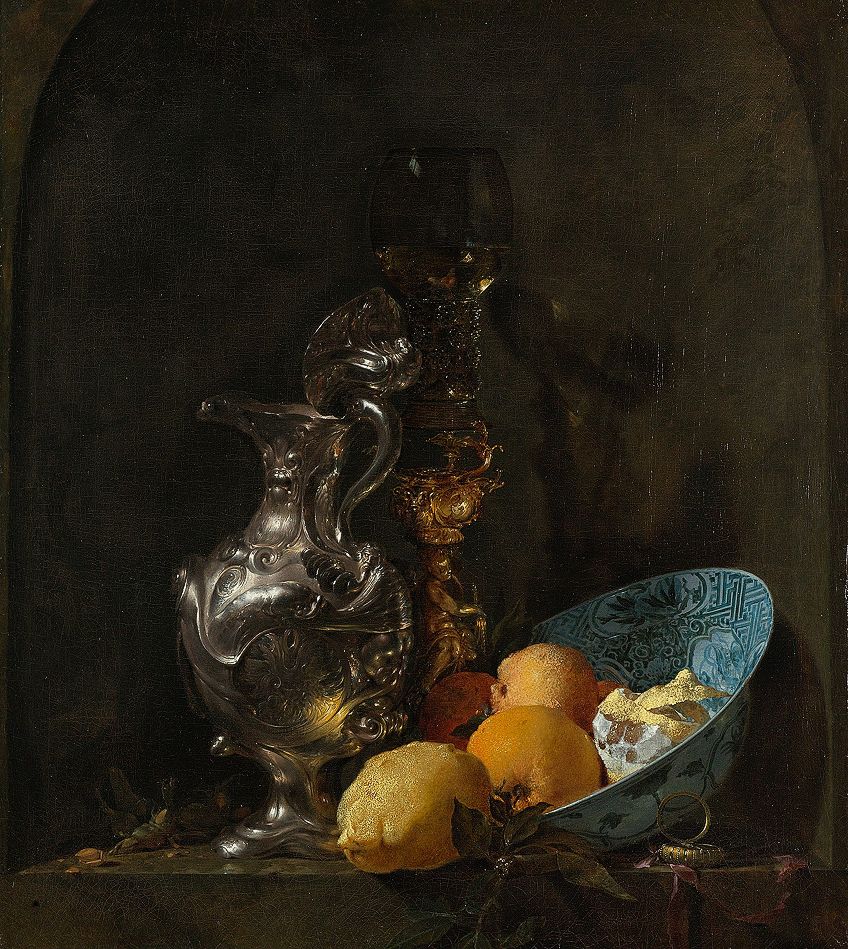
Kalf’s silver jug and porcelain bowl turn reflections, edges, and surface into the main drama. Such objects also point to global trade networks that involved colonial extraction, coercion, and unequal exchange, not prosperity in isolation.
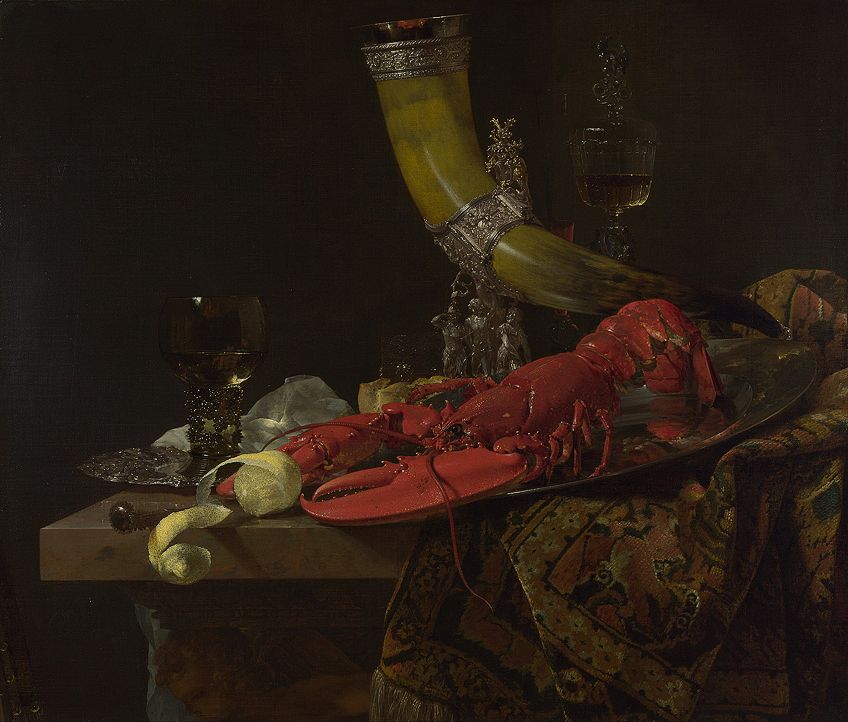
The drinking horn belonged to Amsterdam’s Saint Sebastian Archers’ Guild, making the painting a record of civic prestige as well as a luxurious arrangement. Precise object history prevents symbolic interpretation from becoming generic.
How to Analyze a Still Life
Begin with what is visible, then build context. Identify materials and objects cautiously; note scale, viewpoint, lighting, palette, surface, condition, and how the composition directs attention. Ask whether objects could have occupied the same place and season, who could own them, how they were obtained, and where the painting was meant to hang.
Do not assign a fixed symbol to every object. Compare museum records, provenance, inventories, technical studies, and works by the same artist. The National Gallery of Art’s catalogue entry for a banquet piece shows how food identification, trade, composition, signature, and patron culture can produce a more rigorous reading.
For makers, the same questions become practical: choose a concept and objects, control the light, test thumbnails, decide the viewpoint, and study negative spaces as carefully as the objects. A successful still life does not depend on expensive possessions; ordinary things can carry complex formal and personal meanings.
Frequently Asked Questions About Still Life Painting
What Is a Still Life?
A still life is an artwork in which arranged objects carry the main visual and conceptual weight. Common subjects include food, flowers, vessels, books, tools, specimens, and manufactured goods.
What Is Vanitas Still Life?
Vanitas is a type of still life that emphasizes the transience of life, knowledge, pleasure, or wealth. Skulls, bubbles, clocks, extinguished candles, and wilting flowers are common but context determines meaning.
Why Were Still Lifes Popular in the Dutch Republic?
Urbanization, domestic collecting, specialized art markets, trade, learning, and interest in material goods supported many still-life specialties. Religious and moral ideas also shaped how viewers understood pleasure and impermanence.
How Do You Interpret Symbols in a Still Life?
Start with the whole composition and historical evidence rather than a universal symbol list. An object’s meaning depends on its period, place, neighbors, patron, material history, and role in the painting.

Isabella studied at the University of Cape Town in South Africa and graduated with a Bachelor of Arts majoring in English Literature & Language and Psychology. Throughout her undergraduate years, she took Art History as an additional subject and absolutely loved it. Building on from her art history knowledge that began in high school, art has always been a particular area of fascination for her. From learning about artworks previously unknown to her, or sharpening her existing understanding of specific works, the ability to continue learning within this interesting sphere excites her greatly.
Her focal points of interest in art history encompass profiling specific artists and art movements, as it is these areas where she is able to really dig deep into the rich narrative of the art world. Additionally, she particularly enjoys exploring the different artistic styles of the 20th century, as well as the important impact that female artists have had on the development of art history.
Learn more about Isabella Meyer and the Art in Context Team.
Cite this Article
Isabella, Meyer, “Still Life Painting – History of the Object Painting Genre.” Art in Context. June 18, 2021. URL: https://artincontext.org/still-life-painting/
Meyer, I. (2021, 18 June). Still Life Painting – History of the Object Painting Genre. Art in Context. https://artincontext.org/still-life-painting/
Meyer, Isabella. “Still Life Painting – History of the Object Painting Genre.” Art in Context, June 18, 2021. https://artincontext.org/still-life-painting/.


