

Russian General Indicted Over 2022 Skovoroda Museum Strike

Ukrainian prosecutors have approved an in-absentia indictment of a Russian lieutenant general over the May 2022 missile strike on the Hryhorii Skovoroda National Literary and Memorial Museum. The case moves the alleged responsibility up the command chain, but the filing is an accusation awaiting adjudication—not a conviction.
Prosecutors Allege a Deliberate Strike on the Museum
Ukraine’s Office of the Prosecutor General announced on October 29, 2026, that prosecutors had approved the indictment six days earlier, on October 23. According to the account published by Hromadske, investigators allege that the commander knowingly selected a protected cultural site that was not a military objective.
The allegation is unusually specific. Prosecutors say the lieutenant general ordered the commander of Russia’s 105th Aviation Division to attack the museum, and that the order then passed to a fighter aviation regiment. They say a Russian Su-35S launched a Kh-35 anti-ship missile from airspace over Kharkiv Oblast at 11:30 p.m. on May 6, 2022.
That timing clears up an apparent discrepancy in early coverage. The weapon struck late on May 6, while the fire continued into the morning of May 7, when much of the first reporting appeared. A later Human Rights Watch and Harvard Law School study likewise dates the impact to 11:30 p.m. on May 6 and says the fire was not fully extinguished until 8 a.m. the next day. References to the “night of May 7” do not establish a second attack.

The fire-damaged Hryhorii Skovoroda Museum during a September 2022 event. Photograph by the Kharkiv Regional State Administration, hosted by Wikimedia Commons, licensed under CC BY 4.0.
The Alleged Order Chain Reaches Oleg Makovetsky
The October announcement described the accused but did not name him: a native of Chuhuiv who commanded Russia’s 6th Air and Air Defense Forces Army at the time of the strike. Those details match Oleg Makovetsky, whom Ukraine’s Security Service identified in the earlier suspicion. Suspilne’s January 2025 account names Makovetsky and identifies Denis Kulsh and Ivan Panchenko as the two subordinate officers in the alleged chain.
The new prosecution account says indictments against the aviation-division and fighter-regiment commanders had already been sent to court. That makes the October filing a step upward in alleged command responsibility: prosecutors are no longer describing only the officers closer to the aircraft, but the army commander they say selected the museum and issued the order.
What an In-Absentia Indictment Does Not Prove
“In absentia” describes the posture of the case: the accused is not present in Ukrainian custody. An approved indictment formalizes the prosecution’s accusation and permits the case to advance without the defendant’s physical presence; it is not a judicial finding that the alleged order, knowledge, or intent has been proved.
The distinction matters in a story about cultural-property accountability. The prosecutor’s office alleges that Makovetsky knew the museum was not a military target and nevertheless ordered its destruction. Those are claims for a court to test. The reported penalty is eight to 12 years’ imprisonment if he is convicted.
The Collection Survived, but the Museum Did Not
The museum occupied an 18th-century estate in Skovorodynivka associated with the final years of Hryhorii Skovoroda, the Ukrainian philosopher, poet, and theologian who died in 1794. Its significance was not limited to objects in display cases: the historic house, memorial room, interior, and landscape together connected the collection to the place where Skovoroda lived and worked.
Many collection objects had been removed before the strike, according to the Human Rights Watch and Harvard study. That precaution saved much of the movable collection, but the blast and fire destroyed the roof, exhibition spaces, furnishings, and most interior decoration. A civilian guarding the museum was injured. The survival of a fire-scorched sculpture of Skovoroda amid the ruins became one of the attack’s defining images.
The site remains vulnerable. In May 2026, a drone strike damaged eight spans of the protective roof erected over the monument. Ukraine’s Culture Ministry said one span had a large hole and seven had fragmentation damage, while the historic structure itself and the shelter’s load-bearing elements were not damaged in that incident. The ministry reported the damage to UNESCO.
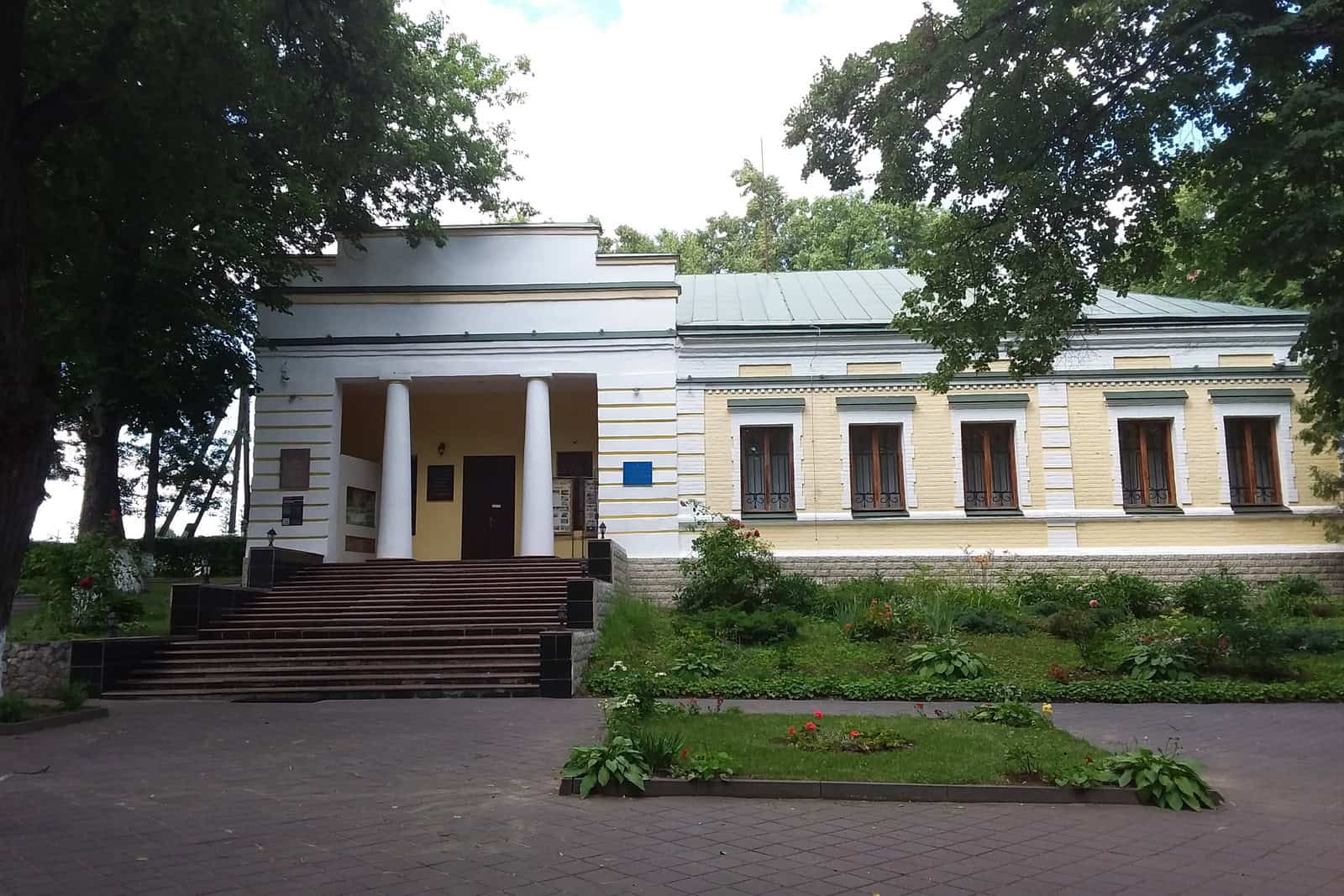
The Hryhorii Skovoroda Museum in Skovorodynivka before the 2022 strike. Photograph by Andrii Orlov, hosted by Wikimedia Commons, licensed under CC BY-SA 4.0. Cropped.
Why the Museum’s Protected Status Is Central
Cultural property receives both the general protection owed to civilian objects and specific protection under the 1954 Hague Convention framework. The International Committee of the Red Cross explains that parties may not direct hostilities against cultural property, with a narrow exception when it has become a military objective and an attack is required by imperative military necessity.
The indictment’s central allegation addresses that dividing line. Prosecutors say the commander knew the museum was not a military objective and chose it because of its cultural value. The museum’s status is therefore not background to the case; it is part of the alleged conduct that Ukrainian authorities characterize as a violation of the laws and customs of war.
The scale figures also require care. Ukraine’s Culture Ministry recorded 2,161 affected cultural-heritage sites and 2,665 affected cultural institutions through the end of September 2026, including 140 museums and galleries. These are different registers, not numbers that should be added into a single total: one counts heritage sites by status, while the other counts institutions by function. The ministry also warns that its inventory remains incomplete in occupied territories and can rise when earlier damage is reported late.
The Case Now Reaches Army-Command Level
Contemporary emergency-service reporting placed the strike and resulting fire at about 11:10 p.m. on May 6, while prosecutors later gave 11:30 p.m.; prosecutors approved the indictment on October 23, 2026, and announced it on October 29. The identifying details in the announcement match Oleg Makovetsky, previously named by the Security Service, while the alleged chain below him had already produced two indictments.
The physical record is equally clear: prior evacuation protected much of the movable collection, but it did not save the historic museum, its memorial interior, or the civilian guard from harm. What remains unresolved is judicial. The prosecution announcement gave no hearing date, Makovetsky has not been convicted, and the allegations about his order and intent have not yet been tested in a judgment.

Isabella studied at the University of Cape Town in South Africa and graduated with a Bachelor of Arts majoring in English Literature & Language and Psychology. Throughout her undergraduate years, she took Art History as an additional subject and absolutely loved it. Building on from her art history knowledge that began in high school, art has always been a particular area of fascination for her. From learning about artworks previously unknown to her, or sharpening her existing understanding of specific works, the ability to continue learning within this interesting sphere excites her greatly.
Her focal points of interest in art history encompass profiling specific artists and art movements, as it is these areas where she is able to really dig deep into the rich narrative of the art world. Additionally, she particularly enjoys exploring the different artistic styles of the 20th century, as well as the important impact that female artists have had on the development of art history.
Learn more about Isabella Meyer and the Art in Context Team.
Choose Art in Context as a preferred source to see more of our reporting in Google Top Stories and other Google Search experiences.
Cite this Article
Isabella, Meyer, “Russian General Indicted Over 2022 Skovoroda Museum Strike.” Art in Context. October 31, 2026. URL: https://artincontext.org/skovoroda-museum-strike-russian-general-indictment/
Meyer, I. (2026, 31 October). Russian General Indicted Over 2022 Skovoroda Museum Strike. Art in Context. https://artincontext.org/skovoroda-museum-strike-russian-general-indictment/
Meyer, Isabella. “Russian General Indicted Over 2022 Skovoroda Museum Strike.” Art in Context, October 31, 2026. https://artincontext.org/skovoroda-museum-strike-russian-general-indictment/.


