


Santa Coloring Pages – 55 stunning and Free Sheets

Get ready to embrace the holiday spirit with our delightful collection of 55 free Santa coloring pages! As the festive season draws near, what better way to celebrate than by adding a touch of creativity to your preparations? These charming Santa Claus-themed coloring pages offer a perfect opportunity for both kids and adults to unleash their artistic talents, whether it’s for decorating your home, sending personalized cards, or simply indulging in some relaxing holiday-themed fun. Join us on this joyful journey as we bring the magic of Santa to life on the pages of your imagination.

A chubby, smiling Santa with a big curly beard and pom-pom hat stands with his arms full of wrapped presents, some tied with bows. The heavy line work and hatching make it a fairly detailed sheet.

Santa waves with one raised hand while the other arm hangs bent at his side. He has a scalloped beard, round nose, two buttons and a solid black belt. Bold, open shapes make it easy to color.

A front-facing portrait of Santa in a pom-pom hat, with bushy eyebrows, a rounded nose, a curled mustache and a long wavy beard drawn in many thin flowing strands. Fine, dense line work makes it a demanding sheet.

Santa’s face peers out from under a fluffy pom-pom hat, framed by holly leaves, stars, a wrapped gift, candy swirls and baubles. The densely hatched beard and crowded border make this a very demanding sheet.

Santa sits on the ridge of a snow-covered roof beside a small chimney, leaning back with his boots stretched out. A belt crosses his round belly, and a brick wall runs along the bottom.

Santa wears round glasses and a pom-pom hat, with a swooping mustache and a long beard of thin strands. Stars, circles and bauble-like shapes surround him. Heavy black fills and halftone shading dominate.

A chubby Santa stands facing front with both arms spread wide, eyes closed in a smile under a bent hat with a small pom-pom. Solid black mittens, boots and belt buckle contrast with large open shapes. The big, bold areas suit small hands.
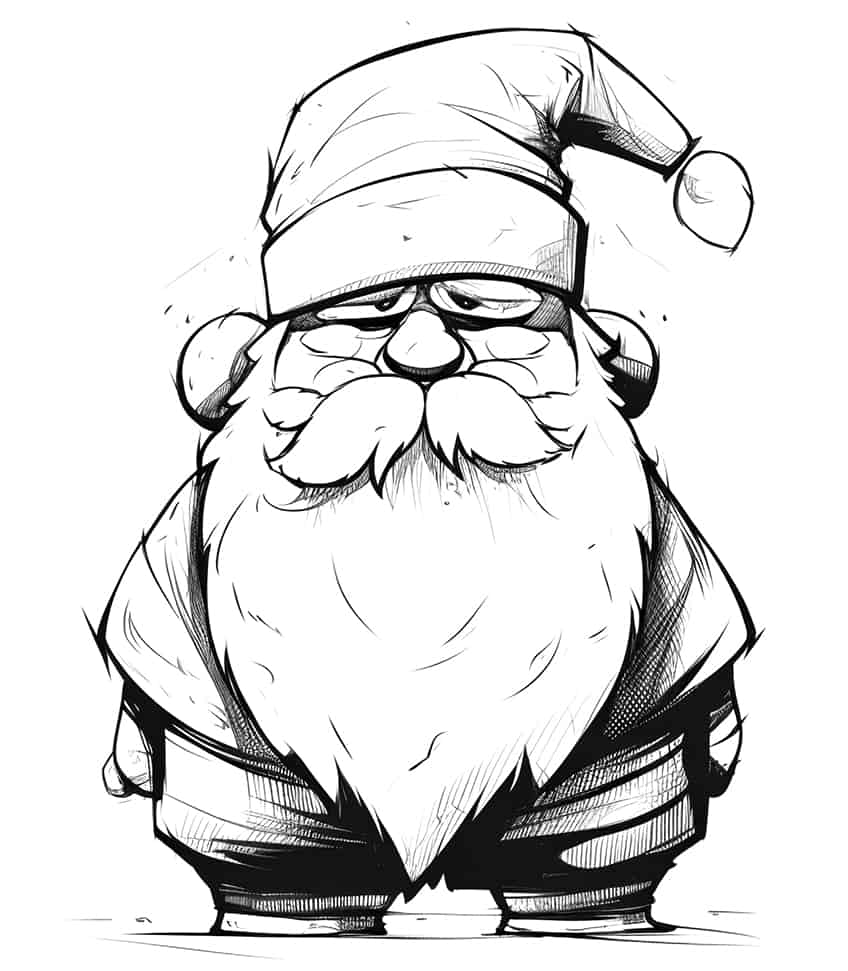
A squat, heavy-lidded Santa stands facing front, his enormous rounded beard hiding most of his coat. A tall hat with a pom-pom tilts back. Hatching and dark shadows mark the sleeves and boots.

A tall, pear-shaped Santa with wide round eyes, a red-nose blob and a bristly beard peeks out under a pointed pom-pom hat. Two small fir trees and scattered snow dots flank him.

Santa’s head and flowing wavy beard sit inside a circular frame, with an ornament-hung fir tree on the left and a snow-capped cottage on the right. Holly leaves and a pine cone lie along the bottom edge.

A stern-faced Santa head seen from the front, with furrowed brows, a long layered beard and swept mustache. The solid black hat carries white snowflake sparkles and ends in a round pom-pom.

Two round-faced Santa figures stand shoulder to shoulder in slouchy pom-pom hats, with dot eyes, button noses and tufted beards. The right hat carries a snowflake and a gingerbread man, and small stars float around them.

Santa in a striped hat and round glasses stands in profile on a snowy hill, his long shaggy beard hanging down. A tall fir tree, small saplings, a little bird and falling snowflakes surround him.

Santa turns his tired, wrinkled face to the side while cradling three stacked gift boxes, two topped with bows. His long wavy beard fills the middle, and a drooping hat ends in two pom-poms. The sketchy, loose linework suits confident colorers.

A big-eyed chibi Santa with a sweeping long beard holds a small teddy bear in one arm and a gift box in the other, while apples and snowflakes surround him.

A bearded man in a hooded coat and tall boots stands beside a huge reindeer with wide, branching antlers and a shaggy chest. Fir trees and distant mountains fill the background.

Drawn in bold ink hatching, this three-quarter bust shows Santa with a round nose, curled mustache and a broad fluffy beard. A short hat ends in a pom-pom beside his ear. The beard stays white and open.

A round, standing Santa with a long pointed beard and a braided belt has small planets and stars dotted over his belly. A crowd of swirls, gifts and tiny houses packs the background. This one is dense and best for patient colorers.

A weathered Santa face with closed, wrinkled eyes, a big round nose and a sweeping curled mustache. A striped hat with a speckled pom-pom sits above swirling beard locks and small floating dots.
New Santa Coloring Pages – Chimney, Elves and Reindeer
36 new sheets have been added to the collection, and they stay close to the Christmas scenes children ask for: Santa and an elf checking the list, his boots and sack on a snowy rooftop, a reindeer being fed carrots, Santa wedged in the chimney, and a workshop bench with a teddy and a wooden train. Each one prints as a PDF in A4, so a single page goes straight to the printer.


What’s the History of Santa Claus?
The history of Santa Claus is a fascinating tale that has evolved over centuries, blending various cultural influences to create the beloved figure we know today. Santa Claus is primarily based on the historical figure of Saint Nicholas, a Christian bishop who lived in the 4th century in Myra, which is now modern-day Turkey. Saint Nicholas was known for his kindness and generosity, especially towards children and those in need.
The modern image of Santa Claus, with his red suit, white beard, and reindeer-driven sleigh, draws heavily from different sources. Dutch immigrants to the United States brought the “Sinterklaas” tradition, a figure similar to Saint Nicholas. In the 19th century, Sinterklaas evolved into “Santa Claus” in America, and various literary works, including the famous poem “A Visit from St. Nicholas” (commonly known as “The Night Before Christmas”), contributed to the development of his modern image.
Coca-Cola’s marketing campaigns in the 1930s further popularized Santa Claus, using the character in their advertisements and helping solidify his appearance as the jolly, rosy-cheeked man we recognize today. Santa Claus is now an iconic symbol of the holiday season, representing generosity, kindness, and the joy of giving. His history is a rich tapestry of traditions, customs, and stories that have been woven together over time, making him a cherished part of global holiday celebrations.
Santa Claus Facts for Kids and Teachers
Santa is easier to color, and more fun to talk about, when you know where each part of his story comes from. The facts below are handy for a classroom discussion, a family conversation at the table, or a few minutes of trivia while the markers come out.
Saint Nicholas and the Name Santa Claus
Saint Nicholas was a bishop of Myra, a city on the southern coast of what is now Turkey. The modern town on the site is called Demre. Stories about his secret generosity spread across Europe, and he became the patron saint of children, sailors, and many other groups. His feast day is December 6, and in the Netherlands and parts of Belgium and Germany children traditionally receive small gifts on or around that date rather than on Christmas Day.
The best known legend tells how Nicholas secretly tossed bags of gold coins through the window of a poor family so that three sisters could marry. In some versions of the tale the coins landed in stockings that were drying by the fire, which is one reason children hang stockings on Christmas Eve. It is a legend rather than documented history, but it explains a lot about why Santa is tied to hidden gifts.
The English name Santa Claus comes from the Dutch Sinterklaas, a spoken form of Sint Nikolaas. In the Netherlands, Sinterklaas arrives each autumn by steamboat, wears a bishop’s red robe and tall hat, and carries a staff, so he looks quite different from the American Santa.
Santa’s Many Names Around the World
Almost every country that celebrates Christmas has its own gift bringer, and the names are fun to say out loud in a classroom:
- Father Christmas in Britain and Ireland
- Père Noël in France
- Papá Noel in Spain and much of Latin America
- Babbo Natale in Italy
- Joulupukki in Finland, which means “Yule goat”
- Ded Moroz in Russia, known as Grandfather Frost
Finland also claims Santa as a neighbor. Rovaniemi, the capital of Finnish Lapland, is home to a Santa Claus Village that sits right on the Arctic Circle, and visitors can meet Santa there all year.
Santa’s Look, Reindeer and Letters
The poem “A Visit from St. Nicholas” was published anonymously in 1823 and is usually credited to Clement Clarke Moore. It describes Santa as a plump, cheerful old elf with a sleigh and eight tiny reindeer, and it gave the reindeer their names: Dasher, Dancer, Prancer, Vixen, Comet, Cupid, Donner (also spelled Donder), and Blitzen. Rudolph, the ninth reindeer with the glowing red nose, was invented much later, in a 1939 story written by Robert L. May for the Montgomery Ward department store.
The cartoonist Thomas Nast, drawing for the magazine Harper’s Weekly in the second half of the 1800s, helped fix Santa’s look in the public mind: a fur-trimmed suit, a big belt, and a workshop at the North Pole. That is why the red coat, black belt, and black boots appear on almost every Santa coloring page.
Real reindeer make a good science lesson. Reindeer are called caribou in North America, and they live in the Arctic and far northern forests of Scandinavia, Russia, Alaska, and Canada. Unlike most deer, both males and females grow antlers. Males usually shed theirs in late autumn or early winter, while females keep theirs through the winter, so a reindeer wearing antlers on Christmas Eve is most likely female. Their wide hooves spread out like snowshoes, and in winter they eat lichen that they dig out from under the snow.
Children can also write to Santa. Canada Post gives Santa his own postal code, H0H 0H0, and every year volunteers answer letters sent there. Another favorite tradition began in 1955, when a misprinted telephone number in a store advertisement sent children’s calls to a military operations center in Colorado Springs. The staff played along, and the tradition grew into the annual NORAD Tracks Santa program that follows his sleigh on Christmas Eve.
Which Colors Work Best for Santa Coloring Pages?
Santa has one of the most recognizable color schemes of any character, so a few well chosen crayons will make a page look right immediately. Here is a simple palette to start with, plus ideas for the extra details in the newer scenes.
- Red for the suit and hat. A true, slightly deep red looks warmer than a bright orange red, and it contrasts well with the white trim.
- White for the beard, mustache, and fur trim. Leave the paper white and add a little light gray in the folds of the beard to give it depth, which also keeps the fur from looking flat.
- Black for the belt and boots, with gold or yellow for the buckle so it stands out.
- Peach, tan, or brown for Santa’s face and hands. Pick a skin tone you like, then press a little lighter in the center of the face and add pink to the cheeks and nose for the rosy look.
- Brown for reindeer fur, with a darker brown for the antlers. Rudolph’s nose is the one place where bright red is allowed to shine.
- Green and red for elf hats, jackets, and holly leaves, with red berries on the holly.
- Orange for carrots, with a little green on the tops, and yellow for hay in the feed trough.
- Brick red and gray for the chimney. Alternate the two on neighboring bricks so each one reads as a separate block.
- Light blue and pale gray for the snow and shadows. Snow looks surprisingly real when the shaded parts are colored a pale blue instead of left empty.
- Brown, tan, and blue for the workshop bench, the teddy bear, and the toy train, then any bright colors you like for the wrapped gifts.
Younger children can stick to red, white, and black, which is enough for a complete Santa. Older kids and adults may enjoy colored pencils for soft shading on the fur and a metallic gold pen for buckles and ornaments.
Frequently Asked Questions
Is Santa Claus a real person?
Santa Claus is based on a real person, Saint Nicholas, a bishop who lived in the 4th century in Myra. The jolly figure with a sleigh and reindeer is a blend of that history with Dutch, British, and American folk traditions and the stories and drawings of later centuries. Many families treat Santa as a magical character who carries on the spirit of Nicholas’s generosity.
Why does Santa wear a red suit?
Red was the color of bishops’ robes, and Saint Nicholas was a bishop, so red clothing was part of his image for centuries. Santa was also drawn in red outfits in magazines before Coca-Cola began using him in its advertisements in the 1930s. The ads, with their warm paintings of a rosy Santa, made the red suit and white fur trim familiar around the world.
What are the names of Santa’s reindeer?
The eight reindeer named in the 1823 poem are Dasher, Dancer, Prancer, Vixen, Comet, Cupid, Donner (or Donder), and Blitzen. Rudolph, the red-nosed reindeer, came later, in a 1939 story, and is now usually shown leading the team. If you color all nine, you could give each one a slightly different shade of brown.
Where does Santa live?
In most American and British stories, Santa lives at the North Pole in a workshop with his elves, a place first pictured by the illustrator Thomas Nast. Finland says he lives in Lapland, and Rovaniemi has a Santa Claus Village on the Arctic Circle. Canada Post even uses the postal code H0H 0H0 for letters to Santa, so children in different countries each have a slightly different answer.
How does Santa deliver presents to the whole world in one night?
That part is pure holiday magic, and every family tells it a little differently. In the stories, his flying sleigh is pulled by reindeer, the elves prepare the gifts ahead of time, and he slips down chimneys with a sack over his shoulder. Children can follow the fun on Christmas Eve with NORAD Tracks Santa, a program that has been following his journey since 1955.
Related Coloring Pages


Matthew Matthysen is an educated multidisciplinary artist and illustrator. He successfully completed his art degree at the University of Witwatersrand in South Africa, majoring in art history and contemporary drawing. The focus of his thesis was to explore the philosophical implications of the macro and micro-universe on the human experience. Matthew uses diverse media, such as written and hands-on components, to explore various approaches that are on the border between philosophy and science.
Matthew organized various exhibitions before and during his years as a student and is still passionate about doing so today. He currently works as a freelance artist and writer in various fields. He also has a permanent position at a renowned online gallery (ArtGazette) where he produces various works on commission. As a freelance artist, he creates several series and successfully sells them to galleries and collectors. He loves to use his work and skills in various fields of interest.
Matthew has been creating drawing and painting tutorials since the relaunch in 2020. Through his involvement with artincontext.org, he has been able to deepen his knowledge of various painting mediums. For example, watercolor techniques, calligraphy and lately digital drawing, which is becoming more and more popular.
Learn more about Matthew Matthysen and the Art in Context Team.
Cite this Article
Matthew, Matthysen, “Santa Coloring Pages – 55 stunning and Free Sheets.” Art in Context. October 9, 2023. URL: https://artincontext.org/santa-coloring-pages/
Matthysen, M. (2023, 9 October). Santa Coloring Pages – 55 stunning and Free Sheets. Art in Context. https://artincontext.org/santa-coloring-pages/
Matthysen, Matthew. “Santa Coloring Pages – 55 stunning and Free Sheets.” Art in Context, October 9, 2023. https://artincontext.org/santa-coloring-pages/.


