


Stolen Meoz Virgin Returns to Spain After 47 Years

Spain’s National Police announced on November 23 that a polychromed medieval Virgin stolen from San Pedro de Meoz in 1979 has returned from Britain. The recovery closes a 47-year absence, while a 2024 collection catalogue supplies a fuller market history and a more specific attribution than the official announcement.
A 47-Year Route From Meoz to Bishop Auckland
The Interior Ministry’s account says the investigation began in mid-April 2026 after police received information about the 1979 theft. Investigators attribute the removal of the carving to René Alphonse van den Berghe, better known as Erik el Belga, whose group moved stolen religious objects by road into stronger European art markets.
The first post-theft point now traceable in the holding institution’s permanent record is 1982. Marjorie Trusted’s 2024 catalogue for the Spanish Gallery and Centro de Estudios Europa Hispánica places the sculpture with Galerie Orphée in Cannes and at Les Antiquaires au Grand Palais that year. It then records a private Antwerp collection from 1982 to 2011, Daniel Katz Ltd in London in 2017, and collector Jonathan Ruffer from 2017.
An EFE dispatch published November 13, citing Spanish Embassy sources, inserts another step: Belgian dealer Bernard Descheemaker in 2012. That report renders the 2017 London dealer’s name as “Daniel Kanz,” while the institution’s catalogue identifies Daniel Katz Ltd. The permanent collection record is the stronger evidence for the dealer’s name; EFE may nevertheless preserve an intermediary that the catalogue does not enumerate.
The dates matter. EFE reported on November 13 that the sculpture was already in Spain after a return completed “a few days” earlier. November 23 is therefore the publication date of the Interior Ministry announcement, not the date of the handover.
Police also say the sculpture appeared at an important Maastricht art fair in 2020 before passing among dealers and collectors. The announcement does not name the fair, exhibitor, or any transaction. Because the catalogue records Ruffer as owner from 2017 and lists only the 1982 exhibition, the available documents do not show whether the 2020 appearance was a loan, a consignment, or another kind of display. The catalogue’s omission is not evidence that the Maastricht appearance did not happen.
El País reported that a staff member in Navarra’s culture department recognized the carving at the Spanish Gallery in Bishop Auckland and alerted police. The Interior Ministry credits London’s Metropolitan Police and the Spanish Embassy’s Interior Office with assisting the recovery. The current holder surrendered the work voluntarily; El País says it was delivered to the embassy, after which British police supported the export formalities and two Spanish officers collected it.

The Carving Has a More Specific Identity Than “Romanesque Virgin”
The police description calls the work an early-13th-century example of Romanesque art, carved in walnut and retaining gilding and polychromy. The Spanish Gallery catalogue is more precise: it titles the carving Sedes Sapientiae, dates it to about 1220–1250, and attributes it to an anonymous artist in the Mosan region, probably Liège. Trusted writes that it was once thought Catalan but was almost certainly produced around the Meuse in present-day Belgium.
Those descriptions need not cancel each other. “Romanesque” is the police’s broad stylistic label; the catalogue proposes a narrower date and production region. A Liège attribution also does not conflict with the carving’s documented presence in a Navarre church. Where an object was made and the church from which it was stolen are separate provenance questions.
Sedes Sapientiae, or “Throne of Wisdom,” describes an enthroned Virgin whose body serves as a throne for Christ. Here that iconography must be read through loss. The 2024 catalogue says the Christ Child is missing, along with the Virgin’s forearms and hands and parts of the throne’s back. The Interior Ministry release and the 2024 catalogue both state that the Christ Child is missing.
The surface is equally important. Police say part of the original gilding and polychromy survives. The catalogue notes extensive surface damage and says some present paint and gilding were probably refreshed. Both statements can be true: an eight-century-old wooden sculpture can retain early decoration alongside later renewal. The catalogue also records cracks in the head, decay at the lower back attributed to damp and beetle infestation, and an iron nail probably added for fixing.
Even the measurements require care. Both records give a height of 54.7 centimeters, but police list 21 by 17 centimeters for the other dimensions, while the catalogue gives 17.5 by 17.5. No released condition or transfer report explains the difference.
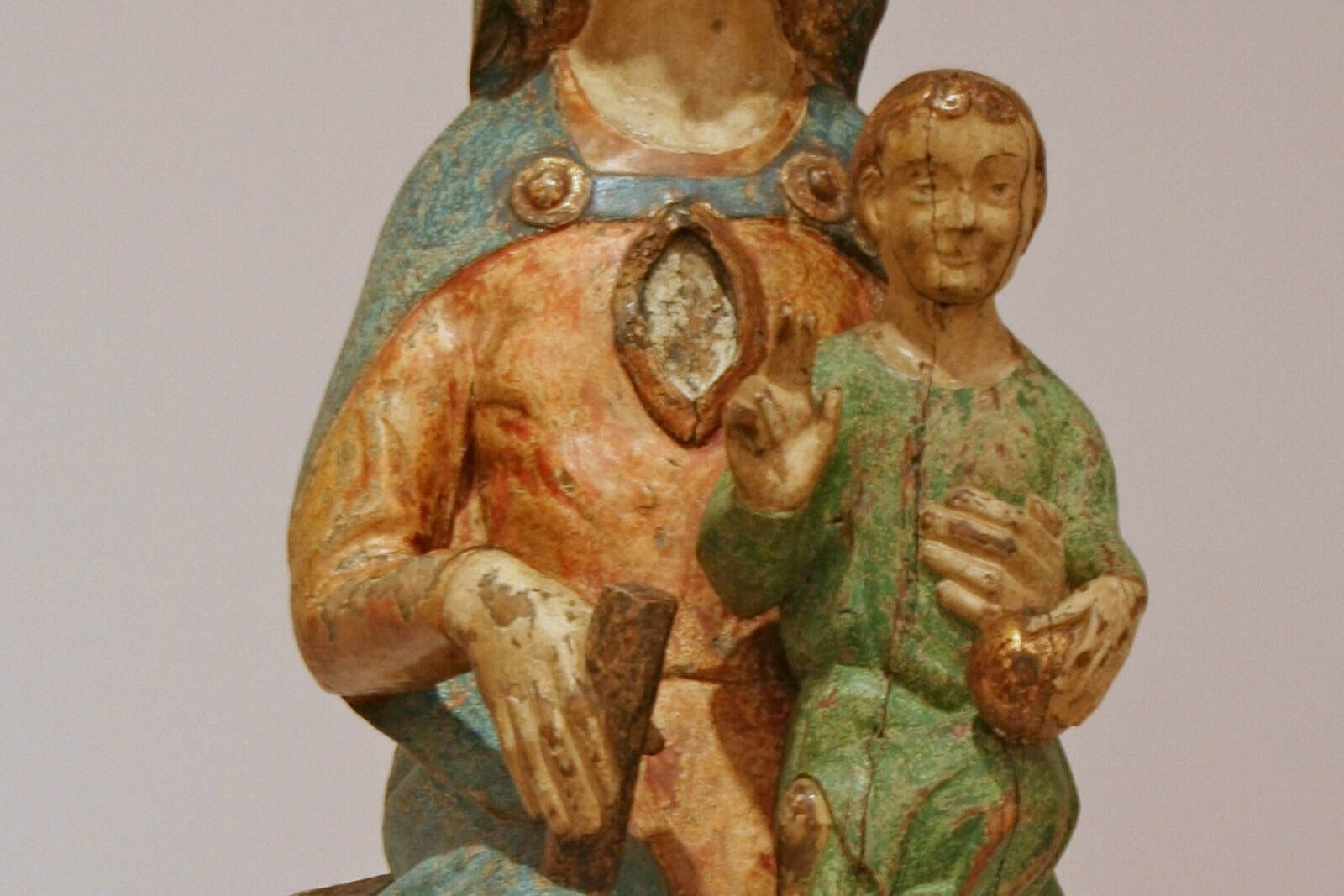
A late-13th-century Mosan Sedes Sapientiae in the Bonnefanten Museum. This is a comparative example, not the carving recovered from Meoz. Photograph: Ophelia2 / Wikimedia Commons (public domain).
Why the Attribution Matters to the Recovery
The identification appears to have begun with expert visual recognition. Neither the Interior Ministry release nor El País names an old inventory number, inscription, or photographic comparison used to confirm the match. That absence does not undermine the recovery, but it leaves the public evidentiary bridge incomplete: before the alert, the museum catalogue treated the work as Mosan and began its listed provenance in 1982, not in Meoz.
The disclosed timeline makes 1982 especially significant. It is the earliest named market appearance, only three years after the theft. The public record does not say what ownership documents accompanied the carving at Galerie Orphée, in the Antwerp collection, or during later transactions, and no source cited here accuses those owners or dealers of knowing it was stolen.
The case also shows why object-level documentation matters for church collections. Police place the theft within a wave targeting art-rich rural churches with limited security. Similar questions about inventories, custody, and identification remain central to Spain’s 2026 Valladolid church-art theft cases, even though the works and investigations are separate.
Recovery is therefore only one stage of stewardship. The carving’s water- and insect-related damage, mixed surface history, and missing elements make its future conservation and display conditions as consequential as the handover itself.
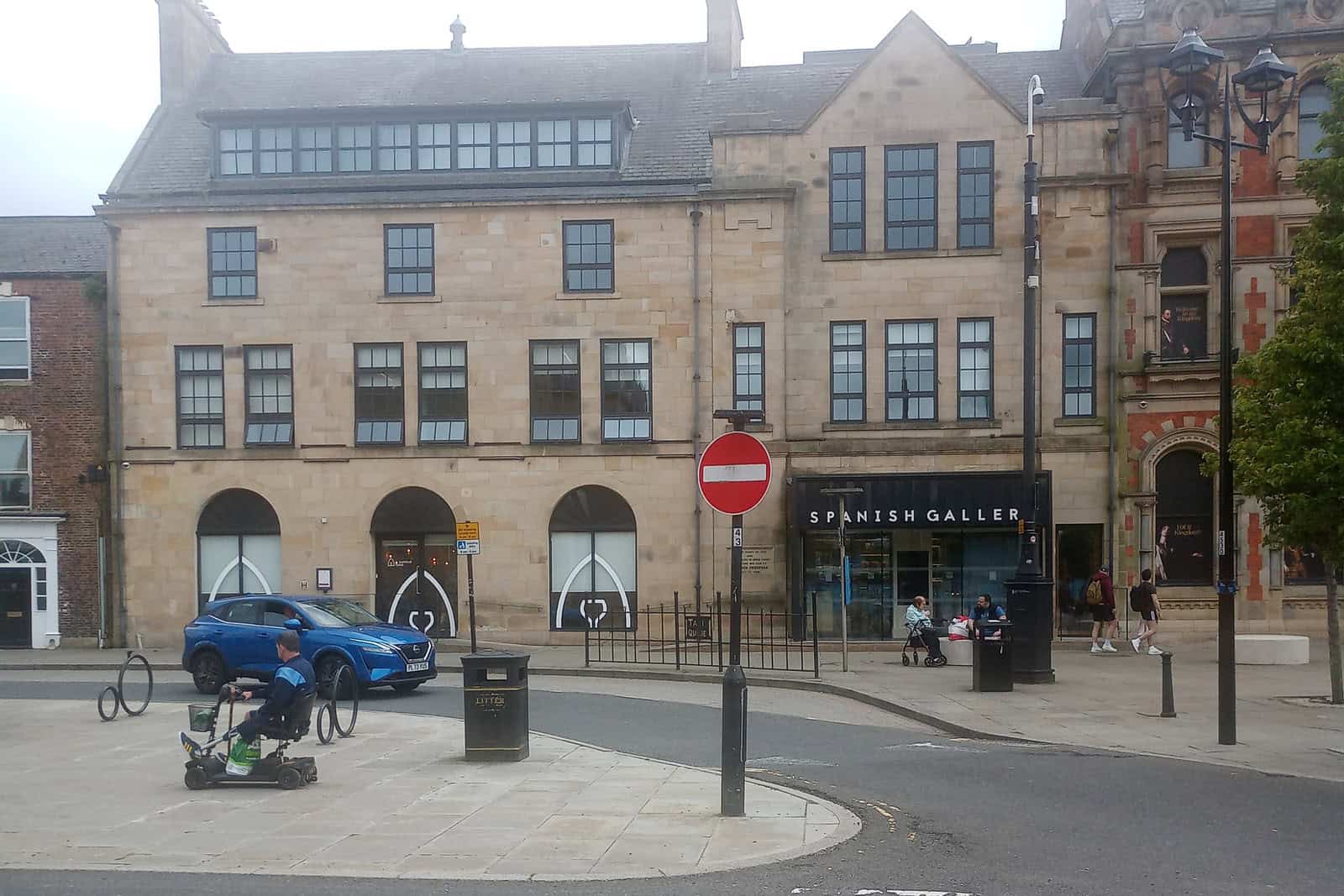
The Spanish Gallery in Bishop Auckland, where the carving was catalogued before its return to Spain. Photograph: Mainlymazza / Wikimedia Commons, CC BY-SA 4.0.
Spain Has the Carving, but Its Final Home Is Undecided
The physical return is established: two Spanish officers brought the work back, and it is now in Spain.
The Spanish Gallery’s 2024 catalogue establishes the more exact object identity now attached to the recovered carving: a walnut Sedes Sapientiae of about 1220–1250, probably made in the Mosan region, with a documented market trail beginning in 1982. It also supports Daniel Katz Ltd—not “Daniel Kanz,” as the EFE copy has it—as the named London dealer in 2017.
The Interior Ministry establishes the 1979 Meoz theft, the April 2026 investigative restart, the reported Maastricht appearance in 2020, and the voluntary surrender. It does not name the Maastricht fair or exhibitor.
No authority has yet announced whether the sculpture will return to Meoz, enter a Navarre institution, or go to another Spanish museum. A conservation plan and the documentary basis of the final identification have likewise not been made public.

Isabella studied at the University of Cape Town in South Africa and graduated with a Bachelor of Arts majoring in English Literature & Language and Psychology. Throughout her undergraduate years, she took Art History as an additional subject and absolutely loved it. Building on from her art history knowledge that began in high school, art has always been a particular area of fascination for her. From learning about artworks previously unknown to her, or sharpening her existing understanding of specific works, the ability to continue learning within this interesting sphere excites her greatly.
Her focal points of interest in art history encompass profiling specific artists and art movements, as it is these areas where she is able to really dig deep into the rich narrative of the art world. Additionally, she particularly enjoys exploring the different artistic styles of the 20th century, as well as the important impact that female artists have had on the development of art history.
Learn more about Isabella Meyer and the Art in Context Team.
Choose Art in Context as a preferred source to see more of our reporting in Google Top Stories and other Google Search experiences.
Cite this Article
Isabella, Meyer, “Stolen Meoz Virgin Returns to Spain After 47 Years.” Art in Context. November 23, 2026. URL: https://artincontext.org/meoz-virgin-recovered-spain-2026/
Meyer, I. (2026, 23 November). Stolen Meoz Virgin Returns to Spain After 47 Years. Art in Context. https://artincontext.org/meoz-virgin-recovered-spain-2026/
Meyer, Isabella. “Stolen Meoz Virgin Returns to Spain After 47 Years.” Art in Context, November 23, 2026. https://artincontext.org/meoz-virgin-recovered-spain-2026/.


