

Hilary Pecis – How Ordinary Places Become Vivid Portraits

Hilary Pecis paints crowded tables, lived-in rooms, neighborhood storefronts, and Southern California trails in saturated acrylic color. Her paintings begin with everyday observation but transform familiar scenes through compressed perspective, repeated pattern, and the slow accumulation of distinctive marks.
Key Takeaways
- Hilary Pecis is a Los Angeles-based American painter. Born in Fullerton, California, in 1979 and raised in Redding, she earned both her BFA and MFA from California College of the Arts.
- Her main subjects are still lifes, interiors, and landscapes. Flowers, books, textiles, artworks, pets, storefronts, palms, hills, and hiking trails recur across her paintings.
- She usually works from her own photographs. Pecis edits visual clutter, changes color, and reimagines perspective rather than treating a photo as a fixed image to copy.
- People are usually absent, but their lives remain visible. Objects, decorations, collections, and traces of activity function as indirect portraits of friends, family, and the artist herself.
- Color and pattern organize the picture. Opaque acrylic, strong outlines, tilted viewpoints, and competing decorative surfaces keep the eye moving across the canvas.
- Her work is held by major museums. Public collections include the National Gallery of Art, LACMA, MOCA Los Angeles, the Museum of Fine Arts Boston, and SFMOMA.
Who Is Hilary Pecis?
Hilary Pecis was born in Fullerton, California, in 1979 and grew up in Redding in the northern part of the state. She received a BFA from California College of the Arts in 2006 and an MFA from the same school in 2009. During her studies, she made conceptually oriented, collage-based work, although representational drawing and painting continued as a secondary practice. After graduate school, her focus shifted toward recognizable subjects.

Pecis has connected the transition to the birth of her son in 2012 and her move to Los Angeles. Still life and landscape offered open structures for pursuing composition, color, and mark-making. In Los Angeles, Pecis worked as a gallery registrar and painted around her job. Her 2017 exhibition at Joshua Liner Gallery was her first New York solo show. She became a full-time artist in early 2019, and additional studio space helped her paintings increase in scale.
What Makes a Hilary Pecis Painting Recognizable?
Pecis paints specific places without pursuing strict naturalism. A room may contain identifiable books and artworks, yet its floor tilts forward. A trail remains recognizable while color records remembered light more than neutral camera data.
- Saturated, opaque color: Bright greens, oranges, pinks, blues, and yellows often meet with limited tonal blending.
- Pattern across every surface: Wood grain, woven textiles, wallpaper, foliage, ceramics, book covers, and animal fur receive comparable attention.
- Compressed or tilted space: Tables and floors tip forward, letting objects spread across the picture rather than disappear into deep perspective.
- Bold contours and repeated marks: Lines separate forms while short strokes build leaves, reflections, fibers, and other textures.
- Evidence of absent people: A partly cleared meal, a stack of books, running medals, or a pet can suggest an owner without depicting a face.
- Art inside art: Paintings, prints, handmade objects, and open monographs allow other artists and makers to enter the composition.
The pictures are packed with information, but pattern draws foreground and background toward the same surface. Attention moves rhythmically between objects and marks rather than settling at one focal point.
How Hilary Pecis Makes a Painting
From Daily Photographs to a Quick Drawing
Pecis takes photographs of her home, friends’ interiors, streets encountered in Los Angeles, places visited while traveling, and landscapes seen during runs or hikes. The camera serves as a notebook. It preserves an arrangement or view that caught her attention, but the photograph does not determine the finished composition.

She begins with a quick drawing and retains many of its irregularities. While painting, she may remove distractions, replace objects, intensify hues, or adjust spatial relationships. The resulting “wonkiness” of perspective can survive from the first sketch.
Building Color, Negative Space, and Detail
Acrylic dries quickly and supports Pecis’s layered, opaque passages. She establishes large color areas before building components with smaller marks. Negative spaces, the areas around depicted objects, may be resolved late and become active shapes rather than filler.
Pecis does not rely on one decisive gesture. She revisits colors and moves among canvases when one becomes stuck. In recent interiors, patterns applied in an underlayer may be redrawn later, giving wood grain or fabric the weight of flowers and furniture.
Painting as Endurance
Pecis is also a committed distance runner, and the steady tempo of running provides a practical analogy for her studio process. Crown Point Press records her description: “I think of painting as an endurance activity, a series of small movements that add up to a finished piece”. Each leaf, letter, reflection, and patterned interval contributes to a cadence that emerges over time.

Still Lifes and Interiors as Indirect Portraits
Pecis rarely paints complete figures. She has explained that a face can seem inadequate as a summary of a person, while a room reveals interests, habits, and aspirations. Flowers indicate care or occasion; books name affinities; handmade objects preserve exchanges; a partly cleared table suggests recent activity.
Common things gain narrative value without becoming fixed symbols. A lamp, cup, or textile belongs to a particular life while also presenting a formal problem to paint.
An open book or framed painting introduces another palette, scale, and style. In Studio Table, a book opened to work by Gabriele Münter makes art history part of an active tabletop. Pecis has also named Alex Katz and Luc Tuymans as painters she admires for their confident marks, contrasting their decisiveness with her iterative approach.
Los Angeles Landscapes Seen on Foot
Pecis’s landscapes often begin during daily runs. Repeated routes make her attentive to details easily ignored from a car: handmade store signs, utility lines, palms rising above roofs, stairways, succulents, patches of shade, and the changing color of sunlit hills. Running supplies both subject matter and a sustained relationship to place. These paintings record personally encountered routes rather than all of Los Angeles.

A liquor store receives the same attention as a mountain view, placing ordinary commercial and residential spaces within the landscape genre. Run photographs may not capture what Pecis remembers about Southern California light. In paint, shadows become graphic shapes, hills intensify, and plants separate into legible marks. Memory supplements rather than replaces observation.
Color, Pattern, and Art-Historical Context
Pecis’s heightened palette places her in conversation with Fauvism, the early twentieth-century movement that used nonnaturalistic color as an independent expressive and structural force. Critics have also related her interiors to Édouard Vuillard and Maurice Denis, whose compressed rooms and decorative surfaces challenge conventional depth. Her all-over attention to textiles and ornament additionally recalls the Pattern and Decoration movement of the 1970s and 1980s.
These comparisons provide context rather than a formula. Books, posters, paintings, and crafts embed sources directly within Pecis’s images. A modernist reproduction and an anonymous flea-market picture can share a room and receive equally careful treatment.
Acrylic’s opacity lets colors meet with crisp boundaries while layered brushwork creates local texture. An image may appear flat at a distance, then disclose different densities of paint up close. Decoration is a means of construction, not an accessory.
Selected Paintings and Projects
Flea Market, 2021
Flea Market, now in the National Gallery of Art, is a 42-by-32-inch acrylic-on-linen painting. A lamp, decorative plate, books, glass objects, cups, and framed images fill a shallow interior. Pattern and implied history give each object comparable visual weight.
Malibu Trail, 2023
At 100 by 140 inches, Malibu Trail turns a hiking environment into an enveloping field organized through outlined shapes and repeated plant marks. It appeared in Paths Crossed, Pecis’s 2023 debut with David Kordansky Gallery.
Cowboy, 2024
Cowboy places a black-and-white cat amid a patterned interior. Fur, purple wood grain, furniture, and yarn compete for attention, while another room extends the inventory of surfaces. The animal provides a focal presence without simplifying the space.
Winter in LA, 2024
The panoramic Winter in LA measures 100 by 140 inches. Its title frames a season through local vegetation, light, and atmosphere rather than snow. In Warm Rhythm, it demonstrated how Pecis applies related methods to outdoor and domestic space.
Medals, 2026
The 77-by-92-inch Medals depicts a display commemorating Pecis’s races. Personal objects form a self-portrait without a body and make the running-painting analogy concrete: repeated acts accumulate into a record of effort.
Exhibitions, Public Projects, and Collections
Pecis’s public and institutional exhibition history includes The Space in Between at the Crisp-Ellert Art Museum in 2020, Art in Focus at Rockefeller Center in 2021, and Orbiting at TAG Art Museum in Qingdao in 2023. The Rockefeller Center project reproduced roughly 40 paintings as vinyl murals across the campus and included three mixed-media vitrines combining original paintings with hand-painted fabric and decals. Paths Crossed in 2023 emphasized landscapes; Warm Rhythm in 2024 concentrated on interiors; and Love Letters in 2026 united both through personally meaningful places, milestones, and activities.
Its indirect portraits extended from possessions to shared experiences. Although acrylic painting remains central, Pecis has also worked in printmaking. Crown Point Press published Geraniums and Camellias and Lemons and Camellias in 2025, both color aquatints using sugar-lift aquatint.
Aquatint is an etching process capable of printing tonal fields; sugar lift allows a drawn or brushed mark to retain a direct, painterly character. Her paintings are held in the permanent collections of the National Gallery of Art, LACMA, MOCA Los Angeles, Museum of Fine Arts Boston, SFMOMA, Columbus Museum of Art, Palm Springs Art Museum, and other institutions. Museum acquisition does not determine how a painting should be interpreted, but it places her close observations of contemporary domestic and urban life within a longer public history of still life and landscape.
Why Hilary Pecis’s Everyday Scenes Matter
Pecis treats ordinary visibility as a serious subject. Her paintings do not depend on spectacular events or remote destinations. They develop from the arrangements people make, the routes they repeat, and the objects through which relationships become legible.
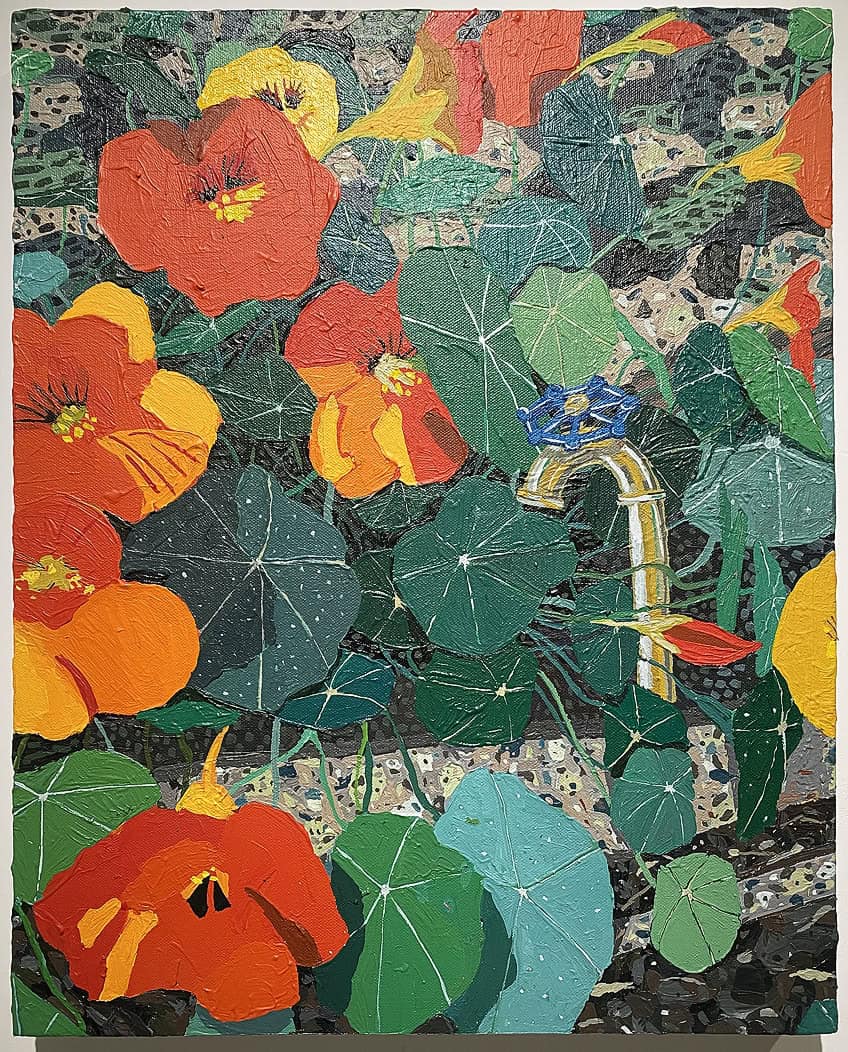
The work also demonstrates that accessibility and formal complexity can coexist. A viewer can recognize a cat, a vase, a liquor store, or a hillside immediately, then continue examining how the image resists conventional depth through color and pattern. Familiarity provides the entrance; sustained looking reveals how deliberately the everyday has been reconstructed.
Frequently Asked Questions
What Is Hilary Pecis Known For?
She is known for saturated acrylic paintings of still lifes, interiors, and Southern California landscapes. Her pictures combine bold color, dense pattern, distorted perspective, and details drawn from daily life.
What Medium Does Hilary Pecis Use?
Most of her paintings are acrylic on linen. She also makes drawings and has produced color aquatint prints with Crown Point Press.
Does Hilary Pecis Paint From Photographs?
Yes. She usually begins with photographs she takes herself, then changes color, perspective, objects, and visual detail while translating the scene into paint. The finished canvas is an interpretation rather than a literal copy.
Why Are People Often Absent From Her Paintings?
Pecis has explained that spaces and possessions can communicate a person’s interests, habits, and aspirations without reducing identity to facial appearance. Her interiors therefore function as indirect portraits.
Where Did Hilary Pecis Study?
She earned a BFA in 2006 and an MFA in 2009 from California College of the Arts in San Francisco.
Where Can You See Hilary Pecis’s Work?
Her work belongs to public collections including the National Gallery of Art, LACMA, MOCA Los Angeles, the Museum of Fine Arts Boston, and SFMOMA. Displays rotate, so visitors should consult each museum’s current listings before planning a visit.
Cite this Article
artincontext, , “Hilary Pecis – How Ordinary Places Become Vivid Portraits.” Art in Context. September 9, 2026. URL: https://artincontext.org/hilary-pecis/
, a. (2026, 9 September). Hilary Pecis – How Ordinary Places Become Vivid Portraits. Art in Context. https://artincontext.org/hilary-pecis/
, artincontext. “Hilary Pecis – How Ordinary Places Become Vivid Portraits.” Art in Context, September 9, 2026. https://artincontext.org/hilary-pecis/.