


Diego Velázquez – The Life and Art of Spanish Painter Velázquez

Diego Velázquez was the leading painter at the court of King Philip IV and one of the defining artists of the Spanish Golden Age. Baptized in Seville on June 6, 1599, he developed from a gifted painter of naturalistic kitchen scenes into a master of royal portraiture, history painting, and visual ambiguity. Diego Velázquez’s paintings combine close observation with increasingly economical brushwork, reaching their fullest expression in Las Meninas.
The Life and Career of Diego Velázquez
Diego Rodríguez de Silva y Velázquez built an exceptional career within the demanding world of the Spanish court. His relatively small surviving body of work ranges from Seville kitchen scenes and religious subjects to royal portraits, mythological paintings, and complex late masterpieces. His changing technique—and his ability to make rank, character, space, and light visible—helped make him a model for later realists, Impressionists, and modern artists.

Early Life and Training in Seville
Velázquez was born in Seville to Juan Rodríguez de Silva and Jerónima Velázquez and was baptized on June 6, 1599. His paternal family had Portuguese origins, while both parents belonged to Seville’s minor gentry. According to later accounts, his first artistic training may have been with Francisco de Herrera the Elder before he entered the workshop of Francisco Pacheco at about age 11.
The brief apprenticeship with Herrera rests largely on Antonio Palomino’s early-18th-century biography; Velázquez’s sustained, documented training was with Pacheco.
Pacheco was an established painter, teacher, writer, and artistic theorist. His workshop introduced Velázquez to drawing, perspective, religious iconography, classical learning, and Seville’s intellectual circles. Velázquez qualified as a master painter in 1617, giving him the professional standing to operate a workshop and accept commissions.

Velázquez married Juana Pacheco, his teacher’s daughter, on April 23, 1618. His early reputation rested partly on bodegones: kitchen or tavern scenes that unite still-life precision with carefully observed figures. Among artists from Spain, his An Old Woman Frying Eggs (1618) is an outstanding example of this new naturalism.
The forceful illumination and everyday models in these works connect Velázquez with the wider naturalist current associated with Caravaggio’s art, José de Ribera, and Seville’s polychrome sculpture.
In works such as Kitchen Scene with Christ at Emmaus (c. 1618) and Kitchen Scene with Christ in the House of Martha and Mary (1618), a humble foreground interior opens onto a biblical scene. The uncertain relationship between the two spaces—window, opening, reflection, or imagined event—already shows Velázquez testing how a painting can join ordinary life with sacred narrative.

The Virgin of the Immaculate Conception (c. 1618–1619) follows an iconographic model promoted by Pacheco, but Velázquez gives the Virgin a tangible presence, natural facial features, and varied surfaces. The combination of prescribed imagery and direct observation distinguishes his early religious painting.
Velázquez’s Move to Madrid and the Court
By the early 1620s, Velázquez had established himself in Seville. He first traveled to Madrid in 1622 with letters of introduction and painted a penetrating portrait of the poet Luis de Góngora, but he did not then secure a royal sitting. He returned in 1623 after the death of court painter Rodrigo de Villandrando created an opening.
Support from the royal chaplain Juan de Fonseca and the powerful Count-Duke of Olivares helped the young painter gain access to Philip IV.
Velázquez painted Philip IV in August 1623. The success of the portrait led to his appointment as painter to the king, beginning a relationship that lasted for the rest of the artist’s life. Some early royal portraits are lost, while the surviving likeness shown below was begun in this period and later reworked. These images established the controlled pose, restrained setting, and acute observation that shaped his court portraiture.

Philip’s approval brought Velázquez a salary, housing, and payment for completed works. He moved his household to Madrid in 1624 and steadily accumulated both artistic and administrative responsibilities. His winning entry in a 1627 competition depicted Philip III overseeing the expulsion of the Moriscos, a politically charged work now known only through descriptions.
The painting was destroyed in the 1734 fire at Madrid’s Alcázar, together with many other works. Its success nevertheless strengthened Velázquez’s standing and brought him the court position of usher of the chamber.
Velázquez’s rise depended not only on artistic skill but also on his ability to work within the court’s hierarchy, where offices, access, and patronage were closely connected.
Peter Paul Rubens visited Madrid on a diplomatic mission in 1628. Velázquez accompanied him to see Titian’s paintings in the royal collection, and Rubens’s example reinforced the younger artist’s interest in Venice, classical mythology, and the prestige of painting.

The encounter did not turn Velázquez into an imitator, but it broadened his ambitions. Soon afterward, he received permission and funding to study the art of major Italian painters firsthand.
Before leaving, Velázquez completed The Triumph of Bacchus, also known as Los Borrachos (1628–1629). The painting places the classical god among weathered contemporary drinkers, joining a mythological subject with the direct physical presence of his Seville bodegones.
Its mixture of idealized myth and ordinary life marks a transition: Velázquez retained his naturalism while absorbing the color, scale, and thematic range associated with Titian and Rubens.
Velázquez’s First Italian Journey
Velázquez traveled through Italy from 1629 to 1631, visiting Venice, Rome, and Naples among other centers. The journey allowed him to study Venetian color, classical sculpture, Renaissance composition, and contemporary Italian painting at close range. In Naples he painted Philip IV’s sister Maria Anna of Spain and probably met the Spanish-born painter José de Ribera.

The major works of this first Italian period include Apollo in the Forge of Vulcan (1630) and Joseph’s Tunic (1630). Both are ambitious history paintings in which news of a deception spreads through groups of life-sized figures. Carefully differentiated gestures, expressions, and bodies turn the instant of recognition into the real dramatic subject.
In Apollo in the Forge of Vulcan, Velázquez used a light, lead-white preparation instead of the darker grounds of many earlier works, contributing to a clearer and more luminous pictorial space.
Mature Court Painting
Velázquez returned to Madrid in January 1631 and entered an especially productive phase. He portrayed the royal family in formal, hunting, and equestrian settings, including the young Prince Baltasar Carlos. These images communicate dynastic authority while preserving the physical presence and individual character of their sitters.
For the new Buen Retiro Palace, Velázquez coordinated imposing royal portraits with a larger decorative program intended to project the power and continuity of Philip IV’s monarchy.
The equestrian portraits balance ceremonial grandeur with convincing movement and atmosphere. For the palace’s Hall of Realms, Velázquez also painted The Surrender of Breda (c. 1635), his best-preserved treatment of a recent historical event.

The composition commemorates the 1625 Spanish victory while avoiding a conventional image of humiliation. Ambrogio Spinola steps forward to receive the city’s keys from Justin of Nassau and prevents the defeated commander from kneeling. Lances, smoke, and distant terrain establish the military setting, but the courteous encounter between the two men becomes the painting’s emotional center.
Velázquez also portrayed the Count-Duke of Olivares, the royal favorite who helped launch his court career. In the Equestrian Portrait of the Count-Duke of Olivares (c. 1636), the minister appears as an active military commander. The dynamic diagonal pose differs sharply from the controlled bearing of the king’s equestrian portrait and gives Olivares a distinct political persona.

Mars Resting (c. 1638) transforms the god of war into a weary, middle-aged figure seated among discarded armor. The painting can be read as both mythological study and individualized portrait, with its tension between heroic identity and bodily fatigue left deliberately unresolved.
Rather than illustrating a single episode, Mars Resting uses an antiheroic body and ambiguous mood to test the boundary between classical myth and observed reality.
The Toilet of Venus, commonly called the Rokeby Venus (1647–1651), is Velázquez’s only surviving female nude. Venus is seen from behind while Cupid holds a mirror whose blurred reflection resists exact identification. Its unusual subject and restrained eroticism make the work exceptional within 17th-century Spanish painting.
Portraiture, Power, and Court Life
Velázquez repeatedly portrayed Philip IV, Queen Isabel of Bourbon, their children, and other members of the court. He adjusted pose, costume, scale, and setting to the sitter’s status, yet avoided disguising age or physical particularity. His portraits of court jesters and people with dwarfism, including Don Diego de Acedo, present named individuals with a psychological presence often denied to them in contemporary court culture. Velázquez received fewer religious commissions after moving to Madrid, but Christ Crucified (c. 1632) is a major exception.

Christ’s isolated body is set against darkness, with the lowered head and falling hair obscuring much of the face. The controlled silhouette, limited narrative detail, and restrained treatment of suffering give the image a meditative stillness. Meanwhile, Velázquez’s son-in-law Juan Bautista Martínez del Mazo developed his own court career and often assisted with portrait production. Philip IV increasingly assigned Velázquez administrative duties as well as artistic commissions.
In 1649, the king sent Velázquez to Italy to acquire paintings and classical sculpture casts for the royal collection and the decoration of Madrid’s Alcázar.
Velázquez’s Second Italian Journey
Velázquez left Spain in January 1649 with Juan de Pareja, his enslaved studio assistant. Traveling through Genoa, Milan, Venice, Modena, Florence, Naples, and Rome, he negotiated purchases and commissions for the king. He also painted commanding portraits, above all Portrait of Pope Innocent X (1650), whose brilliant reds, searching likeness, and concentrated pose make it a landmark of European portraiture.

The portrait’s apparent immediacy depends on deliberate control. Small shifts of crimson distinguish cap, chair, curtain, and robe, while loose marks resolve into fabric and flesh at normal viewing distance. This economical late manner is often described by the Spanish term manera abreviada, or abbreviated manner.
Velázquez’s likeness is frank without becoming caricature: the pope’s watchful expression, compressed hands, and surrounding red forms communicate both individual temperament and institutional authority.
In Rome, Velázquez painted Juan de Pareja (1650) and displayed the portrait at the Pantheon before painting the pope. Pareja had worked in his household and studio while enslaved. Velázquez signed a manumission deed on November 23, 1650, stipulating that Pareja’s freedom would take effect four years later. Pareja subsequently pursued an independent career as a painter. Velázquez was also admitted to Rome’s Accademia di San Luca. The two small View of the Garden of the Villa Medici paintings are now generally dated to around 1630, during his first Italian journey.

Their lightly brushed architecture, foliage, and shifting light make the Villa Medici views unusually direct landscape studies for their time. Alongside his painting, Velázquez commissioned casts and bronze versions of classical sculptures for the Hall of Mirrors in the royal palace. Records also indicate that he fathered a son named Antonio during this stay in Rome.
Return to Madrid and Late Court Painting
Philip IV repeatedly ordered Velázquez to return, and the artist reached Madrid in 1651. He brought paintings and hundreds of sculptural casts and models intended for the royal collection. The king had married Mariana of Austria after Isabel of Bourbon’s death, giving Velázquez a new generation of royal sitters, including Infanta Margarita Teresa and Prince Felipe Próspero.
Velázquez’s late paintings were produced amid expanding palace responsibilities, not in isolation from court life; his artistic authority and administrative rank advanced together.
In 1652, Velázquez became aposentador mayor de palacio, the palace lodging master. The office required him to organize royal quarters, furnishings, and ceremonial travel. Although it reduced his time for painting, several of his most ambitious and influential works belong to this final Madrid period.
The Creation of Las Meninas (1656)
Las Meninas (1656) is set in Velázquez’s studio in Madrid’s Alcázar. At its center stands the five-year-old Infanta Margarita Teresa, daughter of Philip IV and Mariana of Austria, attended by ladies-in-waiting and other members of the court household. Velázquez includes himself at work before a large canvas, while the king and queen appear in a mirror at the rear.

The picture captures a moment of interrupted activity: several figures turn toward the king and queen, whose position appears to overlap with that of the viewer. Doorway, mirror, canvases, gazes, and areas of illumination create a deep yet unstable space. Rather than supplying a single answer about who is being painted, Las Meninas makes seeing, representation, royal presence, and the social status of the artist part of its subject.
The painting’s lasting fascination comes from a carefully constructed uncertainty: the viewer can occupy the royal couple’s apparent position while also looking into a represented room from outside it.
Final Years and Death
Among Velázquez’s last major works is Las Hilanderas, or The Spinners (c. 1655–1660). A tapestry workshop fills the foreground, while the brighter background stage reveals the mythological contest between Arachne and Minerva. The layered construction makes labor, illusion, and artistic rivalry interact across two apparently different scenes.
The tapestry in the background draws on Titian’s Rape of Europa, known to Velázquez through the royal collection and Rubens’s painted copy, linking the myth to a lineage of artistic emulation.
Velázquez’s final portraits of the royal children are among his most refined works. In Infanta Margarita Teresa in a Blue Dress (1659), flickering strokes of blue, silver, and pink describe satin, lace, and light. At close range the marks remain visibly abbreviated; from farther away they cohere into a convincing figure and surrounding atmosphere.

Portrait of Prince Philip Prospero (1659) presents the young heir with ceremonial dignity while acknowledging his vulnerability. Red and white costume, protective charms, dark furnishings, and the small dog create contrasts of splendor, intimacy, and unease. The prince died in 1661 at age four, a year after Velázquez.
Both late portraits demonstrate how a few fluid marks can describe elaborate dress without sacrificing the sitter’s presence, a central achievement of Velázquez’s abbreviated technique.

In 1659, after an inquiry into his lineage and a papal dispensation, Velázquez was admitted to the Order of Santiago. The following year he organized the Spanish lodgings and ceremonial display for the meeting at the Isle of the Pheasants, where Maria Teresa of Spain married Louis XIV of France. He returned to Madrid exhausted, became ill, and died on August 6, 1660. Juana Pacheco died a few days later.
The Legacy of Diego Velázquez’s Artworks
Velázquez left a relatively small surviving oeuvre and few securely attributed drawings. His influence nevertheless extends far beyond the Spanish court. Juan Bautista Martínez del Mazo continued aspects of his portrait practice, and workshop replicas were sometimes later confused with originals. Changing attributions remain important because Velázquez’s apparently effortless surfaces are difficult to imitate convincingly.
His reputation grew especially strongly from the late 18th century onward, when artists began studying not only his royal subjects but also the freedom and economy of his brushwork.
Francisco Goya made etchings after paintings by Velázquez in the royal collection in 1778 and drew on his example throughout his career. Édouard Manet and later realists and Impressionists admired his tonal restraint, open backgrounds, and ability to suggest form with visible marks. In 1957, Pablo Picasso created an extensive series of reinterpretations of Las Meninas, using Velázquez’s composition to explore modern painting, artistic lineage, and the instability of representation.
Diego Velázquez’s Painting Technique and Style
Velázquez’s style changed substantially across his Seville training, court career, and two Italian journeys. He rarely signed or dated paintings, so scholars combine documents, provenance, materials analysis, and stylistic comparison when establishing chronology and authorship. His development was not a simple break between early detail and late looseness; he adjusted method to a work’s scale, purpose, and viewing distance.
His early paintings use strong light-dark contrasts, solid modeling, and close attention to texture. Exposure to Titian, Rubens, classical sculpture, and Italian painting encouraged lighter preparations, more spacious compositions, and increasingly varied handling. Yet direct observation remained central, whether the subject was an egg, a court official, a mythological figure, or reflected light in a palace room.

Velázquez worked with the standard pigments available to a 17th-century court painter, including lead white, earth colors, black, vermilion, azurite, smalt, and red lake. Technical studies show dark earth preparations in early Seville works and lighter grounds in important paintings from and after the first Italian journey. These choices affected luminosity, color relationships, and the speed with which he could revise a form.
In late paintings, broken highlights and abbreviated strokes create convincing faces, textiles, and atmosphere when seen from the intended distance. This economy was highly controlled rather than unfinished. Secure preparatory drawings are rare, while technical imaging frequently reveals pentimenti—changes to contours, placement, or pose made directly during painting.
Velázquez’s method was flexible: he could build an early figure with dense, opaque layers or make a late form emerge from a few precisely placed strokes over a light ground.
Famous Paintings by Velázquez
- Old Woman Frying Eggs (1618)
- The Supper at Emmaus (1622–1623)
- The Triumph of Bacchus (1628–1629)
- The Surrender of Breda (1635)
- The Toilet of Venus (Rokeby Venus) (1647–1651)
- Portrait of Innocent X (1650)
- Las Meninas (1656)
- Las Hilanderas (The Spinners) (c. 1655–1660)

Further Reading
These books offer two different ways to continue exploring Diego Velázquez: a comparative study for adult readers and a concise, image-led introduction for younger audiences. Check the edition details and intended reading level before purchasing.
Rembrandt and Velázquez: Dutch and Spanish Masters (2020)
This exhibition catalog places works by Velázquez and Rembrandt in thematic pairings and expands the comparison to contemporaries such as Zurbarán, Hals, Valdés Leal, and Ribera. Essays examine religion, wealth, love, social position, light, and pictorial construction across the Dutch Republic and Spain.
The two painters did not meet, and their artistic environments differed substantially. The book is most useful when it treats their similarities and contrasts as questions rather than evidence of direct exchange. It suits readers interested in comparative art history, museum scholarship, and high-quality reproductions.

Diego Rodríguez De Silva Y Velázquez (Art for Children) (1988) by Ernest Lloyd Raboff
This short, illustrated volume introduces Velázquez’s life and discusses 15 paintings in language intended for younger readers. Its reproductions and focused explanations make it a practical starting point for families or classrooms, though readers seeking current scholarship will want to supplement this older publication with a recent museum catalog.
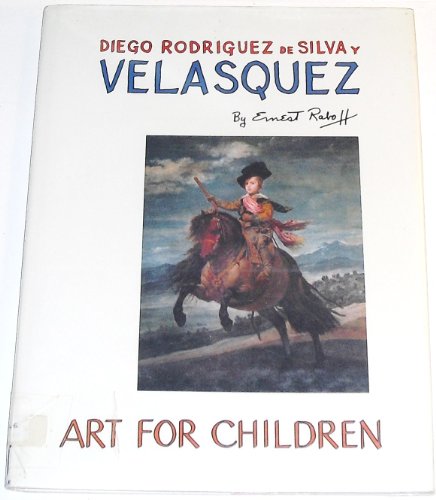
- A brief biography of the 17th-century Spanish painter Velázquez
- With 15 color reproductions and critical interpretations of his works
- Teaches young students how to examine a piece of art
Velázquez transformed close observation into a language flexible enough for kitchens, myths, royal ceremony, and the uncertain space of Las Meninas. His influence rests not on a simple label such as realism or Impressionism, but on the continuing challenge his paintings pose: a few marks can appear spontaneous while organizing complex relationships among light, status, presence, and the act of looking.
Frequently Asked Questions
What Is Diego Velázquez Famous For?
Diego Velázquez is famous for Las Meninas, his portraits of Philip IV’s court, and a painting technique that joins precise observation with economical brushwork. His early bodegones give unusual prominence to everyday people and objects, while later portraits and history paintings explore rank, personality, light, and space. Artists including Goya, Manet, and Picasso studied and reinterpreted his work.
What Is Happening in Las Meninas?
Las Meninas shows Infanta Margarita Teresa and members of her household in Velázquez’s studio as they respond to the apparent presence of Philip IV and Mariana of Austria, reflected in a rear mirror. Velázquez depicts himself beside a large canvas, but its subject is hidden. The arrangement makes the viewer’s position uncertain and turns a court scene into an investigation of vision, representation, and artistic status.
Who Was Juan de Pareja?
Juan de Pareja was an enslaved studio assistant in Velázquez’s household who later became an independent painter. Velázquez portrayed him in Rome in 1650 and displayed the work publicly before painting Pope Innocent X. A manumission deed signed that November required Pareja to continue serving for four more years, so his freedom took effect in 1654. His surviving paintings demonstrate a career distinct from his former enslaver’s.

Isabella studied at the University of Cape Town in South Africa and graduated with a Bachelor of Arts majoring in English Literature & Language and Psychology. Throughout her undergraduate years, she took Art History as an additional subject and absolutely loved it. Building on from her art history knowledge that began in high school, art has always been a particular area of fascination for her. From learning about artworks previously unknown to her, or sharpening her existing understanding of specific works, the ability to continue learning within this interesting sphere excites her greatly.
Her focal points of interest in art history encompass profiling specific artists and art movements, as it is these areas where she is able to really dig deep into the rich narrative of the art world. Additionally, she particularly enjoys exploring the different artistic styles of the 20th century, as well as the important impact that female artists have had on the development of art history.
Learn more about Isabella Meyer and the Art in Context Team.
Cite this Article
Isabella, Meyer, “Diego Velázquez – The Life and Art of Spanish Painter Velázquez.” Art in Context. November 23, 2021. URL: https://artincontext.org/diego-velazquez/
Meyer, I. (2021, 23 November). Diego Velázquez – The Life and Art of Spanish Painter Velázquez. Art in Context. https://artincontext.org/diego-velazquez/
Meyer, Isabella. “Diego Velázquez – The Life and Art of Spanish Painter Velázquez.” Art in Context, November 23, 2021. https://artincontext.org/diego-velazquez/.


