

Charles Le Brun’s Long-Missing Holy Family Returns to Potsdam

Charles Le Brun’s long-missing Holy Family physically returned to Potsdam on November 18, 2026, more than 81 years after it was last documented at Rheinsberg Palace. The handover closes the recovery case but opens two harder ones: the folded canvas needs substantial conservation, and its relationship to Le Brun’s signed Louvre version remains unsettled.
A Return to Potsdam, Not Yet to the Wall
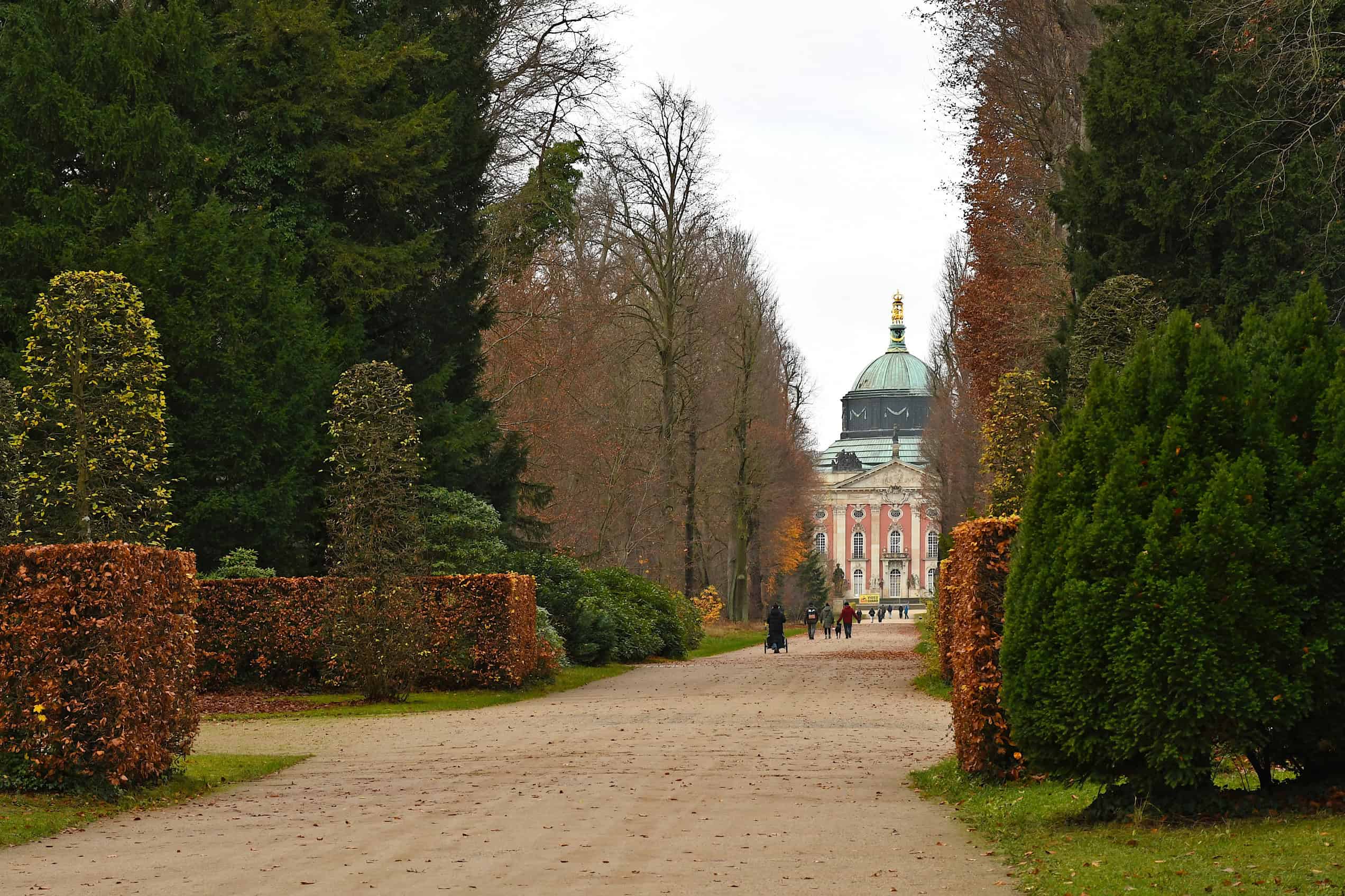
The 88-centimeter oil-on-canvas tondo, cataloged as Heilige Familie or Le sommeil de l’enfant Jésus and dated to about 1655, was presented with its surviving gilded ornamental frame at the New Palace in Potsdam. It was then transferred to the conservation studios of the Prussian Palaces and Gardens Foundation Berlin-Brandenburg, or SPSG, according to the foundation’s November 18 announcement.
That sequence matters. The painting has returned to the SPSG and was physically reunited with its historical setting, but it has not returned to permanent public display. The foundation says that, after restoration, it is intended for the writing cabinet in the Upper Princes’ Quarters, in the frame that remained in Potsdam. The unrepaired painting is on view in the Green Damask Chamber until spring 2027; restoration is scheduled to begin in May, with picture and frame planned for their original site in 2028.
Deutschlandfunk Kultur independently confirmed the completed Wednesday handover. The SPSG says the recovery followed lengthy negotiations with the Canadian buyer, supported by the Ernst von Siemens Art Foundation and the Friends of the Prussian Palaces and Gardens. Its announcement does not disclose a price, the structure of the settlement, or whether money changed hands. The settlement amount and structure remain undisclosed, though Tagesspiegel reports that the two supporting organizations raised money for the return.

The Provenance Record Goes Blank After 1945
The painting’s modern path is unusually precise at its endpoints and blank in the middle.
| Date | What is documented |
|---|---|
| 1942 | Moved from the New Palace to Rheinsberg Palace for wartime safekeeping. |
| July 30, 1945 | Last recorded at Rheinsberg; its trail then disappears. |
| 2021 | Appeared at a Berlin auction house. The Canadian buyer later contacted the SPSG. |
| November 18, 2026 | Presented in Potsdam and transferred to SPSG conservation. |
This chronology establishes loss, rediscovery, and return; it does not establish the painting’s complete chain of custody. The SPSG has not identified the person who removed the canvas from Rheinsberg, the route by which it reached the auction market, the auction house, or its holders between 1945 and 2021. The Canadian buyer should not be conflated with the unknown person who removed it: the official account says only that the buyer acquired it at auction and approached the foundation.
Frederick II had acquired the painting for the newly built New Palace and placed it in a cabinet in one of the apartments for princely guests. That earlier collection history explains why physical return matters, but it does not fill the postwar gap.

Rheinsberg Palace, where the painting was last documented in 1945. Photograph by Peter Seifert, DE, via Wikimedia Commons, licensed under CC BY-SA 4.0.
The Louvre Version Makes Attribution the Central Question
The composition belongs securely to Le Brun’s invention; the unresolved issue is who executed the Potsdam canvas and when. Le Brun, court painter to Louis XIV, occupies a central place in French Baroque painting, yet the SPSG notes that his work is comparatively scarce in German museums.
The fixed reference point is the Louvre’s rectangular Le Sommeil de l’Enfant Jésus ou Le Silence. The museum’s permanent collection record identifies an 87-by-118-centimeter oil on canvas signed and dated “C.L.B. F. 1655.” It expands the group around the sleeping Christ Child into a domestic interior, with a fireplace, a cat, and a view into adjoining space. The Potsdam painting compresses the group into a circular field.
The Louvre record currently summarizes Jacques Thuillier’s hypothesis that the round Potsdam composition was a copy or replica made for Nicolas Fouquet. The SPSG’s 2026 assessment advances a different possibility: although the tondo was long treated as a workshop replica, perhaps with Le Brun’s participation, its quality may indicate an earlier, original version made before the signed Louvre painting. “May” is decisive. The SPSG has announced a research question, not a new attribution.
A squirrel tucked into the crook of the young John the Baptist’s arm is the strongest clue to patronage. It was Fouquet’s heraldic animal, and the finance minister used the emblem in his residences, including Vaux-le-Vicomte, where Le Brun directed decoration from 1658. The SPSG therefore considers Fouquet a very likely commissioner.
The emblem is less conclusive as a test of authorship. The Louvre catalog notes another round version on vellum by François Chauveau that also includes the squirrel, while technical study of the Louvre painting found no hidden squirrel there. The animal connects the round design to Fouquet, but it cannot by itself establish that Le Brun painted the Potsdam canvas or that the tondo came first.

Charles Le Brun portrayed by Nicolas de Largillière. Image via Wikimedia Commons, marked Creative Commons Public Domain Mark 1.0.
Why the Folded Canvas Changes the Research
SPSG conservator Mechthild Most has described the canvas as torn from its stretcher, marked by two fold lines and altered by crude repairs and a brown overpaint. The SPSG says current photographs and a conservation report prepared in Canada show that the canvas was removed from its stretcher and folded when it was taken from Rheinsberg. The foundation expects extensive restoration, but it has not published a detailed condition map identifying particular tears, paint losses, old repairs, or the number and direction of folds.
That distinction prevents a conservation risk from becoming a reported diagnosis. Canadian Conservation Institute guidance explains that physical force can cause distortions or tears in canvas and cracking or loss in paint layers. Those are the kinds of damage conservators must look for; the SPSG has not yet said which are present here.
Conservation now has an evidentiary role as well as a stabilizing one. A condition survey must distinguish deformation caused by folding from original materials and later interventions before differences in brushwork can carry much weight in an attribution. In this case, treatment and connoisseurship cannot be separated: a compromised surface may conceal quality, while an old repair may imitate a change of hand.
The intact historical frame offers the endpoint. Once the canvas is stable and the research is complete, the SPSG intends to reinstall it in the New Palace. Until then, “returned” describes custody and location, not readiness for display.
What the Return Establishes
The completed handover establishes that the 88-centimeter tondo is back with the SPSG and in conservation, not yet back on permanent view. Foundation records anchor its movements in 1942, 1945, 2021, and 2026 while leaving the intervening ownership history unresolved.
The signed Louvre painting remains the secure 1655 benchmark. The Louvre catalog’s copy-or-replica hypothesis and the SPSG’s new earlier-version hypothesis now frame the question that object-based study will investigate. The squirrel makes Fouquet’s patronage highly likely, but it does not prove Le Brun’s hand. The settlement amount and final attribution remain unresolved, while temporary display, restoration and reinstallation milestones are now set for spring 2027, May 2027 and 2028.

Isabella studied at the University of Cape Town in South Africa and graduated with a Bachelor of Arts majoring in English Literature & Language and Psychology. Throughout her undergraduate years, she took Art History as an additional subject and absolutely loved it. Building on from her art history knowledge that began in high school, art has always been a particular area of fascination for her. From learning about artworks previously unknown to her, or sharpening her existing understanding of specific works, the ability to continue learning within this interesting sphere excites her greatly.
Her focal points of interest in art history encompass profiling specific artists and art movements, as it is these areas where she is able to really dig deep into the rich narrative of the art world. Additionally, she particularly enjoys exploring the different artistic styles of the 20th century, as well as the important impact that female artists have had on the development of art history.
Learn more about Isabella Meyer and the Art in Context Team.
Choose Art in Context as a preferred source to see more of our reporting in Google Top Stories and other Google Search experiences.
Cite this Article
Isabella, Meyer, “Charles Le Brun’s Long-Missing Holy Family Returns to Potsdam.” Art in Context. November 19, 2026. URL: https://artincontext.org/charles-le-brun-holy-family-returns-potsdam/
Meyer, I. (2026, 19 November). Charles Le Brun’s Long-Missing Holy Family Returns to Potsdam. Art in Context. https://artincontext.org/charles-le-brun-holy-family-returns-potsdam/
Meyer, Isabella. “Charles Le Brun’s Long-Missing Holy Family Returns to Potsdam.” Art in Context, November 19, 2026. https://artincontext.org/charles-le-brun-holy-family-returns-potsdam/.


