

Bayeux Tapestry Report Finds Two Tiny Fiber Breaks

The initial post-transfer assessment of the Bayeux Tapestry records two new fiber breaks only a few millimeters long, but its authors could not determine whether they occurred during packing, transit, or installation. The same assessment identifies a separate problem—new hollows caused by the flat display support—which matters for the artwork’s planned inclined-table presentation after its 2027 return to Bayeux.
Two Tiny Breaks, but No Proven Transport Cause
The Bayeux Tapestry is not woven tapestry but an embroidery of colored wool on linen. Made in the 11th century and extending nearly 70 meters, it turns the Norman conquest of England into one of the defining narrative works of medieval art. That scale and the different functions of its wool stitches, linen ground, later backing, and display hardware also make its condition unusually difficult to describe with a single verdict.
The artwork left Bayeux on July 9, 2026, and reached the British Museum early on July 10. The French Culture Ministry said it traveled in a custom climate-controlled, anti-vibration crate. A joint French-British examination began after the Tapestry arrived, and the 53-page assessment, which also addresses its late-August installation, was made public on November 26.
The assessment, as detailed by Télérama, describes two distinct fiber failures in areas that were already weak. Each affected segment is no more than a few millimeters long. Le Figaro reports that one change involved red wool in an embroidered area and the other the linen ground; the experts said they could not determine whether the changes happened during July packing, the road journey, or the late-August installation in the display case.
That uncertainty rules out a stronger causal claim. Le Parisien framed the embroidery as slightly damaged during transport. But Le Figaro’s quotation from the assessment says the stage at which the changes occurred cannot be fixed. “Found after the transfer” is supported; “caused by the road journey” is not.
The scale is reassuring only in a narrow sense. A 2020 condition survey, summarized by the French Culture Ministry, had already catalogued 24,204 stains, 16,445 creases, 9,646 losses in the linen or embroidery, and 30 unstabilized tears. The new assessment says the most concerning pre-existing alterations did not move. It does not turn a fragile object into a sound one; it records two minute progressions against a heavily documented baseline.

What the 2022 Risk Study Predicted
A useful comparison is the ministry’s March 2022 transport feasibility study. It called the worsening of tears and fiber breaks a major risk and analyzed crushing, vibration, folds, and uneven support. The authors also stressed that their proposals were theoretical and required further testing, so the document is a risk map rather than a blueprint of the final London installation.
| 2022 risk or safeguard | 2026 finding |
|---|---|
| Fiber rupture was identified as a major vulnerability. | Two millimeter-scale breaks appeared in already weakened zones. |
| Separators and foam were specified to prevent crushing between support panels. | The published assessment calls the overall condition stable and does not identify a major crushing event. |
| Foam interfaces were intended to prevent added folds and deformation. | New hollows now require monitoring for possible deformation. |
| Plastazote foam was meant to compensate for level changes between frame and panel. | Hollows appeared where foam did not compensate for backing thickness and at panel joins. |
The comparison does not prove that a predicted failure simply occurred: the final apparatus and procedures were developed after the 2022 study. It shows that uneven support was already recognized as a risk in the 2022 transfer design, although the London hollows appeared on a later display system. A long, delicate textile needs continuous support, and small changes in level can become visible changes in its surface.
The French Culture Ministry’s footage shows the custom crating, escort, and controlled journey that prose can only summarize.
Those precautions addressed shock, vibration, climate, and handling during a journey of hours. The new hollows raise a different question about what happens while the embroidery rests on a display system for months.
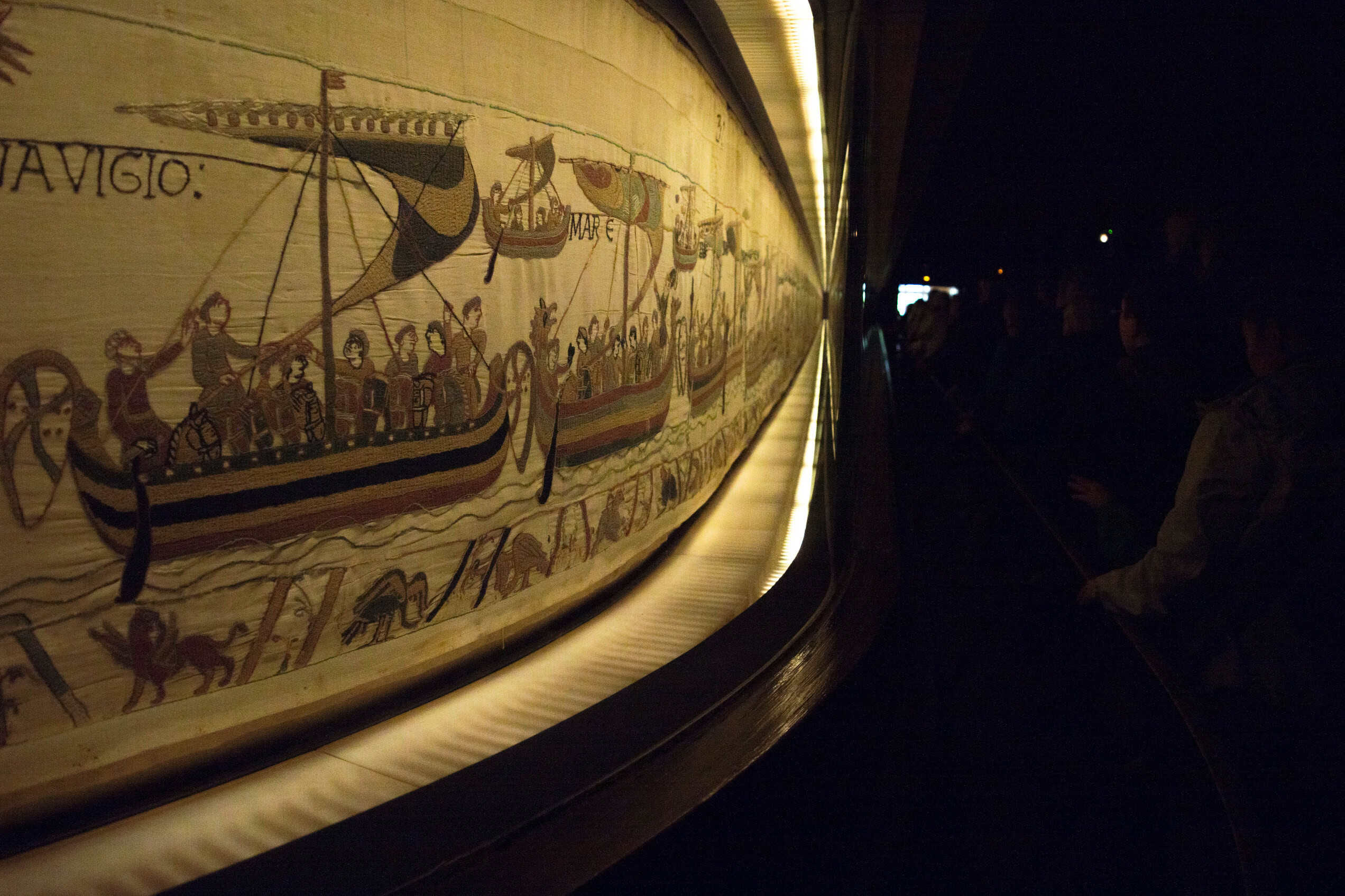
The Bayeux Tapestry in its former Bayeux museum display. Photograph by Supercarwaar via Wikimedia Commons, licensed under the Attribution-Share Alike 4.0 International license. Cropped.
Why the New Hollows Change the Conservation Question
The assessment explicitly separates the hollows from transport. They appeared where Plastazote, a closed-cell polyethylene foam used in conservation, did not make up the thickness of the remaining backing and at junctions between support panels. The experts recommend watching those areas to determine whether an intervention is needed to prevent deformation.
That wording matters. A hollow is an observed change in shape, not a finding of irreversible damage. The report does not say the textile has permanently deformed, and it does not yet prescribe treatment. It identifies a mechanism, a location, and a monitoring decision.
One fiber change involved the colored wool that makes the image; the other involved the linen field carrying that image. A close view of the battle scenes makes the relationship visible: wool stitching builds figures and movement across a much older structural ground.
The shift away from the former suspended display addresses tensions that earlier surveys found in the linen. Yet a flat or inclined orientation introduces its own demand: the surface beneath the textile must follow its changing thickness without leaving unsupported gaps. The London findings therefore do not reverse the case for horizontal presentation. They show what the support must control.
That is directly relevant to Bayeux. The Culture Ministry’s June 2026 museum plan describes a full-length multifunction table that can tilt for display, lie horizontal, and turn the embroidery over for study and restoration. The newly documented hollows give the returning condition survey a specific pattern to check, but the published assessment does not say whether the Bayeux table will need any design change.
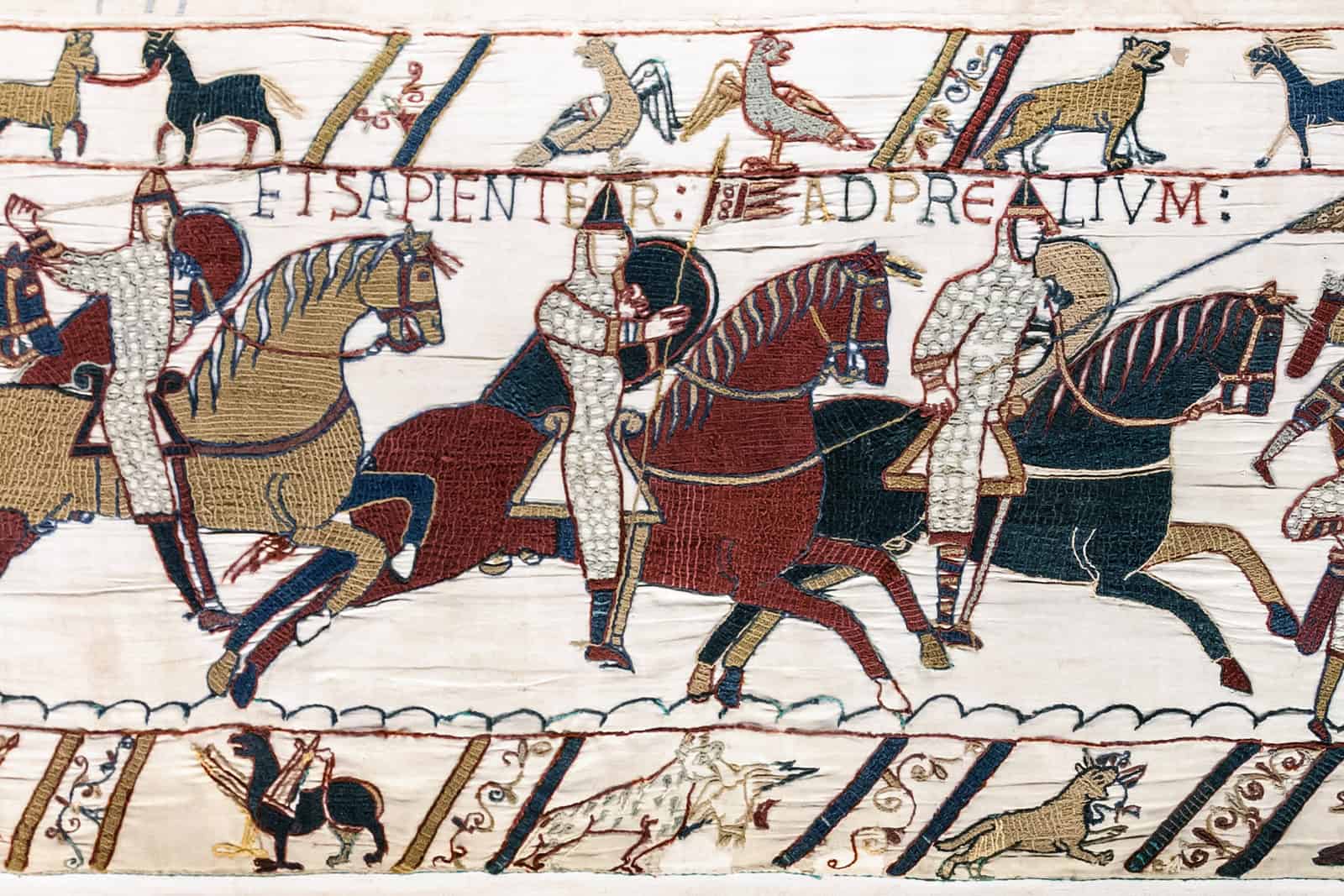
A Battle of Hastings scene from the Bayeux Tapestry. Photograph by Myrabella via Wikimedia Commons, dedicated under the CC0 1.0 Universal Public Domain Dedication. Cropped.
The 2027 Return Will Be the Next Test
The Franco-British administrative arrangement keeps the public exhibition in London through July 2027 and requires the Tapestry to return to Bayeux no later than September 1. It also provides for a return condition assessment after the work is reinstalled horizontally.
That future examination will answer a question the November report cannot: whether the two tiny breaks remain static and whether the hollows stabilize, deepen, or disappear when the support changes. Until then, “satisfactory overall condition” is a dated assessment, not a guarantee for the rest of the loan.
Restoration is planned after the return, using the new table to provide access to both front and back. The immediate unresolved decision is narrower: whether monitoring in London shows that the support-related hollows need intervention before the exhibition closes.
Two Breaks, New Hollows, and One Open Decision
The final assessment establishes that two fibers progressed by only a few millimeters in zones already known to be weak, while the most concerning pre-existing alterations remained stable. Its authors do not establish that road transport caused those breaks, because packing, transit, and installation cannot be separated as the moment of change.
The assessment attributes the new hollows to the flat support rather than the journey and calls for monitoring before any intervention is chosen. What remains unknown is whether those hollows will develop into deformation and whether the Bayeux support will reproduce—or eliminate—the same pattern after the Tapestry returns in 2027.

Isabella studied at the University of Cape Town in South Africa and graduated with a Bachelor of Arts majoring in English Literature & Language and Psychology. Throughout her undergraduate years, she took Art History as an additional subject and absolutely loved it. Building on from her art history knowledge that began in high school, art has always been a particular area of fascination for her. From learning about artworks previously unknown to her, or sharpening her existing understanding of specific works, the ability to continue learning within this interesting sphere excites her greatly.
Her focal points of interest in art history encompass profiling specific artists and art movements, as it is these areas where she is able to really dig deep into the rich narrative of the art world. Additionally, she particularly enjoys exploring the different artistic styles of the 20th century, as well as the important impact that female artists have had on the development of art history.
Learn more about Isabella Meyer and the Art in Context Team.
Choose Art in Context as a preferred source to see more of our reporting in Google Top Stories and other Google Search experiences.
Cite this Article
Isabella, Meyer, “Bayeux Tapestry Report Finds Two Tiny Fiber Breaks.” Art in Context. November 27, 2026. URL: https://artincontext.org/bayeux-tapestry-condition-report-fiber-breaks-hollows/
Meyer, I. (2026, 27 November). Bayeux Tapestry Report Finds Two Tiny Fiber Breaks. Art in Context. https://artincontext.org/bayeux-tapestry-condition-report-fiber-breaks-hollows/
Meyer, Isabella. “Bayeux Tapestry Report Finds Two Tiny Fiber Breaks.” Art in Context, November 27, 2026. https://artincontext.org/bayeux-tapestry-condition-report-fiber-breaks-hollows/.


