


Antony Gormley – How a Body Becomes a Measure of the World

Antony Gormley uses the human body not primarily as an image to be admired, but as a tool for testing space. From hollow lead cases and crowds of clay figures to monumental public works and immersive installations, his sculptures ask how it feels to inhabit a body within architecture, landscape, and a changing planet. Familiar works such as Angel of the North belong to a much broader investigation of presence, absence, material, and collective experience.
Key Takeaways
- Born in London in 1950, Gormley studied archaeology, anthropology, and art history before training at Saint Martin’s, Goldsmiths, and the Slade School of Fine Art.
- He began using his own body as a “life reference” in the early 1980s, but he does not treat the resulting sculptures as conventional self-portraits.
- His sculptural language ranges from bread, lead, and solid cast iron to stainless-steel rods, geometric blocks, fog, architectural chambers, and participatory actions.
- Major works including Field for the British Isles, Angel of the North, Another Place, and Event Horizon shift attention from a single object to the relationship among bodies, viewers, and sites.
- He received the Turner Prize in 1994, was knighted in 2014, and was appointed a Companion of Honour for services to art in 2025.
Who Is Antony Gormley?
Gormley was born in London in 1950. Before entering art school, he studied archaeology, anthropology, and art history at the University of Cambridge. He then traveled through Asia and spent an extended period in India, where he practiced Vipassana meditation. He has identified that encounter with disciplined stillness and inward attention as crucial to his later understanding of the body. Back in London, he studied at Saint Martin’s School of Art, Goldsmiths, and the Slade, completing postgraduate study in sculpture in 1979.

This combination of archaeological thinking, material experiment, and meditation helps explain why his work differs from both anatomical modeling and expressive portraiture. He approaches the body as an experienced place: the first volume each person occupies and the point from which the wider world is sensed. Gormley emerged alongside the renewed attention to sculpture in Britain during the 1980s, but his sources extend beyond that immediate context. Prehistoric monuments, Buddhist practice, land art, and Joseph Beuys’s idea of art as a social process all inform his thinking. These references do not appear as illustrative subjects. They shape his questions about material transformation, shared authorship, and what sculpture can do outside the museum.
Why He Uses His Own Body
Gormley’s repeated use of his own dimensions can be mistaken for autobiography. He instead describes his body as a found object and a practical measure available to him. During the casting process, he holds a chosen position while assistants wrap sections of his body in plaster-soaked scrim.
Once hardened, the mold is cut away, reassembled, and translated into another material or construction system.
The process begins with a specific person at a specific moment, but facial details, expression, clothing, and individual narrative are usually suppressed. What remains is evidence of occupied space: a crouch, a standing posture, a bend, or a prone body. The viewer encounters a trace of embodiment rather than a portrait demanding recognition. This distinction allows one body to become a proposition about bodily experience more generally without pretending to represent every body.

The cast is also important because it records an absence. Early lead sculptures are hollow cases built around the space where the artist had been. Their seams divide the surfaces into measured sections, and small openings may connect the darkness inside to the surrounding room. Sculpture here is less an imitation of visible anatomy than a container for an invisible interior.
From Natural Materials to the Body as Place
Early Traces and Bed
Before concentrating on body casts, Gormley worked with stone, wood, cloth, and food. These materials carried their own histories: tree rings registered time, clothing implied an absent wearer, and bread connected the body to nourishment and consumption. In Sleeping Place, begun after his return from India, plaster-soaked sheets laid over reclining people created shell-like forms that recalled covered sleepers he had seen during his travels.
Bed, made in 1980–81 and now in Tate’s collection, consists of layers of bread preserved with wax. Two recumbent impressions appear as hollows rather than modeled figures.
Gormley removed the bread corresponding to his bodily volume by eating it, turning ordinary food into both material and measure. The work can recall a double bed, a tomb, or the Christian association between bread and the body, but its most concrete operation is spatial: presence is indicated by what has been taken away.
The Lead Bodycases
In Three Ways: Mould Hole And Passage, 1981–82, and the lead bodycases that followed, Gormley established a method that would anchor the next phase of his practice. Plaster molds taken from his body were reinforced, then covered with sheets of lead joined along vertical and horizontal axes. Lead is dense, protective, and toxic; its weight makes even an upright figure feel grounded rather than triumphant.

Works such as Untitled For Francis and Breath adapt the standing figure while refusing the tradition of the heroic monument. The cases have no descriptive faces or modeled muscles. Openings at points on the body complicate their sealed appearance, making viewers imagine the cavity within.
Stillness is therefore active: the sculpture redirects attention from gesture and story toward breathing, balance, and the boundary between inside and outside.
How the Figure Changed
Gormley has not abandoned the body, but he has repeatedly changed the way sculpture maps it. Four transformations clarify this development:
- From shell to mass: hollow lead cases gave way to solid cast-iron figures that displace the viewer’s space with their weight.
- From one body to a field: repeated figures turn an individual presence into a crowd, horizon, or collective gaze.
- From skin to network: rods, nodes, and open matrices describe a bodily zone while allowing light, air, and architecture to pass through it.
- From anatomy to construction: Blockworks rebuild posture through stacked rectangular units resembling pixels, masonry, or compressed architecture.
Mass, Repetition, and Critical Mass II
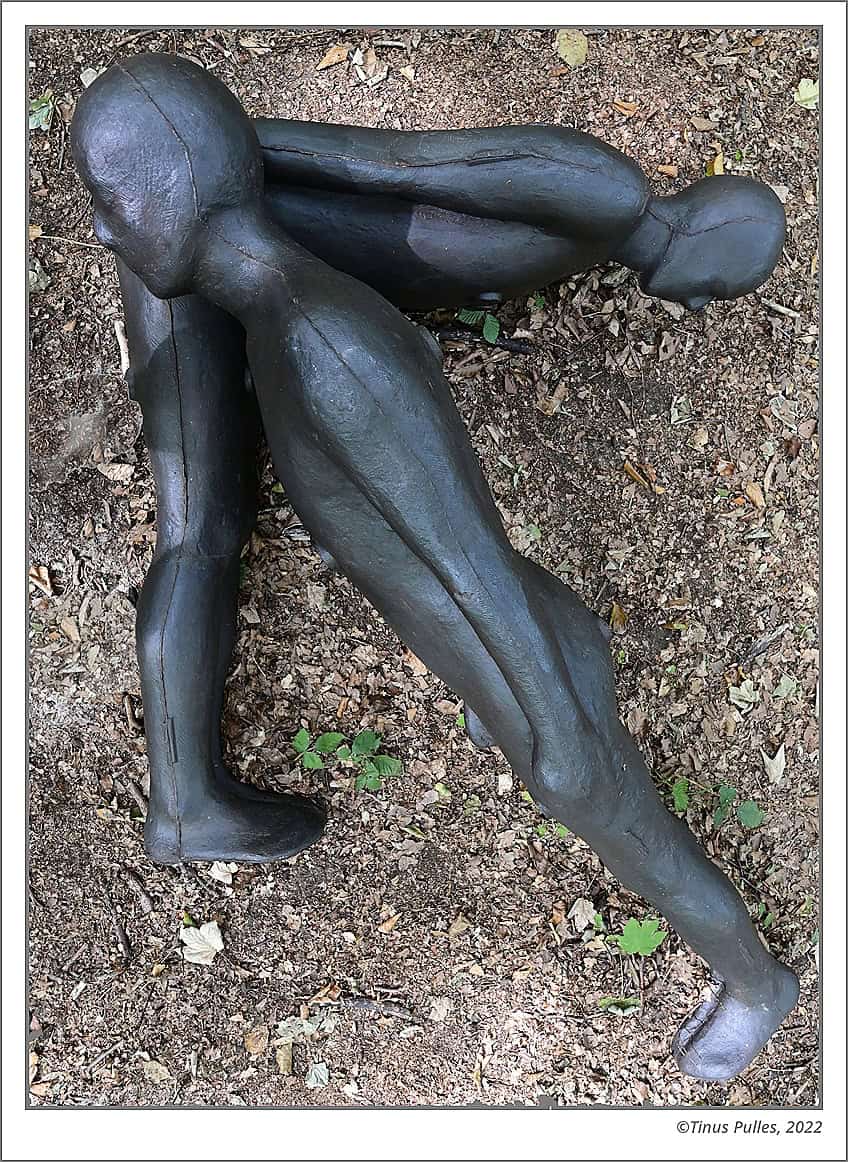
During the 1990s, solid iron became a central material. Critical Mass II, 1995, comprises 60 cast-iron body forms based on 12 positions in a movement from fetal enclosure to standing and falling. First installed in a disused tram depot in Vienna, the figures could be stacked, suspended, overturned, or spread across a site. Their repeated industrial production strips away the uniqueness expected of a monument, while their different placements can evoke a crowd, an obstruction, a store of bodies, or the aftermath of an event. Those associations arise from the installation rather than from individualized expressions.
Networks, Pixels, and Body-Buildings
Around the turn of the millennium, Gormley increasingly opened the figure to its surroundings. The Domain works use stainless-steel rods to mark points and directions within the volume established by a real body. Instead of covering that body-space with a continuous skin, the rods expose it to light and air.
In Quantum Cloud, 2000, a dense human form appears to condense within an irregular web of steel, depending on the viewer’s position. The Blockworks move in another direction.
Rectangular units translate bodily volume into a construction system with affinities to architecture and digital pixels. Balance depends on stacking, cantilevering, and support rather than anatomical modeling. In STAND at the Philadelphia Museum of Art in 2019, ten cast-iron Blockworks, each more than ten feet tall, occupied the museum’s East Terrace. Their scale and building-like structure framed the human body as both inhabitant of the city and a form of architecture.
Field for the British Isles and the Collective Body
Field for the British Isles, 1993, contains approximately 40,000 small terracotta figures. Gormley made it in St Helens with local participants, who shaped figures by hand from clay. Each has a distinct size and form, but all share simple eye holes and face the viewer. The figures fill the exhibition space so densely that visitors remain outside their territory. This reversal matters. A museum audience accustomed to circulating around objects instead confronts a multitude that looks back.

Individual differences remain visible, yet the installation operates as a single collective presence. The work also redistributes authorship: Gormley set the conditions, but many hands produced its physical population. He received the 1994 Turner Prize for Field for the British Isles, and the Arts Council Collection acquired it the following year. Other versions of Field were made with communities in different parts of the world. They should not be treated as interchangeable editions. Their clay, participants, scale, and local processes differ, while the repeated format tests how a mass of handmade figures changes in relation to each site and audience.
Public Sculpture as a Test of Place
Angel of the North
Completed in Gateshead in 1998, Angel of the North is a weathering-steel sculpture roughly 20 meters high and 54 meters across. Its wings are not feathered; their broad, ribbed engineering recalls aircraft and industrial construction. The upright body refers to the human figure, while the enormous span converts a bodily gesture into a landmark visible from roads and rail lines.
The work was commissioned by Gateshead Metropolitan Borough Council for a former colliery site.
That location ties its material and scale to the industrial history of northern England without turning it into a conventional commemorative statue. Its meaning also depends on movement: many people first see it in transit, then experience a radically different relationship to scale when standing beneath it.
Another Place
Another Place, dated 1997, consists of 100 cast-iron figures made from 17 molds of Gormley’s body. At their permanent home on Crosby Beach, the figures extend across three kilometers of coastline and almost one kilometer out to sea. Each weighs about 650 kilograms and faces the horizon.

Tides alternately reveal, surround, and submerge the figures; salt water and marine growth continually alter their surfaces. The installation therefore makes duration visible. The repeated body remains still while weather, ships, visitors, and the shoreline change around it. Gormley has linked the work to departure and emigration, including the sadness of leaving and the hope attached to another place, but the site keeps that interpretation open to daily experience.
Inside Australia, Event Horizon, and Exposure
In Inside Australia, 2003, 51 metal figures derived from residents of Menzies, Western Australia, are distributed across 16 square kilometers of Lake Ballard. Their elongated forms connect particular bodies to an immense salt-lake landscape.
Event Horizon, first realized in London in 2007 and later installed in cities including New York and Hong Kong, placed 31 life-size figures on streets and rooftops. Viewers searching the skyline became aware of their own position within the city.
Exposure, completed in Lelystad in 2010, replaces a closed surface with a vast open lattice of galvanized steel. More than 25 meters high, the seated figure is rooted beside the water yet visually changes with distance, weather, and light. Together, these projects demonstrate that site is not a backdrop. Landscape, architecture, climate, and human movement participate in how the sculpture is perceived.
When the Viewer Becomes the Subject
Some installations remove the recognizable figure almost entirely and work directly on the visitor’s bodily awareness. In Blind Light, presented at London’s Hayward Gallery in 2007, viewers entered a glass chamber filled with dense mist. Ordinary orientation collapsed: walls receded, other people appeared only at close range, and visitors could no longer rely on clear sight to locate themselves. Gormley described the work as putting the outside inside, replacing architectural certainty with exposure and disorientation. One & Other, the 2009 Fourth Plinth Commission in Trafalgar Square, replaced a sculpted hero with living participants.

For 100 continuous days, 2,400 people each occupied the plinth for one hour and decided what to do there. The work transferred visibility, vulnerability, and self-representation to members of the public. It also demonstrated that Gormley’s recurring subject is not his body alone: it is the viewer’s or participant’s experience of becoming conspicuous in space. Later enterable works extend this principle through architectural scale. Cave, made for his 2019 Royal Academy exhibition, turns a massive weathering-steel body into a dark passage visitors can enter.
The external figure is difficult to grasp as a whole, while the interior is understood through bending, touch, restricted vision, and movement. The sculpture is simultaneously object, building, and bodily test.
Drawing as a Laboratory
Although sculpture dominates public accounts of Gormley’s career, drawing is a daily practice and an independent part of his work. His works on paper have used materials including carbon, casein, chicory, walnut ink, blood, and linseed oil.
Some develop possible sculptures; others investigate the body as a field of energy or density without describing a finished object.
The Phillips Collection’s 2012 exhibition Drawing Space, his first United States museum exhibition devoted to works on paper, brought together roughly 80 drawings and prints spanning four decades. On paper, bodily boundaries can dissolve more freely than in cast metal. Lines become paths, cells, horizons, or concentrations of matter, making drawing a place where spatial ideas can emerge before engineering fixes them into weight.
A Common Misconception: The Figures Are Self-Portraits
Most of the familiar figures preserve Gormley’s dimensions, but likeness is not their goal. They lack the facial specificity, clothing, and biographical setting expected of portraiture. His body supplies an index, meaning a physical trace produced through direct contact, comparable in principle to a footprint or mold. The result records where one person was so that another person can reflect on occupying space.

Nor are all of the bodies based on Gormley. Field for the British Isles was made by a community, Inside Australia derives from 51 local inhabitants, and other collaborative projects use participants as their bodily source. The movement from self-cast to collective and participatory work is essential to understanding the practice.
Recognition and Continuing Relevance
Gormley’s major institutional exhibitions have included presentations at the Louisiana Museum of Modern Art, Malmö Konsthall, Tate St Ives, the Hayward Gallery, the State Hermitage Museum, the Royal Academy of Arts, the Philadelphia Museum of Art, and the Musée Rodin. In 2025, the Nasher Sculpture Center in Dallas organized the first major United States museum survey spanning his work from the early 1980s to the present.
The Royal Museum of Fine Arts Antwerp followed in 2026 with Geestgrond, an exhibition extending through its galleries, architecture, roof, square, and the surrounding city.
The public visibility of Angel of the North can obscure how experimental this career has remained. Gormley has moved between ancient materials and computational geometry, solitary casting and mass participation, solid metal and nearly immaterial atmosphere. The persistent question is not what a figure represents, but what happens when sculpture changes a person’s awareness of standing, moving, breathing, or sharing a place.
The Body as a Starting Point
Across more than five decades, Gormley has made the body alternately hollow, solid, multiplied, opened, pixelated, dispersed, and inhabitable. That continuity does not produce a single style. It creates a sustained experiment in how sculpture can connect inner awareness with shared space. His own body may initiate the process, but the work is completed through the places it occupies and the bodies that encounter it.

Frequently Asked Questions
What Is Antony Gormley Best Known For?
He is best known for sculptures and installations that use the human body to investigate space. His most widely recognized public works are Angel of the North in Gateshead and Another Place on Crosby Beach. Field for the British Isles, which contributed to his 1994 Turner Prize, is also central to his reputation.
Why Does Antony Gormley Use His Own Body?
His body provides a readily available, specific measure and a direct record of occupied space. He treats it as a found object or “life reference,” not as the basis for conventional self-portraiture. The simplified result redirects attention toward the viewer’s own embodied experience.
What Materials Does He Use?
His materials include bread, wax, plaster, lead, cast iron, steel, stainless-steel rods, clay, wood, and drawing media. Installations have also used fog, light, sound, and architectural structures. Material choices determine whether a body appears as a cavity, dense mass, open network, landscape marker, or space to enter.
How Was Angel of the North Made?
The 1998 work was fabricated in weathering steel as a large engineered structure rather than cast directly as a traditional statue. It is roughly 20 meters high with a 54-meter wingspan. Its ribbed wings and industrial material connect bodily form with engineering and the history of its former colliery site.
Where Can Antony Gormley’s Public Sculptures Be Seen?
Permanent works include Angel of the North in Gateshead, Another Place at Crosby Beach, Inside Australia at Lake Ballard, Exposure in Lelystad, and Chord at the Massachusetts Institute of Technology. Other figures and projects occupy public sites in Europe, Asia, Australia, and the United States.
Cite this Article
artincontext, , “Antony Gormley – How a Body Becomes a Measure of the World.” Art in Context. October 3, 2026. URL: https://artincontext.org/antony-gormley/
, a. (2026, 3 October). Antony Gormley – How a Body Becomes a Measure of the World. Art in Context. https://artincontext.org/antony-gormley/
, artincontext. “Antony Gormley – How a Body Becomes a Measure of the World.” Art in Context, October 3, 2026. https://artincontext.org/antony-gormley/.


.jpg)


