
Neoclassical Art – A Return to Artistic Symmetry

Neoclassicism reshaped European and Atlantic art from roughly the mid-18th into the early 19th century through renewed study of ancient Greek and Roman objects, buildings, texts, and ideals. It was not a single austere style: painters, sculptors, architects, and designers used antiquity to address morality, political power, domestic taste, empire, revolution, portraiture, and modern public life.
An Introduction to Neoclassicism
“Neoclassical” combines the idea of something new with a later definition of the “classical.” In art history, it usually describes 18th- and early-19th-century practices that deliberately reworked the visual cultures of ancient Greece and Rome. The label covers painting, sculpture, architecture, prints, furniture, interiors, ceramics, fashion, and public monuments. Its dates and forms vary by country and medium.
Neoclassicism is often presented as a clean break from Rococo ornament. The contrast is useful but incomplete. Classical revivals had long histories, and many artists moved between decorative, Baroque, Rococo, Neoclassical, and emerging Romantic idioms. Robert and James Adam, for example, joined archaeological motifs to richly coordinated interiors rather than abandoning decoration.

The movement’s admiration for antiquity was selective. Patrons and artists interpreted ancient evidence through modern collecting, restoration, print culture, travel, social hierarchy, and imperial competition. Ancient sculpture was also frequently encountered stripped of its original color, reinforcing a misleading ideal of white marble even though Greek and Roman sculpture and architecture were often polychrome.
The Renaissance vs. the Age of Enlightenment
The Renaissance and the Enlightenment were not two simple, opposing stages. Renaissance scholars and artists had already studied ancient texts, ruins, sculpture, and architectural theory. Humanism, antiquarian collecting, printing, and the work of figures such as Raphael, Palladio, and Poussin created precedents that later classicists actively reused.
The Enlightenment, conventionally centered in the late 17th and 18th centuries, encouraged debate about reason, observation, natural law, education, government, and human society. It was diverse and contested; science did not simply replace religion, and Enlightenment arguments existed within colonial, commercial, and confessional worlds. Nevertheless, new institutions, publications, academies, museums, and learned networks changed how art and antiquity were studied.
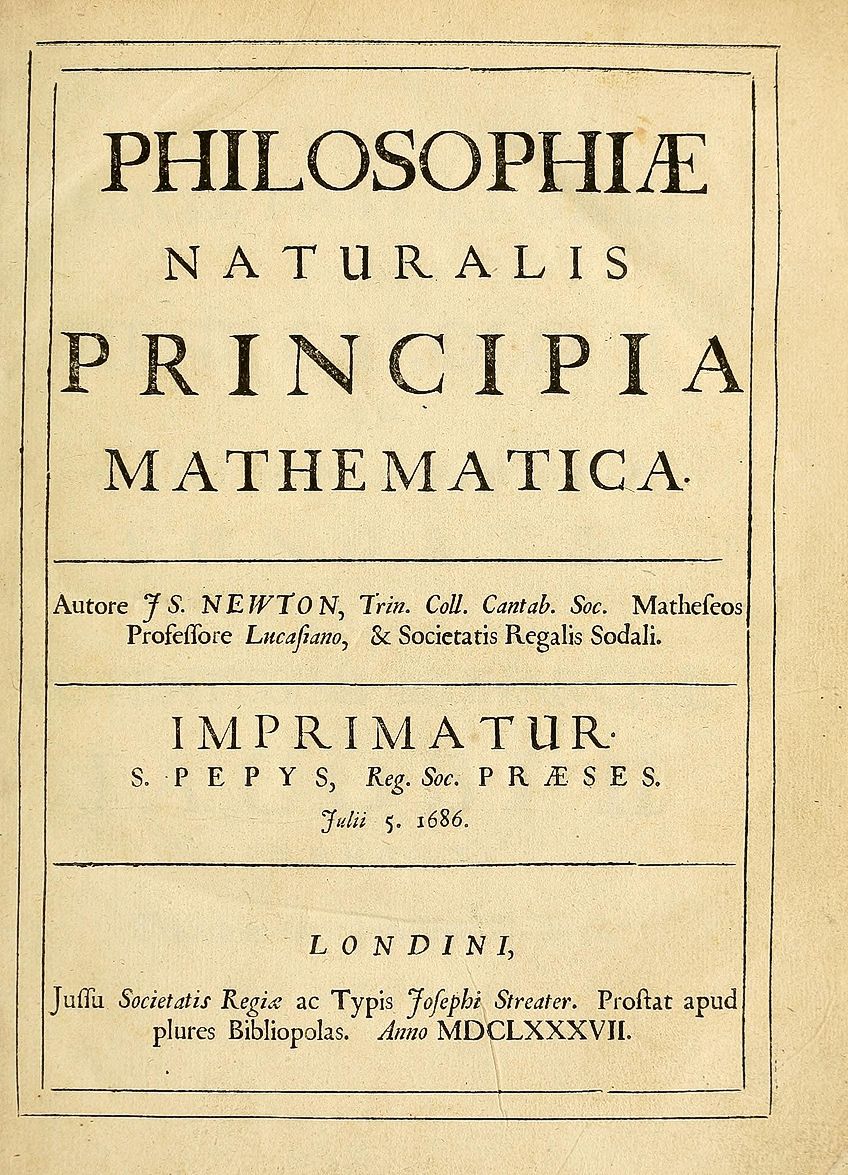
Newton’s Philosophiæ Naturalis Principia Mathematica first appeared in 1687, while John Locke’s An Essay Concerning Human Understanding was published in 1689. Their works did not prescribe a Neoclassical style, but the prestige of systems, evidence, and ordered knowledge formed part of its intellectual environment.
The Influences and Development of Neoclassicism
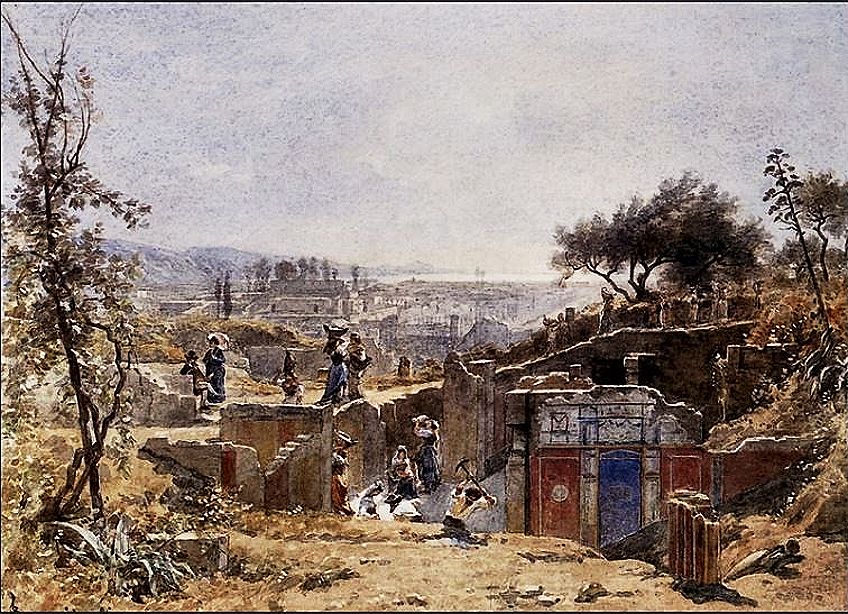
Excavation, publication, and travel made a growing body of ancient material available. Systematic Bourbon-sponsored work began at Herculaneum in 1738 and Pompeii in 1748, although both sites had earlier histories of discovery. Frescoes, objects, buildings, and measured drawings broadened knowledge beyond the monuments of Rome. Publications circulated discoveries far beyond the excavation sites.
The Grand Tour brought wealthy travelers, artists, diplomats, scholars, and collectors—predominantly but not exclusively men—to Italy and sometimes farther east. Access depended on money, status, and political conditions. Travelers commissioned portraits, purchased antiquities and modern reproductions, and returned with books and drawings. This traffic stimulated scholarship and design while also participating in unequal systems of collecting and cultural possession.
Johann Joachim Winckelmann profoundly shaped the field through Reflections on the Imitation of Greek Works in Painting and Sculpture (1755) and History of the Art of Antiquity (1764). His ideal of “noble simplicity and quiet grandeur” elevated Greek art and proposed a developmental history. His writing was foundational but not neutral: later scholarship has challenged its hierarchy of cultures, idealization of whiteness, and reliance on Roman collections and copies. Winckelmann never visited Greece.
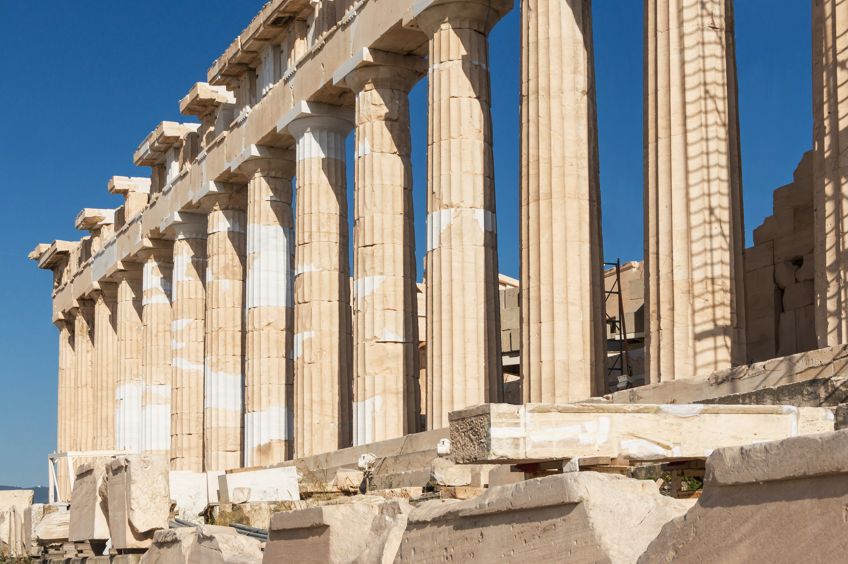
Rome became an international center where artists such as Anton Raphael Mengs, Angelica Kauffmann, Benjamin West, Antonio Canova, and Bertel Thorvaldsen studied, worked, and met patrons. Engravings by Giovanni Battista Piranesi and measured publications by James “Athenian” Stuart and Nicholas Revett offered different models of Roman monumentality and Greek architecture.
The Key Characteristics of Neoclassical Art
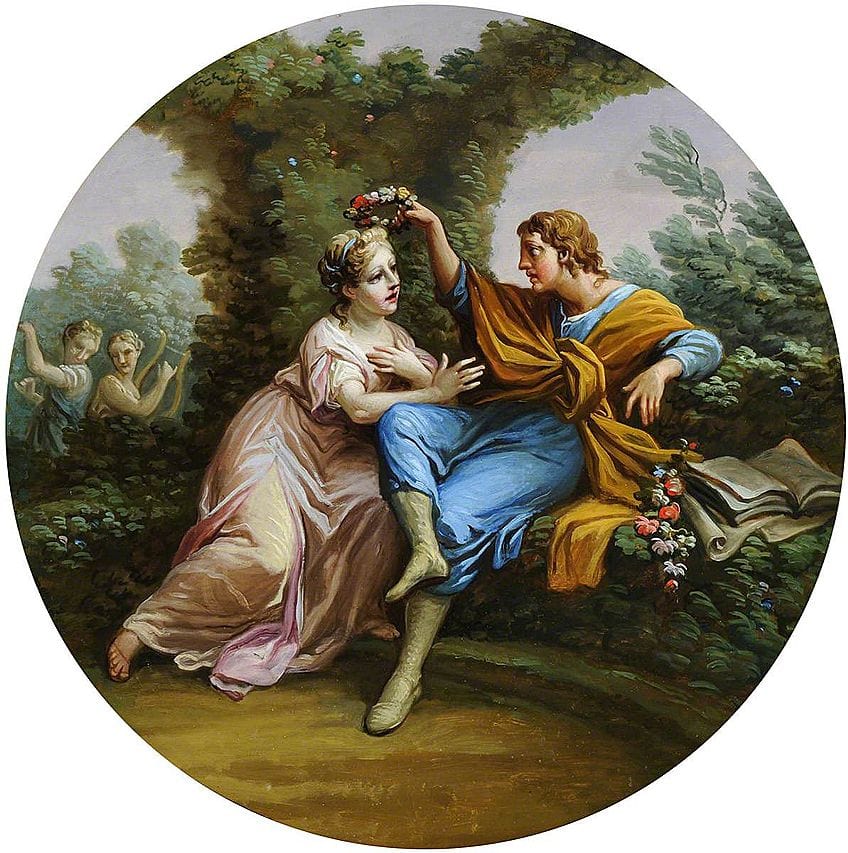
Neoclassical art often favors clear contours, balanced composition, legible gestures, planar space, and subjects drawn from ancient history or mythology. Architecture commonly employs columns, pediments, domes, axial plans, and geometric massing. Sculpture may combine idealized bodies with individualized portrait features. Decorative arts range from restrained profiles to elaborate fields of urns, sphinxes, arabesques, and archaeological motifs.
| Medium | Recurring Features | Important Qualification |
|---|---|---|
| Painting | Clear drawing, staged gestures, history and mythology | Color, emotion, portraiture, and modern dress remained important |
| Sculpture | Marble finish, ideal form, antique subjects, portrait busts | Works were designed for changing viewpoints and could be sensuous or theatrical |
| Architecture and design | Orders, pediments, symmetry, archaeological ornament | Greek, Roman, Renaissance, Palladian, Egyptian, and local sources could overlap |
Noble Simplicity
Winckelmann’s famous phrase described an ethical and aesthetic ideal rather than a checklist. In practice, restraint could mean a limited number of figures, firm outlines, calm poses, or a monumental façade. Yet many Neoclassical works are richly colored, emotionally intense, or densely ornamented. Simplicity was constructed and rhetorical, not the absence of design.
The empty inherited subheading is retained for structural fidelity. It should not be interpreted as an additional art-historical category.
Didactic Subject Matter
History painting occupied a high academic rank because it could present consequential actions and exemplary choices. Artists selected episodes of sacrifice, civic duty, grief, justice, or resistance and arranged gestures so viewers could follow the drama. A moral reading was often intended, but meaning changed with patronage and politics. The same classical language could support monarchy, republicanism, empire, abolitionist debate, or private self-fashioning.
Famous Neoclassical Artists
No list captures the movement’s geographic breadth. The following painters and sculptors illuminate several major routes. Nicolas Poussin, represented below, died decades before Neoclassicism’s usual starting date; he is better treated as a classical precedent admired by later artists rather than as a Neoclassical painter.
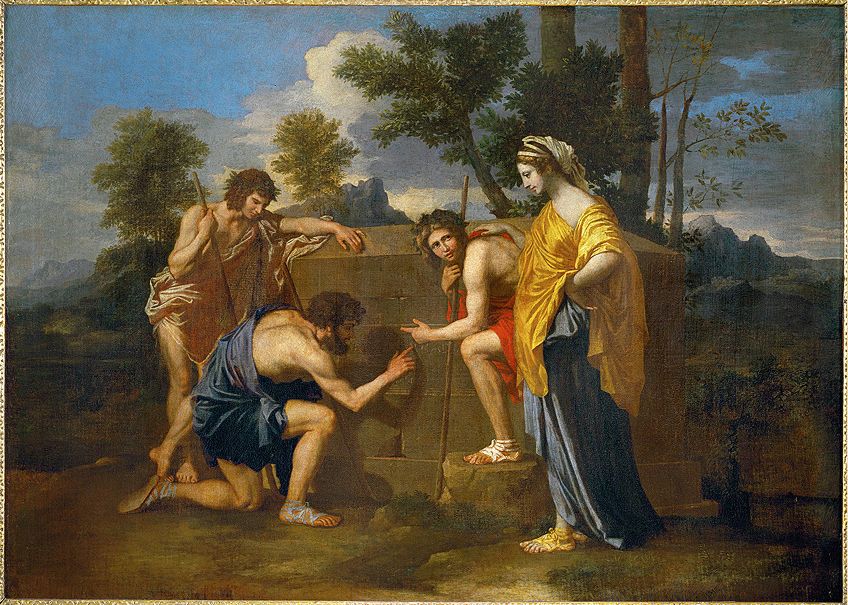
Poussin’s disciplined arrangements and serious historical, biblical, and mythological subjects became important academic models. Claude Lorrain likewise shaped the classical landscape tradition. Later artists did not merely copy them; they used their work to mediate between antiquity and modern painting.
Neoclassical Painting
Because little ancient Greek or Roman panel and wall painting was widely accessible before the Vesuvian excavations, painters often built classical imagery from sculpture, reliefs, coins, texts, Renaissance art, stage design, and imagination. Smooth surfaces and crisp contours could make figures resemble painted reliefs, but Neoclassical painting was never limited to one palette or level of finish.
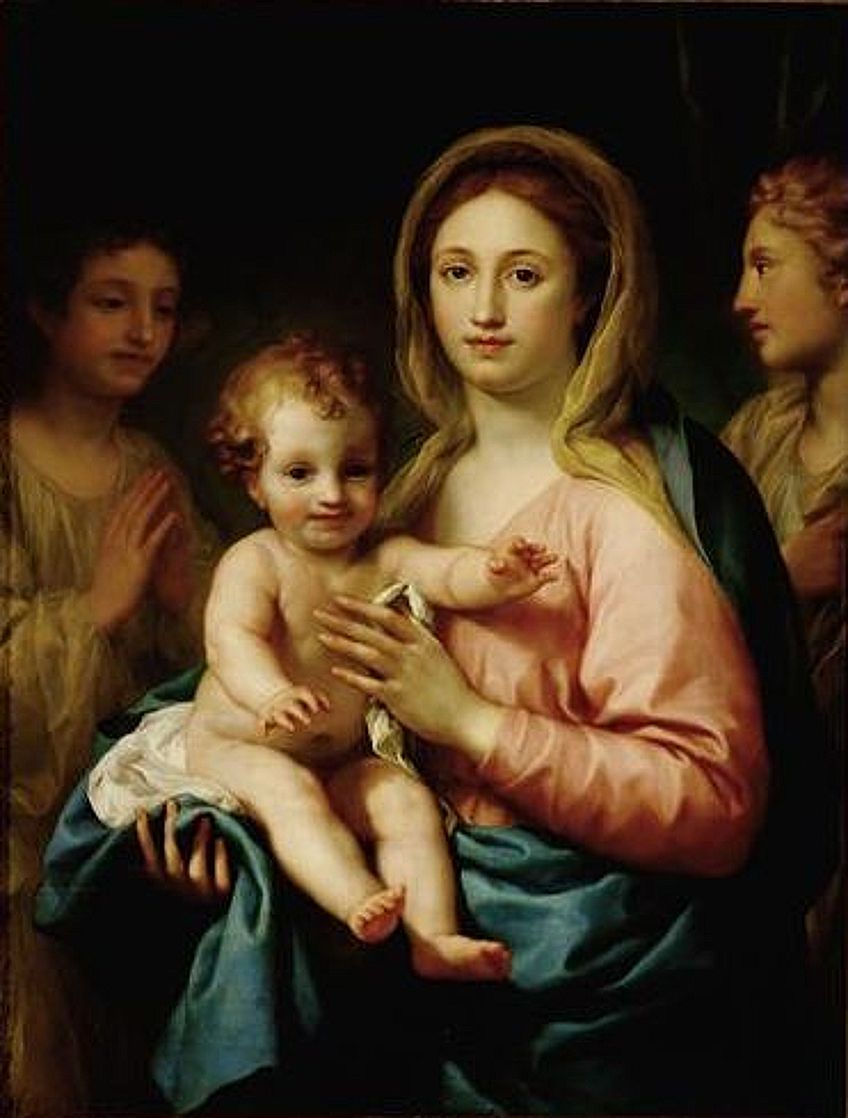
Religious painting, portraiture, contemporary history, and modern dress remained central. The image above also cautions against treating every work by a Neoclassical artist as an antique subject.
Anton Raphael Mengs (1728 – 1779)
Born in Ústí nad Labem and trained by his father in Dresden and Rome, Mengs became a leading court painter and theorist. His friendship with Winckelmann helped define early Neoclassical debate, although his work also retained Baroque and Rococo qualities.
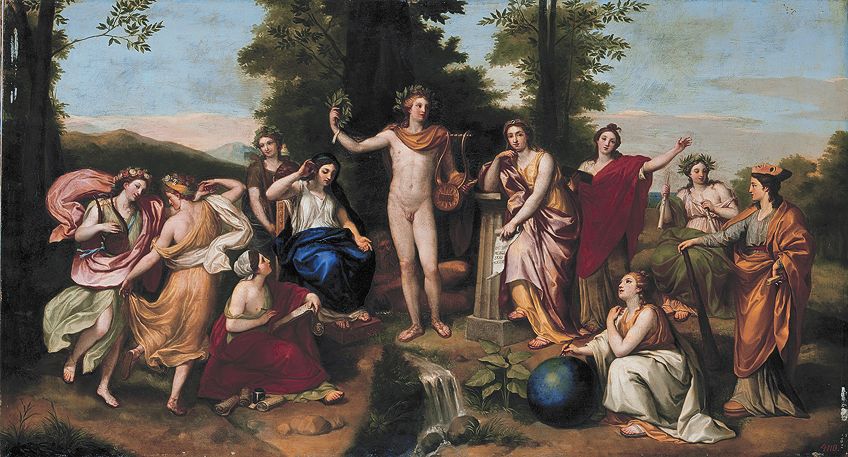
Mengs painted Parnassus on the ceiling of the Villa Albani gallery around 1760–61. Apollo and the Muses are organized in a frieze-like, lucid arrangement indebted to Raphael and ancient relief. The work offered an influential alternative to illusionistic Baroque ceiling painting.
Benjamin West (1738 – 1820)
Pennsylvania-born Benjamin West traveled to Italy and settled in London, where he became a founding member and later president of the Royal Academy. He met leading artists and antiquarians in Rome, but claims that he formally studied under Winckelmann should be treated cautiously.
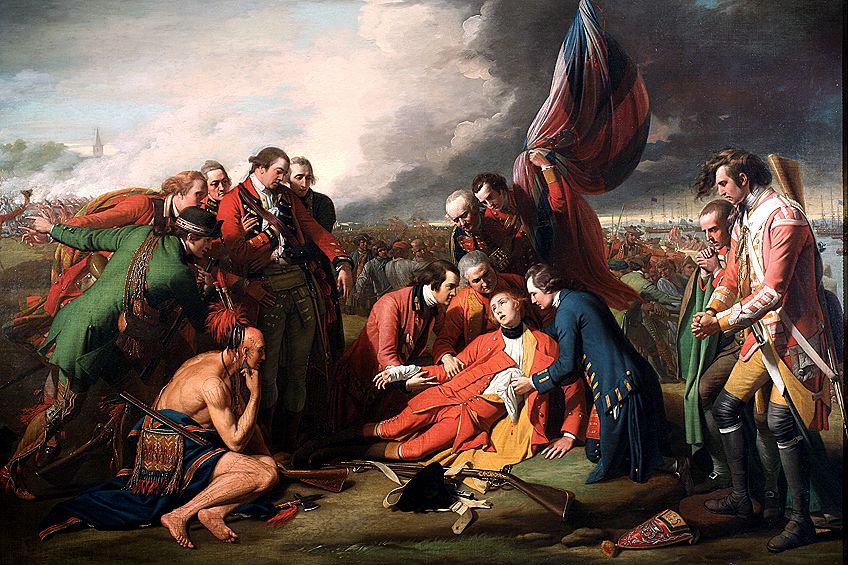
The Death of General Wolfe applies the scale and compositional gravity of history painting to a recent event and depicts many figures in contemporary uniform. Its fame helped legitimize modern history as a subject, although its heroic tableau and inclusion of an Indigenous figure construct a British imperial narrative rather than neutrally document the 1759 battle.
Angelica Kauffmann (1741 – 1807)
Swiss-born Angelica Kauffmann built an international career through portraiture, history painting, decorative schemes, prints, and patronage. In 1768 she was one of two women among the Royal Academy’s 36 founding members. Her classical subjects often make women’s judgment, learning, and moral choice central.
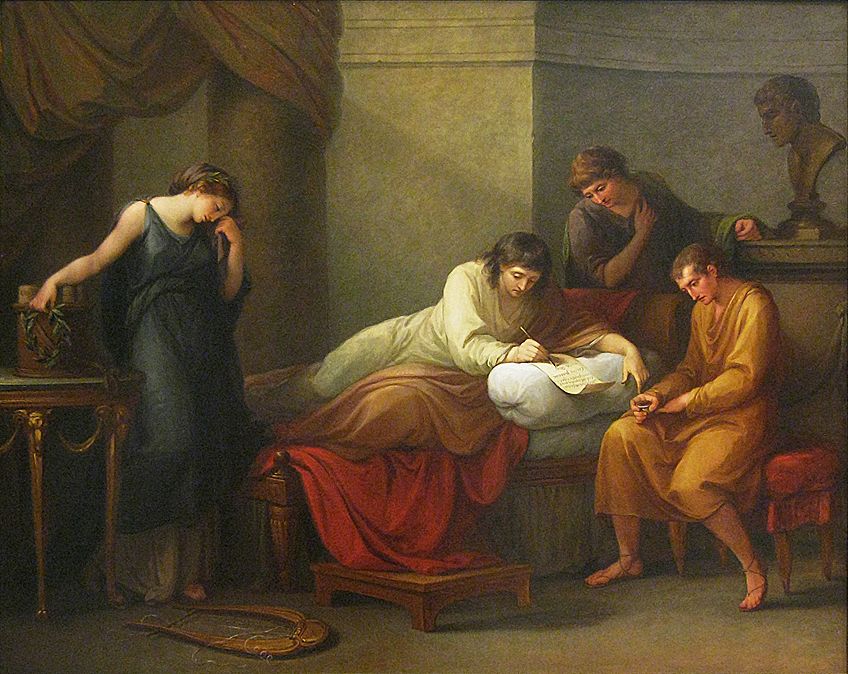
Her work complicates the stereotype that Neoclassicism is exclusively hard, masculine, and politically militant. Graceful color and intimate emotion can coexist with learned history painting.
Jacques-Louis David (1748 – 1825)
Jacques-Louis David transformed French history painting and repeatedly adapted his art to changing regimes. He trained under Joseph-Marie Vien, won the Prix de Rome, joined revolutionary politics, voted for Louis XVI’s execution, organized civic festivals, and later became Napoleon’s First Painter. After the Bourbon Restoration, he lived in exile in Brussels.
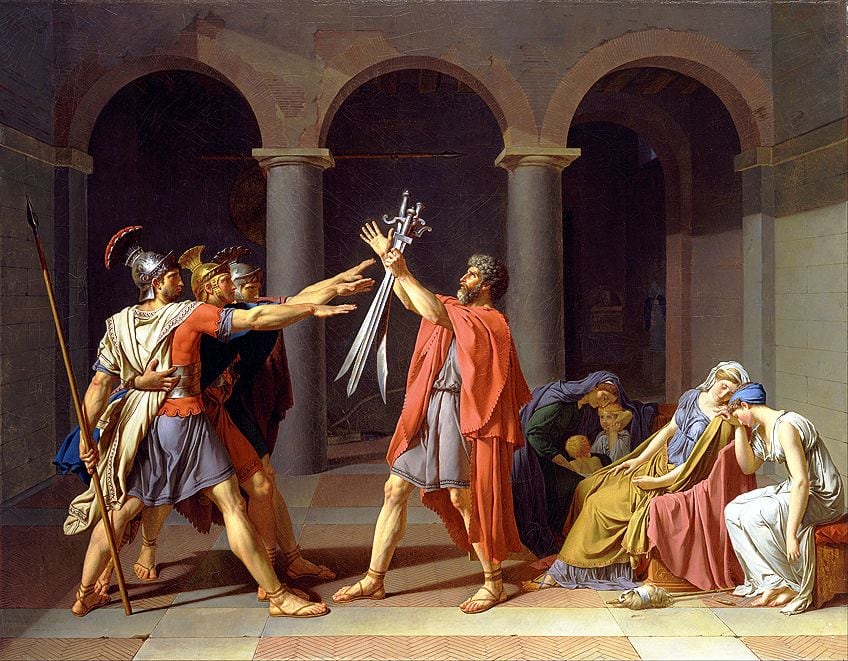
The inherited caption above gives 1786 and credits Girodet, but the Louvre records The Oath of the Horatii as a 1784 painting by Jacques-Louis David. Three brothers reach toward swords held by their father while women and children collapse into grief. Arches divide the groups, and angular limbs oppose curved bodies. Commissioned under the monarchy before the Revolution, the painting later acquired revolutionary associations; it was not originally propaganda for an event that had not yet occurred.
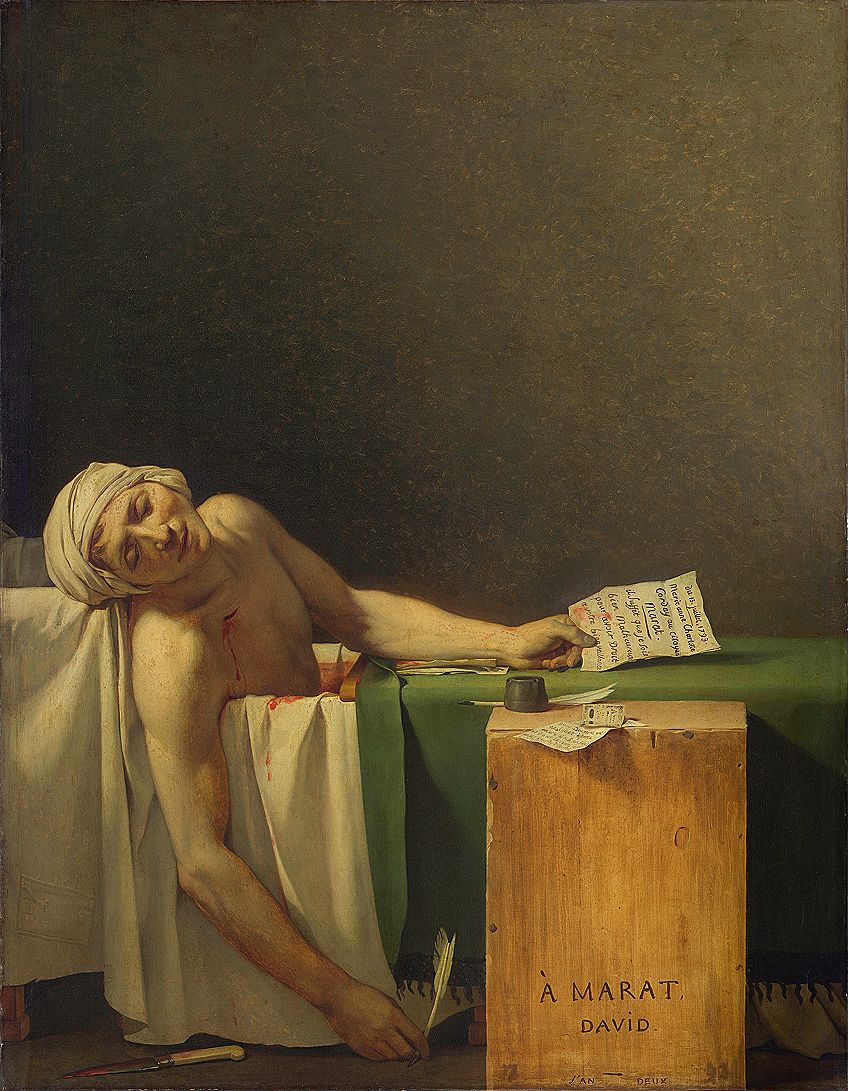
David turned the murdered journalist and deputy Jean-Paul Marat into a revolutionary martyr. The sparse setting, hanging arm, controlled light, and dedicatory inscription invite comparison with Christian lamentation images, but the painting is also political construction. David simplified the scene and shaped the letter in Marat’s hand to characterize Charlotte Corday and Marat’s supposed charity.
Jean-Auguste-Dominique Ingres (1780 – 1867)
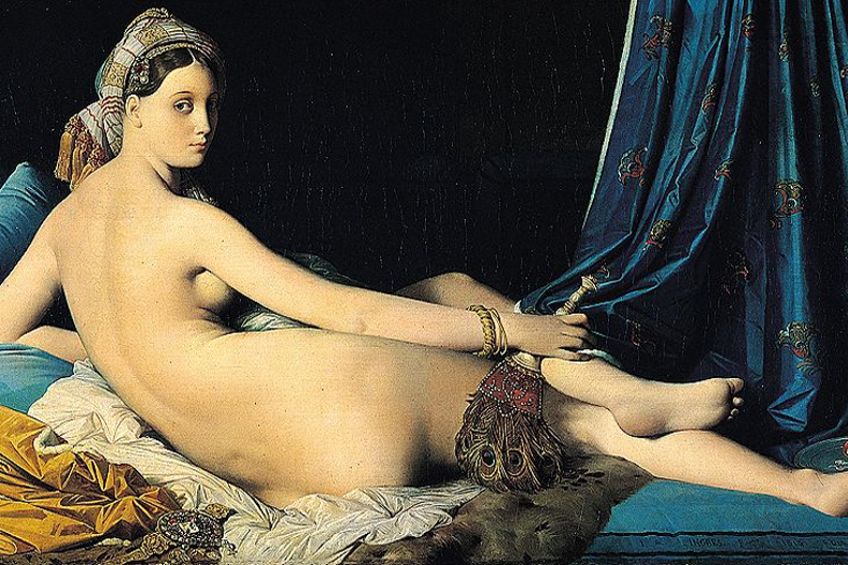
Ingres studied with David but pursued his own line-centered ideal. His portraits can be intensely observational, while his history and nude paintings stretch anatomy for pictorial rhythm. He defended academic classicism even as his elongated bodies, exoticizing fantasies, and sensuous surfaces trouble a neat opposition between Neoclassicism and Romanticism.
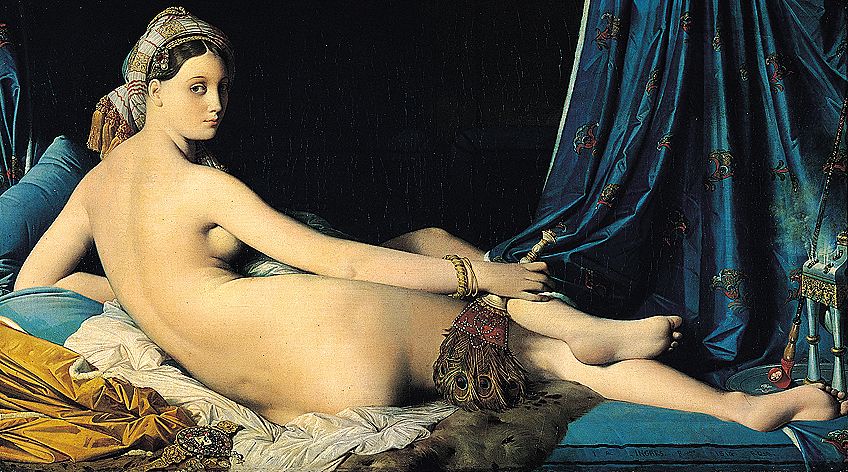
La Grande Odalisque combines an idealized nude tradition with an imagined harem setting shaped by European Orientalism. The body’s extra length is deliberate rather than failed observation. Modern analysis must address the colonial gaze and sexualized fantasy as well as the painting’s celebrated contour.
Neoclassical Sculpture
Neoclassical sculptors studied ancient statues, restorations, casts, and living models. White marble became prestigious, although ancient sculpture’s color was imperfectly understood. Workshops translated clay models through plaster into marble; assistants often performed much of the pointing and carving under the sculptor’s direction.
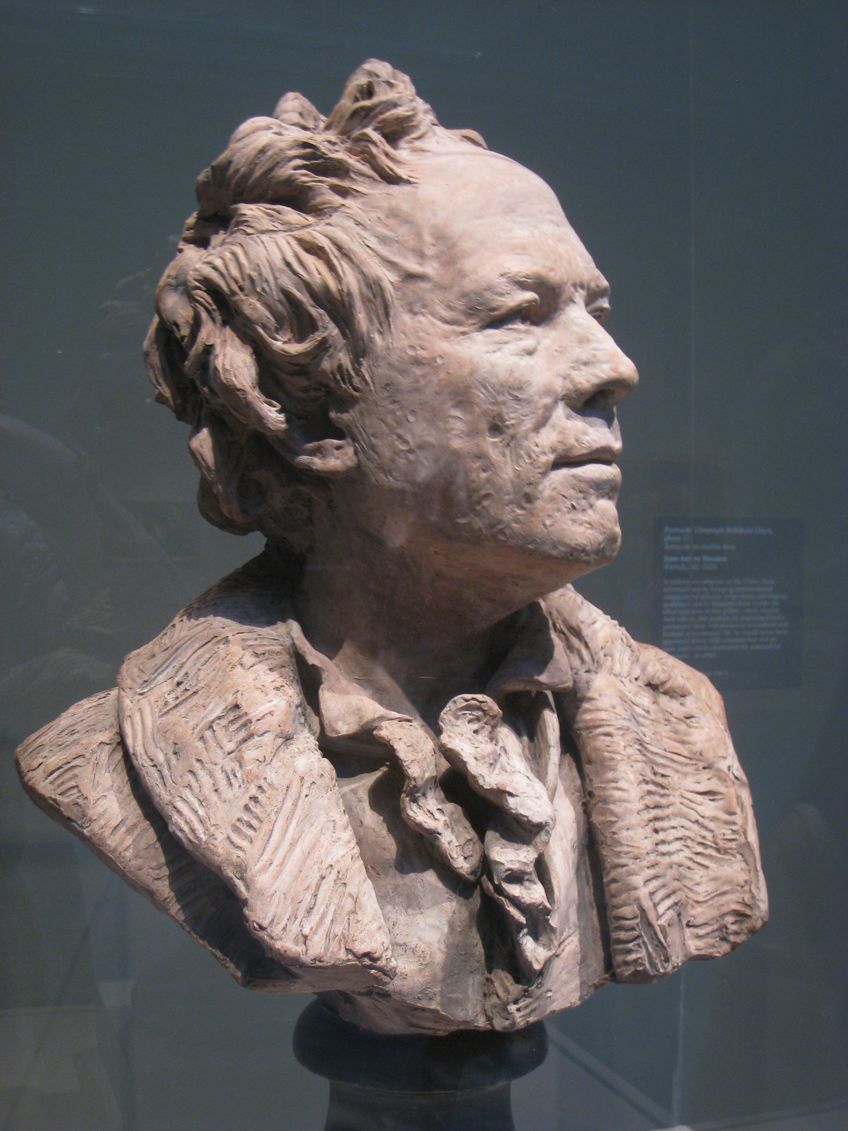
Jean-Antoine Houdon’s portrait busts balance individualized features with controlled presentation. Antonio Canova and Bertel Thorvaldsen became international rivals in Rome. Their works differ in surface, pose, mood, and relationship to antique models; “warm” Canova versus “severe” Thorvaldsen is a traditional shorthand, not an absolute division.
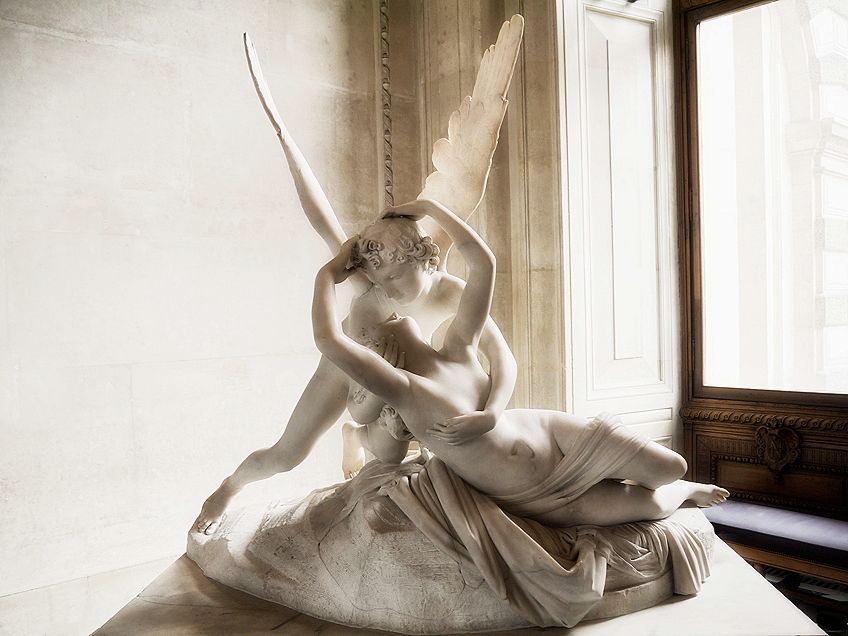
Canova began Psyche Revived by Cupid’s Kiss in 1787 and completed the Louvre marble in 1793. The crossing arms and wings frame the approaching faces, while the sculpture rewards movement around it. Its erotic tenderness and choreographed action show why Neoclassical sculpture should not be equated with emotional coldness. Psyche is awakened by Cupid; the inherited prose’s reversal of their roles was incorrect.
Neoclassical Architecture
Neoclassical architecture encompasses several overlapping revivals: Palladian, Greek, Roman, Etruscan, and later imperial modes. Designers consulted Vitruvius, Renaissance treatises, ruins, measured drawings, and local traditions. Common elements include columnar orders, pediments, domes, porticoes, axial symmetry, planar wall surfaces, and geometric volumes, but no building needs to contain all of them.
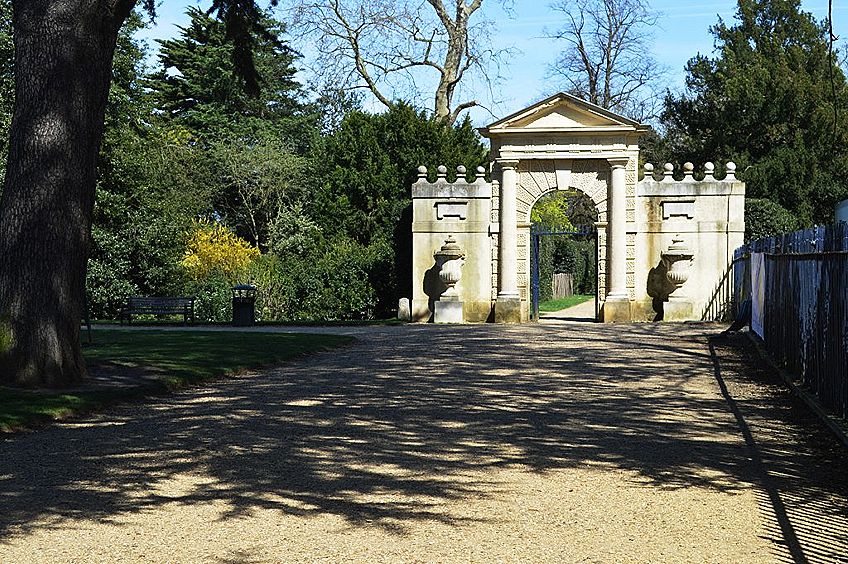
Inigo Jones and Andrea Palladio predate 18th-century Neoclassicism and are better understood as crucial precedents. The Chiswick gate shown above was designed by Jones in the 1620s for Beaufort House and later relocated to Chiswick. Treating it as a 1720s component of the villa obscures that history.
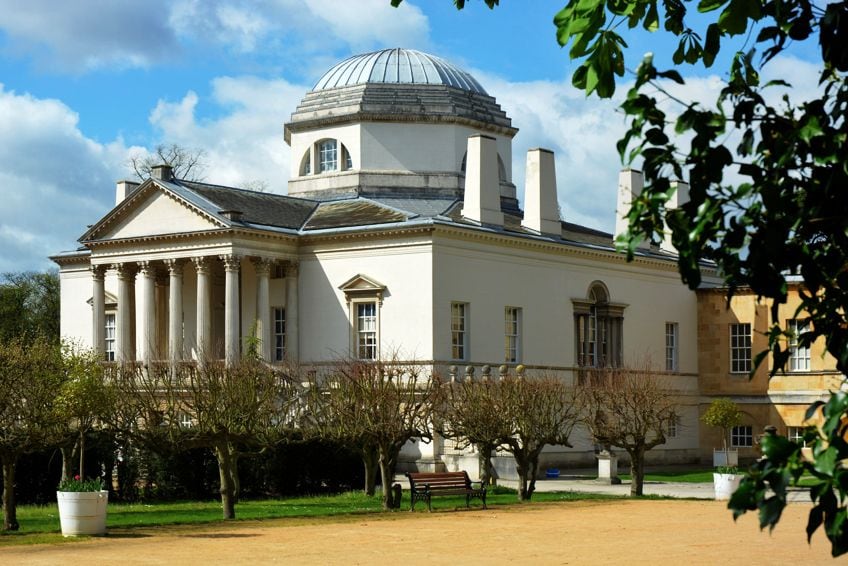
Chiswick House was built between 1726 and 1729 for Richard Boyle, third Earl of Burlington, with William Kent. It is a key Neo-Palladian villa, not a “High Neoclassical” building in a universal two-stage sequence. In France, Jacques-Germain Soufflot’s church of Sainte-Geneviève, begun in 1758 and later transformed into the Panthéon, combined a classical portico and dome with ambitious structural engineering. Across Europe, Russia, and the Americas, classical architecture served courts, legislatures, museums, banks, plantations, and civic institutions; its political meanings were never singular.
The Ever Continued Neoclassical
Neoclassicism did not simply end in 1850 when Romanticism arrived. The two overlapped, and artists such as Ingres cross the categories. Classical forms continued through Greek Revival, Empire, Regency, Beaux-Arts, civic architecture, monuments, academies, and 20th-century state classicisms. Later revivals could express democracy and public education, but they could equally serve colonial authority, nationalism, authoritarianism, finance, or prestige.
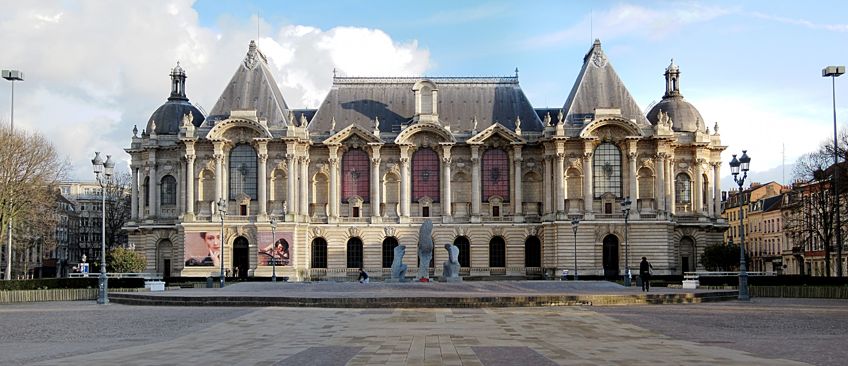
The inherited caption above is chronologically wrong. Architects Édouard Bérard and Fernand-Étienne-Charles Delmas designed the Palais des Beaux-Arts in Lille in the late 19th century; construction began in 1885 and the museum opened in 1892. The building demonstrates Beaux-Arts classicism’s later reuse of columns, symmetry, and monumental urban display rather than an 1809 Neoclassical commission.
Neoclassicism’s legacy is therefore a continuing argument about who may claim antiquity and what classical form communicates. Current scholarship examines women’s professional networks, workshop labor, ancient polychromy, collecting, colonialism, slavery, and the politics of museums alongside formal beauty and archaeological knowledge.
Frequently Asked Questions
What Is Neoclassicism?
Neoclassicism is a broad artistic and cultural engagement with ancient Greek and Roman models, especially influential from the mid-18th to early 19th century. It shaped painting, sculpture, architecture, decorative arts, and public culture, often emphasizing legible form, classical subjects, and archaeological reference.
When Was the Neoclassical Period?
The movement emerged around the mid-1700s and remained powerful into the early decades of the 1800s, with different chronologies across regions and media. It overlapped with Rococo and Romanticism, while later Greek Revival, Empire, Beaux-Arts, and other classical revivals extended its visual language.
What are the Main Characteristics of Neoclassicism?
Common features include clear contours, balanced composition, classical history and mythology, idealized or controlled figures, architectural orders, pediments, symmetry, and archaeological ornament. These are tendencies rather than rules: Neoclassical works can also be colorful, sensuous, emotional, richly decorated, and politically contradictory.
What Influenced the Neoclassical Movement?
Major influences included excavations at Herculaneum and Pompeii; study of Greek and Roman art, buildings, and texts; Winckelmann’s writings; the Grand Tour; academies and print culture; Renaissance classicism and Palladian architecture; and Enlightenment debates about reason, morality, education, and political society.

Isabella studied at the University of Cape Town in South Africa and graduated with a Bachelor of Arts majoring in English Literature & Language and Psychology. Throughout her undergraduate years, she took Art History as an additional subject and absolutely loved it. Building on from her art history knowledge that began in high school, art has always been a particular area of fascination for her. From learning about artworks previously unknown to her, or sharpening her existing understanding of specific works, the ability to continue learning within this interesting sphere excites her greatly.
Her focal points of interest in art history encompass profiling specific artists and art movements, as it is these areas where she is able to really dig deep into the rich narrative of the art world. Additionally, she particularly enjoys exploring the different artistic styles of the 20th century, as well as the important impact that female artists have had on the development of art history.
Learn more about Isabella Meyer and the Art in Context Team.
Cite this Article
Isabella, Meyer, “Neoclassical Art – A Return to Artistic Symmetry.” Art in Context. May 13, 2021. URL: https://artincontext.org/neoclassical-art/
Meyer, I. (2021, 13 May). Neoclassical Art – A Return to Artistic Symmetry. Art in Context. https://artincontext.org/neoclassical-art/
Meyer, Isabella. “Neoclassical Art – A Return to Artistic Symmetry.” Art in Context, May 13, 2021. https://artincontext.org/neoclassical-art/.