

Gustave Moreau: Life, Major Paintings, and Legacy

Gustave Moreau turned familiar myths into tense, jewel-like encounters in which monsters stare back, severed heads glow, and palaces seem built from paint and ornament. He began as an academically trained history painter, yet his richly worked images became a reference point for Symbolists, future Fauves, and later Surrealists. His surviving Paris home and studio reveal the payoff: these visions emerged from disciplined drawing, accumulated sources, and years of deliberate revision.
Who Was Gustave Moreau?
Gustave Moreau was a French painter, watercolorist, draftsman, and teacher born in Paris on April 6, 1826. He died in the same city on April 18, 1898. His paintings draw primarily on mythology, the Bible, and literature, but their importance lies in how he reshaped those inherited stories. Instead of giving viewers a single clear moral, he constructed charged encounters filled with unusual color, dense detail, and meanings that remain open to debate.

Moreau developed this approach within the tradition of history painting, the academically prestigious category devoted to subjects from religion, mythology, literature, and the past. As scenes from contemporary life became increasingly prominent in nineteenth-century French art, he continued to work with ancient heroes, saints, gods, and legendary poets. Yet his treatment of them pushed beyond many conventions of academic art.
He is now closely associated with French Symbolism, but the label requires care. Several of his defining paintings appeared decades before the Symbolist manifesto of 1886, and Moreau considered himself a history painter who was renewing that genre. It is therefore more accurate to describe him as a central figure whom later artists and writers regarded as a precursor of the Symbolist movement.
Gustave Moreau at a Glance
Moreau combined private concentration with substantial public recognition. Oedipus and the Sphinx established his Salon reputation in 1864, he was elected to the Académie des Beaux-Arts in 1888, and he became a professor at the École des Beaux-Arts in January 1892. His pupils included artists who would take modern painting in directions very different from his own.

A major late-life project joined artistic preservation to architecture. Moreau converted the upper floors of his family home at 14 rue de La Rochefoucauld into large studios, then left the house and its contents to the French State. The Musée Gustave Moreau opened there in 1903, five years after his death.
From Academic Training to an Independent Path
Moreau’s development followed neither a straight institutional ascent nor a sudden rejection of tradition. Formal instruction, competition setbacks, friendships, travel, and sustained copying all contributed to the method visible in his mature paintings.
Early Drawing, Picot, and the École des Beaux-Arts
Moreau drew from childhood. His father, Louis Moreau, was an architect who encouraged an education grounded in classical culture, and his mother accompanied him to northern Italy in 1841. That early journey preceded the longer Italian study period that would later transform his working practice.

He studied privately with the history painter François-Édouard Picot before entering the École des Beaux-Arts in 1846. Moreau attempted to win the Prix de Rome twice but was unsuccessful, and he left the school in 1849. These defeats interrupted the conventional academic route, but they did not turn him against historical subjects or close study of older art. Both remained central throughout his career.
Chassériau, the Salon, and Rue de La Rochefoucauld
Moreau befriended Théodore Chassériau in 1851 and regarded the older artist’s influence as decisive. Chassériau offered an example of how firm drawing, expressive color, and historical subject matter could coexist. Moreau made his first official appearance at the Paris Salon in 1852, beginning the public career through which his ambitious history paintings would be judged.

The same period established the physical center of his working life. His family acquired the house at 14 rue de La Rochefoucauld in 1852, and Moreau used it as both home and studio. Decades later, that address would become essential to his plan for preserving his work.
Italy, 1857 to 1859: Copying as Research
From October 1857 to September 1859, Moreau traveled through Italy and undertook an intensive program of study. He copied Renaissance paintings while also examining earlier Italian and Pompeian art. Copying let him follow another artist’s decisions at close range, from the placement of a body to the rhythm of drapery or the construction of a large composition.
This was not allegiance to one master or period. Moreau gathered solutions from different traditions and later combined them with his own studies and reproductions. During the journey he also befriended Edgar Degas. Their contact belongs to the history of the trip, although their later artistic differences caution against treating resemblance as proof of influence.
Alexandrine Dureux was another important presence in Moreau’s adult life. He described her as his “best and only friend.”
Salon Breakthroughs and a Symbolist Language
The Paris Salon gave Moreau access to a large public, but it also exposed every shift in his practice to official judgment and criticism. His Salon record contains breakthroughs, hostile responses, periods of withdrawal, and carefully staged returns.
Oedipus at the Salon of 1864
Oedipus and the Sphinx established Moreau’s public reputation when it appeared at the Salon of 1864. Prince Napoleon acquired it, giving the painter an important mark of recognition. The work’s imposing scale, controlled drawing, and mythological subject fit the expectations of history painting, while its strange stillness made the confrontation unusually intense.

Moreau avoided a crowded action scene. He brought the hero and monster together in a tall, narrow format and held them inside an unbroken exchange of looks. The Sphinx clings to Oedipus rather than waiting at a safe distance, turning an intellectual contest into a physical test. This compressed encounter became an early example of Moreau’s ability to make a familiar narrative feel unresolved.
Criticism in 1869 and the Return of 1876
Moreau received a medal at the Salon of 1869, but official recognition came with harsh criticism. He then stayed away from the Salon until 1876. That seven-year gap matters because it prevents his career from looking like a smooth series of celebrated masterpieces.
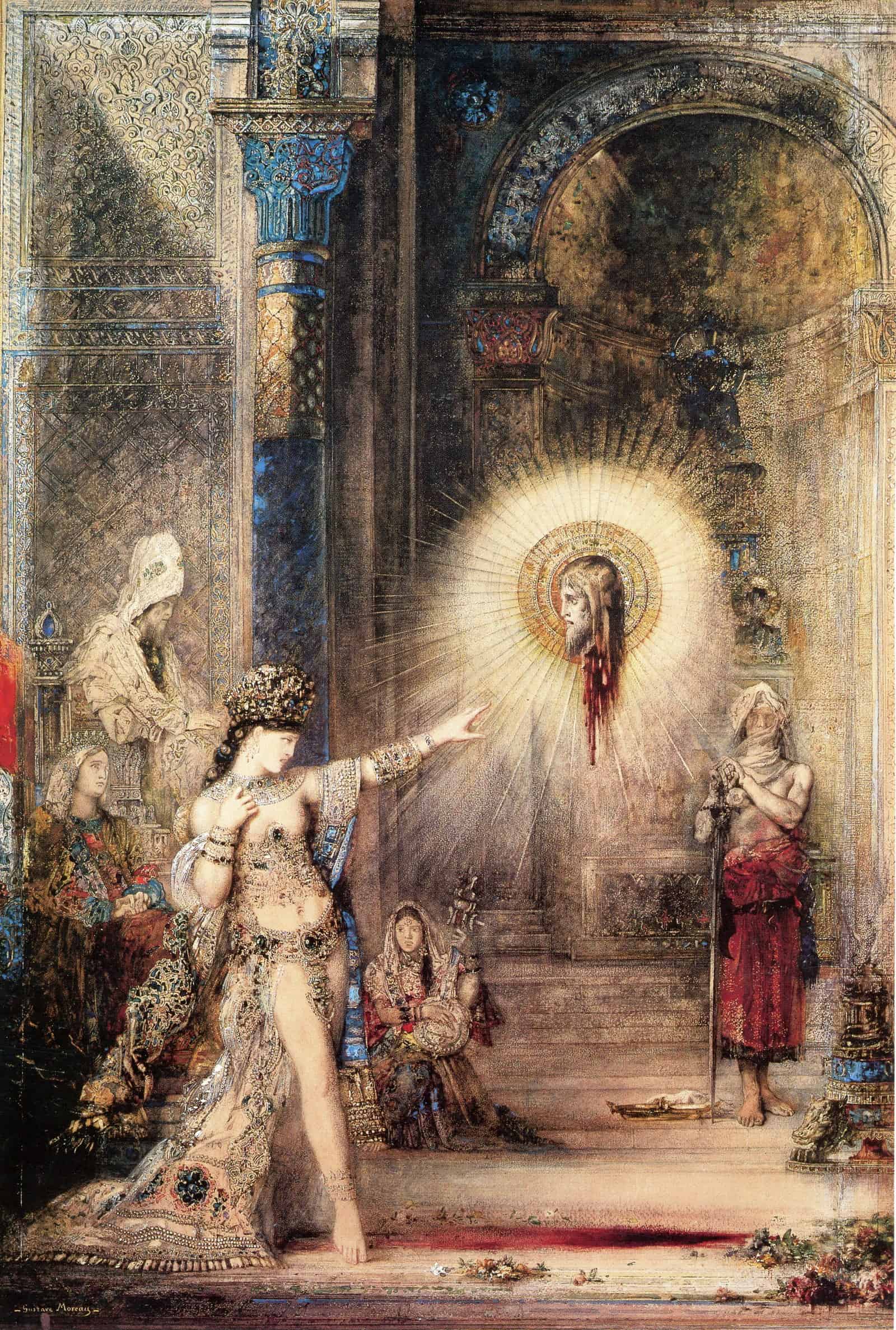
His return in 1876 was substantial and coordinated. He exhibited Salomé Dancing Before Herod, Hercules and the Lernaean Hydra, Saint Sebastian, and the watercolor The Apparition. Together, the works demonstrated the range of his mature practice, from carefully built oil paintings to watercolor effects that loosened edges and made light seem less material.
Why “Symbolist” Needs a Date
The Symbolist manifesto appeared in 1886, after Oedipus and the Sphinx, Orpheus, the Salomé paintings, and many other characteristic works. Moreau therefore did not begin by applying the program of an established Symbolist movement. He emerged from academic history painting and gradually made its narratives more private, ambiguous, and visually elaborate.
The later label remains useful because Moreau refused to reduce a picture to a literal report of events. His figures often occupy dreamlike spaces, and details suggest several associations without fixing one final interpretation. The chronology, however, shows that his mature language preceded the movement’s formal declaration.
The Fables and Moreau’s Final Salon
Moreau began a group of 64 watercolors for La Fontaine’s Fables in 1879. The project extended his interest in literary subjects while giving watercolor a major role in his practice. Its scale also shows that works on paper were not merely incidental preparations for oils.
He made his last Salon appearance in 1880. After that date, institutional recognition continued, including his election to the Académie des Beaux-Arts in 1888, but the Salon no longer organized his public career as it had in the 1850s, 1860s, and 1870s.
How Gustave Moreau Built an Image
The density of a Moreau painting can make it seem spontaneous or dream-generated. Surviving studio materials show a more systematic process. Drawing served as the structure beneath his color, ornament, and unusual combinations of imagery.
Drawing, Tracing, and Layered Sources
Moreau developed compositions through repeated studies. He traced designs and used squaring, a method that places a grid over a drawing so that the composition can be transferred or enlarged section by section. These procedures allowed him to preserve a pose, revise its setting, and test relationships before committing them to a finished surface.
His source base was broad. He drew from life and studied older European art, photographs, engravings, reproductions, Asian art, animals, and architectural forms. Rather than copying one source intact, he assembled details from different visual traditions inside invented settings. The more than 80 preparatory studies connected with Salomé Dancing Before Herod reveal how much work could stand behind one seemingly fantastic scene.
This method also explains why identifying a borrowed detail does not decode an entire picture. A costume, column, animal, or gesture may come from a recognizable source, yet its new relationship to other elements changes how it functions. Moreau used reference material as construction material.
Color, Ornament, and Unresolved Narratives
Several features offer a practical way to recognize Moreau’s mature work. First, look for a staged encounter: two figures may face each other directly while surrounding action slows almost to a halt. Next, notice how architecture compresses the figures rather than opening a convincing everyday space. Columns, thrones, screens, rocks, and decorative bands often act like parts of an elaborate stage.
Then examine the surface. Small accents of color can punctuate dark areas, while jewelry, fabric, plants, and architectural detail accumulate without receiving equal clarity. In some oils, impasto, meaning paint laid thick enough to stand above the surface, turns light-colored accents into tiny physical ridges. Chiaroscuro, the organization of strong light and dark contrasts, can isolate faces and objects inside otherwise shadowed settings.
Finally, resist treating each object as a fixed code. Moreau’s pictures frequently provide narrative clues but stop short of resolving the emotional or moral relationship among them. Watercolor gave him additional freedom to soften boundaries, suspend forms in light, and experiment with color apart from the heavier physical surface of oil.
- Begin with the whole arrangement. Identify the central confrontation and the direction of the main gazes.
- Compare scale and position. A small figure may command attention through light, stillness, or placement.
- Follow gestures and diagonals. Hands, staffs, rocks, and drapery often connect otherwise separate parts of the scene.
- Move from space to surface. Ask whether the setting feels deep and naturalistic or compact and stage-like, then inspect how paint and ornament alter it.
- Keep interpretation provisional. Distinguish what the painting visibly shows from what a symbol might be taken to mean.
Major Paintings and How to Look at Them
Moreau’s major works reward a consistent viewing method. Start with the composition before isolating symbols, then examine gaze, gesture, space, scale, and surface. This approach makes differences among the paintings clearer and avoids forcing their details into a single symbolic dictionary.
Oedipus and the Sphinx: A Locked Gaze
The Metropolitan Museum of Art’s Oedipus and the Sphinx is an oil on canvas from 1864 measuring 206.4 by 104.8 centimeters. Its narrow vertical format keeps the figures close. Oedipus stands upright while the Sphinx grips his body, bringing their faces near the same level. Their locked gaze becomes the compositional center.
Look downward and outward from that exchange. Fragments of earlier victims establish the danger without turning the work into a scene of active violence. A crown, laurel, urn, and densely described surface add possible associations with victory, death, memory, and ritual, but they do not settle the encounter’s meaning. The painting holds physical threat and mental contest in the same suspended moment.
The contrast between Oedipus’s exposed body and the monster’s clinging form makes the hero appear both stable and vulnerable. Moreau does not show the outcome. He gives the viewer the instant in which looking, thinking, and surviving have become inseparable.
Orpheus: Stillness After Violence
Painted in 1865 and exhibited at the Salon of 1866, Orpheus is an oil on wood measuring 154 by 99.5 centimeters, now in the Musée d’Orsay. A richly dressed Thracian girl holds the severed head of Orpheus on his lyre. The subject is violent, but the painting suppresses the expected chaos and noise.
The girl lowers her face toward the poet’s head, creating a quiet exchange between two profiles. Their placement forms one part of a larger diagonal balance that continues through the rocky landscape. The lyre serves as both an instrument and a support for the head, joining the poet’s identity to the object associated with his music.
Compared with the packed interiors of the Salomé works, Orpheus leaves more room around its central figures. The restraint is useful recognition guidance: Moreau does not always rely on maximum ornament. His recurring signature can also appear through poised figures, arrested action, carefully directed gazes, and a landscape shaped around an emotional encounter.
Salomé and The Apparition: One Subject, Different Media
Salomé Dancing Before Herod is an oil on canvas from 1876 measuring 143.5 by 104.3 centimeters, now in the Hammer Museum. It was among Moreau’s works at the 1876 Salon. He prepared more than 80 studies for it, combining decorative references from several ancient and non-European traditions. Colored accents and raised white paint animate an imagined palace whose architecture is too compressed and composite to read as an ordinary interior.
Salomé appears within this dense setting as a carefully posed performer. Her body, gesture, and costume must compete with columns, ornament, seated figures, and surface detail. The oil painting makes the dance part of a material environment in which bodies and decoration nearly merge.
The 1876 watercolor The Apparition, measuring 106 by 72.2 centimeters, is in the Musée d’Orsay collection and recorded in the Louvre’s national collection database. It treats the same biblical episode differently. The illuminated head of John the Baptist confronts Salomé across the palace, interrupting the scene with an image that seems suspended rather than physically supported.
The comparison shows what medium can change. The oil builds weight through layered architecture, colored accents, and raised paint. The watercolor lets the apparition flare against the darker interior, making light itself organize the encounter. Both works resist a simple report of events, but they create their uncertainty through different surfaces.
Jupiter and Semele: A Late Synthesis
Jupiter and Semele is an oil on canvas measuring 2.12 by 1.18 meters in the Musée Gustave Moreau. Commissioned by Léopold Goldschmidt, it developed from an 1889 study and was completed in 1895. It dates from the same late period in which Moreau was transforming his house for the display and preservation of his work.
Begin at the vertical center, where Jupiter sits enthroned and Semele is overwhelmed by the divine encounter. Then allow the eye to move outward and downward through the surrounding assembly. Death, Sorrow, Pan, Hecate, sphinxes, and an eagle inhabit a composition that connects the central myth to figures associated with mortality, nature, night, and divine power.
The painting’s scale of reference is broad, but its structure prevents the details from becoming a random inventory. Jupiter and Semele anchor the vertical movement; subsidiary figures occupy changing levels around them. Ornament fills the surface while shifts in size and position preserve hierarchy. The result brings Moreau’s long-standing practices together: a mythological subject, a design developed from an earlier study, accumulated visual sources, compressed space, and an interpretation that remains larger than any single emblem.
Teacher, Museum Maker, and Legacy
Moreau’s contribution extends beyond the finished paintings. His classroom and house-museum preserve two different forms of artistic transmission: one encouraged younger painters to find individual directions, while the other kept his own working process available for study.
Teaching Future Fauves
Moreau became a professor at the École des Beaux-Arts in January 1892. His students included Henri Matisse, Georges Rouault, Albert Marquet, Henri Manguin, Charles Camoin, and Henri Evenepoel. Several would later be associated with early modernism and Fauvism, whose bold handling of color looks very different from Moreau’s elaborate mythological scenes.
That difference helps clarify his teaching. Moreau encouraged students to develop individual artistic personalities and directed them to study works in the Louvre. His importance as a teacher therefore does not depend on making pupils paint like him. The connection lies in his classroom, his emphasis on sustained looking, and his permission to pursue distinct solutions.
A House-Museum Built Around Process
In 1895, Moreau commissioned architect Albert Lafon to convert the family house at 14 rue de La Rochefoucauld. Large upper-story studios created space to arrange and display the work that had accumulated during his career. The preserved domestic rooms and working spaces made the building more than a neutral gallery.
Moreau’s 1897 will left the house and its contents to the French State. The State accepted the bequest in 1902, and the Musée Gustave Moreau opened in 1903. Its holdings include more than 14,000 paintings, drawings, and watercolors, along with unfinished works, models, letters, archives, and the artist’s library.
This concentration of material changes how the finished paintings can be understood. Tracings, studies, models, and incomplete compositions expose decisions that a polished surface can conceal. The museum preserves not only a sequence of results but also evidence of revision, transfer, source gathering, and abandoned possibilities.
Later Reception Without a Simple Family Tree
Later artists and writers treated Moreau as a predecessor of Symbolism and Surrealism. That reception reflects the appeal of his dreamlike spaces, hybrid sources, and unresolved scenes, but it should not be confused with direct personal contact or membership in every later movement associated with him.
His clearest routes of transmission are more specific. His paintings circulated through the Salon and collections, his pupils encountered him in the classroom, and his house-museum preserved a large working archive. Together, these routes explain how an artist committed to history painting could matter to painters who rejected many of its conventions.
The most revealing way to recognize Moreau’s legacy is therefore to look for a method rather than a decorative formula. Start with disciplined drawing, follow the transformation of varied sources, and watch how color and ornament complicate a familiar story. The apparent dream then becomes visible as a constructed image whose uncertainty was carefully made.
Frequently Asked Questions
These answers clarify Moreau’s relationship to Symbolism, the training that shaped his career, the artists who studied with him, and the present locations of several major paintings.
Was Gustave Moreau a Symbolist?
Moreau is considered a central figure and precursor of French Symbolism, but many of his defining works predate the Symbolist manifesto of 1886. He understood his practice as a renewal of history painting. Calling him a Symbolist is useful when it describes his later reception and ambiguous imagery, not when it erases that chronology.
Who Taught Gustave Moreau?
Moreau studied privately with François-Édouard Picot and entered the École des Beaux-Arts in 1846. Théodore Chassériau became an important early influence after the two artists met in 1851. Moreau also educated himself through direct study and copying during his Italian journey from 1857 to 1859.
Who Were Gustave Moreau’s Students?
His École des Beaux-Arts students included Henri Matisse, Georges Rouault, Albert Marquet, Henri Manguin, Charles Camoin, and Henri Evenepoel. Moreau encouraged individual development, so their later stylistic differences should not be treated as evidence against his importance as a teacher.
Where Are Gustave Moreau’s Major Paintings Today?
Oedipus and the Sphinx is at the Metropolitan Museum of Art in New York. Orpheus and The Apparition are in the Musée d’Orsay collection in Paris, while the Hammer Museum in Los Angeles holds Salomé Dancing Before Herod. Jupiter and Semele remains at the Musée Gustave Moreau in Paris.

Isabella studied at the University of Cape Town in South Africa and graduated with a Bachelor of Arts majoring in English Literature & Language and Psychology. Throughout her undergraduate years, she took Art History as an additional subject and absolutely loved it. Building on from her art history knowledge that began in high school, art has always been a particular area of fascination for her. From learning about artworks previously unknown to her, or sharpening her existing understanding of specific works, the ability to continue learning within this interesting sphere excites her greatly.
Her focal points of interest in art history encompass profiling specific artists and art movements, as it is these areas where she is able to really dig deep into the rich narrative of the art world. Additionally, she particularly enjoys exploring the different artistic styles of the 20th century, as well as the important impact that female artists have had on the development of art history.
Learn more about Isabella Meyer and the Art in Context Team.
Cite this Article
Isabella, Meyer, “Gustave Moreau: Life, Major Paintings, and Legacy.” Art in Context. September 12, 2026. URL: https://artincontext.org/gustave-moreau/
Meyer, I. (2026, 12 September). Gustave Moreau: Life, Major Paintings, and Legacy. Art in Context. https://artincontext.org/gustave-moreau/
Meyer, Isabella. “Gustave Moreau: Life, Major Paintings, and Legacy.” Art in Context, September 12, 2026. https://artincontext.org/gustave-moreau/.


