

36th Bienal de São Paulo Opens a Remade Berlin Edition

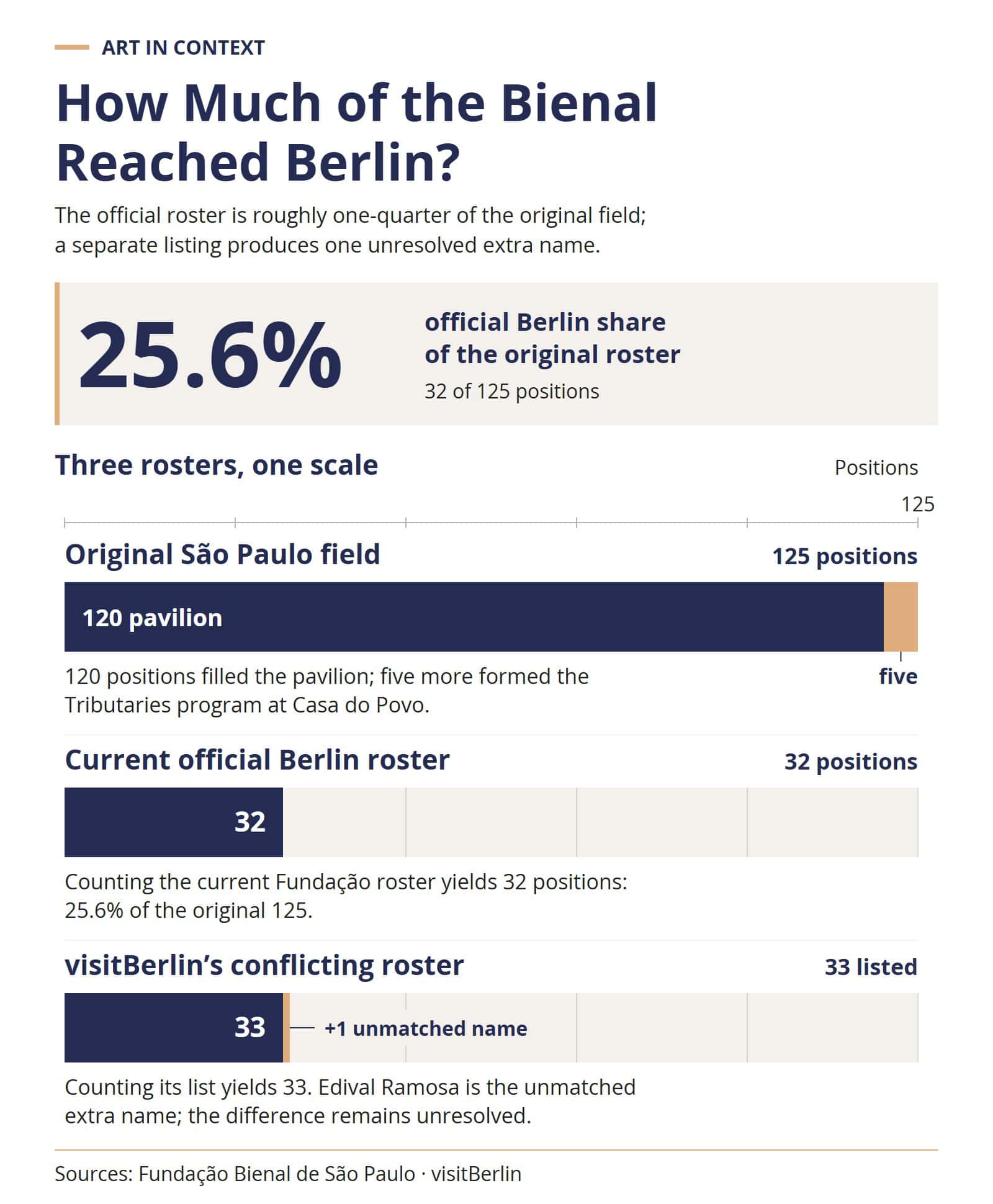
The 36th Bienal de São Paulo opened to the public at Berlin’s Haus der Kulturen der Welt on September 11, with its regular exhibition run beginning September 12. It is the Bienal’s first presentation in Germany, but not a replica of the 2025–2026 exhibition: the current official roster names 32 artistic positions from an original field of 125, while the works include adaptations, new commissions, and interventions shaped for HKW.
What Opened at HKW—and When
Not All Travellers Walk Roads—Of Humanity as Practice runs at HKW through December 6, 2026. The Fundação Bienal de São Paulo’s Berlin page records an opening event on Friday, September 11, followed by the public exhibition period beginning Saturday, September 12. That distinction matters because some listings use September 11 as the start date while others begin with the first full public day.
Alya Sebti, a co-curator of the São Paulo edition, curated the Berlin presentation. Bonaventure Soh Bejeng Ndikung remains credited as chief curator of the 36th Bienal, whose broader team included Sebti, Anna Roberta Goetz, Thiago de Paula Souza, Keyna Eleison, André Pitol, and Leonardo Matsuhei. Gisele de Paula designed the Berlin exhibition.
The title comes from Conceição Evaristo’s poem Da calma e do silêncio. Its curatorial premise treats humanity as a practice sustained through listening, care, and relationships among people, landscapes, water, memory, plants, and other forms of life. The art ranges across installation, film, photography, painting, sound, performance, and spatial intervention.
HKW lists regular hours from noon to 7 p.m., Wednesday through Monday. Admission is €10, reduced to €7; the opening weekend of September 11–13, Mondays, the first Sunday of each month, and the closing weekend of December 5–6 are free.
Berlin Is Roughly One-Quarter of the São Paulo Roster
The original exhibition opened in São Paulo on September 6, 2025, and closed on January 11, 2026. The Fundação’s opening record identifies 120 positions in the pavilion’s six chapters and five more in the Tributaries program at Casa do Povo. The Berlin page says that São Paulo presentation drew 784,000 visitors.
A count of the names on the current Berlin page produces 32 positions, about 26 percent of the original roster. That is a comparison of participants, not works: the published Berlin material does not give a complete object count, so it cannot support the claim that a quarter of the artworks traveled.
Every name on the Fundação’s current Berlin roster also appears in the original São Paulo participant list. The newness of the German edition therefore lies in what selected participants made or changed and how their work is staged, not in the addition of a new named cohort. This is curating as an active reargument: reduction changes which connections become visible.
There is one unresolved roster discrepancy. The current Fundação page names 32 positions, while visitBerlin’s event page lists 33, adding Edival Ramosa. The Fundação’s page is the organizing institution’s current record, so 32 is the firmer published count; neither page explains the difference.
Which Works Traveled, Changed, or Responded to Berlin
The organizers describe the edition as combining works shown in São Paulo with newly commissioned, adapted, and site-specific pieces. They have not yet published a work-by-work status list. The comparison below therefore records only changes that the available institutional records and Philipp Hindahl’s September 7 report for Berlin Art Week identify with enough specificity.
| Artist | São Paulo record | Berlin evidence |
|---|---|---|
| Emeka Ogboh | The Way Earthly Things Are Going II (Mother Earth’s Lament), conceived for the 36th Bienal | Explicitly described as adapted for HKW |
| Laila Hida | Sange khara (2025), a 16mm film within an immersive installation | Film, rugs, cushions, and tent return as a space for reclining and lingering |
| Cevdet Erek | Rhythmic Ramp used the São Paulo pavilion’s circulation | At HKW’s entrance, Cevdet Erek’s Rhythmic Ramp is reconfigured for the building. |
| Tanka Fonta | Philosophies of Being, Perception, and Expressivity of Being wrapped a central column | A foyer frieze and a larger façade banner engage HKW’s building |
| Wolfgang Tillmans | Watching a Minute for a Minute was made for the main edition | A new film is reported, but its relation to the São Paulo installation is not specified |
Ogboh’s case is the clearest documented adaptation. His installation combines cut tree trunks, embedded speakers, charcoal, red light, choral sound, and the smell of burnt soil to address deforestation and ecological grief. Rebuilding that multisensory environment for HKW is more than shipping objects; room shape, circulation, acoustics, and ventilation become part of the work again.
The table also exposes the limit of the phrase “newly commissioned.” It is an accurate description of the edition as a whole, but the public material does not yet attach that status to every named work. Readers interested in how an art commission differs from a restaging or adaptation should not treat those categories as interchangeable.

Haus der Kulturen der Welt in Berlin. Photograph by Farbkontrast via Wikimedia Commons, licensed under Creative Commons Attribution 3.0 Unported; cropped.
Two Modernist Buildings Produce Different Routes
The move connects two buildings from the same era that were not purpose-built as conventional white-cube galleries. Oscar Niemeyer’s Ciccillo Matarazzo Pavilion stands in Ibirapuera Park beside the covered Córrego do Sapateiro; Hugh Stubbins’s former Congress Hall stands at the edge of Berlin’s Tiergarten near the Spree. Both supply curves, landscape, and water to an exhibition organized around the metaphor of an estuary.
Scale changes the encounter. In São Paulo, six chapters and 120 positions spread across Niemeyer’s much larger pavilion, while five additional positions formed the Tributaries program at Casa do Povo. At HKW, curtains trace a river-like course through spaces with relatively few straight walls, and visitors are not directed along one fixed route. Fonta’s façade banner and foyer frieze, Erek’s entrance sound, and Hida’s invitation to sit or recline turn thresholds and circulation into exhibition material.
That produces a more site-legible argument than a conventional touring sampler would. The Berlin selection sacrifices the breadth of the São Paulo survey, but it makes the curatorial idea of relationship concrete: works meet the building, park, river, and one another. The strongest evidence for a genuinely remade edition is not the promotional label “site-specific” on its own; it is the documented alteration of how particular works occupy sound, façade, foyer, and room.

The Ciccillo Matarazzo Pavilion in São Paulo. Photograph by Ana Carolina Terzian via Wikimedia Commons, licensed under Creative Commons Attribution-Share Alike 4.0 International.
The Art Keeps the Political Premise Material
The exhibition’s claims about colonialism, ecology, and care remain anchored in artworks rather than standing as a general political program. Forensic Architecture and Forensis present Delta-Delta: People’s Court I, a video installation that connects the British looting of Benin in 1897 with later resource extraction and ecological damage in West Africa. Its curved screen and tribunal-like form make evidence and testimony spatial.
Hida’s Sange khara takes a different route, using film and an inhabitable tent-like setting to circle memory rather than explain it linearly. Ogboh makes ecological loss bodily through sound, smell, timber, and heat-colored light. Paintings by Mohamed Melehi, Chaïbia Talal, and Maria Auxiliadora place modernism outside a single European canon, while Tillmans’s moving images join everyday urban observation to rivers and other natural systems.
These works show what the compression preserves: not a representative miniature of all six São Paulo chapters, but a concentration on listening, environment, historical memory, and forms of shared presence. What Berlin cannot preserve is the original edition’s full range. The curatorial gain is sharper spatial dialogue; the cost is a much narrower account of the 36th Bienal.

Haus der Kulturen der Welt in Berlin. Photograph by Ansgar Koreng via Wikimedia Commons, licensed under CC BY-SA 3.0 DE.
Thirty-Two Positions, With the Full Work List Still Pending
The Fundação’s current record establishes that this is the Bienal de São Paulo’s first German presentation, open to the public from September 12 through December 6 at HKW. Its roster names 32 of the original edition’s 125 artistic positions, and all 32 came from the São Paulo field.
Work-level evidence establishes an HKW adaptation of Ogboh’s installation and architecture-responsive presentations by Erek and Fonta; it does not yet identify the status of every commission or restaging. The 33-name visitBerlin list conflicts with the Fundação roster because it includes Edival Ramosa, whose participation in the Berlin edition remains unresolved in the published records. The missing document is a final Berlin checklist matching each artist, title, date, medium, and commission status.

Isabella studied at the University of Cape Town in South Africa and graduated with a Bachelor of Arts majoring in English Literature & Language and Psychology. Throughout her undergraduate years, she took Art History as an additional subject and absolutely loved it. Building on from her art history knowledge that began in high school, art has always been a particular area of fascination for her. From learning about artworks previously unknown to her, or sharpening her existing understanding of specific works, the ability to continue learning within this interesting sphere excites her greatly.
Her focal points of interest in art history encompass profiling specific artists and art movements, as it is these areas where she is able to really dig deep into the rich narrative of the art world. Additionally, she particularly enjoys exploring the different artistic styles of the 20th century, as well as the important impact that female artists have had on the development of art history.
Learn more about Isabella Meyer and the Art in Context Team.
Choose Art in Context as a preferred source to see more of our reporting in Google Top Stories and other Google Search experiences.
Cite this Article
Isabella, Meyer, “36th Bienal de São Paulo Opens a Remade Berlin Edition.” Art in Context. September 13, 2026. URL: https://artincontext.org/36th-bienal-sao-paulo-berlin-edition/
Meyer, I. (2026, 13 September). 36th Bienal de São Paulo Opens a Remade Berlin Edition. Art in Context. https://artincontext.org/36th-bienal-sao-paulo-berlin-edition/
Meyer, Isabella. “36th Bienal de São Paulo Opens a Remade Berlin Edition.” Art in Context, September 13, 2026. https://artincontext.org/36th-bienal-sao-paulo-berlin-edition/.


