


11 Famous Roy Lichtenstein Paintings That Define Pop Art

Roy Lichtenstein stands as one of the most defining figures in the Pop Art movement, recognized for his bold, comic-inspired style. The eleven paintings featured in this article showcase the breadth of Lichtenstein’s iconic work, from legendary pieces like “Whaam!” and “Drowning Girl” to lesser-known yet influential masterpieces. Art enthusiasts and newcomers alike will find insight into how these paintings reshaped the boundaries of modern art.
Overview of Roy Lichtenstein’s Artistic Legacy
Roy Lichtenstein was a leading American artist associated with Pop Art. He became widely recognized for his bold use of imagery taken from comic strips and commercial art.
Lichtenstein’s works often feature the Ben-Day dot technique, imitating the printing methods used in comic books. This method, paired with flat, vibrant colors, created a distinctive and recognizable style.

Key Characteristics:
- Comic strip-inspired imagery
- Use of cartoons and commercial icons
- Bold outlines and limited color palette
His art challenged the boundaries between “high” fine art and “low” commercial culture. By elevating everyday visuals and cartoons into the realm of contemporary art, Lichtenstein shifted perspectives on what could be considered serious artwork.
He contributed to defining the visual language of Pop Art in the 1960s, alongside figures like Andy Warhol. The following table highlights essential aspects of his legacy:
| Aspect | Details |
|---|---|
| Artistic Movement | Pop Art |
| Influences | Comic strips, advertisements, cartoons |
| Signature Technique | Ben-Day dots, bold lines |
Lichtenstein’s influence extends throughout contemporary art, and his work is cited in museums, galleries, and art history discussions worldwide. His paintings remain central to debates about originality, mass culture, and the role of the artist in society.
Iconic Lichtenstein Paintings: The List
Roy Lichtenstein’s work transformed popular culture images into fine art by blending comic strip techniques, bold primary colours, and precise lines. His iconic paintings are recognized for their use of Ben-Day dots, speech bubbles, and reinterpretations of commercial and art history imagery.
Whaam! (1963)
“Whaam!” stands out as one of the most recognizable artworks in pop art. The painting dramatically depicts an aerial combat scene borrowed from a DC comic, split across two canvases for a cinematic effect.
Primary colours dominate the image, with vivid reds, yellows, blues, and striking black outlines. Lichtenstein uses Ben-Day dots to reproduce the comic strip style, giving the piece its distinctive printed appearance and texture. The onomatopoeic “Whaam!” graphic pops from the canvas, capturing the explosive action typical in comic books.

The work reflects themes of war, heroism, and mass media, drawing attention to the stylized violence in American culture. It’s held in the Tate Modern, London, and remains a prime example of how Lichtenstein merged fine art with popular imagery.
| Key Fact | Detail |
|---|---|
| Year | 1963 |
| Medium | Acrylic and oil on canvas |
| Dimensions | 172.7 cm × 406.4 cm (68 in × 160 in) |
| Location | Tate Modern, London |
| Source Image | DC Comics’ “All-American Men of War” #89 |
| Dominant Colours | Primary (red, yellow, blue), black, white |
| Style | Comic strip, pop art, Ben-Day dots |
Drowning Girl (1963)
“Drowning Girl” captures a melodramatic scene lifted directly from a comic book panel. The painting shows a young woman up to her neck in turbulent water, with tears streaming down her face, alongside a thought bubble that reads, “I don’t care! I’d rather sink—than call Brad for help!”
Lichtenstein’s meticulous use of Ben-Day dots, bold outlines, and restricted palette enhance the emotional intensity. The cartoon style turns personal drama into pop culture spectacle, raising questions about romance, gender stereotypes, and media representation.
The work is part of the Museum of Modern Art collection in New York. Its emotional impact, visual style, and direct reference to romance comics make “Drowning Girl” one of the most studied paintings in pop art.

| Key Fact | Detail |
|---|---|
| Year | 1963 |
| Medium | Oil and synthetic polymer paint on canvas |
| Dimensions | 171.6 cm × 169.5 cm (67.5 in × 66.75 in) |
| Location | Museum of Modern Art (MoMA), New York |
| Source Image | DC Comics’ “Run for Love!” (Secret Hearts #83) |
| Notable Feature | Speech bubble, emotional cartoon imagery |
| Dominant Colours | Blue, white, black, yellow, red |
Look Mickey (1961)
“Look Mickey” marks a significant moment in Lichtenstein’s career as it was among the first paintings in which he adopted the comic strip aesthetic that would define his style. The painting features iconic Disney characters Mickey Mouse and Donald Duck by a lakeside.

The use of primary colours and Ben-Day dots, combined with the simplified rendering of figures, signals Lichtenstein’s shift from abstract expressionism to pop art. “Look Mickey” demonstrates his skill in transforming everyday commercial images into works of fine art.
This painting is held by the National Gallery of Art, Washington D.C., and is often viewed as a starting point for Lichtenstein’s exploration of mass media and consumer imagery.
| Key Fact | Detail |
|---|---|
| Year | 1961 |
| Medium | Oil on canvas |
| Dimensions | 121.9 cm × 175.3 cm (48 in × 69 in) |
| Location | National Gallery of Art, Washington, D.C. |
| Characters | Mickey Mouse, Donald Duck |
| Notable Features | Speech bubble, bright primary palette, Ben-Day dots |
| Style | Early comic-strip, pop art |
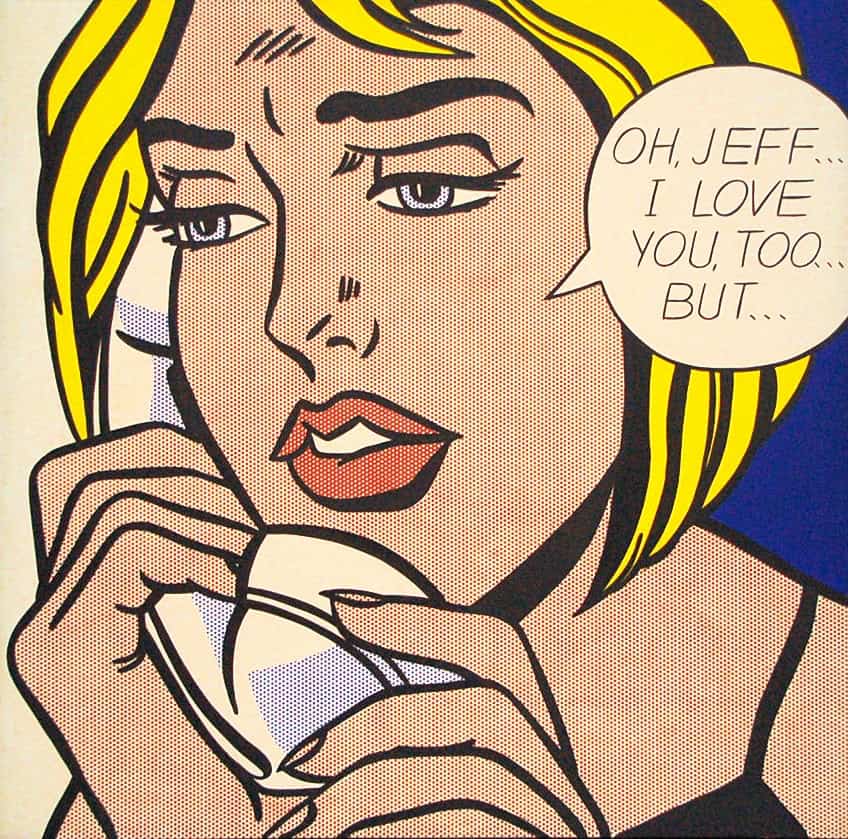
Oh, Jeff…I Love You, Too…But…
In “Oh, Jeff…I Love You, Too…But…”, Lichtenstein captures the drama and longing often found in romance comic strips. The image shows a blonde woman, eyes wide and lips parted, speaking on the telephone. The dialogue in the speech bubble conveys emotional turmoil.
The composition highlights Lichtenstein’s signature technique: thick black outlines, carefully applied dots, and bold blocks of primary colour. The imagery parodies melodramatic romance tropes, pointing to the performative nature of mass media narratives.
This work is part of a series that looks closely at female figures in distress, reflecting both a fascination with and critique of gender roles in popular culture.
| Key Fact | Detail |
|---|---|
| Year | 1964 |
| Medium | Oil and magna on canvas |
| Dimensions | 96.5 cm × 96.5 cm (38 in × 38 in) |
| Location | Private collection |
| Text in Image | “Oh, Jeff…I love you, too…but…” |
| Visual Elements | Phone, primary colours, Ben-Day dots |
| Theme | Romance, melodrama, gender |
Brushstrokes Series
The “Brushstrokes” series, started in the mid-1960s, represented Lichtenstein’s response to Abstract Expressionism. Instead of painting expressive, gestural brushstrokes, he portrayed them as flattened, comic-like shapes.
He used primary colours and black outlines, with exaggerated, cartoonish depictions of what would traditionally be raw, emotional marks. The works are deliberately mechanical and impersonal, poking fun at the seriousness of the Abstract Expressionist movement.
This series includes both paintings and prints, with individual “brushstrokes” shown as isolated objects. Lichtenstein’s approach questions authenticity, artistic process, and the relationship between art and popular culture.
| Key Fact | Detail |
|---|---|
| Year Started | 1965 |
| Medium | Oil and Magna on canvas, prints |
| Key Works | “Brushstroke,” “Big Painting No. 6” |
| Style | Comic strip depiction of brush marks |
| Dominant Colours | Red, yellow, blue, white, black |
| Theme | Irony, art history, gesture |
| Notable Feature | Cartoon style brushstrokes, Ben-Day dots |
Hopeless (1963)
“Hopeless” is another famous work from Lichtenstein’s exploration of comic book romance and melodrama. The painting presents a distressed woman, face turned upward, with a tearful expression and stylized hair.
Using primary colours, Ben-Day dots, and thick outlines, Lichtenstein heightens the emotion while also detaching it through the mechanical reproduction typical of comics. The speech bubble reads, “That’s the way—it should have begun! But it’s hopeless!”

The piece mirrored themes of vulnerability and the repetitive narratives found in romance comics. “Hopeless” is widely regarded as a powerful example of how Lichtenstein transformed familiar cartoon imagery into questions about art, drama, and gender.
| Key Fact | Detail |
|---|---|
| Year | 1963 |
| Medium | Oil and acrylic on canvas |
| Dimensions | 111.8 cm × 111.8 cm (44 in × 44 in) |
| Location | Kunstmuseum Basel, Switzerland |
| Text in Image | “That’s the way—it should have begun! But it’s hopeless!” |
| Technique | Ben-Day dots, primary colours, bold outlines |
| Theme | Melodrama, pop culture, femininity |
Masterpiece (1962)
“Masterpiece” is a self-referential work where Lichtenstein pokes fun at both his own career and the art world. The painting depicts a woman and a man, with a speech bubble where the woman predicts Roy’s success: “Why, Brad darling, this painting is a masterpiece! My, soon you’ll have all of New York clamoring for your work!”
The use of comic strip imagery, speech bubbles, and Ben-Day dots is classic Lichtenstein. The primary palette underscores the pop art style, while the content offers irony about fame and artistic value.
The painting signals a tongue-in-cheek embrace of commercialism and commentary on the market for modern art. It’s held in a private collection but is widely referenced in discussions of Lichtenstein’s legacy.

| Key Fact | Detail |
|---|---|
| Year | 1962 |
| Medium | Oil and Magna on canvas |
| Dimensions | 137.2 cm × 137.2 cm (54 in × 54 in) |
| Location | Private collection |
| Text in Image | “Why, Brad darling, this painting is a masterpiece!” |
| Style | Comic strip, satire, primary colours |
| Theme | Art world satire, fame, self-reference |
Crying Girl (1964)
“Crying Girl” is among Lichtenstein’s most poignant images. He created several versions, both paintings and prints, all showing a woman with tears rolling down her cheek in a close-up view typical of comic panels.
The highly stylized format uses heavy outlines, Ben-Day dots, and few primary colours, making emotion both intense and artificial. The painting captures the repetitive formulas of romance comics and exaggerates them through scale and clarity.
Lichtenstein’s ‘Crying Girl’ stands as an emblem of manufactured feeling in pop art.” Often interpreted as a commentary on emotional alienation in contemporary culture, the work remains popular among collectors.
| Key Fact | Detail |
|---|---|
| Year | 1964 |
| Medium | Oil and synthetic polymer on canvas, lithographs |
| Notable Versions | Lithograph (1963), painting (1964) |
| Iconic Feature | Close-up female face, tears, Ben-Day dots |
| Style | Comic strip, pop art, primary colours |
| Theme | Emotion, artifice, sadness |
| Location | Various (private collections and MoMA) |
In the Car (1963)
“In the Car” shows a man and a woman seated next to each other, both facing forward, in a highly stylized representation of a tense moment. The scene is based on a romance comic panel, and Lichtenstein’s treatment of the figures exudes cool detachment, with no eye contact between them.
Ben-Day dots fill the background and figures, while the car’s interior is rendered in crisp black lines and blocks of primary colour. The painting suggests drama beneath the surface, hinting at unspoken tension.
“In the Car” is part of the Scottish National Gallery’s collection in Edinburgh. It is frequently cited as a key example of Lichtenstein’s exploration of narrative moments and popular imagery.

| Key Fact | Detail |
|---|---|
| Year | 1963 |
| Medium | Oil and magna on canvas |
| Dimensions | 172.7 cm × 203.2 cm (68 in × 80 in) |
| Location | Scottish National Gallery, Edinburgh |
| Scene | Couple in a car, comic strip style |
| Notable Features | Ben-Day dots, primary colours, emotional tension |
| Source | Comic book panel |
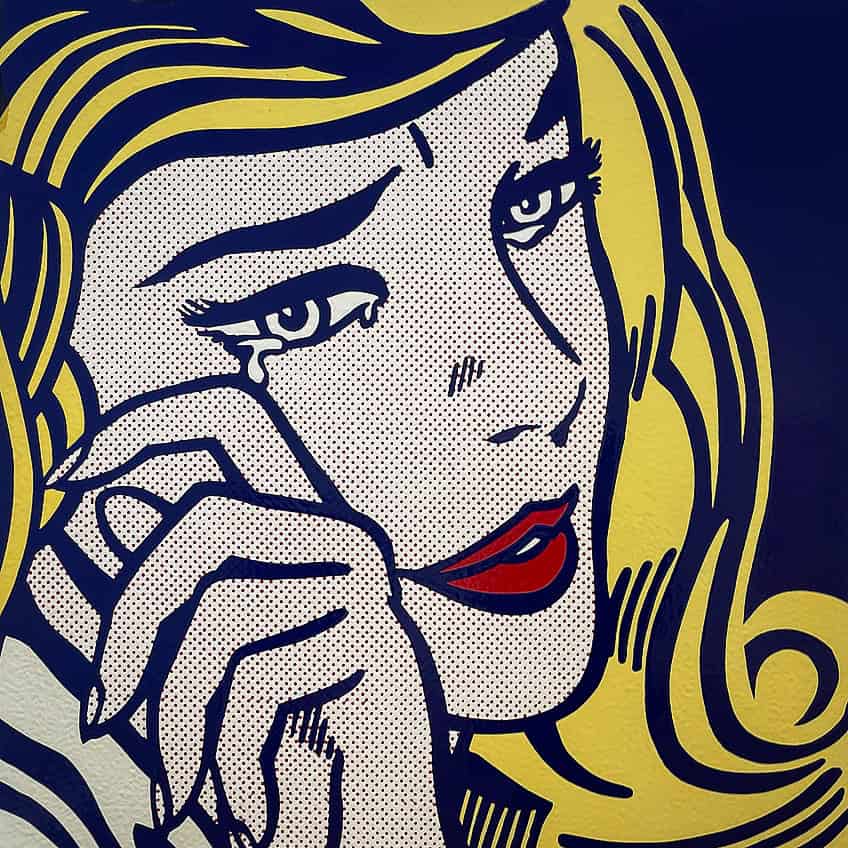
Happy Tears (1964)
“Happy Tears” depicts a woman with tears on her cheeks and her hand delicately covering her face, accompanied by a subtle smile. Unlike more anguished figures in Lichtenstein’s oeuvre, the mood here is ambiguously optimistic, signaling relief or joy.
The composition continues his tradition of bold lines, Ben-Day dots, and a vivid comic strip palette. The cropping of the face and hand shows Lichtenstein’s ability to create emotionally charged moments with minimal detail.
Held in a private collection, “Happy Tears” is often lauded for its blend of pop culture aesthetics and nuanced storytelling. It gained further fame when used on the cover of a 1970s popular novel.
| Key Fact | Detail |
|---|---|
| Year | 1964 |
| Medium | Oil and acrylic on canvas |
| Dimensions | 96.5 cm × 96.5 cm (38 in × 38 in) |
| Location | Private collection |
| Feature | Close-up, Ben-Day dots, single tear |
| Mood | Joy, relief, mixed emotion |
| Style | Pop art, comic strip, primary colours |
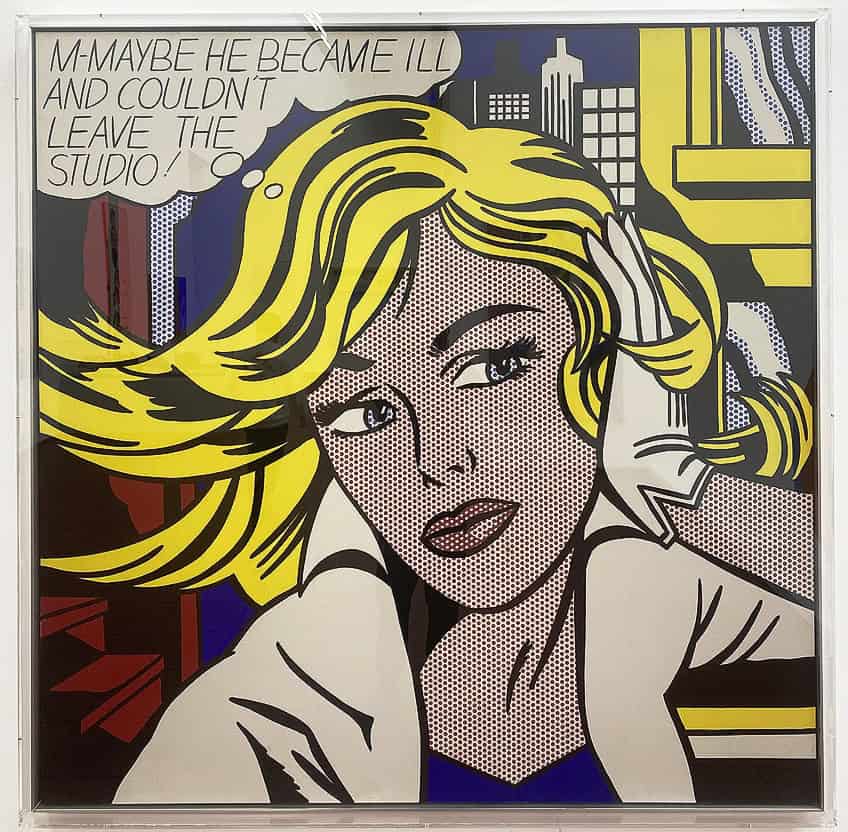
M-Maybe (1965)
“M-Maybe” features a young woman glancing sideways, appearing lost in thought, with the words in a speech bubble: “M–Maybe he became ill and couldn’t leave the studio.” The image exemplifies Lichtenstein’s mastery of narrative suggestion and emotional ambiguity, typical of his romance comic adaptations.
Identifiable by the uniform Ben-Day dots, thick outlines, and primary colours, the painting freezes a fleeting moment in a larger, unseen storyline. The cropped composition and dramatic facial expression invite the viewer to speculate about the woman’s situation.
“M-Maybe” is part of the Ludwig Forum für Internationale Kunst in Aachen, Germany. The painting is regularly featured in exhibitions exploring the nature of mass media narratives and emotional expression in pop art.
| Key Fact | Detail |
|---|---|
| Year | 1965 |
| Medium | Oil and acrylic on canvas |
| Dimensions | 101.6 cm × 101.6 cm (40 in × 40 in) |
| Location | Ludwig Forum, Aachen, Germany |
| Text in Image | “M–Maybe he became ill and couldn’t leave the studio.” |
| Visual Features | Close-up face, Ben-Day dots, thought bubble |
| Colour Palette | Primary colours, black, white |
Frequently Asked Questions
Roy Lichtenstein is recognized for his unique approach to Pop Art, drawing heavily from comic strips and commercial imagery. His work is celebrated for its distinct style and memorable icons in the art world.
What are the signature techniques used by Roy Lichtenstein in his paintings?
Lichtenstein frequently used Ben-Day dots, a method of printing common in comic books, to create his signature visual effect. He also favored bold black outlines, primary colors, and speech bubbles to mimic the look of mass-produced comic art.
His process often involved magnifying and hand-painting these dots onto large canvases, resulting in a mechanical yet painterly appearance. This combination of industrial printing techniques and fine art contexts set his work apart in the Pop Art movement.
Which artwork is considered Roy Lichtenstein’s most iconic, and why?
Lichtenstein’s painting “Whaam!” (1963) is widely regarded as his most iconic piece. It features a dramatic aerial battle scene inspired by comic books and exemplifies his use of Ben-Day dots, bold graphics, and onomatopoeic text.
“Whaam!” stands out for its scale, vibrant colors, and eye-catching composition, making it a defining example of Pop Art. This painting is frequently referenced in discussions of Lichtenstein’s influence on 20th-century art.

Isabella studied at the University of Cape Town in South Africa and graduated with a Bachelor of Arts majoring in English Literature & Language and Psychology. Throughout her undergraduate years, she took Art History as an additional subject and absolutely loved it. Building on from her art history knowledge that began in high school, art has always been a particular area of fascination for her. From learning about artworks previously unknown to her, or sharpening her existing understanding of specific works, the ability to continue learning within this interesting sphere excites her greatly.
Her focal points of interest in art history encompass profiling specific artists and art movements, as it is these areas where she is able to really dig deep into the rich narrative of the art world. Additionally, she particularly enjoys exploring the different artistic styles of the 20th century, as well as the important impact that female artists have had on the development of art history.
Learn more about Isabella Meyer and the Art in Context Team.
Cite this Article
Isabella, Meyer, “11 Famous Roy Lichtenstein Paintings That Define Pop Art.” Art in Context. December 12, 2025. URL: https://artincontext.org/10-famous-roy-lichtenstein-paintings/
Meyer, I. (2025, 12 December). 11 Famous Roy Lichtenstein Paintings That Define Pop Art. Art in Context. https://artincontext.org/10-famous-roy-lichtenstein-paintings/
Meyer, Isabella. “11 Famous Roy Lichtenstein Paintings That Define Pop Art.” Art in Context, December 12, 2025. https://artincontext.org/10-famous-roy-lichtenstein-paintings/.


