


What Are Artifacts? – The Historical and Cultural Value of Objects

What are artifacts? Tools, clothing, and art objects are a few of the types of artifacts created by humans. Historical artifacts, such as ancient world artifacts, are able to give modern humans insight into a past where there was often no written language. Let us find out more about archaeological artifacts by finding the answers to related questions on the subject, for example, what are cultural artifacts, and which item is an example of an artifact?
What Are Artifacts?
Archaeological artifacts help scholars understand ancient cultures. Archaeologists unearth ancient structures and use the historical artifacts found there to study the past.
Because many ancient societies did not actively document their histories, ancient world artifacts are often among the most important pieces of material evidence for how the people lived from day to day.
In archaeology, the generic term is “artifact,” although in museums, the comparable broad term is usually “object,” and in art history, it might be “artwork” or a more specialized term like “carving.” In various settings, the same object may carry several of these labels, with more precise terminology used for individual pieces or related groups.

There are many types of artifacts, and they are commonly mistaken for ecofacts (such as discovered animal parts) and features (elements in the landscape that appear to be manmade, usually structural); all three can be discovered together at archaeological sites.
Many studies are carried out to better understand historical artifacts and share information with the scientific community and the public. However, examining ancient world artifacts can be hampered by theft and collection, which raises ethical concerns.
Which Item Is an Example of an Artifact?
Artifacts can originate from any archaeological environment, such as grave goods buried with the deceased, places where they were used as votive offerings, residential settings, or hoards, such as those found in wells, and even ancient rubbish dumps. Pottery containers, stone tools, metal objects such as weaponry, and personal ornamentation such as jewelry, buttons, and clothes are examples of types of artifacts.
Organic remains such as animal bones found within or near human settlements are not artifacts: archaeologists classify such natural materials as ecofacts, along with charcoal from a hearth or plant material utilized for nourishment.

Artifacts Are the Results of Behavioral and Transformative Processes
A behavioral process entails collecting raw resources, producing them for a specified purpose, and ultimately discarding them. Transformational processes start at the end of behavioral processes: this is when nature or people alter the artifact after it has been buried. Both processes shape what archaeologists call an artifact’s context.
Context is described using two terms: the matrix, the physical material surrounding the artifact, and the provenience, its precise position within that matrix. Context itself falls into two categories: primary context, where the deposit is undisturbed since burial, and secondary context, where later processes have altered the matrix and provenience.
Transformational Processes
Transformational processes are what turn primary context into secondary context. Features are non-portable human activity remnants such as hearths, roadways, deposits, ditches, and other similar relics. Ecofacts, also known as biofacts, are archaeologically significant organic remains not made or modified by humans, such as pollen or animal bones.
Manuports are natural items that have been relocated but not modified by people. Seashells brought inland or spherical pebbles relocated away from the water flow that created them are two examples of manuports.
These lines are frequently blurred; a bone extracted from an animal’s body is a biofact, yet a bone fashioned into a useful utensil is an artifact.
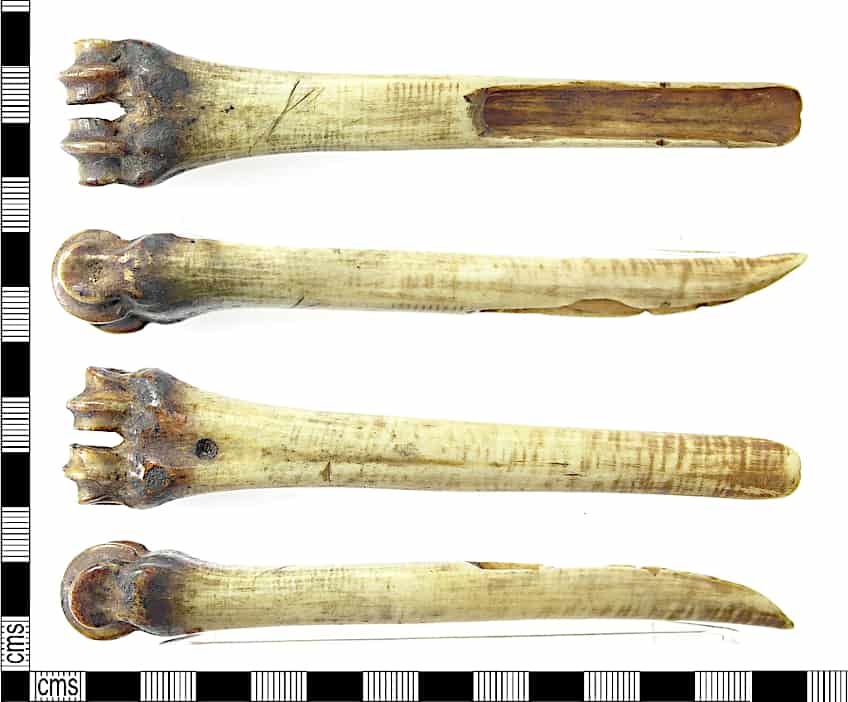
Early Stone Items
Likewise, there may be controversy about early stone items that are either simple handmade tools or occur naturally and happen to just look very similar to early human or Homo sapiens objects.
It can be difficult to discern between genuine man-made lithic artifacts and geofacts, which are naturally produced lithics that mimic man-made tools.
Artifacts can be authenticated by looking at the general features of man-made tools as well as the local features of the location. At sites, artifacts, features, and ecofacts can all be found together. Sites may feature various combinations of the three; many may contain all three, whereas others could only contain one or two.

Quick Test: Artifact, Ecofact, Geofact, or Manuport?
The four terms cause confusion because all four can turn up side by side in the same excavation. Checking who or what moved the object, and whether it shows deliberate shaping, usually settles which applies:
| Term | Moved or made by | Shows deliberate shaping or use? | Example |
|---|---|---|---|
| Artifact | Humans | Yes | A flaked stone blade |
| Ecofact (biofact) | Nature (though humans may collect or deposit them) | No | An unworked animal bone in a midden |
| Geofact | Natural forces (frost, pressure, water) | Looks worked, but is not | A stone fractured by frost that resembles a tool |
| Manuport | Humans, moved only | No | A seashell carried inland |
Sites Can Have Distinct Borders
These include walls and moats, although this is not always the case. Sites can be differentiated by categories such as geography and previous roles. The presence of artifacts at these locations can provide researchers with essential archaeological knowledge. One example would be using the position and depth of buried artifacts to create a chronological order of prior events at the site.
As Carol Kramer put it, “pots are not people,” and modern archaeologists take care to separate material culture from ethnicity, which is frequently more nuanced.
Discovery of Historical Artifacts
An artifact is any item that was purposefully made, modified, or used by humans. Some relics are discovered by chance, such as by a farmer cultivating his field or a worker laying a foundation.
Archeological excavations and artifact recovery, on the other hand, usually follow well-established protocols meant to capture as much information about a location and its artifact collection as possible.
When excavating artifacts from a site, archeologists attempt to determine and record the context in which the piece was discovered.

To establish context, the artifact’s precise vertical and horizontal placements, its relationship to the strata in which it was discovered and any cultural influences that led to its location must all be documented.
Each excavation phase is documented with precise maps and images of the site. Some archeologists collect data on discovered artifacts on specially formulated data sheets, which are then input into a computer. Before being delivered to a laboratory for study, recovered artifacts are packed in bags (and occasionally allocated field numbers).

The propensity of artifacts to deteriorate when dried too quickly makes retrieval of artifacts in damp or flooded locations more challenging. Some retrieved materials may require particular care even in dry caverns if they are to be maintained. It is critical that an archeologist conservator be onsite to aid in the recovery of artifacts in these circumstances. Plaster, resin, or latex rubber can be used to preserve delicate items.

Once conserved, the artifacts are packed for transport off-site, where documentation begins as soon as possible. Each professional participating in an excavation is typically responsible for preparing a report on his or her own discoveries at the site.
These papers will be compiled and published as a report in a scientific journal or book. Archaeologists are frequently in charge of creating a report on how the location should be managed, explored further, or preserved.

Analysis of Archaeological Artifacts
The type of artifact being analyzed influences artifact analysis. Lithic analysis is the study of stone artifacts, which are frequently in the form of tools. Stone artifacts are common in prehistoric periods and hence play an important role in addressing archaeological concerns about the past.
Lithic artifacts can assist archaeologists in studying how technology has evolved through time by displaying a diversity of tools and production processes from various eras of time.

However, this form of study can provide answers to more profound concerns, such as how civilizations were constructed and structured with respect to institutionalization and the distribution of wealth. Neutron activation, petrographic analysis, x-ray fluorescence, individual flake analysis, and mass analysis are among the lab methods that contribute to the lithic analysis process. Ceramic analysis, which is focused on the archaeological examination of pottery, is another sort of artifact analysis.
This sort of examination can assist archaeologists in learning about the basic materials used and how they were employed in the production of pottery. The laboratory techniques that enable this are mostly based on spectroscopy.

Atomic absorption and x-ray fluorescence are some of the spectroscopic techniques employed. The ceramic study provides more than simply data on raw materials and pottery manufacture; it also provides insight into historical cultures’ technology, economics, and social structure.
There is also faunal analysis, which studies ecofacts in the form of animal remains. Faunal remains, like lithic artifacts, are very common in the area of archaeology. Because animals are traded in diverse marketplaces through time and over great distances, faunal research gives insight into commerce. Faunal remains from earlier complex societies can also give information on social position, ethnic differences, and food.

Artifact dating and presenting a chronological timeline are critical components of artifact analysis. The many sorts of analyses mentioned above can all help with artifact dating. Relative dating and absolute (or chronometric) dating are the two basic methods of dating, alongside historical dating for eras with documented written evidence. When objects are put in a certain sequence in relation to one another, relative dating occurs, using techniques such as typology and seriation, whereas absolute dating methods, such as radiocarbon dating, dendrochronology, and thermoluminescence, can assign an actual age to an object or site, including in prehistoric periods with no written record.
Typology, one of the main techniques used in relative dating, classifies objects based on their substance and shape. This technique is founded on the concept that certain object styles correspond to specific time periods and that these styles vary slowly through time.
Ethics of Collecting and Repatriating Artifacts
Artifacts vs. Antiques
The two words get used as if they were interchangeable, but they answer different questions. An antique is defined mainly by age and market appeal: its value usually comes from craftsmanship, rarity, or the maker’s reputation, and it can change hands with no record of where it was found. An artifact’s value to researchers rests on its context, meaning exactly where it turned up and what it was found alongside. A pot lifted from a grave without recording that grave is still a valuable antique, but it has lost most of what it could have told archaeologists.
| Antique | Artifact | |
|---|---|---|
| Definition | An object valued mainly for its age, craftsmanship, rarity, or demand | An object made, modified, or used by humans, studied mainly for its documented context |
| Archaeological context | Not required | Central to its value: exact findspot and association with other evidence |
| Provenance | Ownership history, not necessarily where it was found | Documented findspot and stratigraphic position |
| Research value | Limited, mainly aesthetic or historical interest | Central to reconstructing past cultures and building chronologies |
| Possible overlap: the same object can be both. An artifact removed from its findspot and sold or collected still functions as an antique, but it loses most of what it could have told archaeologists. | ||
The gathering and plundering of artifacts have generated heated controversy in the archaeological community. In archaeological terminology, looting occurs when objects are taken from sites and privately acquired or sold before they can be examined and evaluated through legitimate scientific archaeology. The argument is around the contrast in ethics between archaeologists and collectors.
When it comes to artifacts, archaeologists are concerned with excavations, history, and laboratory work, whereas collectors are driven by a variety of personal interests. This prompts people to consider the archaeological issue, “Who possesses the past?”

There are also ethical concerns regarding the display of objects in museums that were acquired or removed under contested circumstances, such as the British Museum’s display of the Parthenon Marbles. The exhibition of historical artifacts belonging to non-European native peoples by European museums, notably those captured during the European colonization of Africa, has also aroused ethical concerns.
Pan-African activists and governments have pressed European museums to return artifacts taken from Africa during the colonial era. Germany, for example, transferred ownership of more than 1,000 Benin Bronzes to Nigeria in 2022, with the first pieces physically returned that December.
Ancient world artifacts, whether precious or everyday, remain the clearest record of how people lived when no written account survives. Most of what they can tell us, though, comes from where they were found and what they were found alongside rather than from the objects alone, which is why archaeologists rely on context and comparison across sites to build a timeline of a culture rather than reading any single find in isolation.
Frequently Asked Questions
Which Item Is an Example of an Artifact?
Any object made, modified, or used by humans is regarded as an artifact. Ancient artifacts can include clothing worn by our ancestors, the tools they used, or even the art they made. A famous artifact is the Venus of Willendorf, a limestone figurine carved around 30,000 years ago (c. 28,000 BCE) and discovered in 1908, which portrays a female human figure. Many Hollywood movies revolve around discovering or retrieving artifacts, such as the search for the biblical artifact known as the Ark of the Covenant in the Indiana Jones movie from the 1980s.
What Are Cultural Artifacts?
Cultural artifacts are historical artifacts that relate to art or history. This could be an ancient artifact such as a carved statue, or a historical document. Another type of artifact is a media artifact. This includes digital files, photographs, and films. Other types of artifacts include data artifacts, such as source code written by a programmer, or designs, plans, and strategies. In archaeology specifically, though, “cultural artifact” usually refers to an object unearthed at an ancient site. These historical artifacts are what give modern-day humans insight into how ancient peoples lived.
What Is the Difference Between an Artifact and an Antique?
An antique is valued mainly for its age, craftsmanship, and market demand, and it can be sold with no record of where it came from. An artifact is valued mainly for its documented context: exactly where it was found and what other objects and evidence it was found alongside. The same object can be both, but stripping an artifact from its findspot to sell it as an antique destroys most of what it could have told archaeologists.
How Can You Tell an Artifact From a Geofact or an Ecofact?
Check whether the object shows deliberate shaping or use, and by whom. An artifact carries signs of intentional human manufacture, such as regular flake scars or tool marks. A geofact only looks worked but was shaped entirely by natural forces like frost or water pressure. An ecofact is an organic remain, such as a bone or seed, that has not been modified by humans at all.

Isabella studied at the University of Cape Town in South Africa and graduated with a Bachelor of Arts majoring in English Literature & Language and Psychology. Throughout her undergraduate years, she took Art History as an additional subject and absolutely loved it. Building on from her art history knowledge that began in high school, art has always been a particular area of fascination for her. From learning about artworks previously unknown to her, or sharpening her existing understanding of specific works, the ability to continue learning within this interesting sphere excites her greatly.
Her focal points of interest in art history encompass profiling specific artists and art movements, as it is these areas where she is able to really dig deep into the rich narrative of the art world. Additionally, she particularly enjoys exploring the different artistic styles of the 20th century, as well as the important impact that female artists have had on the development of art history.
Learn more about Isabella Meyer and the Art in Context Team.
Cite this Article
Isabella, Meyer, “What Are Artifacts? – The Historical and Cultural Value of Objects.” Art in Context. February 22, 2023. URL: https://artincontext.org/what-are-artifacts/
Meyer, I. (2023, 22 February). What Are Artifacts? – The Historical and Cultural Value of Objects. Art in Context. https://artincontext.org/what-are-artifacts/
Meyer, Isabella. “What Are Artifacts? – The Historical and Cultural Value of Objects.” Art in Context, February 22, 2023. https://artincontext.org/what-are-artifacts/.