

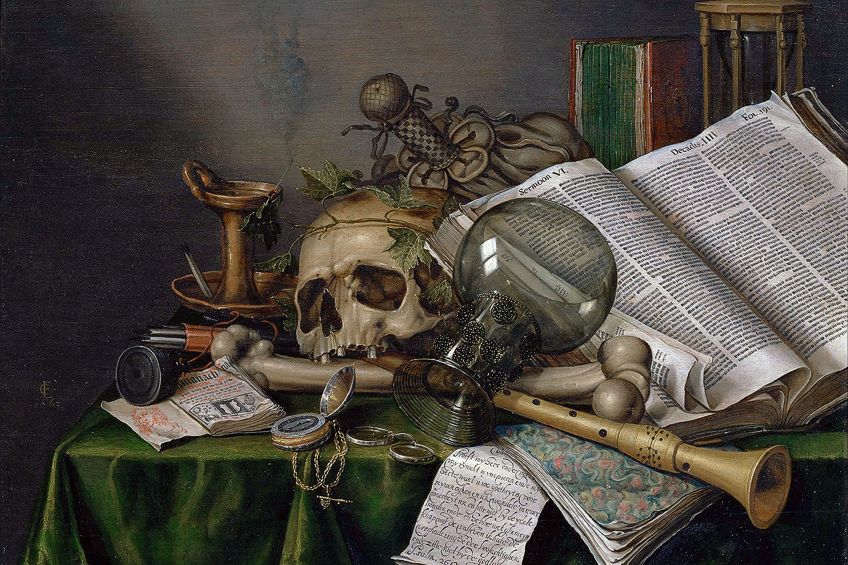
Vanitas – Detailed Definition, History and Examples

Vanitas is an artistic theme that confronts the brevity of life, the instability of achievement and pleasure, and the certainty of death. It flourished in 17th-century Dutch and Flemish still life, but its sources and reach are broader: biblical language, memento mori traditions, humanist learning, confessional debate, global trade, collecting, and the display of artistic skill all shaped its meanings.
What Is Vanitas?
Vanitas pictures ask viewers to weigh worldly goods against time and mortality. A skull, extinguished candle, watch, bubble, fading flower, toppled glass, or decaying fruit may signal transience. Books, maps, instruments, weapons, jewelry, crowns, and luxury vessels can represent learning, music, power, wealth, and sensual pleasure—valuable human pursuits that nevertheless cannot defeat death.
The theme did not originate as one fixed 16th-century Dutch genre. Medieval and Renaissance memento mori images, funerary art, portraits with skulls, religious texts, emblems, and allegories supplied precedents. Specialized vanitas still lifes became especially prominent in Leiden and other centers of the Dutch Republic during the 1620s and 1630s, while related works appeared in Catholic Flanders, Spain, France, Germany, and elsewhere.
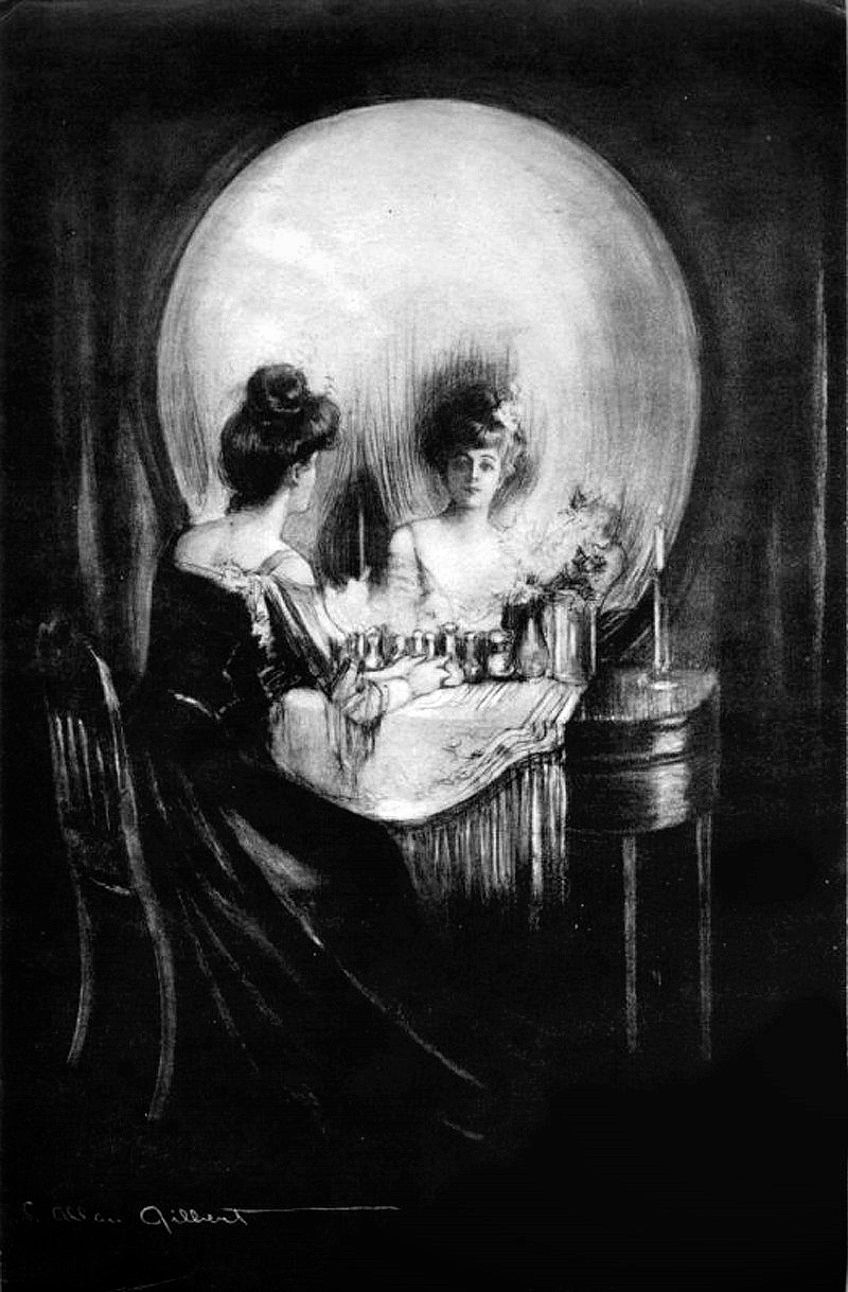
Charles Allan Gilbert’s 1892 illustration is a later optical double image rather than evidence for 17th-century Dutch Vanitas. From one reading, a woman sits at a mirror; from another, the whole arrangement forms a skull. Its popularity shows how readily modern visual culture adapted the older theme.
Vanitas works are not uniformly dark, chaotic, or condemnatory. Many are exquisitely balanced and sensuously painted. Their attraction creates a productive contradiction: the painting displays costly things and extraordinary skill while warning that possession, beauty, knowledge, and fame pass away. A viewer may be invited to moral reflection, Christian hope, aesthetic pleasure, or all three.
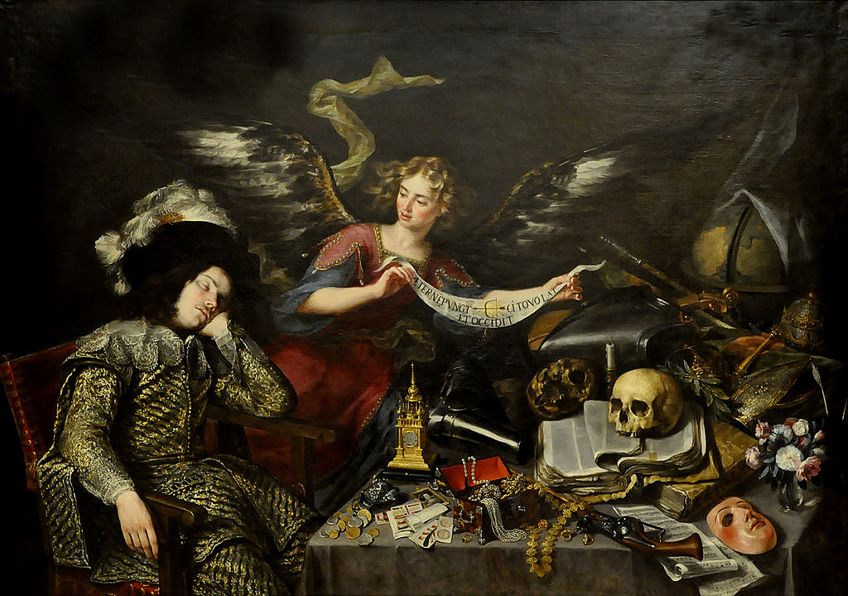
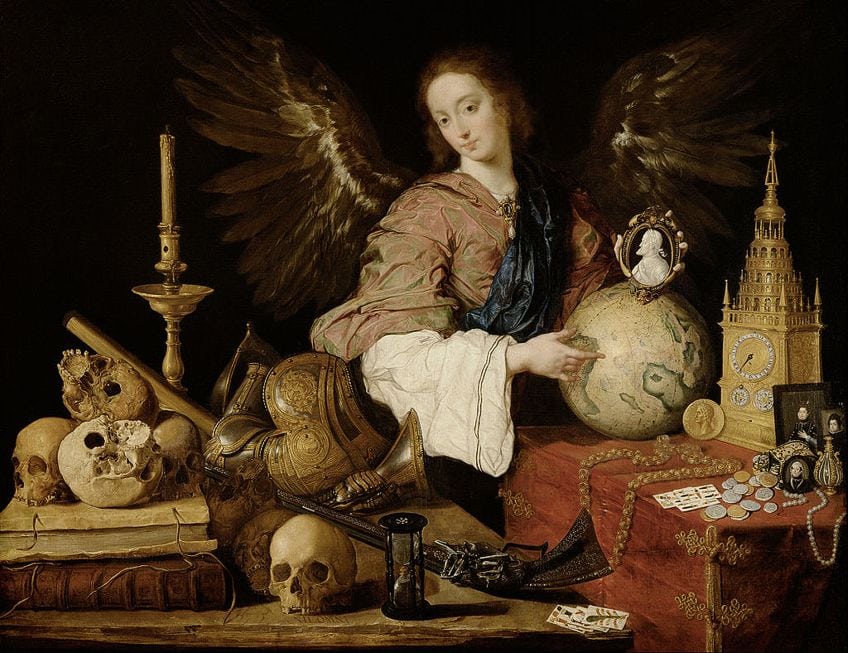
The Spanish Knight’s Dream demonstrates why Vanitas cannot be explained only through Dutch Protestantism. An angel unfurls a warning above luxury, armor, books, weapons, money, and signs of rank. The painting’s attribution and dating have been discussed in scholarship, so collection-level metadata should guide publication.
Understanding the Vanitas Art Definition
Latin vanitas can mean emptiness, worthlessness, unreality, or vanity. The art-historical term is connected to Ecclesiastes: “vanity of vanities; all is vanity” in the King James Bible. The underlying Hebrew word hevel literally evokes breath or vapor and can suggest transience, enigma, or futility. Calling “vanity” simply a mistranslation erases the word’s range and long history of interpretation.
Vanitas overlaps with memento mori, “remember that you must die,” but the terms are not identical. Any reminder of mortality can be memento mori; Vanitas usually develops a broader meditation on the fleeting status of goods, accomplishments, pleasures, and human life.
Vanitas Reminds Us of Vanities
“Vanities” are not limited to personal appearance. A crown may signify political power, a globe worldly knowledge or ambition, a musical instrument pleasure and harmony, books learning, and coins wealth. Their meanings are not a universal code. Context, inscriptions, condition, placement, and contemporary emblem books can change how an object functions.
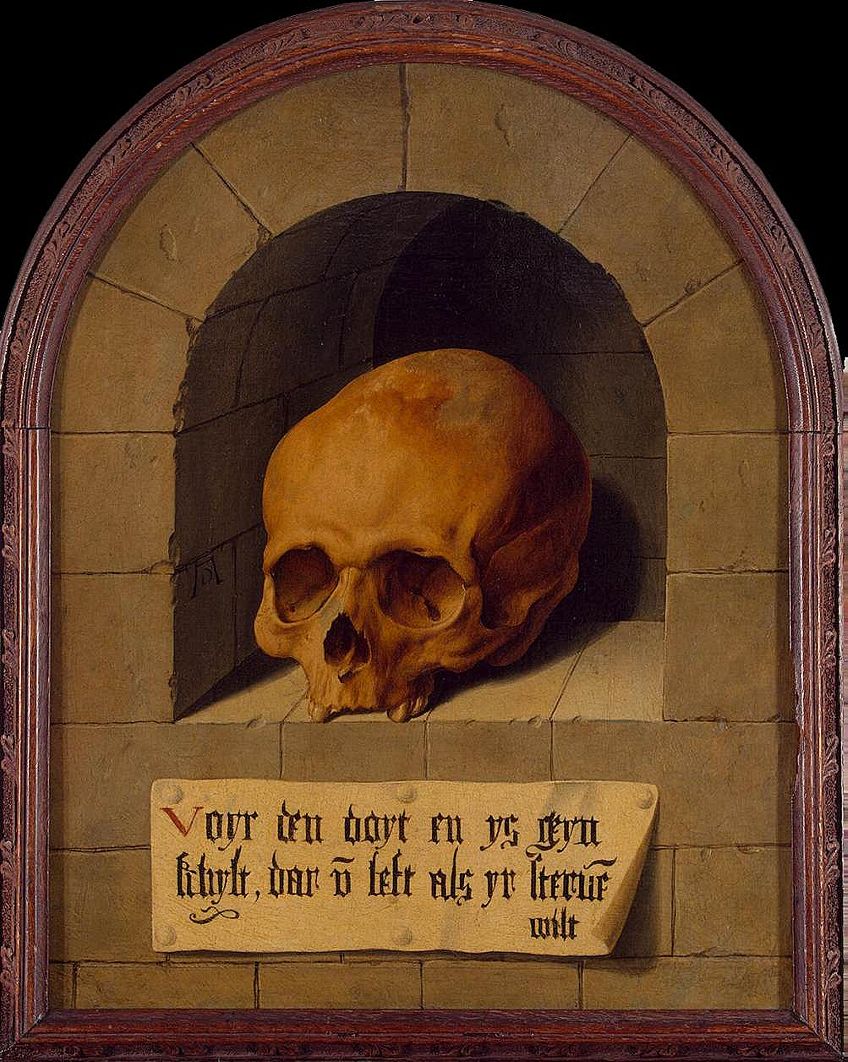
Bruyn’s skull may originally have formed the reverse of a portrait. Turning the panel would confront the sitter’s living likeness with its bodily end. Such portrait reverses are important precedents for independent Vanitas compositions.
The Relationship Between Vanitas and Religion
Christian teaching gave Vanitas much of its moral vocabulary: earthly life is brief, pride is dangerous, and salvation exceeds material success. Yet religious interpretation varied by region, patron, and confession. The theme served Reformed households, Catholic devotional culture, courtly allegory, and secular collecting.
The Reformation and Counter-Reformation intensified debates about images, luxury, death, and proper devotion, but they did not generate one common program. Catholic authorities did not generally advocate the eradication of sacred images; the Council of Trent affirmed their use under regulation. Iconoclasm was associated especially with certain Protestant movements. Vanitas images therefore belong to a contested visual world, not a simple Catholic-versus-Protestant contrast.
The Influence of Protestantism
The Dutch Reformed Church held a privileged position in the Dutch Republic, but the population remained confessionally diverse. Catholics, Mennonites, Jews, Lutherans, Remonstrants, and others participated in its culture and markets. Calvinist suspicion of religious images in churches encouraged some artists and patrons toward subjects suitable for homes, but market demand, urban wealth, collecting, guilds, and artistic specialization were also crucial.
Vanitas could support introspection by turning ordinary objects into moral prompts. It was not merely “built on Protestant ethics,” as Catholic Spanish and Flemish examples make clear.
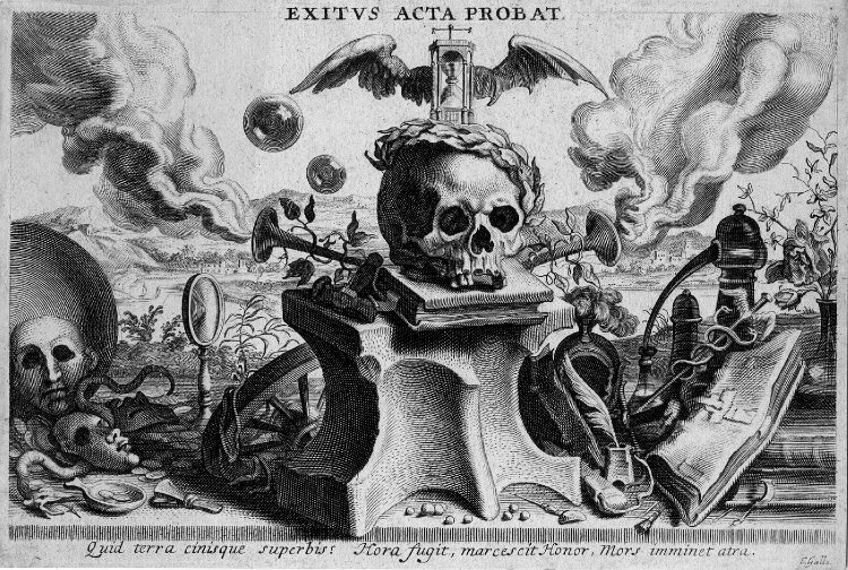
The inherited English translation is unreliable. The Latin more nearly asks why earth and ash are proud, then warns that the hour flees, honor withers, and dark death threatens. The print is associated with Nicolaas van der Horst’s design and Cornelis Galle II’s engraving, a collaboration not fully reflected in the caption.
Vanitas and Realism
Close observation made glass, metal, paper, fruit, bone, and reflection convincingly present. This naturalism does not separate Protestant “earthly” art from supposedly mystical Catholic art; artists across confessions used illusion, symbolism, and material splendor. Realism can intensify the paradox: the more persuasively an object is painted, the more strongly its depicted fragility registers.
Trompe-l’œil painters such as Cornelis Norbertus Gijsbrechts turned deception itself into a theme. A seemingly tangible object is only paint, making perception another form of uncertainty.
Vanitas and Still Life
Vanitas is often treated as a still-life subgenre, but not every banquet, flower, or luxury still life is Vanitas. A convincing identification depends on the combination of motifs, inscriptions, title, provenance, and historical interpretation. An overturned cup or half-peeled lemon may suggest interrupted pleasure; it need not convert every breakfast piece into a sermon on death.
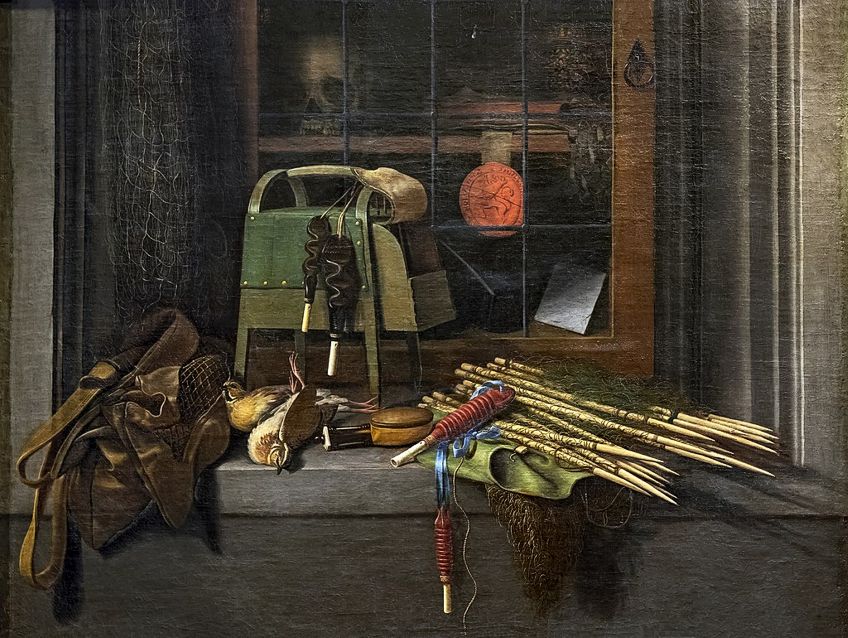
Gijsbrechts’s hunting equipment can evoke death and the end of activity, but it also showcases illusionistic mastery. Its Vanitas force comes from that combination rather than one isolated object.
Characteristics of a Vanitas Artwork
Vanitas works combine material attraction with temporal instability. Diagonals, precarious stacks, objects extending over an edge, reflections, opened containers, and directional light can make a still arrangement feel momentary. Dark backgrounds are common, but floral and fruit garlands may be bright and abundant.
Themes
Core themes include mortality, passing time, fragile beauty, uncertain fame, limits of knowledge, and the moral use of prosperity. These ideas connect to earlier death imagery without making every Vanitas picture morbid. Hope, redemption, and the responsible enjoyment of creation may counterbalance warning.
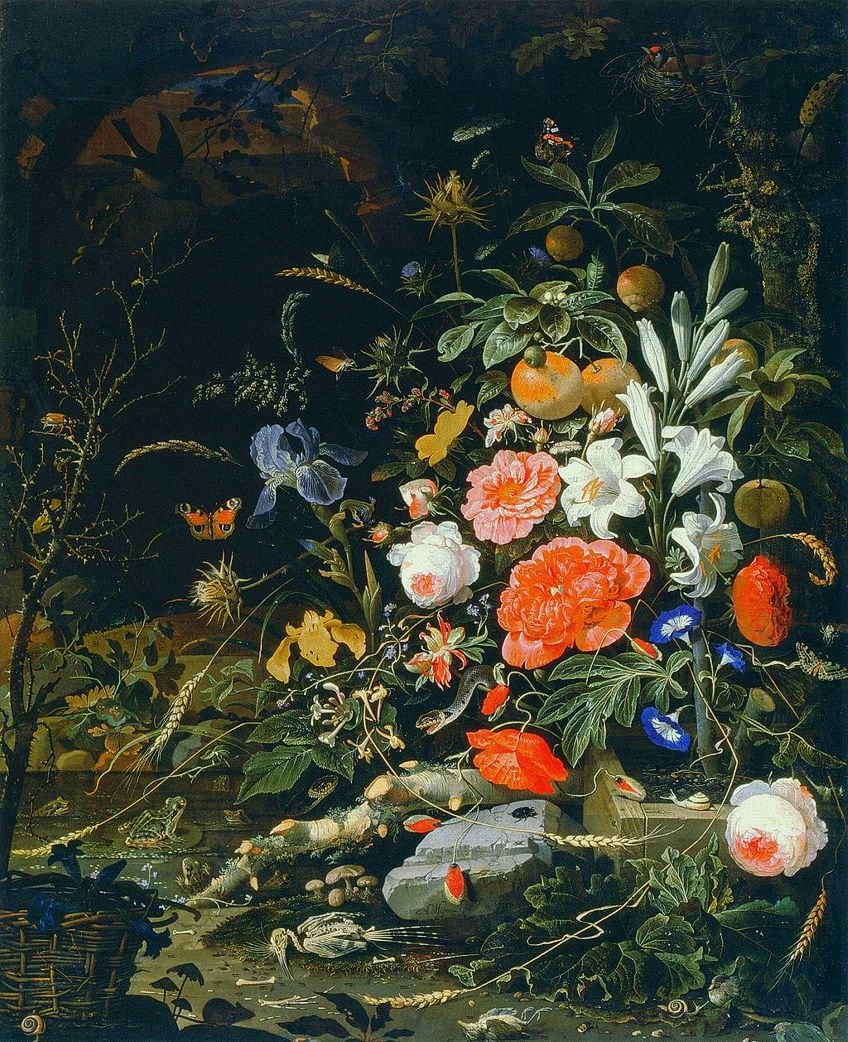
Mignon’s abundant ecosystem joins bloom, ripeness, predation, fungus, and bone. Life and death are simultaneous, not two separate categories.
Motifs
| Motif | Possible Association | Why Context Matters |
|---|---|---|
| Skull, bone, extinguished flame | Death and bodily end | A skull can also concern anatomy, scholarship, or a named sitter |
| Watch, hourglass, smoke, bubble | Passing time and fragility | Placement and inscriptions can shift emphasis |
| Flowers, fruit, food | Beauty, appetite, decay | They also celebrate seasons, trade, rarity, and skill |
| Books, maps, globe, instruments | Knowledge, worldliness, music | The painting may honor as well as limit learning |
| Coins, jewels, armor, crowns | Wealth, status, military or political power | Patronage can make critique deliberately ambivalent |
Symbolism Within Vanitas Paintings
Symbols work through relationships. A violin beside a broken glass may join harmony to interruption; a globe beneath a skull can place worldly reach under mortality; a reflection may insert the absent artist or viewer. There is no requirement that a skull appear, and symbols rarely yield one final translation.
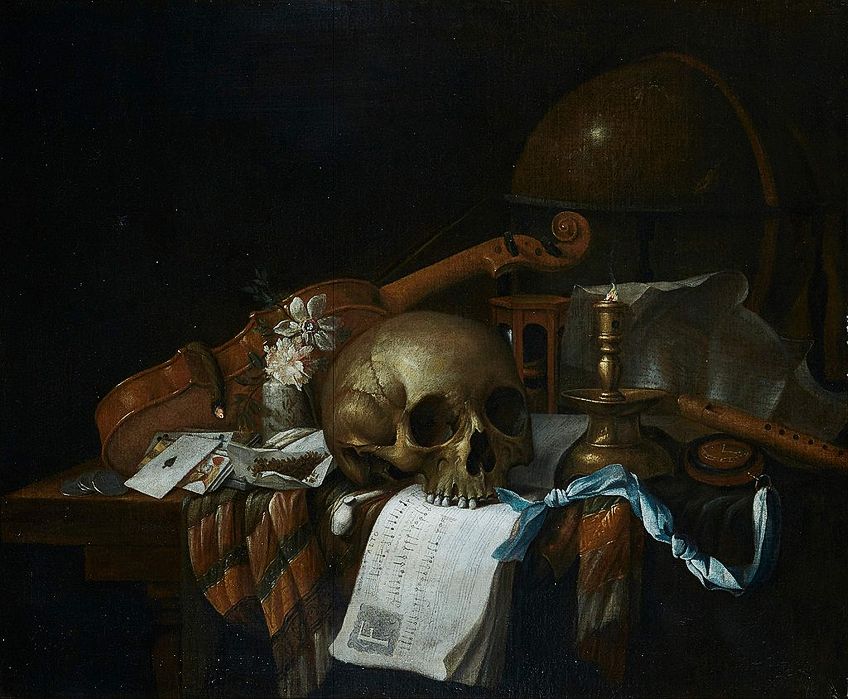
Here, art, play, knowledge, travel, time, and death crowd one surface. The draped table and objects near its edge make stability feel temporary.
The Legacy of Vanitas Art
Vanitas changed as Dutch still-life markets and religious culture changed, but it did not end at one date or because reform “lost its force.” Trompe-l’œil, flower painting, banquet pieces, portraiture, print, and allegory continued to exchange motifs. Later artists returned to skulls, clocks, flowers, mirrors, food, photography, and decaying materials whenever modern conditions made time and consumption newly urgent.
Modern and contemporary uses are not automatically Vanitas. Andy Warhol’s skulls and Damien Hirst’s death-centered works can enter the conversation, but their meanings also concern mass media, celebrity, commodity, medicine, display, and the art market. The theme’s contradiction—beautiful object versus warning about objects—remains especially productive in consumer culture.
Famous Vanitas Artists and Their Artworks
The following works show the theme moving across portraits, genre scenes, banquet pieces, flower pictures, and allegorical still life. Some are central Vanitas examples; others are precursors or border cases.
Hans Holbein the Younger: The Ambassadors (1533)
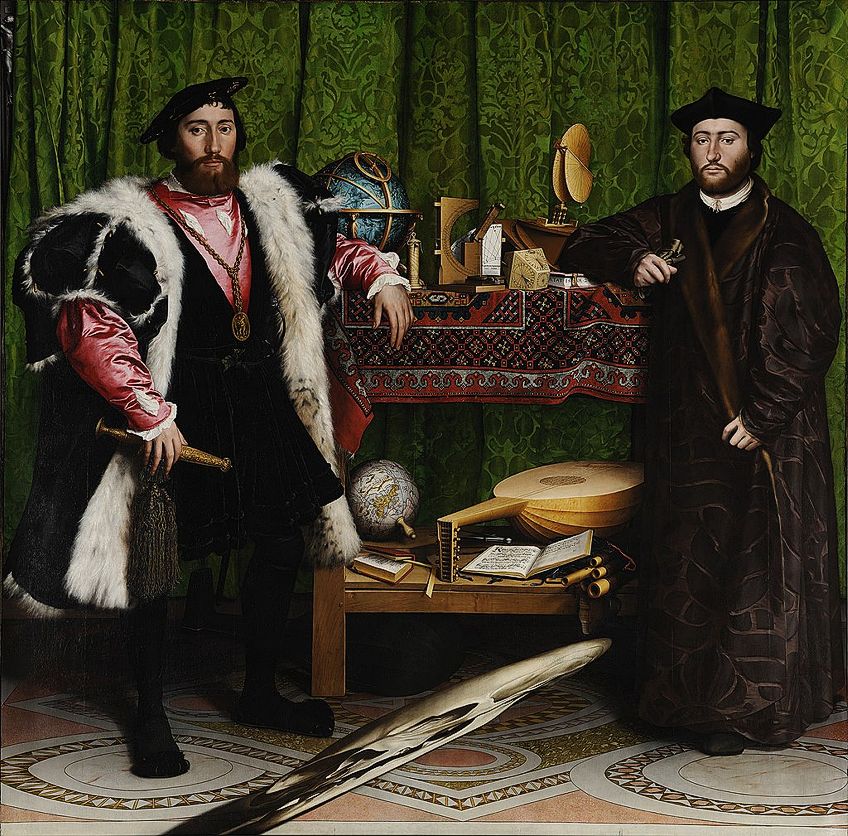
Holbein portrayed Jean de Dinteville and Georges de Selve amid instruments of learning, diplomacy, music, and measurement. An anamorphic skull resolves from an oblique viewpoint, while a partly hidden crucifix offers a Christian counterpoint. The painting predates the specialized Dutch Vanitas still life and is best described as a sophisticated precursor and memento mori image.
Pieter Claesz: Vanitas Still Life with violin and glass ball (c. 1628)
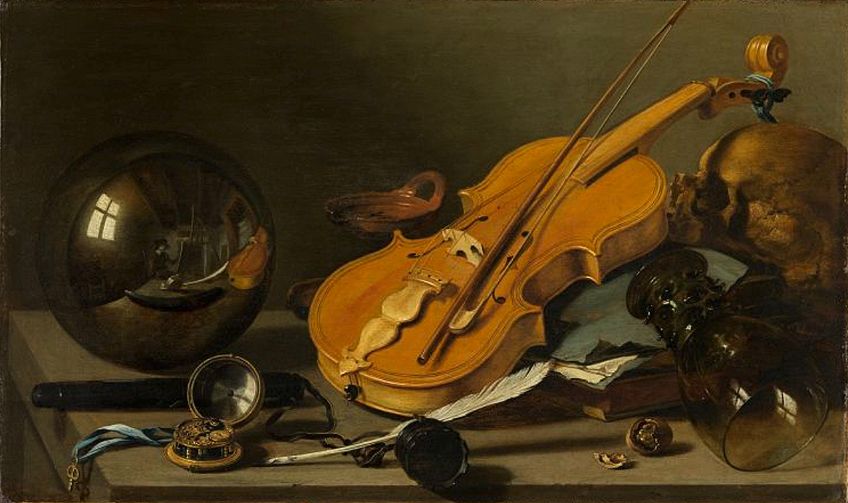
Pieter Claesz specialized in tonal banquet and Vanitas still lifes. In this work, a skull, extinguished lamp, watch, violin, books, pen, and cracked nut gather around a glass sphere. The sphere reflects the room and the painter at his easel, turning artistic self-representation into another meditation on time.
Antonio de Pereda: Allegory of Vanity (1632 – 1636)
Pereda’s allegory assembles armor, crowns, money, jewelry, portraits, books, a globe, clock, skulls, and an angel holding a cameo-like image. Temporal and spiritual power are displayed at their most seductive and then placed under death. Spanish Catholic Vanitas here is explicit, learned, and materially lavish.
Jan Miense Molenaer: Allegory of Vanity (1633)
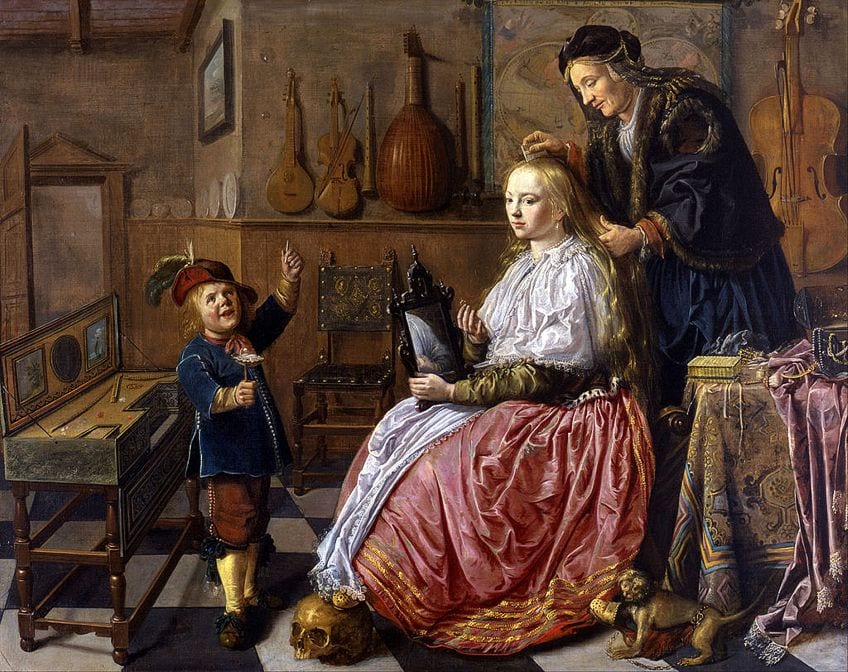
Molenaer embeds moral warning in a lively genre scene. Music, fine clothing, drink, and a wall map suggest cultivated pleasure, while the work’s full object history and figures complicate any simple inventory of sins. Genre painting can communicate Vanitas through action and social behavior rather than a skull-centered still life.
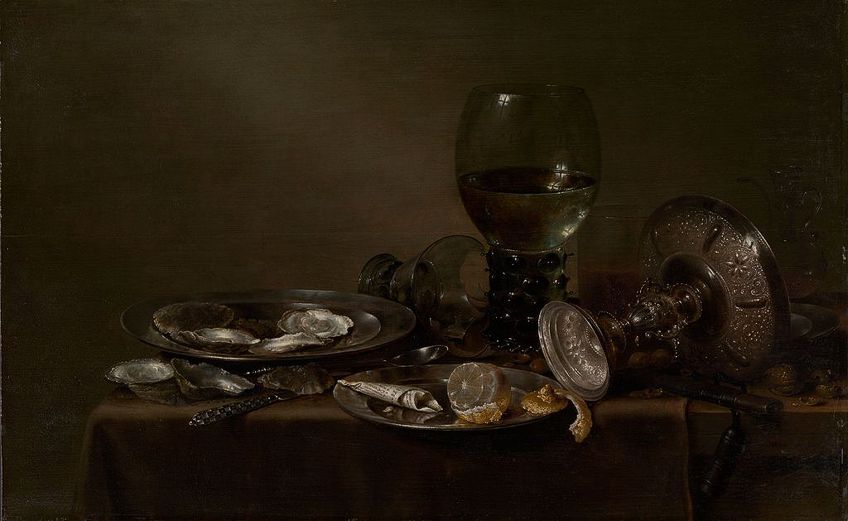
Willem Claesz: Still Life with Oysters (1635)
The artist is Willem Claesz. Heda. His 1635 arrangement of oysters, silver tazza, glassware, lemon, and table linen belongs to the refined tonal banquet tradition. Interrupted food, fragile glass, and a tipped vessel may imply transience, but the absence of an explicit skull does not itself make the work Vanitas. Museum cataloguing and close object-level interpretation should determine the label.
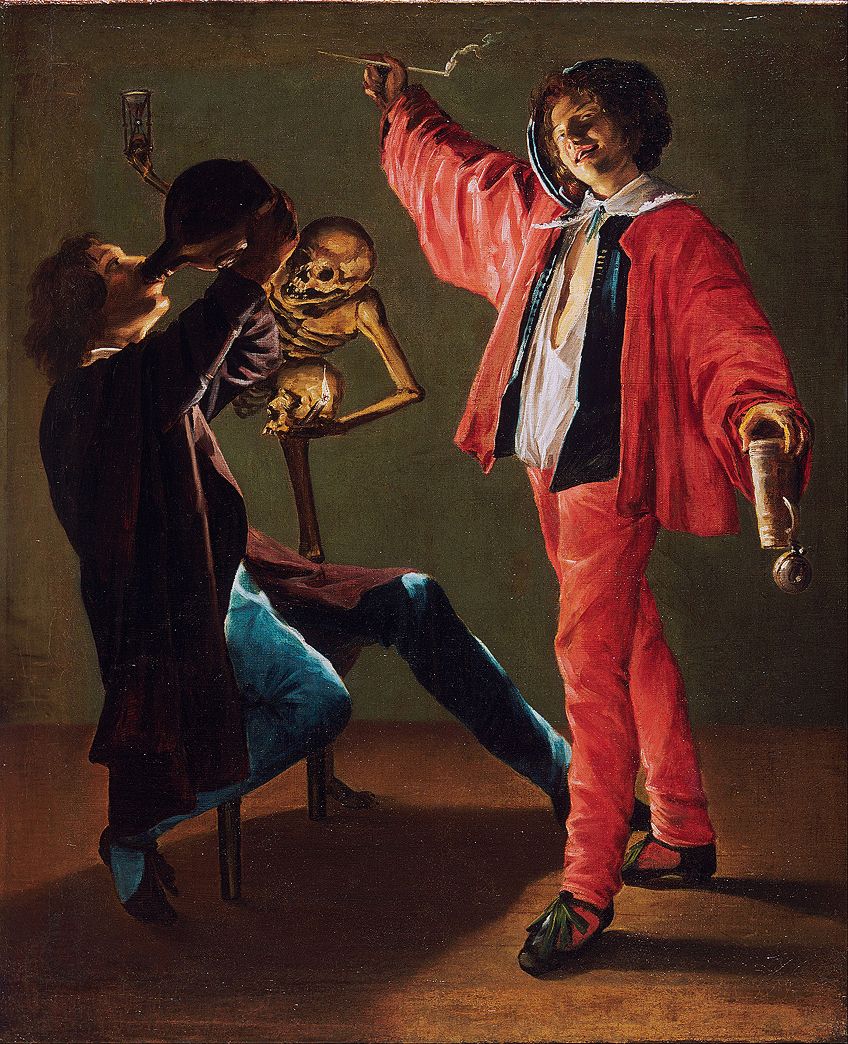
Judith Leyster: The Last Drop (The Gay Cavalier) (1639)
Two revelers drink as a skeleton presents an hourglass and skull, converting festive excess into memento mori. Ultraviolet and conservation research has helped recover the skeleton after it was obscured. Philadelphia Museum sources currently differ between c. 1629 and c. 1639 presentations, so the exact cataloguing date requires confirmation.
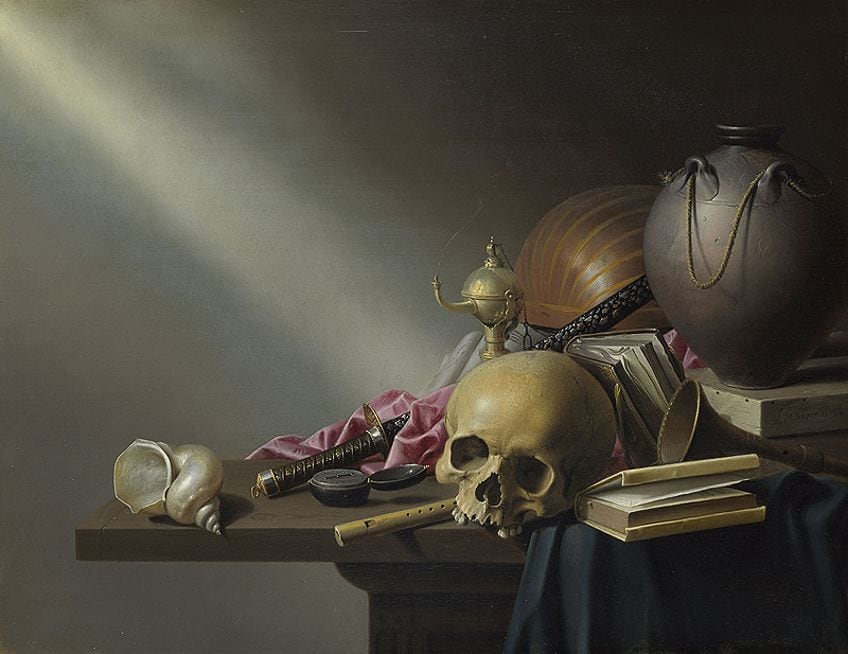
Harmen van Steenwyck: Still Life: An Allegory of the Vanities of Human Life (1640)
Steenwyck’s c. 1640 painting places a skull, chronometer, shell, sword, books, lamp, and musical instruments in a diagonal beam of light. Each object carries both value and limit: knowledge ends, music falls silent, power cannot protect, and exotic rarity remains earthly.
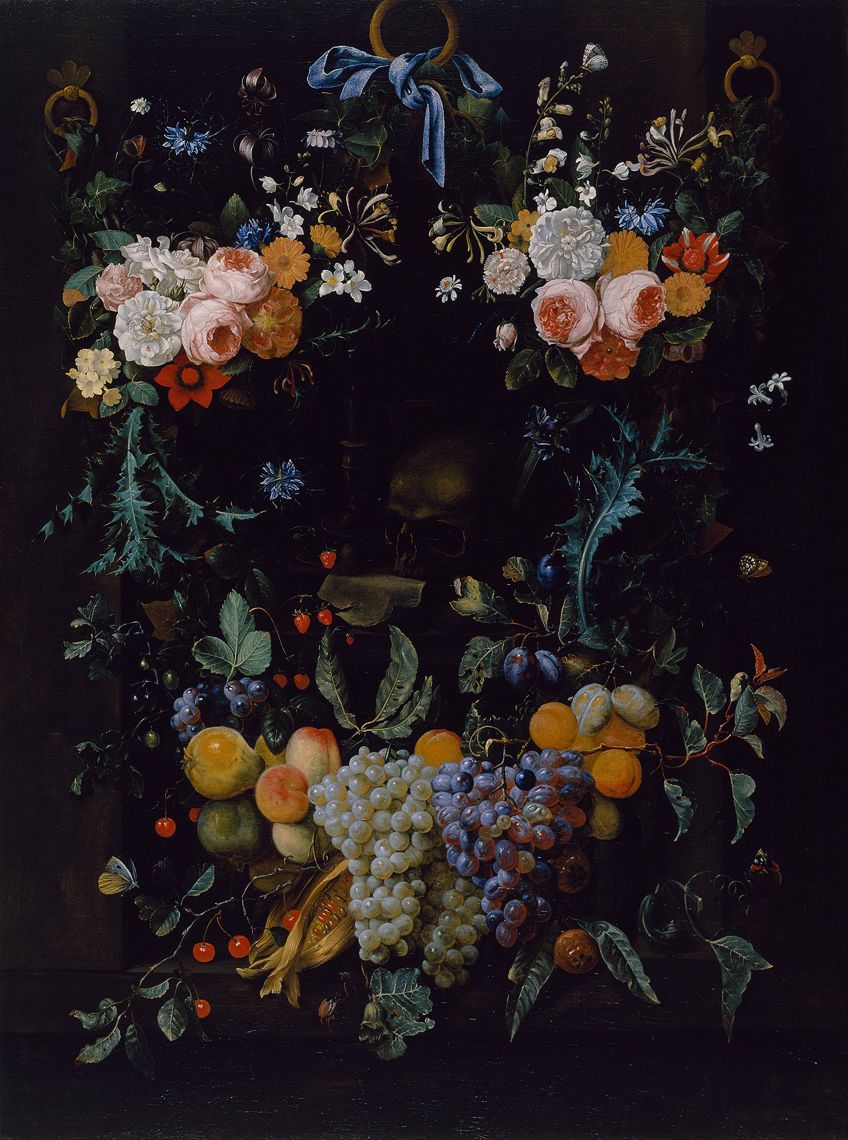
Joris van Son: Allegory on Human Life (1658 – 1660)
Van Son surrounds a central scene with a garland of fruit, flowers, grain, and luxury. Ripeness and decay coexist. The work’s bright abundance shows that Vanitas can seduce the eye before redirecting attention toward mortality and salvation.
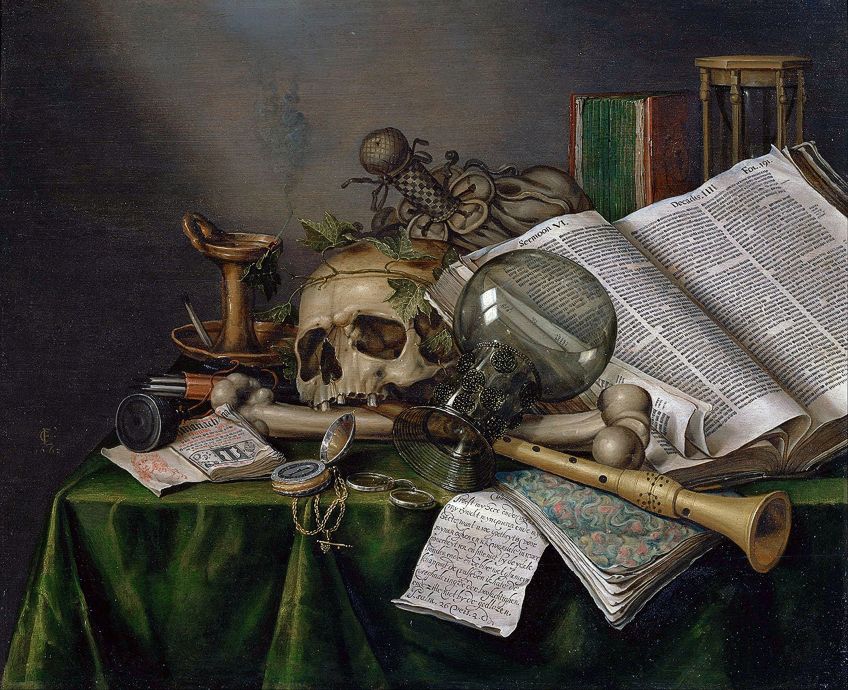
Edwaert Collier: Vanitas – Still Life with Books and Manuscripts and a Skull (1663)
Collier repeatedly combined books, instruments, globes, jewelry, skulls, and inscriptions. His birth year is not secure enough to make the inherited claim that he was exactly 21 in 1663. What matters here is the deliberate crowding of learning, art, and wealth under a skull’s gaze.
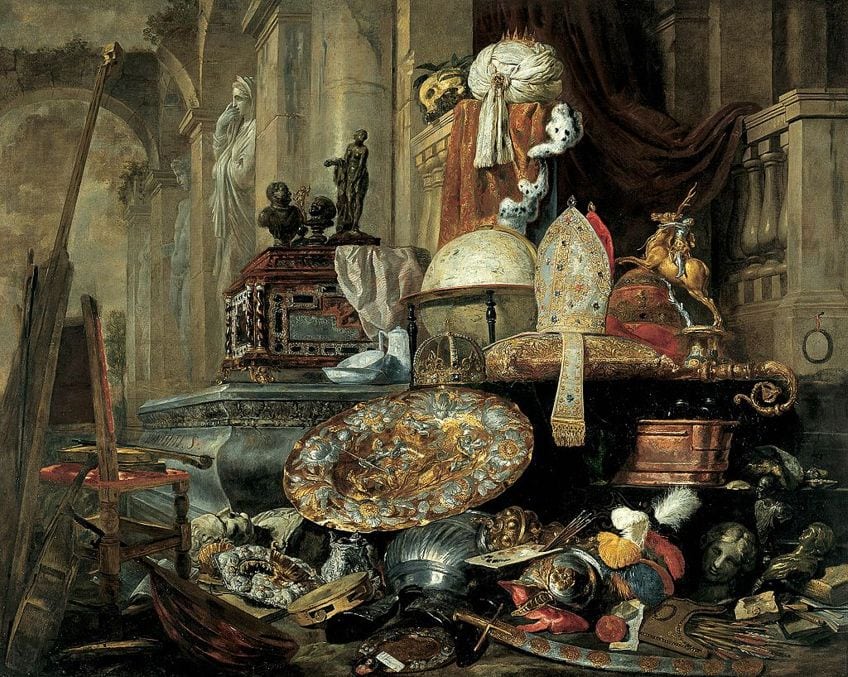
Pieter Boel: Allegory of the Vanities of the World (1663)
Boel’s monumental composition piles ecclesiastical and temporal regalia, armor, textiles, vessels, books, and art objects in a ruined setting. A crowned skull and circular form of eternity place institutions and empires under time. The lavish scale makes the warning inseparable from spectacle.
Vanitas does not say that life is worthless. Its strongest works hold pleasure, knowledge, beauty, mortality, and responsibility in unresolved relation. The viewer is asked not merely to decode a skull, but to decide how to live with time.

Isabella studied at the University of Cape Town in South Africa and graduated with a Bachelor of Arts majoring in English Literature & Language and Psychology. Throughout her undergraduate years, she took Art History as an additional subject and absolutely loved it. Building on from her art history knowledge that began in high school, art has always been a particular area of fascination for her. From learning about artworks previously unknown to her, or sharpening her existing understanding of specific works, the ability to continue learning within this interesting sphere excites her greatly.
Her focal points of interest in art history encompass profiling specific artists and art movements, as it is these areas where she is able to really dig deep into the rich narrative of the art world. Additionally, she particularly enjoys exploring the different artistic styles of the 20th century, as well as the important impact that female artists have had on the development of art history.
Learn more about Isabella Meyer and the Art in Context Team.
Cite this Article
Isabella, Meyer, “Vanitas – Detailed Definition, History and Examples.” Art in Context. May 10, 2021. URL: https://artincontext.org/vanitas/
Meyer, I. (2021, 10 May). Vanitas – Detailed Definition, History and Examples. Art in Context. https://artincontext.org/vanitas/
Meyer, Isabella. “Vanitas – Detailed Definition, History and Examples.” Art in Context, May 10, 2021. https://artincontext.org/vanitas/.



I disagree with your assessment of Judith Leyster’s: The Last Drop (The Gay Cavalier) (1639)
The word gay has had multiple meanings over time, but didn’t come to mean a homosexual male til around the 1920s/30s. The word’s original meaning meant something to the effect of “joyful”, “carefree”, “full of mirth”, or “bright and showy”. In the early 17th century, the word began to be associated with immorality. By the mid 17th century, according to an Oxford dictionary definition at the time, the meaning of the word had changed to mean “addicted to pleasures and dissipations. Often euphemistically: Of loose and immoral life”. This is an extension of one of the original meanings of “carefree”, meaning more or less uninhibited.
So this painting shows two young men, carefree and celebrating. If you look into it a bit, apparently they are binging on alcohol on the last night before Lent. The skeleton represents the consequences of their overindulgence, and holds both a skull and an hourglass, which they are ignoring. It fits well within the theme of this page, but does not necessarily have anything to do with their sexuality.
Thank you for your thoughtful comment and detailed historical insights. You are absolutely correct that the term “gay” had a different meaning in the 17th century compared to its modern usage. The title The Gay Cavalier refers to the carefree, hedonistic lifestyle of the men depicted, rather than their sexual orientation. As you noted, “gay” in that era often meant “joyful,” “carefree,” or even “immoral.”
We appreciate your feedback, and we’ve already updated our blog post to reflect this historical context more accurately. The revised description now focuses on the themes of indulgence and excess, potentially tied to pre-Lenten celebrations, while also emphasizing the Vanitas elements of the painting. The skeleton, with its skull and hourglass, serves as a stark reminder of mortality and the consequences of overindulgence.
Thank you for helping us enhance our interpretation of Judith Leyster’s The Last Drop! We value the input of our readers in creating richer discussions about art.