

Jean Dubuffet: Biography, Art Brut, and Major Works

Jean Dubuffet moved from gritty paintings that seem built out of city soil to enormous black-and-white environments that visitors can enter. Behind that transformation lies an unusually delayed career, a restless search for new materials, and a complicated relationship with Art Brut. Following his major changes in style makes his rough portraits, cellular Hourloupe figures, performances, and architectural spaces much easier to recognize.
Who Was Jean Dubuffet?
Jean Philippe Arthur Dubuffet was a French painter, sculptor, printmaker, writer, collector, and creator of large environments. Born in Le Havre on July 31, 1901, he died in Paris on May 12, 1985. Although he received some formal instruction when young, his sustained professional career did not begin until 1942, when he was 41.

That late commitment helps explain the compressed energy of his subsequent development. Over four decades, Dubuffet repeatedly changed how a work could be made and experienced. He mixed pigment with sand and gravel, scratched into thick surfaces, printed from plants, constructed collages from painted fragments, designed moving stage works, and enlarged his graphic vocabulary into spaces that surrounded the viewer.
His significance also rests on two related but separate activities. He produced an internationally exhibited body of art under his own name, while collecting and theorizing works that he called Art Brut. His project challenged assumptions about training and cultural authority, but Dubuffet himself was not an anonymous creator working beyond the art world. He dealt with galleries, published texts, formed relationships with writers and artists, and received major museum exhibitions.
From Wine Merchant to Postwar Artist
Dubuffet’s biography does not follow the familiar path from academy to studio success. Art and the wine trade alternated for years before painting became his permanent occupation. The interruptions matter because they prevent his eventual career from looking inevitable.

Le Havre, Paris, and the Long Interruption
Dubuffet grew up in a wine-merchant family in Le Havre. He attended evening art courses there and moved to Paris in 1918 after completing his secondary-school diploma. His time at the Académie Julian lasted only about six months. He then continued independently rather than completing a long academic program, which makes the label “self-taught” only partly accurate.

In 1924, he stopped painting. He traveled to Buenos Aires and became involved in the family wine business, later establishing his own enterprise in the Bercy district of Paris. A return to art in the 1930s did not last. Business demands and wartime conditions interrupted his work again, and he resumed trading wine.
The Decisive Return of 1942
The lasting change came in 1942, when Dubuffet committed himself fully to painting. He entered a Parisian cultural network that included the writer and editor Jean Paulhan, an important supporter who also became a repeated portrait subject. Paul Éluard, Francis Ponge, Henri Michaux, and painter Jean Fautrier were among the other figures in his postwar circle.
Galerie René Drouin presented Dubuffet’s first solo exhibition in Paris in 1944. The timing placed his coarse surfaces and deliberately flattened figures in a city emerging from occupation, but the paintings did not depend on conventional heroic imagery. Dubuffet focused instead on bodies, faces, walls, streets, and soil, often treating all of them as substances embedded in the same resistant surface.
Paris, New York, and Museum Recognition
Pierre Matisse Gallery organized Dubuffet’s first New York solo exhibition in 1947. He later lived in New York during 1951 and 1952, but recognition remained gradual rather than immediate. His first museum retrospective took place at Schloss Morsbroich in 1957. In 1962, the Museum of Modern Art organized a traveling retrospective, giving American audiences a broader view of the shifts already underway in his work.
These dates reveal a career built through successive thresholds. Dubuffet was already in his forties at his first solo exhibition and in his fifties at his first museum retrospective. Yet he did not stabilize around one successful formula. Museum recognition coincided with further experiments in printed nature, spattered surfaces, and eventually the Hourloupe cycle.
Art Brut and Cultural Authority
Art Brut, literally “raw art,” was Dubuffet’s historical category for work developed beyond official art institutions and their professional conventions. It became a program of research, collecting, exhibition, and argument. A fuller account of Art Brut and outsider art helps place the term within its later history, but Dubuffet’s original project had a specific network and chronology.

From Research Trips to the Compagnie de l’Art Brut
Dubuffet began systematic research into such work during a Swiss trip in 1945. In 1947, the Foyer de l’Art Brut opened as a place to gather and present discoveries. The Compagnie de l’Art Brut followed in 1948, bringing supporters together around the collection. A major public exhibition in 1949 was accompanied by Dubuffet’s manifesto on cultural art and Art Brut.
This activity was more than a search for a rough visual style. Dubuffet was interested in work made without close dependence on academies, galleries, museums, or established aesthetic expectations. He questioned the idea that official culture should determine which art mattered. The category arose through his choices as a collector and theorist, so it should be understood historically rather than treated as a neutral label for every unconventional image. Nor should the creators in the collection be reduced to diagnoses or assumed states of mind.
Dubuffet’s Work Versus the Work He Collected
Dubuffet’s collecting affected how he questioned polished technique and cultural prestige, but his own body of work and the Art Brut collection remain distinct. His paintings were signed, exhibited by established dealers, reviewed, purchased, and shown by museums. He was an informed professional participant in the very cultural system he criticized.
Calling every Dubuffet painting Art Brut therefore collapses an important difference. A rough surface, awkward figure, or apparently spontaneous mark may reflect his resistance to academic finish, but visual resemblance alone does not turn his work into an object from the collection. The more accurate distinction is that Dubuffet created his own art while building a separate collection that informed his thinking.
How the Collection Reached Lausanne
In 1951, the collection moved to the Long Island home of artist and collector Alfonso Ossorio. It returned to Paris in 1962, and an exhibition in 1967 presented about 700 works by 75 creators. Dubuffet then donated roughly 5,000 works by 133 creators to the city of Lausanne in 1971.
The subsequent steps occurred over several years. The donation was ratified in 1972, the works were physically transferred in 1975, and the Collection de l’Art Brut opened as a public museum in Lausanne in 1976. Keeping those dates separate clarifies how a private research project became a permanent institution.
How Dubuffet’s Art Changed
A useful recognition method begins with the surface. Early mature works look scraped, compacted, and mineral. The Hourloupe replaces that earthy density with linked graphic cells. Later works break images apart and reconstruct them through collage or strip the field back again.

Matter, Scratched Figures, and Printed Nature
During the 1940s and 1950s, Dubuffet mixed pigment with substances such as sand and gravel. He spread these mixtures with brushes and palette knives, then scraped or scratched into them. The resulting high paste, meaning a thick physical buildup on the support, could behave like plaster, packed earth, or an eroded wall. Figures and buildings were often pressed toward the flat canvas surface rather than modeled within deep, orderly space.
Printmaking opened another route into texture. In 1953, Dubuffet impressed leaves, ferns, and grasses into prints. He later incorporated botanical matter into collages, so nature supplied working material rather than merely a subject to copy. The Texturologies, begun in 1957, used paint-spattering processes to create extensive fields that can suggest matter viewed at very close range or terrain seen from far above.
The scale is deliberately uncertain. A granular patch might read as soil, skin, stone, or an aerial landscape without settling into one answer. This instability links Dubuffet’s technique to perception: material comes first, while the viewer supplies shifting possibilities of distance and identity.
How to Recognize the Hourloupe
The Hourloupe began in 1962 with a doodle made during a telephone call. Its basic unit is an irregular cell enclosed by a strong black outline. Cells join, overlap, bulge, or divide, often carrying red or blue hatching against white. Faces, hands, furniture, architecture, and ground can all appear to belong to the same continuous network.
To identify an Hourloupe work, look for three linked features: compartmentalized shapes, assertive black contours, and selective red or blue striping. Then notice how difficult it is to separate a figure from its surroundings. The system can hover between recognizable objects and abstract art, making space feel unstable without relying on traditional perspective.
Dubuffet extended this vocabulary beyond flat pictures into painted sculpture and architectural environments. A line that once enclosed a drawn cell could now travel around a projecting volume, while a white painted field could become a floor, wall, or artificial hill. The viewer no longer stood outside the image.
From Animated Painting to Memory Collage
Coucou Bazar, developed between 1971 and 1973, turned the Hourloupe into performance. The production drew on approximately 175 freestanding elements, mechanisms, and costumes. At its 1973 Guggenheim presentation, performers animated about 60 elements to music, making it difficult to separate painted shape, moving sculpture, costume, and stage action.
The use of actual movement may invite comparison with Alexander Calder’s Mobile, but Coucou Bazar followed Dubuffet’s own path from cellular drawings to costumed figures and theatrical space. It was not simply a painting brought to life. It reorganized the relationship among image, object, performer, and audience.
Between 1975 and 1979, Dubuffet changed direction again with the Theatres of Memory. He cut up painted fragments and rearranged them into large collages, making composition a process of selection and recombination. The later Mires and Non-lieux cycles show that he did not preserve the Hourloupe as a fixed signature. Reinvention remained part of his practice through his final years.
Major Works to Look At
Four works make the changes in Dubuffet’s practice especially clear. Together they move from compressed city space and distorted portraiture to botanical collage and a landscape-sized environment.
Apartment Houses, Paris (1946): A City Pressed Flat
Apartment Houses, Paris is an oil, sand, and charcoal painting on canvas measuring 45 by 57 5/8 inches. It belongs to the Metropolitan Museum of Art as accession 1996.403.15. That current collection record corrects older descriptions that still place the work in private hands.
Dubuffet stacks building fronts across the canvas while compressing streets and depth into a shallow field. The elevated viewpoint suggests looking down into the city, yet many facades remain insistently face-on. As a result, the image offers incompatible spatial cues at once: the viewer seems to see above, across, and directly into the urban fabric.
The sand-bearing paint does more than illustrate masonry. Its grain makes the entire city feel physically compacted. Windows, walls, roads, and gaps become marks within one continuous skin. Rather than creating a clear route through Paris, Dubuffet turns the city into a dense inventory of surfaces, an approach that rewards scanning more than imagined entry into conventional perspective.
Jean Paulhan (1946): Portrait Without Conventional Likeness
Dubuffet’s 1946 portrait Jean Paulhan combines acrylic, oil, and high-paste materials on a rigid panel. Scratched contours cut through the buildup. Paulhan is identifiable as the named subject, but the work belongs to an extensive portrait group in which expressive distortion took priority over polished, conventionally flattering likeness.
The face is treated as a constructed surface. Enlarged and simplified features meet lines that appear incised rather than delicately drawn. The method prevents the sitter from separating cleanly from the material around him. Paulhan appears as both a person and a cluster of physical marks, which makes the portrait’s technique inseparable from its presence.
Baptism of Fire (1959): Nature as Material
Baptism of Fire grew from Dubuffet’s experiments with botanical impressions and incorporated plant matter into the work itself. By pasting and layering collected leaves, he allowed fragments of nature to participate directly in making the image. A leaf could register through its outline, texture, or material body rather than appearing as a carefully painted specimen.
This shift clarifies the difference between depicting nature and working with it. The botanical fragment is recognizable, but it also becomes a compositional unit that can be repeated, overlapped, and reoriented. The work belongs to the same broad investigation that produced fields resembling soil or distant terrain, yet its method remains concrete: collected matter is reorganized by hand.
Jardin d’émail (1974): A Painting Visitors Can Enter
Dubuffet completed Jardin d’émail for the Kröller-Müller Museum in 1974. Made with concrete, fiberglass, epoxy resin, and polyurethane paint, the environment measures approximately 8 by 20 by 30 meters. It was designed as a surface that visitors could enter, walk over, and touch.
Its swelling white forms and black lines convert Hourloupe drawing into terrain. Contours that would organize cells on paper now bend across mounds, depressions, and upright shapes. Scale shifts with the visitor’s movement: a black line can read first as a drawn boundary, then as a path-like mark crossing a built surface.
This physical encounter is the work’s central achievement. A viewer cannot take in Jardin d’émail from one fixed position because the body must navigate it. Dubuffet transformed the visual uncertainty of Hourloupe paintings into an experience of balance, touch, changing sightlines, and uncertain boundaries between sculpture, architecture, and landscape.
Fondation Dubuffet, the Lausanne Collection, and Legacy
Dubuffet’s legacy is preserved through two institutions with different responsibilities. Their similar names and shared history can cause confusion, but distinguishing them also clarifies his double role as artist and collector.
Two Institutions With Different Collections
The Collection de l’Art Brut in Lausanne preserves and presents the body of work that Dubuffet assembled from creators outside official artistic systems. It grew from the collection donated in 1971 and opened as a dedicated museum in 1976. Its central subject is not Dubuffet’s personal production, even though his collecting decisions shaped its beginnings.

Fondation Dubuffet, by contrast, was established in 1973 and recognized as serving the public interest in 1974. Its mission concerns Dubuffet’s own art and archives. Working through its Paris and Périgny sites, it preserves, documents, protects, and promotes his work, handles rights tied to his authorship and the integrity of his work, and cares for the Closerie Falbala, an immersive Hourloupe complex built around the Cabinet logologique.
The foundation also oversees a catalogue raisonné, the systematic scholarly catalog of an artist’s known work. Dubuffet’s catalog comprises 38 published installments and covers production from 1917 through his final drawing, dated April 17, 1985. That endpoint gives the record unusual chronological precision.
What Dubuffet Changed
Dubuffet’s contribution can be measured through changes in artistic practice rather than broad claims of greatness. He made filler, grit, plant matter, scratching, transfer, cutting, and recombination central to how images carry meaning. He treated painting as something that could become a textured object, a field of uncertain scale, a moving performance, or an environment large enough to occupy.
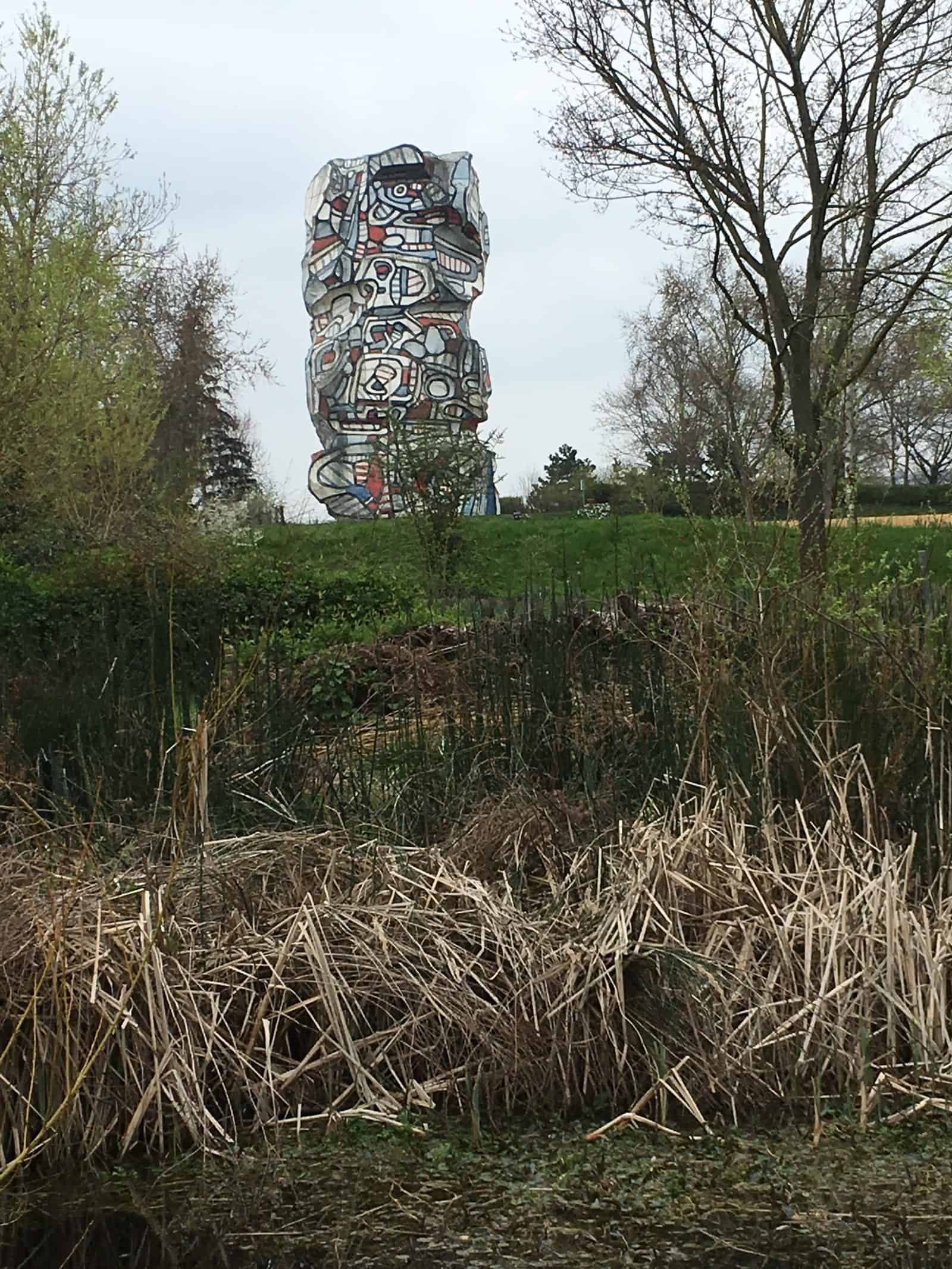
His monumental projects tested that expansion in different ways. The 24-meter Tour aux figures has a colored exterior and an internal black-and-white route called the Gastrovolve. The Closerie Falbala uses Hourloupe forms to create an encompassing site. These environments do not merely enlarge small drawings; they make the visitor’s movement part of seeing.
His Art Brut project had a different consequence. It assembled, classified, and eventually secured public stewardship for thousands of works that stood outside the professional art system. That collecting history should be evaluated alongside, not confused with, his own studio production. Dubuffet represented France at the 1984 Venice Biennale and died in Paris the following year, but the institutions he established or enabled still preserve the distinction between those two achievements.
Frequently Asked Questions
These answers clarify Dubuffet’s training, his role in developing Art Brut, his unusual painting materials, and where his large environments can be experienced.
Was Jean Dubuffet Self-Taught?
Not entirely. Dubuffet took evening art courses in Le Havre and attended the Académie Julian in Paris for about six months. He then developed independently, and his professional career began only after long periods spent in the wine trade. “Limited formal training” is more accurate than simply calling him self-taught.
Did Jean Dubuffet Invent Outsider Art?
No single person invented art made outside official institutions. Dubuffet developed Art Brut as a particular historical category and built a collection, research network, exhibition program, and argument around it. The works came from many independent creators whose practices should not be collapsed into Dubuffet’s biography.
Why Did Dubuffet Put Sand and Gravel in Paint?
Sand and gravel gave his paint physical density and made scraping, scratching, and spreading visibly consequential. These granular surfaces could suggest walls, soil, skin, or terrain without using shading to make forms appear three-dimensional. The material was therefore part of the image’s structure, not a decorative addition.
Where Can Visitors Experience His Large Environments?
Jardin d’émail belongs to the Kröller-Müller Museum and was designed to be entered and walked over. Fondation Dubuffet preserves the Closerie Falbala at Périgny, while Tour aux figures stands on Île Saint-Germain near Paris. Because access conditions can vary, visitors should consult the responsible institution before traveling.

Isabella studied at the University of Cape Town in South Africa and graduated with a Bachelor of Arts majoring in English Literature & Language and Psychology. Throughout her undergraduate years, she took Art History as an additional subject and absolutely loved it. Building on from her art history knowledge that began in high school, art has always been a particular area of fascination for her. From learning about artworks previously unknown to her, or sharpening her existing understanding of specific works, the ability to continue learning within this interesting sphere excites her greatly.
Her focal points of interest in art history encompass profiling specific artists and art movements, as it is these areas where she is able to really dig deep into the rich narrative of the art world. Additionally, she particularly enjoys exploring the different artistic styles of the 20th century, as well as the important impact that female artists have had on the development of art history.
Learn more about Isabella Meyer and the Art in Context Team.
Cite this Article
Isabella, Meyer, “Jean Dubuffet: Biography, Art Brut, and Major Works.” Art in Context. October 11, 2026. URL: https://artincontext.org/jean-dubuffet/
Meyer, I. (2026, 11 October). Jean Dubuffet: Biography, Art Brut, and Major Works. Art in Context. https://artincontext.org/jean-dubuffet/
Meyer, Isabella. “Jean Dubuffet: Biography, Art Brut, and Major Works.” Art in Context, October 11, 2026. https://artincontext.org/jean-dubuffet/.


