


Daniel Arsham – Why the Present Looks Ancient in His Art

Daniel Arsham turns cameras, sneakers, sports equipment, cars, and familiar characters into objects that appear to have survived for centuries. Working across sculpture, architecture, drawing, film, and performance, he uses simulated erosion and geological materials to imagine how the present might look from an archaeological future.
Key Takeaways
- Arsham is an American artist born in Cleveland in 1980, raised in Miami, and based in New York.
- His best-known concept, fictional archaeology, presents contemporary objects as damaged or crystallized relics discovered in the future.
- Materials such as volcanic ash, sand, quartz, selenite, pyrite, amethyst, and hydrostone give manufactured objects a geological appearance.
- Architecture is central to his practice: walls seem to ripple, figures emerge from surfaces, and structural elements appear eroded or physically impossible.
- His color vision deficiency shaped his initially restricted palette. Special filtering glasses later contributed to his use of vivid blues, purples, and mineral colors.
- Collaborations with choreographers, designers, sports organizations, and commercial brands extend his ideas into performance and popular culture, but they should be distinguished from his independent studio work.
Who Is Daniel Arsham?
Daniel Arsham was born in Cleveland, Ohio, in 1980 and grew up in Miami, Florida. He attended Miami’s Design and Architecture Senior High School before studying at Cooper Union in New York. In 2003, he received the school’s Gelman Trust Fellowship Award. Architecture entered his art through both education and personal experience.
When Arsham was twelve, Hurricane Andrew severely damaged his family’s Miami home. He has repeatedly discussed seeing familiar rooms and building materials transformed by the storm. His mature work does not simply illustrate that event, but its combinations of ruin, reconstruction, and unstable space give the biographical episode relevant context. After Cooper Union, Arsham returned to Miami and helped establish The House, an artist-run exhibition space. His early installations already treated buildings as flexible visual material rather than neutral containers.
Walls appeared to swell, fold, or absorb human bodies, establishing a spatial vocabulary that would remain important even after portable sculptures became more prominent.
What Is Fictional Archaeology?
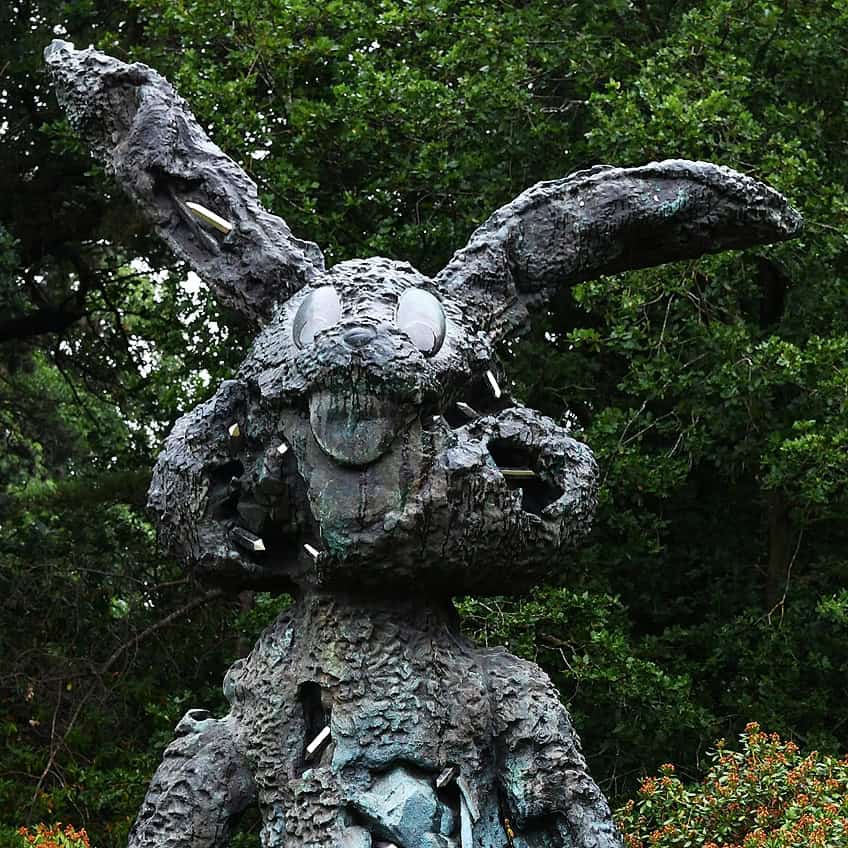
Fictional archaeology is Arsham’s method of presenting objects from recent life as artifacts from an imagined future. Archaeology ordinarily reconstructs earlier cultures from surviving material evidence. Arsham reverses that direction: he asks viewers to examine their own possessions from the hypothetical perspective of researchers who have not yet been born. A camera, telephone, cassette player, game controller, sneaker, or sports jersey may retain its recognizable shape while sections of its surface appear broken away. Mineral deposits occupy the cavities, suggesting both decay and crystalline growth. The object therefore seems old and newly forming at the same time.

These sculptures are not naturally fossilized consumer goods. They are carefully fabricated casts whose distressed surfaces simulate the effects of long duration. Arsham has worked with combinations of hydrostone, volcanic ash, sand, quartz, selenite, pyrite, blue calcite, rose quartz, and amethyst. The materials create a productive contradiction: an obsolete electronic device may look fragile and ruined, yet the crystal associated with its deterioration can appear precious and enduring.
Why Everyday Objects Matter
Arsham generally chooses forms that can be recognized without extensive explanation. Cameras preserve images, telephones transmit information, clocks measure time, and sports objects carry personal and collective associations.
Cars, sneakers, and entertainment devices also reveal how quickly technological and consumer identities become dated.
The sculptures do not provide a detailed story about the civilization that supposedly excavated them. Instead, the missing narrative makes viewers supply their own temporal distance. A recently familiar device can suddenly resemble an artifact from a culture whose habits are no longer fully understood.
Erosion as a Constructed Effect
The damaged areas are essential to the works’ legibility. Rather than coating an intact product with decorative crystals, Arsham interrupts its silhouette and surface. The eye alternates between identifying the object and examining what appears to be missing from it.

This method also complicates the idea of preservation. Museums usually attempt to protect objects from physical change. Arsham manufactures the appearance of deterioration and then presents it with the care normally given to a historical specimen. Damage becomes part of the object’s designed identity rather than evidence of neglect.
Architecture That Behaves Impossibly
Before eroded cameras and cars became widely associated with his name, Arsham was producing architectural interventions in which apparently solid structures behaved like fabric or skin. A façade might seem to billow in the wind, while a figure could appear caught inside a wall. Stairs lead nowhere, corners stretch around bodies, and openings reveal no practical function. These works depend on the viewer’s familiarity with ordinary buildings. Walls are expected to bear weight and divide rooms; they are not expected to sag, swallow objects, or respond like soft material.
By violating those expectations with relatively restrained gestures, Arsham turns architecture into an active subject. In 2007, he founded Snarkitecture with Alex Mustonen.
The collaborative practice works across architecture, art, and design, producing installations, interiors, and functional objects. Snarkitecture’s projects share Arsham’s interest in altered space, reduction, and unexpected material behavior, but they are collaborative works with their own authorship and context. They should not automatically be treated as interchangeable with his individual art practice.
Performance, Film, and Staged Time
Arsham’s approach to space developed through performance as well as sculpture. In 2004, choreographer Merce Cunningham invited him to create the stage design for eyeSpace. Arsham subsequently toured with the Merce Cunningham Dance Company and continued designing for dance, theater, and musical performance. A stage differs from a gallery because scenery is encountered through changing bodies, sound, lighting, and duration. That experience helped make movement and time structural components of his work.

His film project Future Relic translated fictional archaeology into a science-fiction narrative. Conceived as a sequence of short films, it presents fragments of a future world in which objects familiar to contemporary viewers acquire uncertain historical roles. Film enables Arsham to place the relics inside an imagined society instead of displaying them only as isolated museum-like specimens.
Projects That Clarify Arsham’s Approach
Welcome to the Future
For Welcome to the Future at Locust Projects in Miami in 2014, Arsham transformed the gallery into an excavation site. A trench cut into the floor contained thousands of calcified versions of twentieth-century media devices, including cameras, VHS tapes, game controllers, televisions, guitars, and cassette players.
The installation expanded the logic of the individual relic into an entire archaeological environment.
Instead of encountering one carefully isolated sculpture, visitors looked down on accumulated technological remains. The density of the objects emphasized repetition, consumption, and planned obsolescence while collapsing recent memory into an imagined deep past.
Hourglass
The High Museum of Art presented Hourglass in 2017 as three related installations. The exhibition included a blue garden inspired by Japanese dry-landscape gardens, a purple amethyst cavern filled with sports equipment, and large hourglasses containing crushed crystals and sculptural casts.

Performers periodically altered parts of the installation, making time perceptible through physical change rather than through clocks alone. The garden, cavern, geological materials, and hourglasses joined several different measures of duration: bodily movement, sediment, erosion, ritual maintenance, and mechanical timekeeping.
Wherever You Go, There You Are
In 2023, the Orange County Museum of Art organized Wherever You Go, There You Are, described by the museum as Arsham’s first major United States museum exhibition. It brought together sculpture and architectural thinking through cameras, telephones, figures, an hourglass, and a replica of the DeLorean associated with the film Back to the Future. The DeLorean is especially apt within Arsham’s practice because it is simultaneously a vehicle, a recognizable piece of design, and a popular image of time travel.
Recasting it as a damaged artifact makes cinematic nostalgia part of the exhibition’s broader investigation of how objects carry information about an era.
Cars as Cultural Artifacts
Automobiles allow Arsham to apply fictional archaeology on an architectural scale. Full-size and reduced vehicle sculptures preserve distinctive profiles while replacing functional mobility with material stasis. Their apparently corroded bodies and mineral cavities turn machines associated with speed into stationary remnants.

Arsham Auto Motive at the Petersen Automotive Museum placed these works within an institution devoted to automotive history. That setting sharpened the difference between a restored historical vehicle and Arsham’s invented relic: one preserves documented mechanical history, while the other fabricates the appearance of a future history.
From a Restricted Palette to Mineral Color
Arsham has a color vision deficiency and initially worked predominantly with whites, grays, and blacks. This limited palette suited his interest in casts, architecture, fossils, and the visual conventions of archaeological displays. The restrained color was therefore both a practical response to perception and a coherent formal language. Around 2015, he began using special filtering glasses that allowed him to distinguish a broader range of hues.
Color soon became more conspicuous in works such as the blue garden and purple cavern presented in Hourglass. Blue calcite, amethyst, and rose quartz offered color through materials already associated with his geological vocabulary.
The change did not replace the earlier monochrome work with conventional naturalistic color. Instead, concentrated blues and violets often separate crystalline areas from pale, eroded surfaces. Color reinforces the tension between an object’s manufactured exterior and the mineral formations apparently emerging from within it.
How to Recognize Daniel Arsham’s Work
- Familiar objects displaced in time: Contemporary technologies and cultural symbols appear as specimens from an unknown future.
- Controlled erosion: Missing sections expose rough cavities rather than leaving the original form completely intact.
- Geological materials: Quartz, selenite, volcanic ash, pyrite, calcite, and related substances create the appearance of mineral transformation.
- Unstable architecture: Walls and façades seem to bend, billow, crumble, or merge with bodies.
- A museum-like mode of display: Plinths, cases, excavation sites, and carefully arranged environments encourage viewers to examine recent culture historically.
- Compressed chronology: Classical sculpture, twentieth-century technology, contemporary brands, and imaginary futures can occupy the same visual field.

Art, Design, and Commercial Collaboration
Arsham’s career crosses institutional art, stage design, architecture, fashion, sports, film, and collectible products. Documented collaborators include Dior, Porsche, Tiffany & Co., and Pharrell Williams. He has also adapted familiar entertainment and sports imagery, bringing his archaeological language to audiences beyond museums and galleries. This movement between categories is central to his public profile, but context matters.
A unique sculpture shown in a museum, a numbered edition, a jointly authored design project, and a branded consumer object may share an eroded appearance without having the same purpose or status. Materials, scale, authorship, edition information, and exhibition history help distinguish them.
The collaborations also test one of the practice’s central questions: which objects will represent the present? Luxury goods, sneakers, cars, team symbols, and entertainment characters already circulate as objects of desire and memory. By treating them like excavated remains, Arsham draws attention to the processes through which commodities become cultural evidence.
A Common Misconception: The Work Is Not Only About Crystals
Images of crystallized objects are the most immediately recognizable part of Arsham’s work, but reducing the practice to that surface effect misses its larger structure. The crystals operate within a sustained investigation of time, architecture, preservation, and the uncertain boundary between historical evidence and fiction. His wall interventions begin with the behavior of built space. His stage projects depend on bodies moving through time. Excavation installations arrange objects as if they belonged to an unknown civilization, while films construct narrative settings around them.

The eroded sculpture is therefore one expression of a broader method: making the familiar seem temporally and physically unstable. Daniel Arsham’s art asks viewers to look backward from a future that does not yet exist. By aging the technologies, commodities, buildings, and cultural images of the present, he reveals how quickly familiarity can become historical distance. His strongest works do more than reproduce the appearance of a ruin: they turn time into a material problem and make the contemporary world look unexpectedly archaeological.
Frequently Asked Questions
What Is Daniel Arsham Best Known For?
He is best known for fictional archaeology: sculptures that transform recognizable contemporary objects into apparently eroded and crystallized relics. Cameras, sneakers, sports equipment, cars, and popular-culture figures are among his recurring forms.
What Materials Does Daniel Arsham Use?
His sculptures and installations have used hydrostone, plaster, sand, volcanic ash, quartz, selenite, pyrite, amethyst, rose quartz, blue calcite, glass, metal, and other materials. The exact combination varies by work and should be checked in its individual record.
Are Daniel Arsham’s Sculptures Real Archaeological Objects?
No. They are contemporary artworks designed to resemble artifacts affected by long geological processes. Their apparent age and erosion are fabricated, creating an imagined viewpoint from which the present has already become history.
Why Does His Work Often Look Damaged?
The simulated damage makes time visible. Eroded surfaces shift attention from an object’s intended use toward its possible survival, disappearance, or reinterpretation. Crystal-filled cavities also allow deterioration and material growth to appear together.
Is Daniel Arsham An Architect?
Arsham is primarily identified as a visual artist, although architecture is fundamental to his work. He also co-founded the collaborative practice Snarkitecture with Alex Mustonen, which produces architectural installations, interiors, and design objects.
Why Are Many of His Works White or Gray?
His early palette was closely connected to his color vision deficiency and to his interest in casts, ruins, and archaeological presentation. After using special filtering glasses, he introduced stronger blues, purples, and other mineral-derived colors without abandoning monochrome work.
Does Daniel Arsham Work Only in Sculpture?
No. His practice includes architectural interventions, drawings, paintings, installations, films, stage environments, performance collaborations, and design projects. Sculpture remains the clearest expression of fictional archaeology, but it is part of a wider interdisciplinary practice.
Cite this Article
artincontext, , “Daniel Arsham – Why the Present Looks Ancient in His Art.” Art in Context. October 5, 2026. URL: https://artincontext.org/daniel-arsham/
, a. (2026, 5 October). Daniel Arsham – Why the Present Looks Ancient in His Art. Art in Context. https://artincontext.org/daniel-arsham/
, artincontext. “Daniel Arsham – Why the Present Looks Ancient in His Art.” Art in Context, October 5, 2026. https://artincontext.org/daniel-arsham/.


%27_by_Daniel_Arsham,_2022_-_geograph.org.uk_-_8112968.jpg)