


Alma Allen’s US Pavilion Seeks $1 Million as Sculptures Face Uncertain Return

The American Arts Conservancy has told prospective donors that it needs about $1 million for the final deinstallation and safe return of Alma Allen’s sculptures from the 2026 US Pavilion in Venice. The appeal is urgent because “Call Me the Breeze” closes on November 22, but the public figures do not fully reconcile: a reported $1.4 million raised against a $2.5 million need leaves a $1.1 million gap, while it remains unclear whether the separate $375,000 federal grant is included.
What the US Pavilion’s $1 Million Appeal Actually Says
The Art Newspaper reported on October 30 that Jenni Parido, director of the American Arts Conservancy, wrote to potential donors about an “urgent funding need” connected to final deinstallation and the artworks’ safe return to the United States. The outlet said Parido put the amount raised at $1.4 million out of a $2.5 million total need and described the remaining ask as about $1 million.
The AAC’s live donation page confirms that the nonprofit presents “Call Me the Breeze” and is soliciting public contributions. It says gifts support production, installation, and the broader presentation, with selectable amounts running from $2,500 to $250,000. The page displays no campaign target, amount collected, or progress bar and therefore does not confirm the $1.4 million figure.
The Four Numbers in the Funding Ledger
| Item | Figure | Evidence |
|---|---|---|
| Federal grant | $375,000 | State Department figure reported in April |
| Amount raised | $1.4 million | Parido letter, as reported |
| Total need | $2.5 million | Parido letter, as reported |
| Urgent ask | About $1 million | Deinstallation and safe return |
The arithmetic establishes a disclosure gap. Subtracting $1.4 million from $2.5 million produces $1.1 million, close enough to explain an “about $1 million” appeal through rounding. But Hyperallergic reported in April that the State Department supplied $375,000 and left the remainder to private fundraising. If the $1.4 million excludes that grant, available funds would total $1.775 million and the shortfall would be $725,000. The available disclosures do not say whether “raised” includes federal money, pledges, or only cash received.

Why Allen’s Sculptures Make the Final Phase Difficult
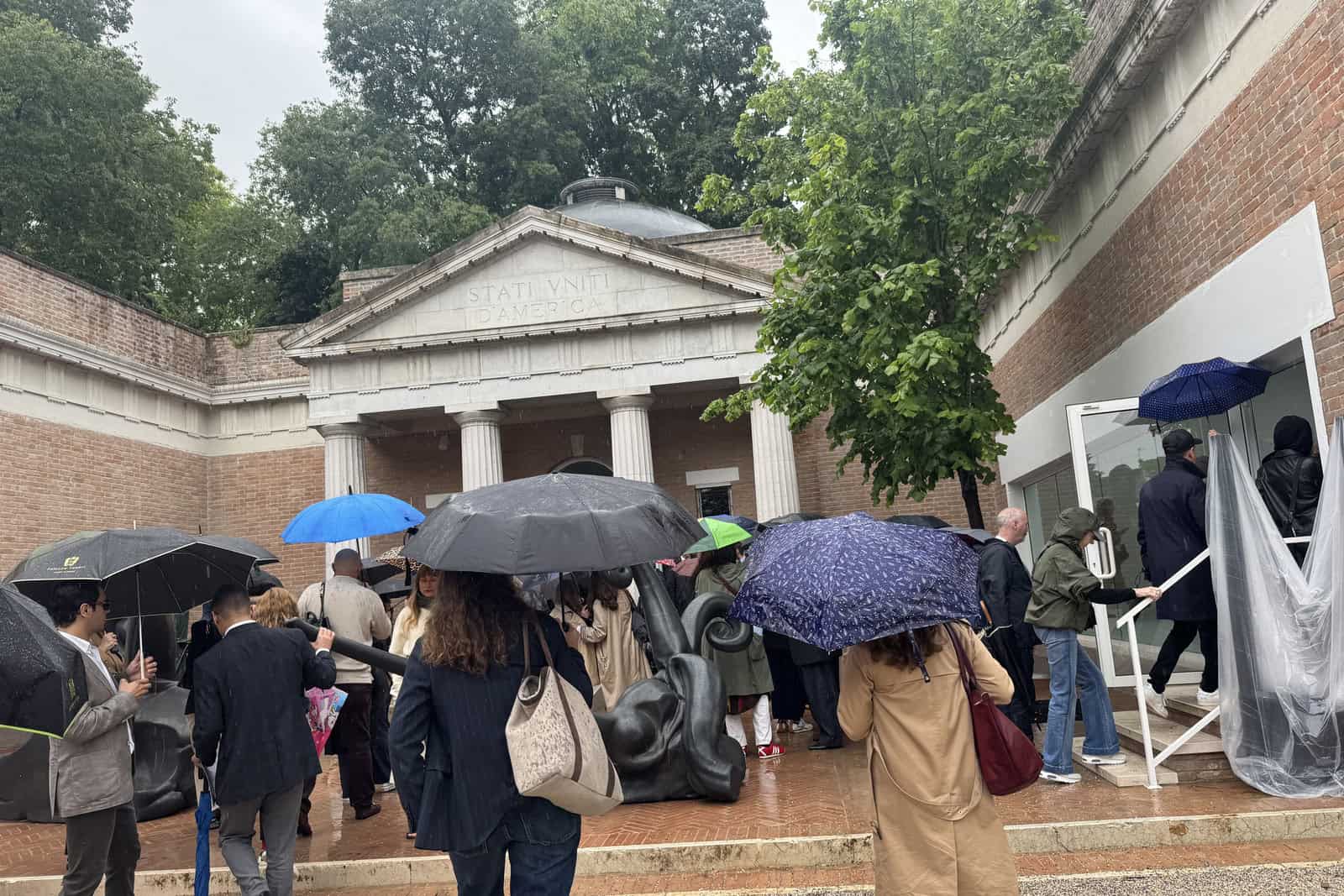
The art itself turns a bookkeeping problem into a physical deadline. The pavilion’s official exhibition statement identifies six stone sculptures made with Mexican onyx, Guatemalan green quartzite, Mexican black marble, Persian travertine, and Colorado Yule marble. It also describes bronze reliefs and a walnut-burl sculpture. These are substantial objects, not a show that can be rolled, boxed, and carried onto a flight.
The Art Newspaper reported that some works weigh almost a ton, citing art historian Katy Siegel, a co-curator of the 2017 US Pavilion. Siegel also warned that storage in Venice would be difficult to secure. That makes the closing date consequential, but it does not establish that $1 million is the price of freight alone.
The wording published from Parido’s appeal combines “final deinstallation” with “safe return.” No public itemization divides the ask among taking the exhibition apart, handling, packing, insurance, storage, customs, or transatlantic transport. Roughly $1 million is being sought for the final phase of the project, not for a single shipping invoice.
Allen told The New York Times that he was unaware of the AAC’s financial problems and had received only reimbursement for travel and inexpensive lodging. That statement does not resolve who owns the sculptures or who bears the contractual return costs.

Alma Allen at the 2026 Venice Biennale. Photograph by Ondine Goat, via Wikimedia Commons, licensed under CC BY-SA 4.0; cropped.
A Smaller Budget Did Not Remove the Risk
The reported $2.5 million total is strikingly low beside recent US Pavilion budgets. The Art Newspaper put the 2024 presentation at $5 million and the 2022 pavilion at $7 million; Hyperallergic described the earlier totals as more than $5 million and an estimated $7 million, respectively. On those reported figures, the 2026 total is no more than half the 2024 budget and about 36 percent of the 2022 estimate.
The $375,000 federal contribution would represent 15 percent of a $2.5 million project. That comparison does not prove that one pavilion was managed more efficiently than another, because the published totals may cover different scopes. It does show that describing the 2026 pavilion as unusually inexpensive was not the same as showing that it was fully financed.
The funding model was visibly fragile before the opening. Hyperallergic reported on April 28 that Parido said AAC had received no corporate or foundation funding, while Perrotin said it would provide operational and logistical support but not finance the pavilion. The nonprofit instead sought private gifts and online donations. The October appeal therefore documents an unresolved project-wide funding problem surfacing at the return stage; the available evidence does not establish a new, standalone $1 million transport charge.
The financial strain also followed a disrupted commissioning cycle. The Associated Press reported that an earlier proposal collapsed after its institutional sponsor withdrew and that Allen then had only months to prepare. Three works proposed for Lazzarini’s abandoned US Pavilion project are included in the Boston exhibition “Robert Lazzarini: metes and bounds.” That history does not explain the present shortfall, but it helps explain why the 2026 presentation began without the long institutional runway typical of a national pavilion.
Who Pays If the Appeal Falls Short?
The public record assigns fundraising leadership to AAC but does not publish a fallback. The nonprofit says it presents the exhibition and that donations support its realization. Parido’s reported letter places the urgent request with that organization. A State Department spokesperson, quoted by Finestre sull’Arte, said the department was not involved in fundraising and offered no further comment on the 2026 Biennale.
Perrotin’s April statement covered operational and logistical support while expressly excluding funding. Neither the official pavilion site nor AAC’s donation page identifies the owner of each work, the party holding the return-transport contracts, or the party obligated to pay for storage if departure is delayed. Any such contracts are not public.
That distinction matters because “stranded in Venice” remains a risk scenario, not an established outcome. The exhibition remains open through November 22, leaving time to raise money or arrange another solution. No published statement from AAC, the State Department, Perrotin, or Allen specifies what will happen if the appeal fails.
A press conference during the opening of the American Pavilion at the 2026 Venice Biennale. Photograph by Jennifer 8. Lee/WikiPortraits, via Wikimedia Commons, licensed under CC BY-SA 4.0; cropped.
What Is Established Before the November 22 Closing
Five points are established:
- The official exhibition record confirms six stone sculptures alongside bronze and wood works, making deinstallation a material part of the problem.
- Parido’s donor appeal, as reported by The Art Newspaper, seeks about $1 million for final deinstallation and safe return after $1.4 million was raised toward a reported $2.5 million need.
- The published arithmetic leaves a $1.1 million gap if the federal grant is included, but a $725,000 gap if it is additional; the reports do not define which treatment applies.
- The quoted appeal does not support labeling the entire sum as freight, because it covers both dismantling and return and supplies no cost breakdown.
- No public contingency identifies where the works would be stored, but the State Department’s grant terms require the award recipient, AAC, to supply matching funds and budget for dismantling and return or onward shipping.
The sculptures’ route home remains unresolved rather than canceled.

Isabella studied at the University of Cape Town in South Africa and graduated with a Bachelor of Arts majoring in English Literature & Language and Psychology. Throughout her undergraduate years, she took Art History as an additional subject and absolutely loved it. Building on from her art history knowledge that began in high school, art has always been a particular area of fascination for her. From learning about artworks previously unknown to her, or sharpening her existing understanding of specific works, the ability to continue learning within this interesting sphere excites her greatly.
Her focal points of interest in art history encompass profiling specific artists and art movements, as it is these areas where she is able to really dig deep into the rich narrative of the art world. Additionally, she particularly enjoys exploring the different artistic styles of the 20th century, as well as the important impact that female artists have had on the development of art history.
Learn more about Isabella Meyer and the Art in Context Team.
Choose Art in Context as a preferred source to see more of our reporting in Google Top Stories and other Google Search experiences.
Cite this Article
Isabella, Meyer, “Alma Allen’s US Pavilion Seeks $1 Million as Sculptures Face Uncertain Return.” Art in Context. October 31, 2026. URL: https://artincontext.org/alma-allen-us-pavilion-1-million-funding-gap/
Meyer, I. (2026, 31 October). Alma Allen’s US Pavilion Seeks $1 Million as Sculptures Face Uncertain Return. Art in Context. https://artincontext.org/alma-allen-us-pavilion-1-million-funding-gap/
Meyer, Isabella. “Alma Allen’s US Pavilion Seeks $1 Million as Sculptures Face Uncertain Return.” Art in Context, October 31, 2026. https://artincontext.org/alma-allen-us-pavilion-1-million-funding-gap/.


