

Dina Babbitt’s Daughters Sue Auschwitz Museum for 7 Watercolors

Dina Gottliebova Babbitt’s daughters filed a federal lawsuit on September 14 seeking seven watercolor portraits she was forced to paint at Auschwitz in 1944. The case centers on initial ownership of the physical sheets while also raising threshold questions about jurisdiction, statutory coverage, and applicable law.
Why the Seven Watercolors Are Now in Federal Court
Michele Babbitt Kane and Karin Wendy Babbitt sued the Auschwitz-Birkenau State Museum in the U.S. District Court for the Central District of California. The federal docket for Kane v. Państwowe Muzeum Auschwitz-Birkenau records the September 14, 2026 filing, case number 2:26-cv-10429, and seven watercolor exhibits. The Associated Press published its account on September 19, five days after the complaint was filed.
The plaintiffs ask the court to declare Babbitt the rightful owner, order the return of the works, and award unspecified damages. Those requests are allegations and remedies sought, not findings. As of September 19, the docket establishes that a case exists; it does not establish ownership.
The basic facts about creation are largely shared. Babbitt, a Czech Jewish prisoner, painted the portraits in 1944 after Josef Mengele ordered her to record Roma prisoners selected for his racist research and medical experiments. The complaint says she complied in the hope that Mengele would spare her and her mother. It also says each sitter was later murdered. At least six sheets bear the penciled signature and date “Dinah 1944,” using the artist’s original spelling.
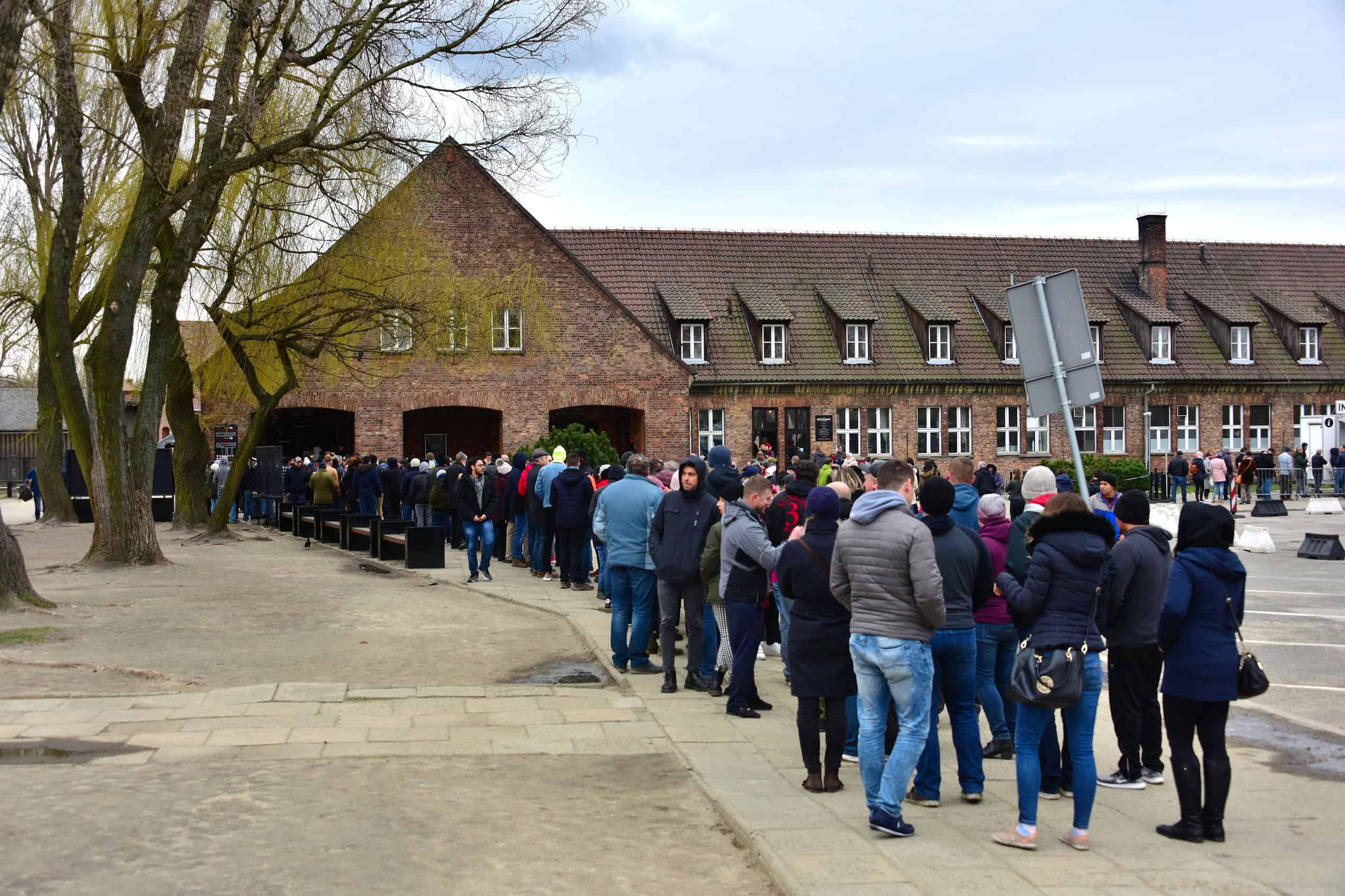
The entrance to the Auschwitz-Birkenau State Museum at Auschwitz I in 2019. Photograph by Adrian Grycuk via Wikimedia Commons, licensed under Creative Commons Attribution-Share Alike 3.0 Poland; cropped.
A Provenance Timeline With a Missing Legal Link
The portraits are part of the history of art made during the Holocaust, but their provenance begins differently from that of a painting removed from a collector’s wall. They did not exist before the persecution. They were brought into existence through it.
In 1944, according to the complaint, Mengele took the completed portraits. The plaintiffs say Babbitt never voluntarily sold, assigned, or relinquished them. That is the foundation of their title claim, but it has not been tested in court.
The museum’s current account, reported by The New York Times, says it acquired six portraits from a camp survivor in 1963 and the seventh in 1977. Babbitt visited Auschwitz in 1973, identified the first group as her work, and expected to take them home. The museum retained them. That sequence matters: her authentication established authorship, but authentication alone did not resolve who owned the paper.
An official museum notice from 1999 said the works had been purchased legally and in good faith in the 1960s when the artist was unknown. The same notice said Babbitt deserved copyright and royalties while maintaining that the objects should remain at Auschwitz. Copyright in an image and title to the physical sheet are separate rights, so that acknowledgment did not concede ownership of the originals.
The available institutional notices do not supply an unbroken title chain between Mengele’s wartime possession and the later sellers. That absence does not prove the museum lacks title. It identifies the evidentiary gap the litigation must address: whether the people who transferred the works in 1963 and 1977 possessed rights they could pass to the museum.
Diplomacy did not settle the issue. In Public Law 107-228, enacted in 2002, Congress called Babbitt the rightful owner and urged the paintings’ return. But that section was expressly a “sense of Congress”—a policy position, not a judgment binding a Polish museum. Babbitt continued seeking the originals until her death in 2009.

The entrance to Auschwitz I in May 1945. Photograph by an unknown creator, from the United States Holocaust Memorial Museum; public domain via Wikimedia Commons.
Authorship, Ownership, and the Museum’s Evidence Argument
The museum does not dispute Babbitt’s authorship; it maintains that forced production for the SS did not make her the legal owner and that, under Polish law, the museum owns these seven portraits.
Its ethical argument is preservation. In 2009, the International Auschwitz Council reiterated that the originals should remain because they are rare evidence of Mengele’s crimes and of the murdered Roma prisoners. The council treated authenticity and the completeness of the memorial as overriding concerns.
The heirs’ case starts from the opposite premise: coercion could not give Mengele valid ownership, and the museum’s later purchases could not convey better title than the sellers held. That is the plaintiffs’ legal theory, not an adjudicated fact. Preservation value explains why the museum wants custody; by itself, it does not answer the antecedent property question.
That distinction also explains why the label “Nazi-looted art” is contested here. The museum told AP that the phrase mischaracterizes works Babbitt made against her will and, in its view, never owned. The heirs place the same coercion at the center of their claim. Unlike the Goudstikker portrait restitution dispute, which concerns a preexisting painting taken from an identifiable collection, this case asks a court to locate initial ownership at the moment of forced creation.
New Restitution Laws Open a Door Without Deciding Title
The timing is not accidental. California’s 2024 AB 2867 directs courts to apply California substantive law in covered recovery actions brought by California residents or their heirs for art lost through Holocaust-era or other political persecution. The law responded to earlier cases in which foreign law controlled the outcome.
Federal law changed too. President Donald Trump signed the Holocaust Expropriated Art Recovery Act of 2025 on April 13, 2026. Public Law 119-82 permanently removed the 2016 act’s sunset and expanded judicial authority. It also restricts passage-of-time defenses and specified non-merits grounds for dismissal in covered claims.
Neither statute awards these seven watercolors to the Babbitt family. They change which claims can reach a merits decision and which law or defenses may apply. The court must still decide whether it has jurisdiction over the Polish state museum, whether this forced-creation claim falls within the statutes, which ownership rules govern, and what the 1963 and 1977 transactions legally transferred.

First Street U.S. Courthouse in downtown Los Angeles. Photograph by Levi Clancy, CC0, via Wikimedia Commons.
The Record Establishes a Dispute Over First Ownership
The September 14 docket establishes a live federal case over seven identified works, not a ruling that they were looted or that either side owns them. The museum’s account dates six acquisitions to 1963 and one to 1977, while Babbitt’s 1973 visit established her authorship of the group then known.
The museum’s 1999 notice separated Babbitt’s copyright from ownership of the physical sheets; Congress’s 2002 statement endorsed her moral and property claim but did not adjudicate it. The unresolved issue is the first link in the chain: whether forced creation gave title to Babbitt, to her captor, or to neither under the law the California court ultimately applies. No court has yet resolved jurisdiction, applicable law, or ownership.

Isabella studied at the University of Cape Town in South Africa and graduated with a Bachelor of Arts majoring in English Literature & Language and Psychology. Throughout her undergraduate years, she took Art History as an additional subject and absolutely loved it. Building on from her art history knowledge that began in high school, art has always been a particular area of fascination for her. From learning about artworks previously unknown to her, or sharpening her existing understanding of specific works, the ability to continue learning within this interesting sphere excites her greatly.
Her focal points of interest in art history encompass profiling specific artists and art movements, as it is these areas where she is able to really dig deep into the rich narrative of the art world. Additionally, she particularly enjoys exploring the different artistic styles of the 20th century, as well as the important impact that female artists have had on the development of art history.
Learn more about Isabella Meyer and the Art in Context Team.
Choose Art in Context as a preferred source to see more of our reporting in Google Top Stories and other Google Search experiences.
Cite this Article
Isabella, Meyer, “Dina Babbitt’s Daughters Sue Auschwitz Museum for 7 Watercolors.” Art in Context. September 19, 2026. URL: https://artincontext.org/dina-babbitt-watercolors-auschwitz-museum-lawsuit/
Meyer, I. (2026, 19 September). Dina Babbitt’s Daughters Sue Auschwitz Museum for 7 Watercolors. Art in Context. https://artincontext.org/dina-babbitt-watercolors-auschwitz-museum-lawsuit/
Meyer, Isabella. “Dina Babbitt’s Daughters Sue Auschwitz Museum for 7 Watercolors.” Art in Context, September 19, 2026. https://artincontext.org/dina-babbitt-watercolors-auschwitz-museum-lawsuit/.


.jpg)