


87 Met Antiquities Among 147 Returned to Three Countries

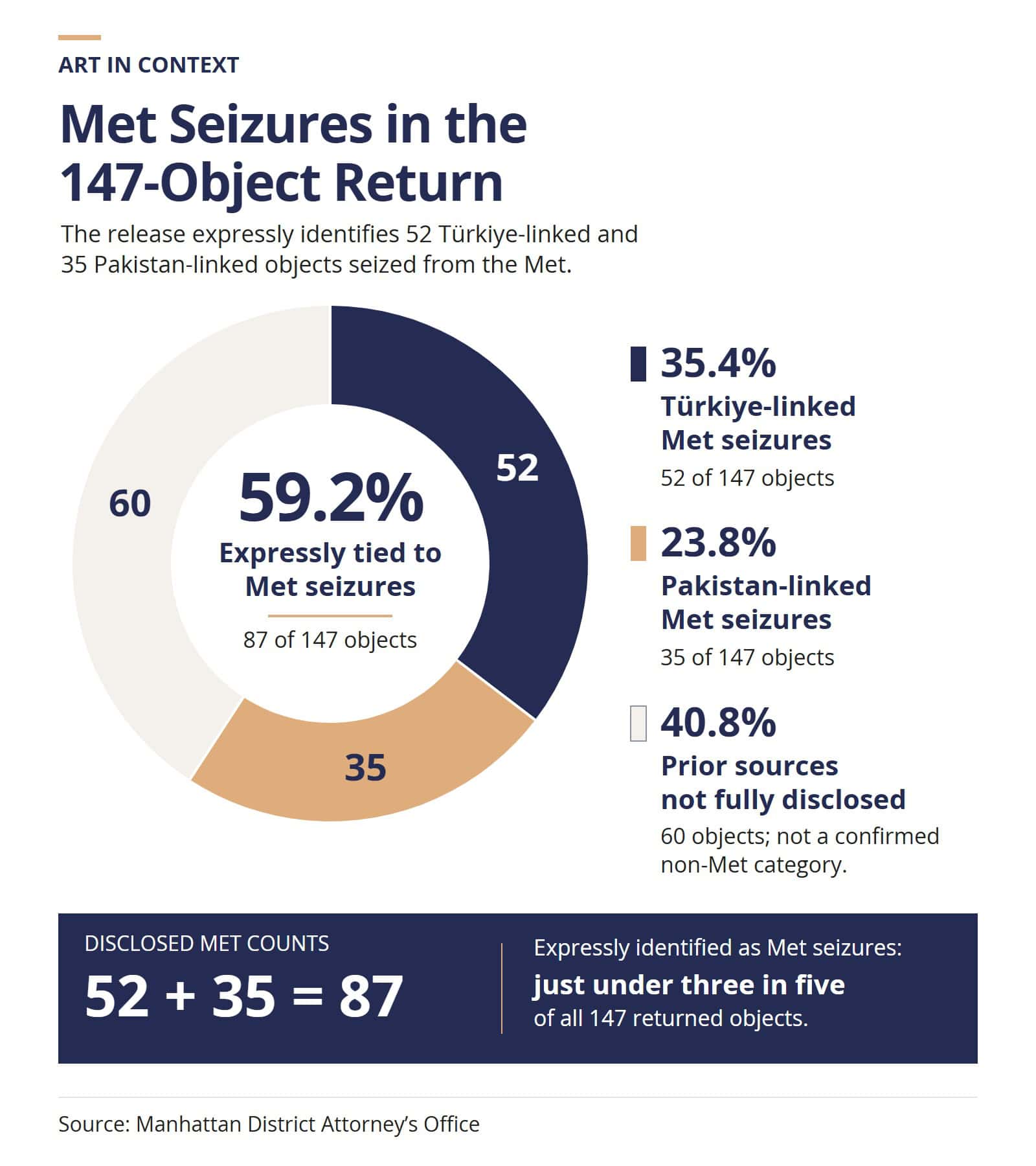
The Manhattan District Attorney announced the return of 147 antiquities to Türkiye, Pakistan, and Thailand on September 18, 2026. The release identifies 87 objects seized from the Metropolitan Museum of Art—59.2 percent of the full group—making the return as much a museum-provenance story as a diplomatic handover.
The 147 Antiquities, by Recipient
The District Attorney’s September 18 announcement divides the return into 100 antiquities for Türkiye, 36 for Pakistan, and 11 for Thailand. It values the full group at nearly $2.4 million, but the country-level disclosures are uneven.
| Recipient and count | Disclosed prior source | Named link |
|---|---|---|
| Türkiye: 100; more than $2.2 million | 52 seized from the Met; 48 not identified by institution | Hermes statuette; George Zakos |
| Pakistan: 36; current value not stated | 35 seized from the Met; Yakshi from an unnamed auction house | Mehrgarh figurines |
| Thailand: 11; current value not stated | Five from a Kapoor storage unit; six not identified by holder | Subhash Kapoor investigation |
Adding the two disclosed Met figures—52 for Türkiye and 35 for Pakistan—produces 87. That is 59.2 percent of all 147 objects, or just under three in five. The release identifies 87 Met objects; it does not say that none of Thailand’s 11 pieces ever passed through the museum.
“Seized from the Met” also describes where investigators recovered an object, not a criminal accusation against the museum. The Met told The New York Times in June that it exchanged information with investigators and agreed to surrender objects after an internal review. The newspaper reported that the museum packed the pieces and delivered them to the prosecutor’s office.
What the Dollar Figures Do—and Do Not—Show
Türkiye is the only recipient for which the release gives a current country-specific value: more than $2.2 million. The stated $22.5 million for Pakistan and $675,000 for Thailand are cumulative totals for all of the office’s returns to those countries, not valuations of the 36 and 11 objects in this announcement.
That distinction prevents a tempting but unsound subtraction. “Nearly $2.4 million” for the whole group and “more than $2.2 million” for Türkiye are rounded thresholds, so they cannot produce a defensible exact value for the Pakistani and Thai groups.
The Hermes Statuette Connects 1971 to 2026
The clearest object history belongs to the bronze Hermes. The Met’s permanent collection record identifies it as a 29.1-centimeter Greek or Roman bronze from the first century BCE to the first century CE, acquired through the Rogers Fund in 1971. The page now marks the statuette “Restituted” and says it left the collection in June 2026.
The District Attorney’s Office supplies the contested ownership history. It says the statuette was looted from Türkiye, exported in the 1960s by convicted dealer George Zakos, and sold to the Met in 1971 without provenance. Investigators valued it at approximately $500,000.
Hermes stands in a poised, gently turning posture, with wings strapped to his feet. The Met says he probably held a herald’s staff in his missing left hand; fittings on his laurel crown once carried another pair of wings, and his eyes were originally inlaid. Those losses make the surviving bronze fragmentary, while its finely controlled pose explains why it remained a prominent museum object.
The June date on the Met record and the September announcement describe different procedural moments. The New York Times reported that a stipulation covering the Hermes and other objects was dated June 9. The September 18 release records the later repatriation announcement. Legal surrender, removal from a collection, and diplomatic handover need not occur on the same day.
Pakistan and Thailand Followed Different Routes
The Pakistani group combines one stone sculpture with a large terracotta collection. The District Attorney’s Office says the gray-schist Yakshi, a female nature spirit shown in a three-bend pose with two vessels, was seized from an auction house earlier in 2026. It says the Mehrgarh figurines, dated to about 3000–2700 BCE, were donated to the Met in 2001 and remained there until their seizure.
An Associated Press of Pakistan report dated September 16 says Pakistan’s handover ceremony occurred on Monday, two days before publication. The September 18 announcement therefore grouped a return already publicly handed over with other repatriations; it did not describe one simultaneous three-country ceremony.
There is also an unresolved counting detail. APP describes 35 terracotta fertility figures, while the Met’s restituted collection record titles one grouped entry “Thirty-four Mehrgarh Dolls.” The official 36-object total is not in doubt, but neither record reconciles the 35 Met-seized objects with that 34-doll grouped record accession by accession. Treating either label as a complete inventory would overstate what it proves.
Thailand’s 11 objects followed another route. Prosecutors say all were recovered through the investigation of Subhash Kapoor and that five came from one of his New York storage units. The release says Kapoor was convicted in India in 2022 and that his extradition to the United States remains pending; it does not identify the prior holders of the other six Thai objects.
The distinction matters for collection governance. A seizure places an object in government custody while ownership is resolved through forfeiture, stipulation, or another legal process; a proactive museum provenance partnership can identify gaps and build source-country collaboration before a prosecutor intervenes. The Hermes record shows why the public catalog must also preserve an object’s changed status rather than simply making a returned work disappear.

Bronze Statuette of Hermes, photographed by the Metropolitan Museum of Art; hosted by Wikimedia Commons; released under the CC0 1.0 Universal Public Domain Dedication.
At Least 87 Objects Came From the Met
- The September 18 release covers 100 objects for Türkiye, 36 for Pakistan, and 11 for Thailand, with a combined stated value of nearly $2.4 million.
- The release expressly identifies 87 objects seized from the Met, equal to 59.2 percent of the entire group; it does not disclose every prior holder among the remaining 60.
- The Met dates the Hermes restitution to June, and Pakistan’s national news service places its handover ceremony before the September 18 collective announcement, so “return” refers to a sequence rather than one event date.
- The Pakistan total is official, but the relationship between APP’s 35 figurines and the Met’s grouped 34-doll record is not reconciled by the cited institutional records.

Isabella studied at the University of Cape Town in South Africa and graduated with a Bachelor of Arts majoring in English Literature & Language and Psychology. Throughout her undergraduate years, she took Art History as an additional subject and absolutely loved it. Building on from her art history knowledge that began in high school, art has always been a particular area of fascination for her. From learning about artworks previously unknown to her, or sharpening her existing understanding of specific works, the ability to continue learning within this interesting sphere excites her greatly.
Her focal points of interest in art history encompass profiling specific artists and art movements, as it is these areas where she is able to really dig deep into the rich narrative of the art world. Additionally, she particularly enjoys exploring the different artistic styles of the 20th century, as well as the important impact that female artists have had on the development of art history.
Learn more about Isabella Meyer and the Art in Context Team.
Choose Art in Context as a preferred source to see more of our reporting in Google Top Stories and other Google Search experiences.
Cite this Article
Isabella, Meyer, “87 Met Antiquities Among 147 Returned to Three Countries.” Art in Context. September 19, 2026. URL: https://artincontext.org/147-antiquities-returned-turkiye-pakistan-thailand/
Meyer, I. (2026, 19 September). 87 Met Antiquities Among 147 Returned to Three Countries. Art in Context. https://artincontext.org/147-antiquities-returned-turkiye-pakistan-thailand/
Meyer, Isabella. “87 Met Antiquities Among 147 Returned to Three Countries.” Art in Context, September 19, 2026. https://artincontext.org/147-antiquities-returned-turkiye-pakistan-thailand/.


