

Tretyakov Confirms Trinity Capsule Work, Not Damage

The Tretyakov Gallery says Andrei Rublev’s Trinity was removed from display while specialists adjust its climate capsule. Director Olga Galaktionova called the work technical and said the icon remains under specialist supervision, but her September 16 statement did not confirm—or disprove—published claims that the fifteenth-century panel itself has warped or otherwise deteriorated.
Tretyakov Confirms Capsule Work, Not Damage
In the clearest official account so far, Galaktionova said the icon had been taken out because the climate capsule needed adjustment. Interfax reported her comments on September 16, two days after the gallery’s press office confirmed that its staff were checking the work in the Trinity Lavra of St. Sergius workshops.
Galaktionova described the intervention as a routine technical matter, said the workshop environment meets the necessary conditions, and said there was no need to move the icon elsewhere. When asked about restoration, she stressed that she had not said restoration was underway. That distinction matters: a work can sit in a restoration workshop for examination or safekeeping without being treated.
Her statement establishes that the capsule required work. It does not establish that the icon is undamaged. Galaktionova called the photographs unknown, but BBC Russian reported that Natalia Komashko of the Andrei Rublev Museum vouched for their authenticity and that two sources dated the image to August 2026. Categorical claims at either end—catastrophic damage or no damage—go beyond the public evidence.
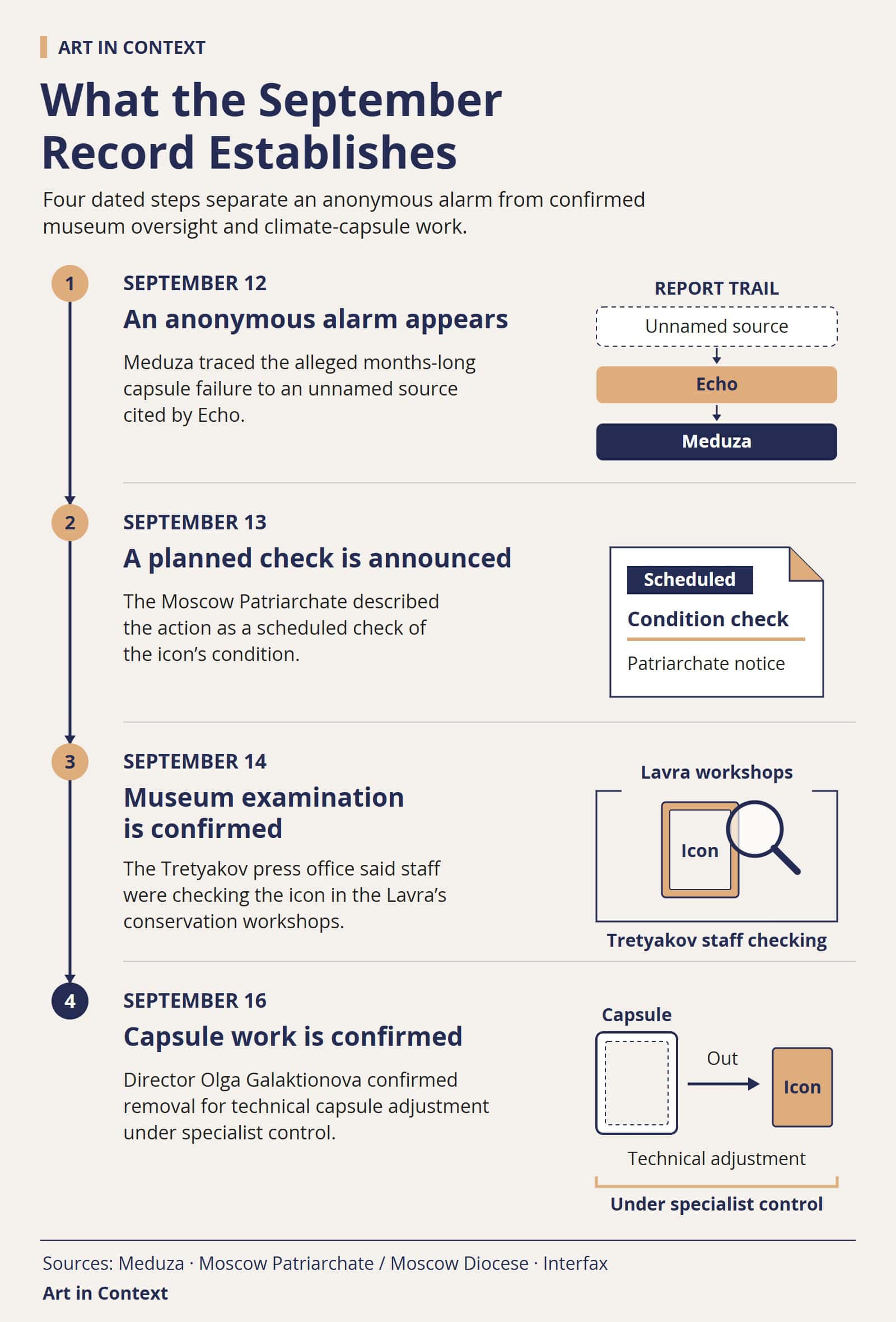
What the September Timeline Actually Shows
The controversy grew through claims with very different evidentiary weight.
| Date | Verified event | Damage status |
|---|---|---|
| September 12 | Echo, as relayed by Meduza, cited an anonymous source alleging a months-long capsule failure. | Unconfirmed allegation |
| September 13 | The Moscow Patriarchate called the removal a planned condition check under the 2023 loan agreement. | No findings released |
| September 14 | Tretyakov’s press office told Interfax that museum staff were examining the icon in Lavra workshops. | No findings released |
| September 16 | Galaktionova confirmed capsule adjustment and said the icon’s required conditions were being maintained. | Damage neither confirmed nor denied |
Meduza’s September 14 account attributed the most serious claims to Echo’s anonymous source: relative humidity of 80 percent, swelling boards, and a paint layer beginning to curl. It also described a photograph shared by medievalist Oleg Voskoboynikov; journalist Ksenia Luchenko said the visible substance was glue forced toward the surface as the boards swelled. Those are specific claims, but neither a published instrument log nor an official examination report accompanies them.
RBC added a narrower, independently reported point on September 14: one professional source said the display case might need repair, while a Lavra source confirmed the icon was no longer in the iconostasis and disputed alarming accounts of its condition. The icon was moved and the enclosure needed attention, while BFM quoted art historian Ksenia Korobeynikova reporting that the boards converged, adhesive surfaced, and a small area of the face changed.
BBC Russian reports that the icon was removed from the iconostasis in late August, before Echo published the allegations on September 12.
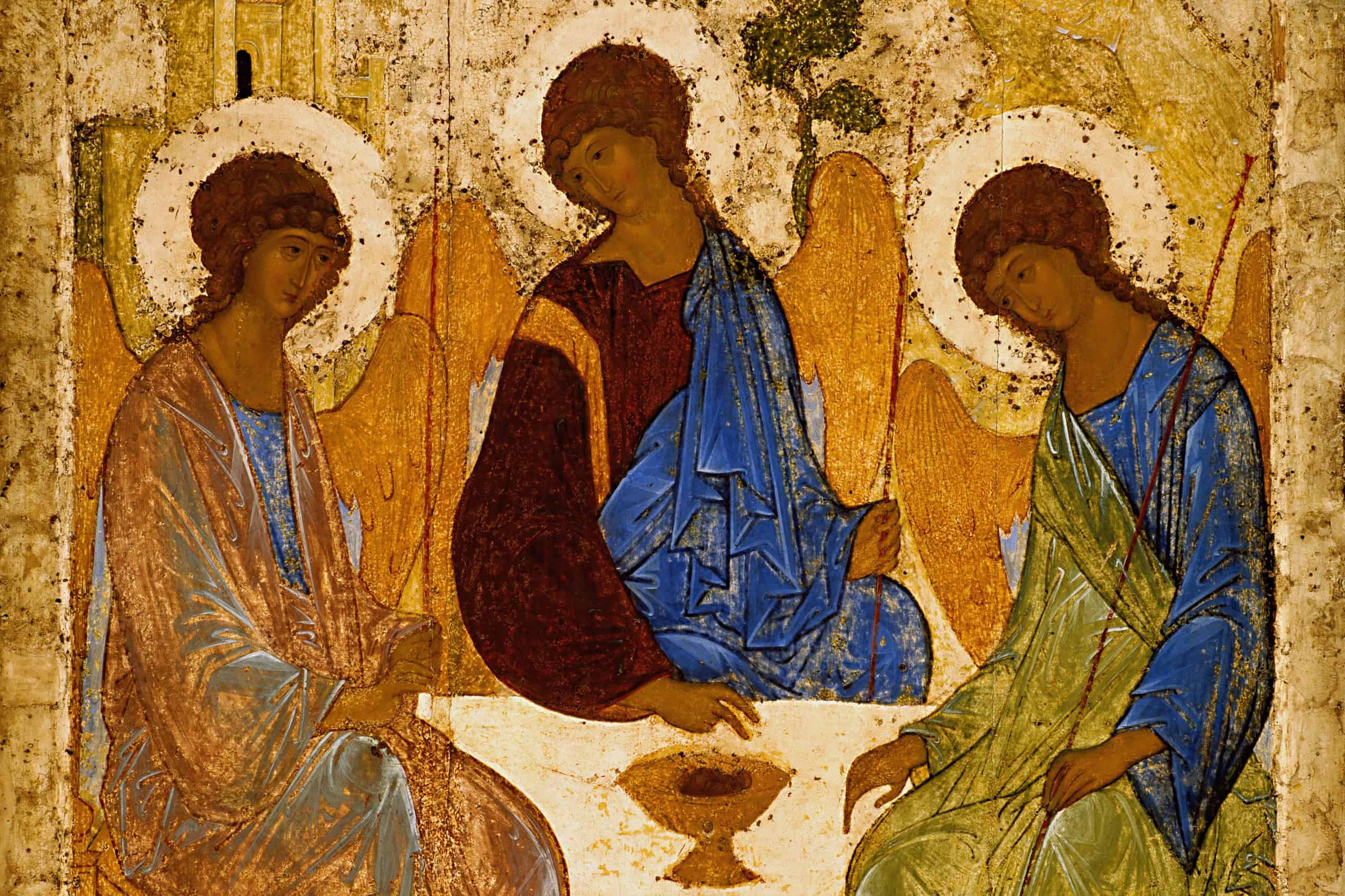
Andrei Rublev’s The Trinity (1422–1427), digital reproduction by Google Arts & Culture, via Wikimedia Commons; Creative Commons Public Domain Mark 1.0.
Why a Condition Report Matters More Than a Photograph
Rublev’s Trinity, generally dated 1422–1427 by the Tretyakov, is egg tempera on three joined wooden boards. The image reduces the biblical Hospitality of Abraham to three angels seated around a table, organizing their inclined bodies, wings, and gazes into a quiet circular movement around the chalice. Its radical compression made it a defining work of medieval Russian art; its material structure also makes the joins beneath that composition central to its survival.
Wood responds to moisture, while the ground and paint above it respond differently. The Canadian Conservation Institute’s guidance for panel paintings explains that rising relative humidity can expand wood more than its ground and paint layers, while low humidity can produce contraction, warping, and lifting. It recommends stable relative humidity, typically within 40 to 60 percent for paintings on wood or canvas. That science makes the anonymous 80-percent figure consequential—but it does not make the figure verified.
In its September 14 report, RBC cited a Tretyakov response from June 2026 saying that its summer 2025 examination found “some changes” and created a research baseline for tracking the icon. The museum did not publicly enumerate those changes. A formal inspection record is still needed for a complete comparison, but BFM quoted art historian Ksenia Korobeynikova, after her Lavra visit and conversations with specialists, saying that the boards converged, adhesive surfaced, and a small area of the face changed.
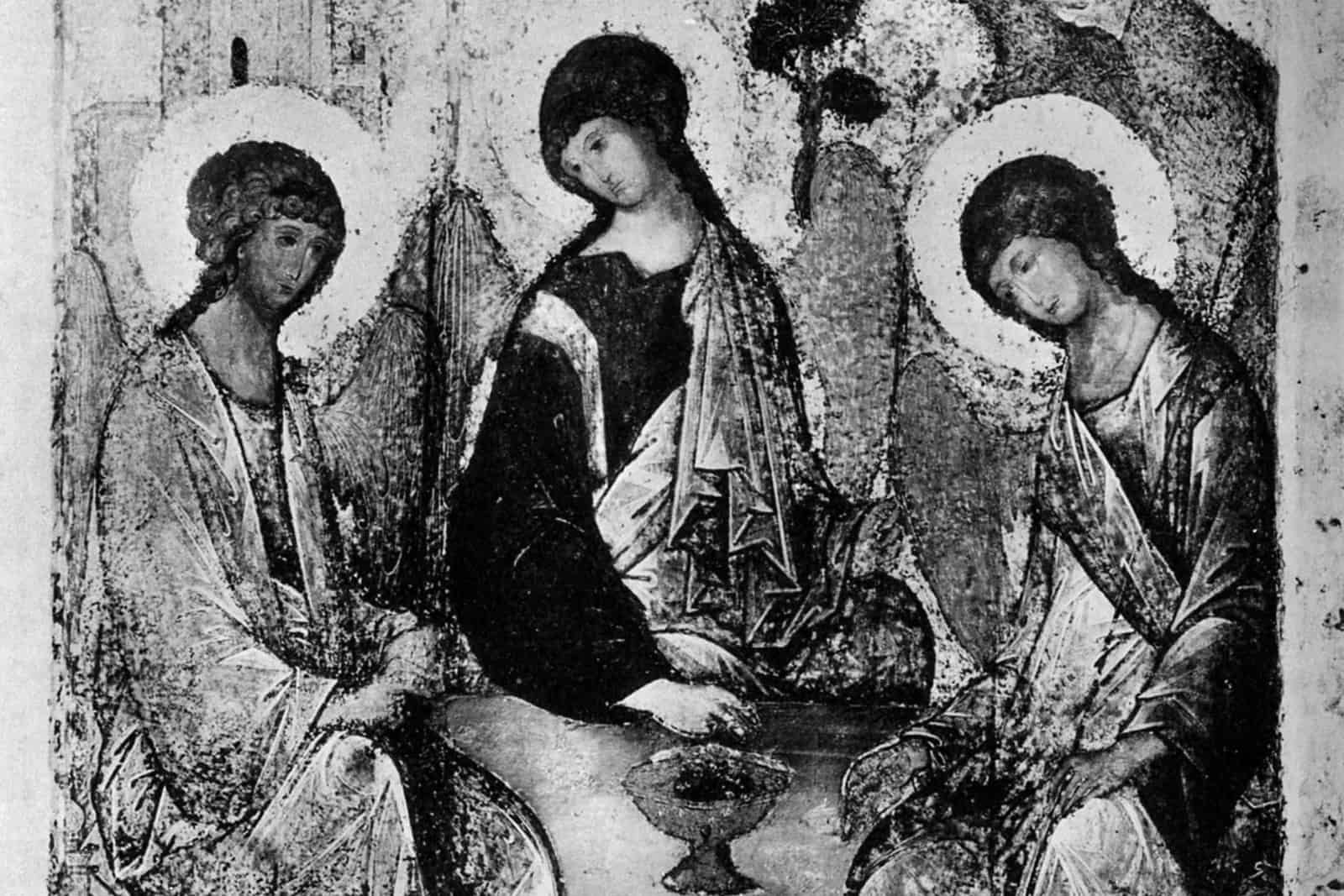
Andrei Rublev’s Trinity after its 1904 cleaning and before Guryanov’s first restoration intervention. Photograph by Guryanov and his team, via Wikimedia Commons; public domain.
The 49-Year Church Loan Preserved Museum Oversight
The icon returned to the Trinity Lavra of St. Sergius in June 2024 under a 49-year free-use arrangement, but it remained federal property and within the Tretyakov’s institutional custody. This is not a transfer of ownership. It is an unusually long loan into an active place of worship.
The publicly quoted portion of the July 12, 2023 agreement is precise about one responsibility. Clause 2.1.3, reproduced in the Moscow Patriarchate’s September 13 statement, gives the Tretyakov the right to conduct regular condition checks, remove the icon from its specialized climate display, and take it to a qualifying room on Lavra territory.
In June 2026, Patriarchate legal official Ksenia Chernega told RBC that the Tretyakov retained operational management and that preservation responsibility was shared by the church and museum. The accessible clause supports the museum’s inspection authority, but it does not publicly identify who must service the capsule, how quickly a malfunction must be reported, or whether environmental logs must be released.
That continued museum role is consistent with the conservation function of an art museum: custody involves documentation, environmental control, and specialist review even when an object is displayed elsewhere.

The Trinity Cathedral at the Trinity Lavra of St. Sergius in Sergiyev Posad. © Vyacheslav Argenberg, via Wikimedia Commons; licensed under CC BY 4.0.
Capsule Work Is Established; New Damage Is Not
The evidence now supports four concise findings:
- The Tretyakov director confirmed on September 16 that the climate capsule was being adjusted and that the icon remained in a controlled workshop environment.
- No official 2026 condition report has confirmed the reported warping, surfaced glue, or lifting paint.
- The gallery acknowledged unspecified changes during its 2025 inspection, but the public record does not connect them to the current capsule work.
- The 2023 agreement preserved Tretyakov inspection authority while the Lavra received long-term use of the federally owned icon.

Isabella studied at the University of Cape Town in South Africa and graduated with a Bachelor of Arts majoring in English Literature & Language and Psychology. Throughout her undergraduate years, she took Art History as an additional subject and absolutely loved it. Building on from her art history knowledge that began in high school, art has always been a particular area of fascination for her. From learning about artworks previously unknown to her, or sharpening her existing understanding of specific works, the ability to continue learning within this interesting sphere excites her greatly.
Her focal points of interest in art history encompass profiling specific artists and art movements, as it is these areas where she is able to really dig deep into the rich narrative of the art world. Additionally, she particularly enjoys exploring the different artistic styles of the 20th century, as well as the important impact that female artists have had on the development of art history.
Learn more about Isabella Meyer and the Art in Context Team.
Choose Art in Context as a preferred source to see more of our reporting in Google Top Stories and other Google Search experiences.
Cite this Article
Isabella, Meyer, “Tretyakov Confirms Trinity Capsule Work, Not Damage.” Art in Context. September 16, 2026. URL: https://artincontext.org/andrei-rublev-trinity-icon-capsule-damage-unconfirmed/
Meyer, I. (2026, 16 September). Tretyakov Confirms Trinity Capsule Work, Not Damage. Art in Context. https://artincontext.org/andrei-rublev-trinity-icon-capsule-damage-unconfirmed/
Meyer, Isabella. “Tretyakov Confirms Trinity Capsule Work, Not Damage.” Art in Context, September 16, 2026. https://artincontext.org/andrei-rublev-trinity-icon-capsule-damage-unconfirmed/.


