

Whitney’s Roy Lichtenstein Survey Reopens the 1962 Record

The Whitney Museum of American Art will open Roy Lichtenstein: Like New on October 11, bringing together roughly 130 works, a first reunion of the works it assigns to Lichtenstein’s 1962 Pop-style exhibition at Leo Castelli Gallery, and recreations of three murals. The exhibition’s copying thesis is compelling, but the Roy Lichtenstein Foundation’s own archive complicates the museum’s claim that the 1962 group is complete.
Three Devices Reframe Roy Lichtenstein’s Career
The Whitney’s exhibition record schedules Like New from October 11, 2026, through May 10, 2027. Its roughly 130 works range from the early 1940s through the 1990s and include paintings, drawings, collages, prints, sculptures and film. Meg Onli organized the exhibition with guest curator Alex Da Corte, assisted by Nakai Falcón and David Crane.
Scale is only part of the proposition. Three curatorial devices shift attention from the familiar Roy Lichtenstein biography toward what happens when an image is repeated, installed again or borrowed by another artist.
| Device | What it tests |
|---|---|
| 1962 Castelli grouping | How one installation became a Pop origin story |
| Three recreated murals | Whether a design can outlive its material object |
| Lawler, Pettibone and Sturtevant | What happens when Lichtenstein becomes the source |
Those devices are more revealing together than a chronological parade of famous paintings. The Castelli grouping returns surviving objects to a historically charged relationship. The recreations do not all replace lost or site-bound originals: Greene Street Mural was destroyed, while the original World’s Fair Mural survives at the Weisman Art Museum. The later artists reverse the direction of borrowing: Lichtenstein, once the appropriator of commercial images, becomes material for somebody else.
That structure also clarifies why the handmade character of Lichtenstein’s paintings matters. His crisp outlines and dot patterns imitate mechanical printing, yet the Whitney emphasizes that he constructed those effects meticulously by hand. A machine-like image produced through touch already contains a tension between original object and reproducible appearance.
Tate’s archival film makes that tension visible through footage of Lichtenstein at home and in his studio, accompanied by interviews with Dorothy Lichtenstein and writer Frederic Tuten. It supplies something a static installation list cannot: evidence of the labor and decisions behind surfaces designed to suppress expressive touch.
The “Complete” 1962 Reunion Has an Archival Problem
The Whitney says the exhibition reunites, for the first time, all the works from Lichtenstein’s first exhibition of Pop-style work at Leo Castelli Gallery. Artsy’s July 22 announcement turns that into a more specific claim: all eight works from the 1962 debut.
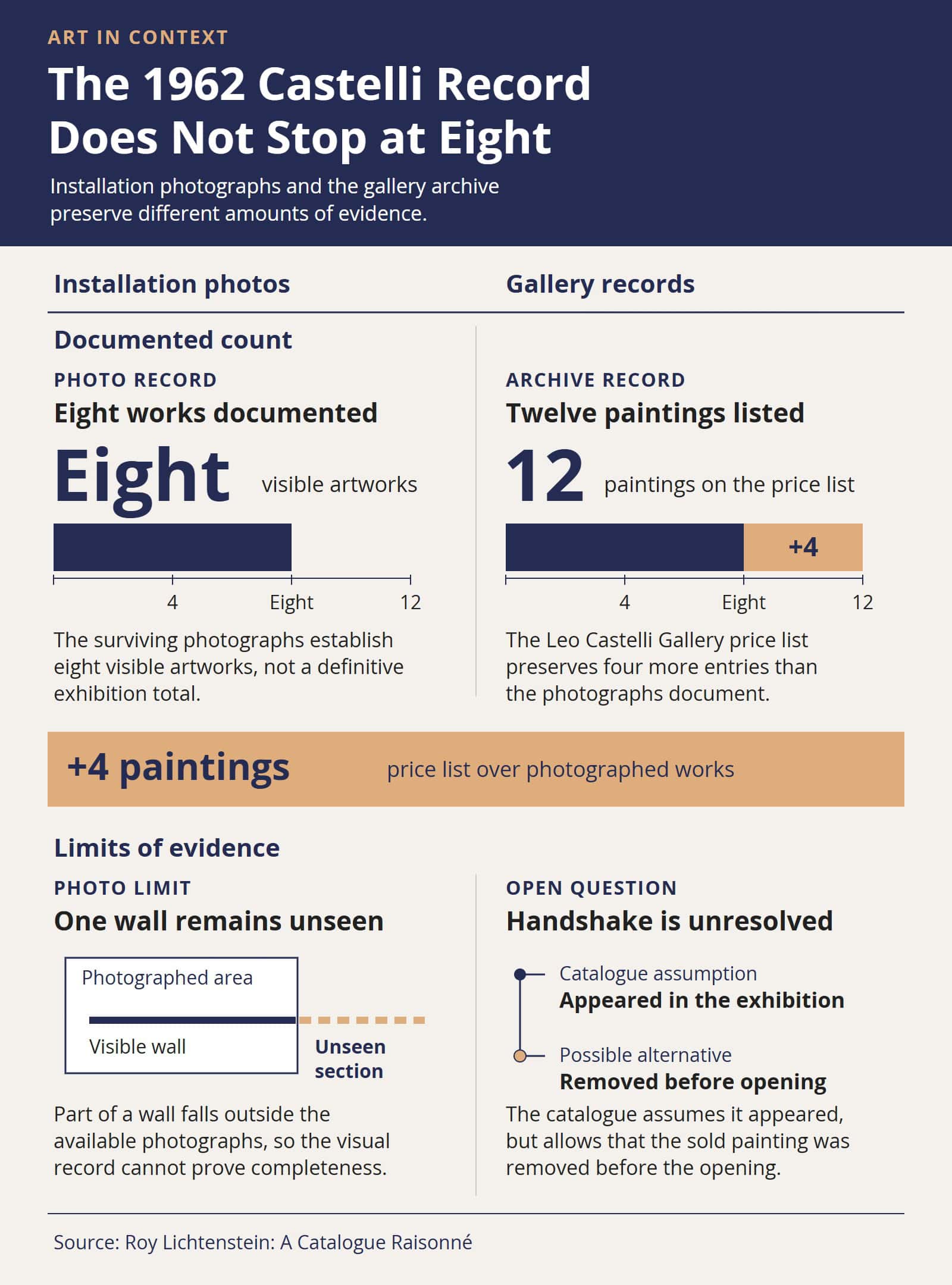
The foundation’s current catalogue entry is less definite. The Roy Lichtenstein Foundation’s catalogue raisonné entry for the February 10–March 3, 1962, exhibition says the Castelli price list contained 12 paintings. Available installation photographs document eight works, but part of one wall is not visible. The catalogue consequently does not treat eight as an uncontested total.
Its uncertainties are specific. Handshake is assumed to have appeared because Castelli’s inventory contains a note and the painting was reproduced on the exhibition mailer, although it may have been removed after selling before the opening. Electric Cord, Girl with Ball and Brattata were likely installed elsewhere in the gallery. The multi-panel Live Ammo was also at Castelli at the time, and the archive says other works mentioned by reviewers may have been accessible.
A 2021 Castelli Gallery essay by art historian Kenneth E. Silver names the eight paintings visible in the familiar account: The Kiss, Washing Machine, Turkey, The Refrigerator, Blam, The Grip, The Engagement Ring and Laughing Cat. That list accords with the photographed installation, but it does not resolve the foundation catalogue’s wider documentary evidence.
The distinction does not diminish the reunion. Bringing those eight paintings together is historically valuable. The announced eight-work reunion appears to follow the photographed installation, but the Whitney has not yet published its checklist for that grouping. The archive supports a narrower claim than the publicity.
That ambiguity unexpectedly strengthens the show’s theme. Images do not merely change as artists copy them; exhibitions change as photographs, inventories, price lists and later accounts circulate. The 1962 display now exists as both an event and a reconstructed art-historical image of that event.

Roy Lichtenstein in 1969. Photograph by Bernard Gotfryd, Library of Congress, via Wikimedia Commons. Public domain; no known copyright restrictions. Cropped.
The Greene Street Mural Returns Without Its Original Wall
The largest recreation is a nearly 96-foot iteration of Greene Street Mural. The foundation’s catalogue entry for the 1983 mural identifies its materials as acrylic, tape and cut printed paper applied directly to a wall. It measured 216 by 1,148 inches—18 feet high and 95 feet 8 inches long—and was conceived as a temporary, site-specific installation at Castelli’s Greene Street space.
Lichtenstein painted it with studio assistants James dePasquale, Robert McKeever and Olivia Motch; Leo Castelli and Dorothy Lichtenstein added small areas. With the artist’s consent, the mural was covered in January 1984 and fully destroyed in October 1988. A full-scale 2015 replica was likewise destroyed after its exhibition closed.
The Whitney visitor will therefore encounter a new realization of the design, not surviving material from 1983. That is not a secondary detail: it turns fabrication, authorization and collective labor into part of the artwork’s reception. A mural that was collaborative even during Lichtenstein’s lifetime is an especially productive test of where execution ends and authorship begins.
The Whitney page names Greene Street Mural, and Artsy also identifies Girl in Window; neither source names the third mural or details its fabrication.
Later Artists Turn Lichtenstein Into Source Material
Works by Louise Lawler, Richard Pettibone and Sturtevant give the copying argument its second direction. Their inclusion asks readers to move beyond the basic question of what Lichtenstein borrowed from comics, advertising and art history. It places his own images inside the later history of appropriation in art, where display, scale, repetition and attribution can become the subject.
That is a better frame for icons such as Drowning Girl, which the Whitney confirms will appear, than treating recognition as an endpoint. Once an image becomes instantly identifiable, every new display changes its audience and context. Lawler, Pettibone and Sturtevant make that afterlife visible rather than leaving “influence” as an abstract curatorial claim.
The exhibition’s revisionist case is therefore strongest when the three devices remain distinct. The 1962 paintings are surviving objects placed back into a historical relationship; the murals are contemporary recreations of earlier designs; the later artists’ works show Lichtenstein’s imagery and methods circulating beyond his control. Calling all three simply “copies” would erase the differences that make the comparison useful.

The square below the Whitney Museum of American Art. Photograph by Michael Mroczek, CC0, via Wikimedia Commons.
Eight Photographed Works Are Not the Whole 1962 Record
- The Whitney confirms roughly 130 works, three mural recreations and an October 11, 2026, opening.
- The foundation catalogue records eight works in known installation photographs, but a 12-painting price list and an unseen wall prevent that number from defining the entire 1962 exhibition without qualification.
- The original Greene Street Mural was a collaborative, temporary wall work that was covered in 1984 and destroyed in 1988; the Whitney will show a new iteration.
- The identities and fabrication methods of the other two recreated murals remain undisclosed on the museum’s public exhibition page.

Isabella studied at the University of Cape Town in South Africa and graduated with a Bachelor of Arts majoring in English Literature & Language and Psychology. Throughout her undergraduate years, she took Art History as an additional subject and absolutely loved it. Building on from her art history knowledge that began in high school, art has always been a particular area of fascination for her. From learning about artworks previously unknown to her, or sharpening her existing understanding of specific works, the ability to continue learning within this interesting sphere excites her greatly.
Her focal points of interest in art history encompass profiling specific artists and art movements, as it is these areas where she is able to really dig deep into the rich narrative of the art world. Additionally, she particularly enjoys exploring the different artistic styles of the 20th century, as well as the important impact that female artists have had on the development of art history.
Learn more about Isabella Meyer and the Art in Context Team.
Choose Art in Context as a preferred source to see more of our reporting in Google Top Stories and other Google Search experiences.
Cite this Article
Isabella, Meyer, “Whitney’s Roy Lichtenstein Survey Reopens the 1962 Record.” Art in Context. September 13, 2026. URL: https://artincontext.org/whitney-roy-lichtenstein-like-new-2026/
Meyer, I. (2026, 13 September). Whitney’s Roy Lichtenstein Survey Reopens the 1962 Record. Art in Context. https://artincontext.org/whitney-roy-lichtenstein-like-new-2026/
Meyer, Isabella. “Whitney’s Roy Lichtenstein Survey Reopens the 1962 Record.” Art in Context, September 13, 2026. https://artincontext.org/whitney-roy-lichtenstein-like-new-2026/.


